
Why Your Heat Pump Runs Constantly in Winter — Normal or a Problem?
Heat pump running all day in winter? Learn when long operation is normal, what defrost and auxiliary heat mean, and how to spot faults and reduce heating costs.
Contents
- Quick answer: is it normal for a heat pump to run all day in winter?
- Why heat pumps work differently from boilers and furnaces
- The simple heat-loss balance
- Seven reasons your heat pump may run almost nonstop
- 1. Cold weather increases the heating load
- 2. Your inverter compressor is deliberately modulating
- 3. Low flow temperatures make heating slower but steadier
- 4. Weather compensation keeps the heat pump active
- 5. The system is catching up after an overnight setback
- 6. The outdoor unit is defrosting in damp, cold conditions
- 7. The building loses more heat than the installation was designed for
- What is a normal winter run time? Why there is no universal number
- Normal winter defrost cycle or a frozen heat pump?
- What normal defrost looks and sounds like
- What is not typical
- Auxiliary heat versus emergency heat: the expensive winter trap
- Step-by-step troubleshooting: what to check safely before calling a technician
- Step 1 — Compare your room temperature with the setpoint
- Step 2 — Check the basic operating mode
- Step 3 — Check filters, room airflow and accessible obstructions
- Step 4 — Look for defrost cycles rather than uninterrupted heating
- Step 5 — Check hot-water priorities on air-to-water systems
- Step 6 — Note electrical consumption, not merely operating hours
- Step 7 — Document symptoms and call the installer when needed
- Does leaving a heat pump on all day necessarily cost more?
- COP, SCOP and why cold days look different
- Should you turn your heat pump off overnight?
- What about a home with a time-of-use tariff?
- Why radiators may feel barely warm while the house stays comfortable
- Heat pump running continuously but the house still feels cold
- Heat pump cycling on and off every few minutes: the opposite problem
- How different systems behave: UK, US and European homes
- Safe winter maintenance that can help reduce unnecessary running
- When to call an installer or HVAC technician immediately
- What to tell the engineer: a useful 24-hour troubleshooting log
- How to reduce winter costs without making the house colder
- Final verdict: constant winter operation is a symptom, not a diagnosis
- Official technical sources and further reading
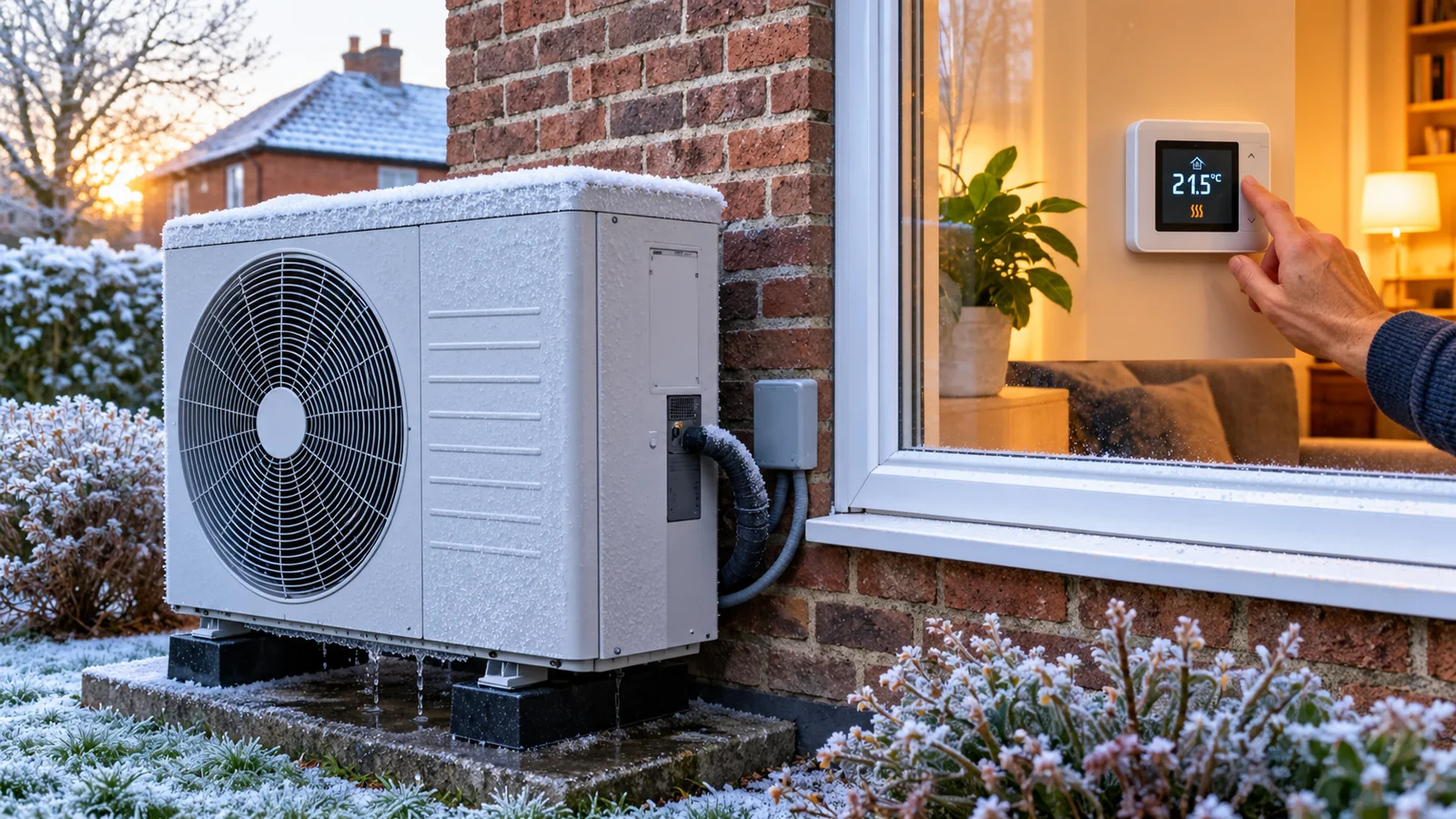
Your heat pump seems to run from breakfast until bedtime. The outside fan keeps turning, the radiators never feel as hot as they did with your old boiler, and the electricity meter keeps adding up the kilowatt-hours. Does that mean the heat pump is too small, broken, or expensive to run? Not necessarily. In winter, long, steady operation is often how a correctly designed heat pump keeps a home comfortable.
The important distinction is how the system performs while it runs. An inverter-driven air-source heat pump can operate at a low output for many hours while meeting the home’s heat demand efficiently. A system that runs continuously but cannot maintain the set temperature, repeatedly relies on electric backup, or stays encased in ice is a different matter. The US Department of Energy explains why variable-capacity equipment is designed to reduce repeated stopping and starting; Energy Saving Trust’s 2026 guidance likewise recommends long, steady operating periods for many UK installations.
This practical guide separates normal winter behaviour from warning signs. It covers UK air-to-water systems, American ducted air-source heat pumps, ductless mini-splits and common European installations. Where the controls or expected behaviour differ, we will say so rather than claiming one thermostat setting works for every heat pump.
Quick answer: is it normal for a heat pump to run all day in winter?
Often, yes. A heat pump running for long periods is not automatically a problem if the home stays near its target temperature, its electricity use is plausible, and the equipment is cycling through its normal operating modes. Constant operation combined with falling room temperature, permanent backup heat, severe icing, unusual noise or error codes deserves investigation.
| What you notice | Usually normal? | What to check first |
|---|---|---|
| Outdoor unit runs for many hours in cold weather | Often, if comfort is steady | Room temperature versus setpoint, outdoor temperature and energy use |
| Radiators feel warm rather than very hot | Often in low-flow-temperature UK systems | Whether all rooms reach the intended temperature |
| Indoor fan stays on after heating stops | May simply be fan set to On instead of Auto | Thermostat fan mode and compressor status |
| Outdoor fan pauses and unit steams briefly | Often a defrost cycle | Whether ice clears and heating resumes |
| Aux/backup heater comes on only in the coldest spells | Can be expected on some designs | Duration, temperature and configured backup strategy |
| Auxiliary/emergency heat runs for hours in mild weather | Potential warning sign | Thermostat settings and technician check |
| Set temperature never reached despite nonstop operation | Not something to dismiss | Airflow, building heat loss, fault messages and sizing |
| Solid ice builds up and does not clear | Not normal | Safe visual check and professional service |
Why heat pumps work differently from boilers and furnaces
A traditional gas furnace or boiler often sends a relatively large burst of heat into the building, stops when the room reaches the thermostat target, then starts another cycle later. Many heat pumps instead deliver a smaller quantity of heat more continuously. They transfer thermal energy from outside air or ground into the house using a compressor and refrigerant circuit rather than producing most of their heat by electric resistance.
Think of driving a car at a steady moderate speed instead of repeatedly accelerating and braking. It is not a perfect engineering analogy, but it helps explain the purpose of variable-speed compressors: matching the output to the demand with fewer large changes. The Department of Energy describes staged, multi-speed and inverter-driven compressors as ways to operate near the heating capacity required at different outdoor temperatures.
The simple heat-loss balance
Every house loses heat through its walls, windows, roof, floors and air leakage. When the outdoor air becomes colder, that heat loss usually increases. On a cold day, the heat pump may need to supply energy nearly continuously just to replace the heat leaving the building. If it supplies heat at roughly the same rate the building loses it, the room temperature remains stable even while the compressor runs for hours.
The number of hours alone therefore does not tell you whether the unit is efficient. The same running time at low electrical input can cost less than fewer hours at much higher input. Whether that happens in your home depends on equipment type, weather, electricity rates, operating efficiency and comfort settings.
Seven reasons your heat pump may run almost nonstop
1. Cold weather increases the heating load
An air-source heat pump extracts useful energy even from cold outdoor air, but colder conditions generally make the heat-transfer job harder and can lower capacity and efficiency. As outdoor temperatures fall, the building also needs more heat. Both effects can lengthen compressor operation. Cold-climate products are specifically designed for this: ENERGY STAR describes low-temperature performance requirements for its cold-climate label.
Continuous running on a freezing night can therefore be entirely different from continuous running on a mild autumn afternoon. Record the outdoor temperature with any runtime observation, and compare several days before deciding there is a fault.
2. Your inverter compressor is deliberately modulating
A modulating or inverter heat pump does not simply switch between 100% power and zero. It adjusts compressor speed across an operating range. When there is only a modest heat demand it may run quietly for a long period at a lower output, preserving stable indoor temperature without frequent cycling.
Do not mistake a continuously rotating outdoor fan for a compressor permanently at maximum electrical draw. Some systems also run circulation pumps or indoor fans independently of the compressor. The controller’s operating mode, installer diagnostics or a properly interpreted energy monitor can reveal which components are actually running.
3. Low flow temperatures make heating slower but steadier
In many UK and European air-to-water systems, the heat pump feeds radiators or underfloor heating at lower water temperatures than an older boiler installation might have used. Lower flow temperatures can improve efficiency, but heat enters the rooms more gradually. A radiator can feel only lukewarm yet still provide adequate heat over many hours.
Energy Saving Trust’s installer guidance contrasts typical heat-pump heating-water temperatures with boiler systems and emphasises suitable heat emitters. The test is not whether the radiator is too hot to touch; it is whether the room reaches and maintains a comfortable, safe temperature.
4. Weather compensation keeps the heat pump active
Weather compensation changes the heating-water flow temperature based on outside conditions. On relatively mild days it can allow the system to circulate moderately warm water for longer periods rather than sending out short bursts of unnecessarily hot water. The design aims to match the heating output to the home’s heat loss. Energy Saving Trust’s installer toolkit explains that this can reduce cycling and support efficiency.
A heating curve set too high can waste electricity or cause unnecessary cycling. A curve set too low may leave rooms cold. Some user manuals permit gradual adjustment, but changes to commissioning parameters should follow the installer’s or manufacturer’s instructions—particularly if your system includes hot-water hygiene, frost protection, a buffer tank or multiple zones.
5. The system is catching up after an overnight setback
If the thermostat has been set far lower overnight, the house may need hours of additional heat to recover. Raising the target temperature sharply can also engage resistance backup on some North American ducted systems. A modest, model-appropriate setback or a steady comfortable target is often easier for heat pumps to manage than a deep nightly temperature drop.
These rules are not completely universal: electricity tariffs, building insulation, thermal mass, and control strategies all matter. ENERGY STAR advises steady thermostat settings for many air-source systems, while Energy Saving Trust discusses small setbacks and time-of-use tariffs for UK installations. Start with the manufacturer’s recommended schedule, not a generic heating tip designed for a gas boiler.
6. The outdoor unit is defrosting in damp, cold conditions
An air-source heat pump can develop frost on its outdoor heat exchanger, especially in cold and humid weather. During an automatic defrost cycle, the system temporarily changes how it operates so the ice can melt. The outdoor fan may slow or stop, warm water may drip below the unit, and a cloud that looks like steam can briefly appear. Some indoor systems temporarily reduce delivered heat or operate supplementary heating during this cycle.
The US DOE-supported homeowner guide explains that automatic defrost and runoff are expected. A short spell of unusual behaviour followed by normal heating is different from a thick, persistent ice layer that obstructs airflow. Never use a sharp tool, boiling water or an open flame to remove ice from the coils.
7. The building loses more heat than the installation was designed for
A heat pump can be functioning normally but working against a house with substantial heat loss. Draughty doors, inadequate loft or attic insulation, cold bridging and significant ventilation losses can all make it run for longer. Closed or undersized radiators, blocked grilles, unbalanced circuits or duct leaks can further limit heat reaching the rooms.
This is why a proper heating design starts with a room-by-room heat-loss assessment, selection of a suitable heat pump and adequately sized emitters. Energy Saving Trust’s sizing toolkit makes clear that equipment capacity and required flow temperatures depend on the building and local design conditions. Oversizing is not the default solution, as it can create cycling and control problems of its own.
What is a normal winter run time? Why there is no universal number
There is no evidence-based rule that a heat pump must shut off after 20 minutes, stop every hour, or never operate for 24 hours. Run time changes with the design temperature, system capacity, weather, insulation and control method. A well-sized inverter system in cold conditions may stay on through much of the day while a different model cycles normally.
| Operating pattern | How to interpret it | Useful observation |
|---|---|---|
| Long low-speed run with stable rooms | Can be efficient and normal | Compare room temperature, energy and outdoor weather |
| Short on/off cycles every few minutes | May suggest controls, airflow or capacity mismatch | Log cycle frequency; seek installer advice if repeated |
| All-day operation but rooms getting colder | Insufficient delivered heat or a fault may exist | Inspect safe basics and request service if persistent |
| Compressor stops but indoor fan remains on | Fan-only mode may be selected | Change only normal user fan controls |
| After a cold night, takes hours to recover | Possible recovery from setback or low output | Check setpoint strategy and commissioning |
| Defrost interruptions in humid freezing weather | May be normal | Watch whether the unit returns to heating and drains properly |
Do not compare your air-to-water heat pump directly with a neighbour’s ductless mini-split or with a boiler using much hotter water. Their control strategies, thermal inertia and system boundaries differ. A good comparison uses the same building at comparable outdoor temperatures while keeping indoor comfort similar.
Normal winter defrost cycle or a frozen heat pump?
What normal defrost looks and sounds like
- A light frost film appears on the outdoor coil in suitable weather, then clears after defrost.
- The outdoor fan pauses or changes speed briefly; you may hear a click or change in compressor sound.
- Mist or water vapour appears temporarily as thawed moisture meets cold air.
- Meltwater drains from the outdoor unit; it must not create a hazardous ice patch on a walkway.
- The unit returns to heating without persistent error codes or lasting loss of comfort.
What is not typical
- Ice remains thick across most of the outdoor coil for prolonged periods and blocks airflow.
- The fan blades strike ice or the unit is making alarming scraping or grinding noises.
- Defrost happens repeatedly without clearing the frost, while the house becomes progressively colder.
- Water has nowhere to drain and creates a large ice mass under or inside the unit.
- A warning light or fault code persists after the normal cycle.
If severe icing appears, stop attempting homeowner repairs and contact a qualified heat-pump engineer. The problem may involve drainage, sensors, controls, airflow or refrigerant performance. The DOE-supported owner guide and ENERGY STAR ductless installation guidance both highlight defrost water and ice hazards.
Auxiliary heat versus emergency heat: the expensive winter trap
In some US ducted air-source heat pump systems, auxiliary heat means a secondary heat source—often electric resistance strips—supports the compressor when needed. It may engage during very cold weather, a defrost event or rapid recovery. Because resistance heat can use substantially more electricity for each unit of heat delivered than a functioning heat pump, unusually long auxiliary operation may raise bills.
Emergency Heat is a separate user-selected or equipment-specific mode commonly intended when the heat pump itself cannot provide heat. Depending on the installation, it may bypass the compressor and rely on the backup system. Do not leave Emergency Heat selected just because the day is cold unless your equipment instructions or a professional tell you to. Not every heat pump offers these labels, and dual-fuel gas systems may use different control logic.
| Display or mode | What it commonly means | What to do |
|---|---|---|
| HEAT | Normal space-heating request | Keep target stable; check comfort |
| AUX / AUX HEAT intermittently | Supplemental heater assisting compressor | Note outdoor temperature and duration |
| AUX HEAT continuously in mild weather | Possible misconfiguration or inadequate heat | Ask contractor to review controls and load |
| EM HEAT / Emergency Heat | Backup-only or special emergency mode on many systems | Check manual and contact provider if unexpectedly engaged |
| DEFROST | Outdoor unit temporarily melting frost | Allow normal cycle; check that ice clears |
| HEAT BOOST (air-to-water) | An additional heating element may be running | Review documented configuration with installer |
The US DOE guidance on residential heat-pump purchasing and operation says unnecessary resistance-heat operation should be minimised. And in a monitored cold-climate research project, NREL documented cases where auxiliary-heat behaviour signalled control or sensor problems. Avoid modifying electrical backup wiring or disabling safety-related heat without professional assessment.
Step-by-step troubleshooting: what to check safely before calling a technician
Use this checklist over a few hours or a full day while keeping the house safely warm. Do not open the unit casing, break refrigerant connections, reset sealed controls repeatedly or test live electrical parts. If there are sparks, a burning smell, exposed conductors or alarming vibration, stop using the equipment where safe and request urgent professional help.
Step 1 — Compare your room temperature with the setpoint
Read the actual indoor temperature at the thermostat or with a separate thermometer placed away from direct sunlight, draughts and radiators. If the room sits comfortably near the target while the heat pump runs, the runtime may be expected. If the thermostat asks for 21°C (70°F) but the room remains at 17°C (63°F) for hours, particularly in moderate outdoor weather, that is useful evidence of underheating.
Step 2 — Check the basic operating mode
Make sure a ducted or mini-split system is in HEAT rather than AUTO where the manufacturer recommends it, and check that a fan-only selection is not being mistaken for compressor heating. On a US thermostat, verify that Emergency Heat was not selected inadvertently. On UK systems, check normal heating schedules and any holiday or setback mode.
Step 3 — Check filters, room airflow and accessible obstructions
Inspect user-accessible air filters according to the manufacturer’s maintenance instructions. A clogged filter can reduce airflow and heating performance. Remove furniture or curtains blocking indoor air outlets, and make sure vents or grilles are not shut by mistake. For ductless systems, check the filter and louvers; for ducted systems, check return-air grilles and the filter location.
Look from a safe location at the outdoor unit. If loose snow, fallen leaves or packaging blocks its airflow, remove only material you can reach without touching coils, fan blades, electrical parts or ice. Keep the manufacturer-required clearance and drainage paths open. The DOE-supported maintenance guide recommends filter upkeep and keeping outdoor units clear of debris.
Step 4 — Look for defrost cycles rather than uninterrupted heating
Spend a little time observing whether the outdoor fan stops and restarts, whether water drips during thawing, and whether a frost layer disappears afterward. Record the approximate outdoor temperature and whether the home maintains comfort. Do not assume that every pause indicates compressor damage or that every short plume is smoke.
Step 5 — Check hot-water priorities on air-to-water systems
Some UK/European systems temporarily prioritise domestic hot-water heating over space heating. During hot-water charging, radiator circulation or space heating may pause or change. Periodic high-temperature cylinder hygiene cycles may also use additional energy. Read the system’s schedule and display, but do not disable hygiene or legionella-prevention settings to save electricity; discuss adjustments with the installer.
Step 6 — Note electrical consumption, not merely operating hours
Use your utility meter, validated heat-pump energy meter or supplier data to compare kWh for similar weather periods. Many heat-pump apps estimate rather than measure actual input, and whole-home readings include appliances, EV charging and water heating. Look for a sudden unexplained step-change in consumption rather than using run time as a stand-alone efficiency measure.
Step 7 — Document symptoms and call the installer when needed
If rooms fail to heat, the unit locks out, auxiliary heat remains active unusually long, severe ice persists or noise becomes abnormal, gather the model number, photos of fault codes, outdoor and indoor temperatures, recent electricity readings and a brief symptom timeline. This gives the technician a clearer basis to check airflow, heat-loss calculations, refrigerant circuit, hydronic balancing, sensor function or control settings.
Does leaving a heat pump on all day necessarily cost more?
No, but it also does not guarantee a lower bill. What matters is the electricity consumed over time (kWh) and the price per kWh. A long period at low compressor input can use less electricity than a shorter period at high input or backup resistance heat. Conversely, a unit consuming substantial power all day can produce a high bill even if it never switches off.
Here is a simple hypothetical calculation, not a measured heat-pump performance benchmark. Suppose a heat pump draws an average of 0.9 kW for 18 hours: 0.9 × 18 = 16.2 kWh. At an illustrative tariff of £0.25/kWh, the energy cost is £4.05. Another arrangement drawing 2.2 kW for 8 hours would use 17.6 kWh and cost £4.40 at the same tariff. These two patterns do not necessarily deliver the same useful heat or comfort, and actual efficiency varies throughout the day.
| Illustrative scenario | Average electrical input | Hours | Electricity used | Energy at £0.25/kWh |
|---|---|---|---|---|
| Steady, low-input operation | 0.9 kW | 18 | 16.2 kWh | £4.05 |
| Shorter, high-input operation | 2.2 kW | 8 | 17.6 kWh | £4.40 |
| Unwanted resistive backup example | 4.0 kW | 5 | 20.0 kWh | £5.00 |
The first column is not a recommendation to target a certain runtime. Tariffs may include standing charges, demand charges or variable time-of-use rates. Use your actual heat-pump input and the tariff you pay. For related guidance on checking home power data, see our guide to unexplained smart meter readings.
COP, SCOP and why cold days look different
The coefficient of performance (COP) is useful heat delivered divided by electrical energy used during a defined operating condition. If a system provides 3 kWh of heat while consuming 1 kWh of electricity, its COP for that case is 3. An individual winter moment is not the same as a full-season measure. Seasonal COP (SCOP) or seasonal efficiency includes changing temperatures, cycling, controls and, depending on the defined method, other system inputs.
A low flow temperature and moderate source temperature often improve efficiency, but household comfort, hygiene and manufacturer limits still come first. Energy Saving Trust’s design guidance explains why the source temperature, emitter temperature and heat-pump sizing are fundamental to measured performance. The practical rule is to judge seasonal delivered comfort per unit of electricity, not only the stopwatch.
Should you turn your heat pump off overnight?
For many inverter heat pumps, fully switching heating off every night is not the best default because the building cools and requires substantial reheating the next morning. Deep setback may increase compressor power or trigger auxiliary heat. A stable temperature or a small setback may work better, especially in a well-designed low-temperature radiator or underfloor system.
However, there is no universal ban on setbacks. Occupancy patterns, energy tariffs, building mass and system design may make timed operation appropriate. Follow the manufacturer or commissioning advice, and test modest changes while checking room comfort and actual kWh. ENERGY STAR generally favours a steady comfortable setpoint for air-source heat pumps; Energy Saving Trust offers a nuanced approach to long operating periods and controlled setbacks.
What about a home with a time-of-use tariff?
If night electricity is unusually cheap, a building with adequate thermal storage may benefit from pre-heating or shifting some hot-water production. In other homes, night-time air is colder and the heat pump can be less efficient, partly offsetting tariff savings. The only reliable answer is to compare total cost and comfort for your actual tariff, equipment and building. Avoid sudden extreme thermostat changes to chase one cheap hour.
Why radiators may feel barely warm while the house stays comfortable
A common complaint after a UK boiler-to-heat-pump retrofit is: “The radiators never get hot, so the system must be running constantly to compensate.” Radiator surface temperature is a poor fault diagnosis on its own. Low-temperature heating relies on prolonged heat transfer; larger emitters and careful hydraulic balancing may keep rooms warm without very hot radiators.
If every room is comfortable, that behaviour is generally reassuring. If some rooms remain cold while others overheat, check whether radiator valves, schedules or zoning are restricting distribution; ask a heating engineer to review emitter sizing, balancing and flow temperatures. Do not raise the flow-temperature limit dramatically or change safety parameters without advice.
Heat pump running continuously but the house still feels cold
This is the combination that deserves a more systematic investigation. Separate three possibilities: the home requires more heat than expected, the heat pump is not producing enough useful heat, or the heat is not reaching the rooms. They call for different fixes, so replacing the entire unit before establishing the cause may waste money.
| Likely category | Typical clues | Professional check or safe homeowner observation |
|---|---|---|
| High building heat loss | Draughts and cold walls; worse in windy weather | Check gaps and insulation; request room-by-room heat-loss review |
| Restricted indoor airflow | Weak airflow; dirty filters; blocked grilles | Clean user-accessible filters and clear room outlets |
| Poor hydronic circulation or balancing | Some radiators cold; room-to-room mismatch | Ask engineer to check pumps, valves, filters and balancing |
| Incorrect weather compensation curve | Slow recovery, persistent underheating or high bills | Review with installer against design temperatures |
| Outdoor airflow or defrost fault | Coil remains packed with ice; frequent lockouts | Qualified heat-pump service |
| Incorrect equipment sizing or commissioning | Struggles at design cold temperature despite service | Installer heat-loss and manufacturer performance review |
| Backup heat control problem | Auxiliary mode runs unexpectedly; high electricity use | Technician to test sensors, changeover and controls |
A single cold day below the system’s design condition does not prove it is undersized. Nor does an extremely quiet outdoor unit prove a compressor fault; variable-speed systems can be quiet by design. Consider temperature records, current output, error codes and measured electrical energy together.
Heat pump cycling on and off every few minutes: the opposite problem
Very short, repeated on/off cycles may be as important as nonstop operation. Excessive cycling can arise when the minimum output exceeds the current heating demand, when multiple zones close, or when controls and system water volume are poorly matched. Dirty filters, poor sensor placement and certain faults can contribute as well. Some cycling is expected during milder weather, so the exact threshold is model- and conditions-specific.
Do not force the heat pump to run continuously by disabling thermostats or bypassing control wiring. Record the pattern, read the manufacturer’s guidance and ask the installer to examine minimum modulation, zoning, sensors and heating-system design. Energy Saving Trust’s technical guide on weather compensation explains how flow-temperature control can reduce avoidable cycling.
How different systems behave: UK, US and European homes
| System | Common winter behaviour | Important caution |
|---|---|---|
| UK air-to-water heat pump + radiators | Long space-heating periods with relatively low flow temperature | Compare room temperature and heating curve, not radiator touch temperature |
| European underfloor heat-pump system | Long runs and very slow response to schedule changes | Avoid large setbacks without design advice |
| US ducted air-source heat pump | Compressor cycles or modulates; backup heat may engage | Distinguish AUX from Emergency Heat and blower-only mode |
| Ductless mini-split | Indoor unit and outdoor compressor modulate independently | Clean filters; check each zone’s settings and mode |
| Ground-source heat pump | Can run long in winter without outdoor coil defrost cycles | Check circulating loop and specialist system maintenance |
| Hybrid/dual-fuel system | May switch from heat pump to boiler/furnace at a set condition | Have professional verify changeover logic and fuel costs |
In the United States, many buyers encounter cold-climate ratings, HSPF2 and hybrid furnaces. In the UK, weather compensation, hot-water cylinders, radiator sizing and installer commissioning often dominate the discussion. Continental European homes may use underfloor heat, district-informed controls or variable energy tariffs. The physics is shared; operating guidance must still match the actual system.
Safe winter maintenance that can help reduce unnecessary running
- Follow filter instructions: wash or replace accessible filters as often as required by the manufacturer, particularly with pets or indoor dust.
- Leave room for airflow: keep furniture away from supply and return grilles and avoid covering indoor heads.
- Keep the outdoor unit clear: gently move loose leaves or snow only from safely reachable areas; maintain the recommended clearance.
- Watch for icing hazards: defrost water can refreeze on paths; ask the installer for suitable drainage if needed.
- Protect thermostat accuracy: do not obstruct the temperature sensor or put a space heater directly beneath it.
- Book regular service: have a qualified technician inspect the equipment, especially after a performance change or repeated fault.
- Review installation documentation: know your design flow temperature, heat-loss estimate, hot-water schedule and normal auxiliary-heat strategy.
Do not access refrigerant circuits, refrigerant valves, high-voltage parts, sealed control cabinets or internal pump components. Refrigerant work and many electrical tasks require qualified professionals. The US DOE-supported homeowner guidance details filters, outdoor airflow, abnormal smells, persistent ice and the signs that a technician should inspect.
When to call an installer or HVAC technician immediately
- A burning smell, smoke, sparks, tripped safety devices or visibly damaged electrical components.
- A loud grinding noise, striking fan or severe vibration coming from the outdoor unit.
- Persistent heavy ice that does not clear through normal defrost cycles.
- A fault or lockout code that prevents heating, especially in freezing weather.
- A suspected refrigerant leak, exposed refrigerant pipe damage or loss of heating capacity.
- Indoor temperatures dropping toward unsafe levels despite continuous heating; use an appropriate safe temporary heat source and seek urgent service.
If vulnerable occupants are in a cold home and reliable heat is unavailable, prioritise safety and local emergency support over efficiency troubleshooting. If you use portable electric heaters temporarily, follow their safety instructions and never place them near curtains, bedding or flammable materials.
What to tell the engineer: a useful 24-hour troubleshooting log
Instead of saying only “it never switches off”, write down the pattern. A short set of observations helps the service professional distinguish control behaviour from insufficient heat, icing or a mechanical problem. A log is particularly valuable when the fault happens only overnight.
| Observation | Example entry | Why it matters |
|---|---|---|
| Date and outdoor temperature | Tuesday, 07:00; 0°C outside | Provides weather context |
| Indoor target and actual | Set 20.5°C; actual 20.3°C | Shows whether comfort is maintained |
| Heating mode | HEAT, not Emergency Heat | Distinguishes normal demand and backup modes |
| Outdoor unit behaviour | Runs steadily, pauses once for defrost | Shows whether operation changes normally |
| Electrical energy | 22 kWh whole-home usage since last morning | Shows a trend but includes other loads |
| Visible condition | Light frost cleared; drains to gravel | Helps evaluate defrost performance |
| Fault or auxiliary message | No error, AUX displayed for 20 minutes | Supports technician diagnosis |
Add the model number and photographs of any error codes. If possible, include historical utility bills for comparable outdoor temperatures, but remember that other household electricity use can change the comparison. Ask for a written diagnosis and whether the installation design, commissioning and controls have been checked.
How to reduce winter costs without making the house colder
If the system keeps the home warm but bills look excessive, work in order. First check the tariff, the actual kWh used, and whether backup resistance heat is operating too often. Then ask about heat-loss improvements and appropriately configured weather compensation. Only after that consider changing schedules or replacing equipment. A run-hour total without power and heat data cannot identify the cheapest approach.
- Hold a consistent, comfortable temperature rather than raising it dramatically every morning.
- Discuss heating-curve optimisation with your installer; low practical flow temperature often supports better efficiency.
- Investigate excessive backup heat rather than simply switching off a safety or frost-protection function.
- Improve the building envelope: insulation and draught control may reduce heating demand.
- Use real meter data: compare similar-weather days and watch both comfort and electricity costs.
- Consider smarter tariffs only after checking your own consumption pattern and contracted rates.
Households managing other winter moisture problems may also find our guide to window condensation and black mould helpful. Better heating alone is not a substitute for appropriate ventilation or repairing damp defects.
Final verdict: constant winter operation is a symptom, not a diagnosis
A heat pump operating for most of a winter day may be doing exactly what it was designed to do: slowly and steadily replacing the heat the house loses. It is more reassuring when rooms stay comfortable, the unit defrosts normally, error codes are absent and electricity use is consistent with the weather and system design. Longer runtime is not, by itself, evidence of high cost or mechanical trouble.
On the other hand, continuous operation should not be dismissed if the home remains cold, backup heat runs for unusually long periods, the outdoor unit is packed with ice, or energy consumption suddenly spikes. Start with safe homeowner observations, record the context and let a qualified professional inspect controls, airflow and heating capacity when needed. Judge the heat pump by comfort, delivered heat and measured energy—not by whether the fan seems to stop.
Official technical sources and further reading
- Energy Saving Trust — The Most Efficient Way to Run a Heat Pump (May 2026) — long operation, heating curves, setbacks, backup heating and maintenance.
- Energy Saving Trust Installer Toolkit — Heat Pump Myths — what continuous operation actually means.
- Energy Saving Trust — Weather Compensation and Other Controls — control curves, steady heating and cycling.
- Energy Saving Trust — Sizing a Heat Pump — design temperatures, COP and selection.
- US Department of Energy — Heat Pump Systems — heat transfer and inverter-driven compressors.
- ENERGY STAR — Air-Source Heat Pumps — cold-climate equipment, steady setpoints and maintenance.
- ENERGY STAR — Ductless Heating and Cooling — filters, icing and unit placement.
- US DOE-supported Homeowner Guide — You Installed an Air-Source Heat Pump. Now What? — defrost and troubleshooting signs.
- US Department of Energy — Energy-Efficient Residential Air-Source Heat Pumps — auxiliary heat and maintenance.
- US National Renewable Energy Laboratory — Cold-Climate Heat Pump Field Validation — monitored performance and auxiliary heater data.
You may also like
 Technology & How-To
USB Drive Empty but Space Used? Find the Missing Data Safely
Find why an accessible USB looks empty while space remains occupied, using visibility checks, Trash review and device-versus-volume…
 Technology & How-To
Windows 11 Clipboard History Not Working? Find What Failed
Separate Windows clipboard history failures from ordinary paste, app restrictions, cloud sync and Remote Desktop with a two-item…
 Technology & How-To
Chrome Keeps Reloading Tabs? Stop the Right Kind of Refresh
Find why Chrome tabs reload with targeted Memory Saver settings, controlled comparisons, extension checks and diagnostics that protect…