
Why Do Ceiling Fans Collect Dust Even When They Are Spinning?
A physics-backed explanation of dust buildup on spinning ceiling fan blades, plus safe cleaning methods and practical ways to reduce indoor particles.
Contents
- Why does dust stay on a ceiling fan that keeps spinning?
- Where does ceiling-fan dust come from?
- Is static electricity responsible for the dust?
- Static charge can play a role
- Moisture, grease, and finish make a difference
- Blade design and airflow affect where dust collects
- Can the blades get dusty when the fan is turned off?
- How to clean ceiling fan blades without spreading dust
- Pillowcase, microfiber, or long-handled duster: which works best?
- How often should you clean a ceiling fan?
- How to reduce the amount of dust reaching the fan
- Is dust on ceiling fans bad for your health?
- Five mistakes that make fan cleaning less effective
- Frequently asked questions
- Does static electricity attract all the dust?
- Why does dust stay attached when the blades move so fast?
- Will running a ceiling fan on high clean it?
- Can I use water on ceiling fan blades?
- Will a HEPA air purifier stop fan blades getting dusty?
- Why is there more dust on the top or front edge?
- Bottom line
- Reliable sources and further reading
- Related reading
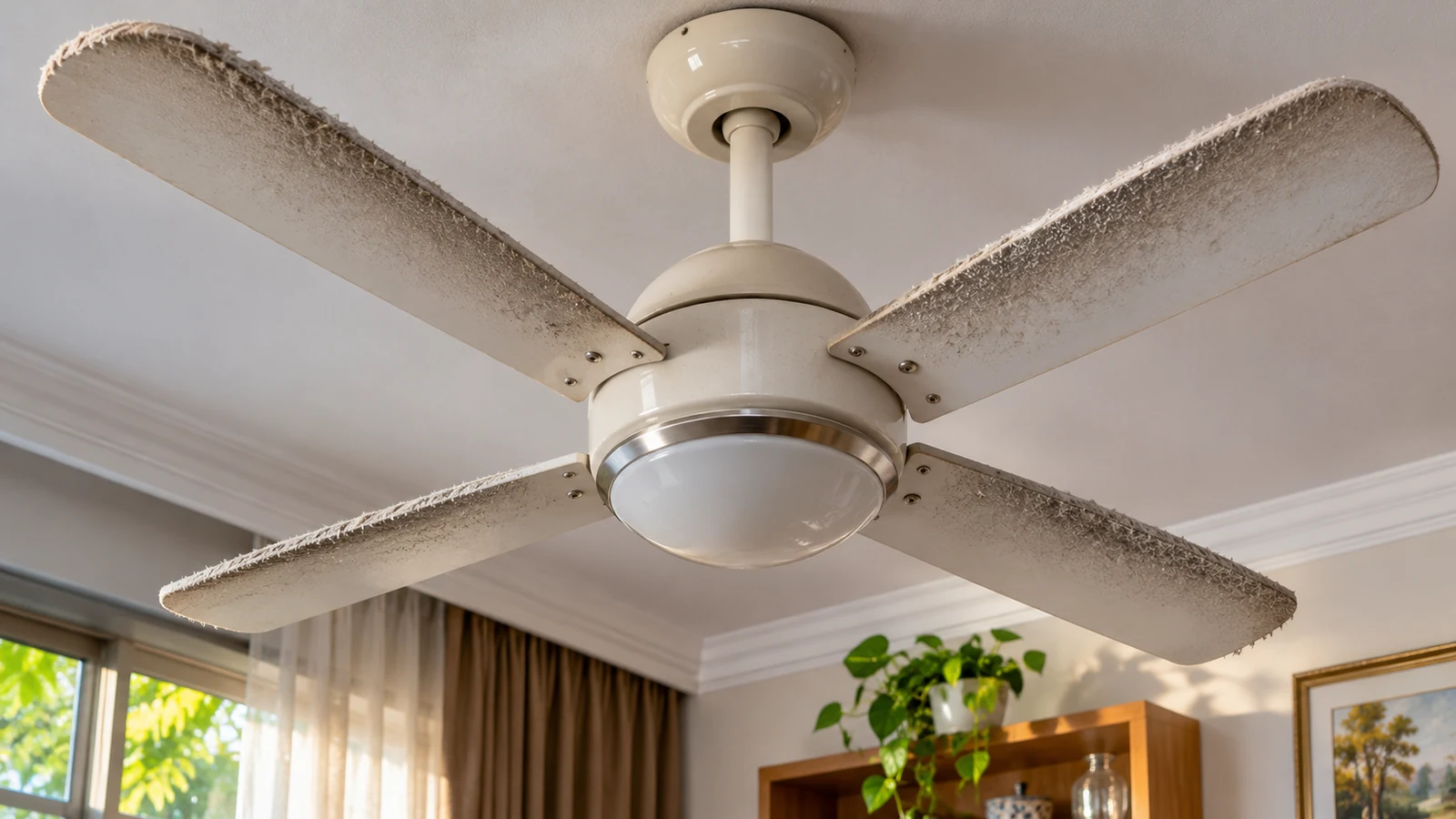
Ceiling fans can collect thick lines of dust even when they run for hours every day. The blades move air, but that does not mean the air can remove every particle touching their surfaces. A very thin boundary layer forms next to each blade, where air moves much more slowly relative to the surface. Fine particles can settle or stick there. Static charge, moisture, and cooking residue can contribute, but static electricity is not the whole explanation.
The practical solution is not to run the fan faster. Switch it off, capture the dust, gently clean the blades, and address the sources of dust in the room. Here is the physics, a safe cleaning method, and what to avoid.
Why does dust stay on a ceiling fan that keeps spinning?
Air has viscosity. Close to a solid surface, the relative speed of the air falls toward zero. This region is called the boundary layer. Farther from the blade, the air may be moving rapidly, but the air touching the blade is not sweeping the surface clean.
Very small particles can remain inside this near-surface zone and adhere to the finish. The Smithsonian National Air and Space Museum explains exactly why dust persists on fan blades in its guide to friction drag. A moving blade therefore does not behave like a self-cleaning surface.
Where does ceiling-fan dust come from?
Household dust is a mixture, not a single material. Depending on the home, it can include textile fibers, tracked-in soil, pollen, pet dander, skin flakes, and particles from cooking or other activities. Some particles remain airborne; others settle onto shelves, lamps, furniture, and fan blades.
The US Environmental Protection Agency notes that walking, vacuuming, and cleaning can put settled dust back into the air. A ceiling fan moves that air around but generally does not filter it. It does not create dust out of nowhere; it encounters particles already circulating indoors.
Is static electricity responsible for the dust?
Static charge can play a role
Particles and surfaces may carry electrical charges, and electrostatic attraction can help some dust stick to certain finishes. But blade material, humidity, surface condition, particle size, and local airflow all matter. There is no sound basis for claiming that the fan generates the same amount of static charge on every blade simply by spinning.
Moisture, grease, and finish make a difference
Blades near cooking areas may develop a slightly sticky film of airborne cooking residue. Humidity and surface contaminants can also make dust harder to remove. A clean, smooth bedroom fan may show a loose gray film while a fan near a kitchen needs more careful wiping. This difference is consistent with different room conditions, not proof of an electrical fault.
Blade design and airflow affect where dust collects
Dust may be most visible on the upper surface, near an edge, or in streaks. Its distribution depends on blade pitch, airflow direction, rotation, how long the fan sits idle, and the surface finish. It is inaccurate to suggest that every ceiling fan accumulates dust on one particular edge for exactly the same reason.
Can the blades get dusty when the fan is turned off?
Yes. Airborne particles settle onto stationary blades much as they settle onto furniture. Some loose dust may move again when the fan starts, while attached particles remain. If a fan has been unused for weeks or months, check and clean visible dust before switching it back on.
How to clean ceiling fan blades without spreading dust
Follow the instructions for your fan model, especially when its blades are wood, composite material, or a delicate coated finish. The following method combines guidance from ceiling-fan manufacturer Kichler with the EPA’s dust-reduction advice.
- Turn the fan off. Wait until the blades stop completely. Isolate power at the breaker before dismantling components or working around wiring, as directed by the manufacturer.
- Work from a stable position. Use an appropriate, secure step ladder and obtain help if needed. Never balance on a swiveling chair or unstable furniture. For high ceilings, consider professional cleaning.
- Use a clean pillowcase to contain loose dust. Carefully slip it over a blade and draw it back gently so dust stays inside the fabric. Avoid pulling or bending the blade.
- Wipe remaining dust with soft microfiber. Some finishes call for a dry, lint-free cloth. If the manufacturer permits damp wiping, use a barely damp cloth and dry the surface promptly.
- Deal with greasy residue gently. Where approved by the manufacturer, apply a small amount of diluted mild cleaner to the cloth—not directly onto the fan—and wipe without aggressive scrubbing.
- Inspect before restarting. Make sure the blades are dry, no tools are left near the fan, and all fittings remain secure.
Important: Never spray water or cleaner into the motor housing, light fixture, or wiring. Avoid abrasive products, harsh chemicals, and alcohol on finishes unless the manufacturer specifically permits them. Do not press down on blades: bending them can cause wobble or imbalance.
Pillowcase, microfiber, or long-handled duster: which works best?
| Tool | Useful for | Important caution |
|---|---|---|
| Clean pillowcase | Containing visible loose dust | Pull gently; do not strain the blade |
| Soft microfiber cloth | Regular maintenance and light residue | Only dampen when the finish allows it |
| Long-reach duster | Accessible fans without climbing | Can scatter particles when used aggressively |
| Mild cleaner applied to cloth | Sticky residue on compatible finishes | Keep liquids away from the motor and wiring |
How often should you clean a ceiling fan?
There is no universal schedule. Look at the upper blade surfaces every few weeks and clean them when a visible film develops. Homes with shedding pets, frequent open windows, heavy traffic dust, or nearby construction may need more frequent maintenance. Recheck after a prolonged period of non-use or unusually dusty weather.
The purpose is to prevent buildup, not to achieve a sterile fan. If the blades are difficult or unsafe to access, professional help is more sensible than taking risks on a ladder.
How to reduce the amount of dust reaching the fan
- Damp-dust surfaces gently. Capturing particles with a slightly damp cloth generally releases less dust back into the room than aggressive dry dusting.
- Vacuum appropriate surfaces regularly. A vacuum with a HEPA filter may help prevent some captured particles from escaping during cleaning.
- Control tracked-in dust. Use doormats and maintain entryways; use judgment about open windows during outdoor dust or pollen events.
- Address cooking particles and smoke. Use suitable ventilation and remove avoidable particle sources rather than relying on a ceiling fan.
- Manage moisture problems. Fix leaks and condensation, and clean only after addressing the cause of persistent dampness.
- Consider appropriate filtration. A well-sized portable HEPA air cleaner can supplement—not replace—source control and ordinary cleaning.
A regular ceiling fan is an air circulator, not an air purifier. The EPA’s guide to home air cleaners emphasizes controlling sources and using clean ventilation, with filtration as a supplement. A suitable air cleaner may reduce airborne particles but cannot prevent every speck of dust from settling.
Is dust on ceiling fans bad for your health?
A visible dust layer is not by itself proof of a serious health hazard. However, household dust can contain allergens and irritants, including pollen and pet dander. The implications depend on the individual, the amount and composition of dust, and the room conditions. For people with asthma or allergies, methods that contain dust rather than fling it into the air are especially useful.
If buildup is unusually black, sticky, or associated with smoke odor, investigate cooking, combustion, and ventilation sources. Persistent moisture or suspected mold near the ceiling requires attention to the underlying water problem; fan cleaning alone does not fix it.
Five mistakes that make fan cleaning less effective
- Turning the fan to maximum speed to “blow the dust off” instead of wiping the blades.
- Brushing thick dust into the room with a dry duster and no attempt to contain it.
- Spraying liquid cleaner toward the motor, lights, or electrical connections.
- Cleaning moving blades or using an unsafe chair to reach the ceiling.
- Bending a blade or damaging its protective finish with strong chemicals.
Frequently asked questions
Does static electricity attract all the dust?
No. Static charge may contribute, but airflow close to the blade, ordinary particle deposition, the blade finish, and sticky residue also matter. No single explanation accounts for every fan and household.
Why does dust stay attached when the blades move so fast?
The air immediately adjacent to the blade moves slowly relative to the surface because of viscosity. Fine particles may stick within that boundary layer rather than being swept away by the faster airflow farther from the blade.
Will running a ceiling fan on high clean it?
No. Some loose dust may be displaced, but attached buildup stays behind. Faster airflow is not a replacement for careful physical cleaning and may spread particles throughout the room.
Can I use water on ceiling fan blades?
Only when the manufacturer allows damp wiping for that material or finish. Use minimal moisture and keep all liquids away from motors, light fittings, and wiring.
Will a HEPA air purifier stop fan blades getting dusty?
A correctly sized air purifier may reduce the number of airborne particles, but it will not eliminate every source or prevent all surface deposition. Regular cleaning remains necessary.
Why is there more dust on the top or front edge?
Deposition patterns vary with blade angle, direction of rotation, local airflow, material, and periods when the fan is off. A common-looking streak is not enough to diagnose a unique cause.
Bottom line
A ceiling fan can be dusty while spinning because moving air does not sweep its surface clean. The near-surface boundary layer provides a physically sound explanation, while electrostatic effects, moisture, and grease may add to adhesion. Switch the fan off, capture dust carefully, follow the manufacturer’s cleaning instructions, and reduce particle sources in the room. A clean fan is a maintenance result—not something achieved simply by running it faster.
Reliable sources and further reading
- Smithsonian National Air and Space Museum — Friction Drag and the boundary layer on fan blades.
- US EPA — Sources of Indoor Particulate Matter and dust-reduction advice.
- Kichler Lighting — Cleaning a Ceiling Fan: safe steps and finish precautions.
- US EPA — Guide to Air Cleaners in the Home.
- ENERGY STAR — Ceiling Fan Installation and Usage Tips.
Related reading
Dust and airflow problems also affect electronic cooling systems, but the diagnosis is different: Laptop Fan Running Constantly? Diagnose and Fix It Safely. For persistent dampness and mold near windows, read Stop Condensation and Black Mold Around Windows.
You may also like
 Science & Technology
UK Polar Vortex: Does a Weakening Vortex Mean Snow?
Does a weakening polar vortex mean UK snow? Understand the November signal, the limits of snow maps and…
 Science & Technology
Artemis II Explained: What It Achieved and Why It Didn’t Land on the Moon
What Artemis II achieved, why it did not land on the Moon, what NASA learned from Orion’s heat…
 Science & Technology
Can Capella-2 See Through Walls? What SAR Satellites Really Show
Capella-2 cannot see into homes. Learn why Tokyo’s radar image looked transparent, what SAR really detects, the meaning…