
Artemis II Explained: What It Achieved and Why It Didn’t Land on the Moon
What Artemis II achieved, why it did not land on the Moon, what NASA learned from Orion’s heat shield, and how Artemis III and IV now fit into the plan.
Contents
- Artemis II at a glance
- Why did Artemis II not land on the Moon?
- What did the mission actually demonstrate?
- What did NASA learn about Orion’s heat shield?
- What science could astronauts do without landing?
- What happens after Artemis II?
- How to read Artemis claims without mixing up missions
- Sources and image credits
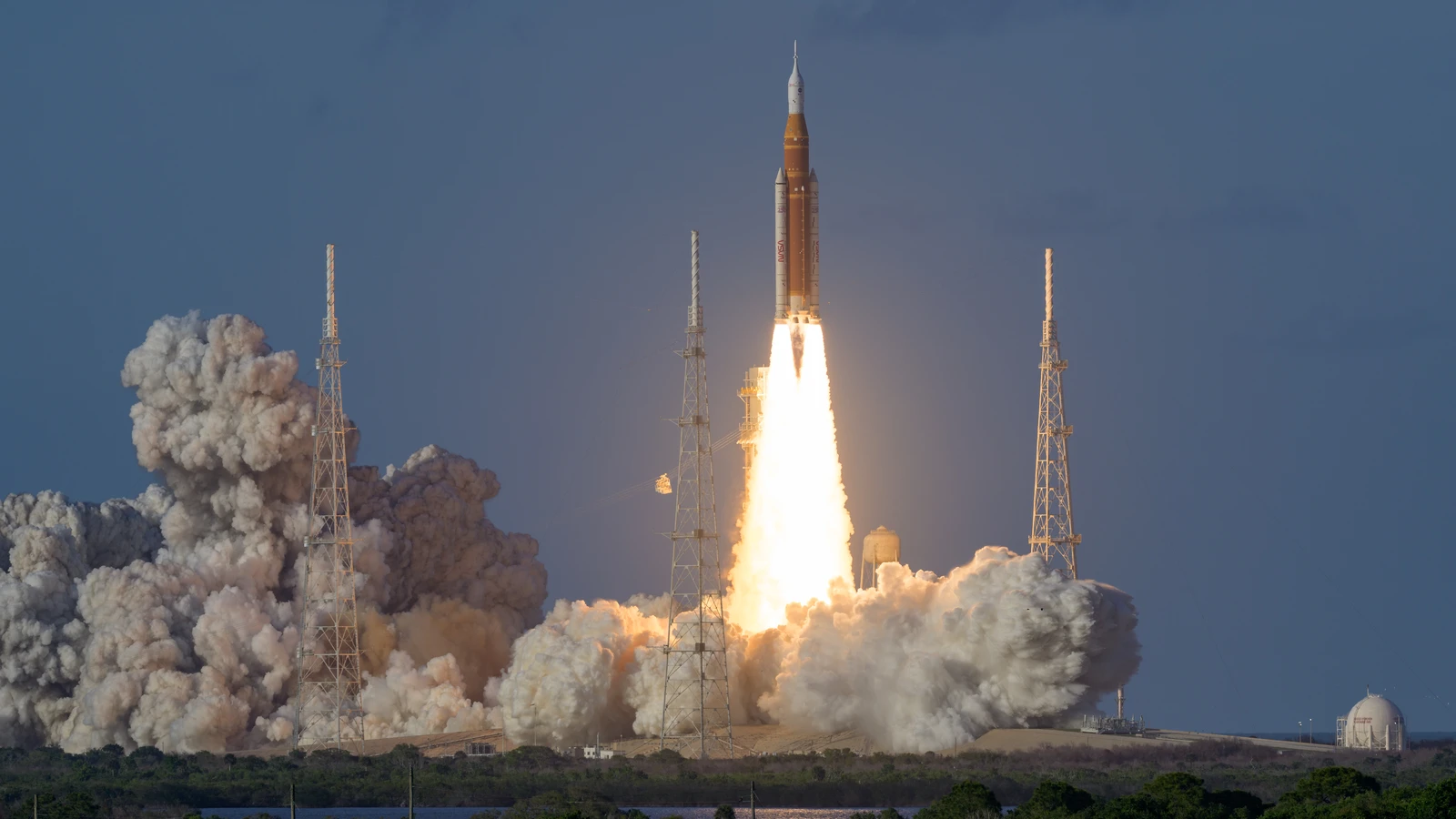
Artemis II carried four astronauts around the Moon and safely back to Earth in April 2026. It did not land because it was designed as a crewed flight test of Orion and its supporting systems, rather than a lunar surface expedition. Its achievements included operating the spacecraft with people aboard in deep space, collecting lunar observations, and returning the crew through Earth’s atmosphere.
Information checked: 6 November 2026. The flight is complete. The important questions now are what its results showed and how they support the next missions. Future dates below are NASA planning targets, not completed milestones.
Artemis II at a glance
| Question | Answer |
|---|---|
| What kind of mission was it? | A crewed lunar flyby. |
| When did it launch? | 1 April 2026, local time in Florida. |
| When did it return? | 10 April 2026, local time in California. |
| How long did it last? | 9 days, 1 hour and 32 minutes, according to NASA’s mission summary. |
| Who flew? | Reid Wiseman, Victor Glover and Christina Koch of NASA, and Jeremy Hansen of the Canadian Space Agency. |
| Did anyone walk on the Moon? | No. The crew remained aboard Orion. |
Sources: NASA’s Artemis II mission summary and ESA’s splashdown report. The return occurred on 10 April in California but on 11 April in the UK and continental Europe. Those different dates describe the same event in different time zones.
Why did Artemis II not land on the Moon?
NASA’s mission questions and answers describes Artemis II as a test of the systems needed to sustain astronauts in deep space. The crew evaluated life support, navigation, power, propulsion, thermal control, communications and spacecraft handling. A flight around the Moon allowed those systems and procedures to be exercised with astronauts aboard before more complex missions.
Reaching the Moon and landing on it involve different tasks. A surface expedition adds descent, landing, surface operations, ascent and a route back to the returning spacecraft. A successful flyby can establish useful evidence about the transport spacecraft without demonstrating every one of those additional capabilities.
The absence of a landing was part of Artemis II’s mission design. It should not be described as a landing attempt that failed, or as astronauts abandoning a planned moonwalk during the flight.
What did the mission actually demonstrate?
- Crewed spacecraft operations: astronauts worked with Orion’s controls and systems in the environment for which they were being tested.
- Deep-space mission procedures: the flight exercised navigation, communications, spacecraft handling and crew routines at lunar distances.
- Return and recovery: Orion brought the crew back through the atmosphere for ocean recovery.
These are different kinds of evidence. Completing a flight shows that its particular sequence worked; inspecting recovered hardware helps explain how it worked and where margins or weaknesses remain. Neither is a guarantee that every future mission configuration will behave identically.
What did NASA learn about Orion’s heat shield?
In its 15 October 2026 post-flight assessment, NASA reported that Artemis II’s heat shield performed as expected. The agency had changed the re-entry trajectory after investigating Artemis I, limiting the time spent in a temperature range associated with the earlier shield’s cracking and loss of charred material.
NASA reported nine locations of char loss on the Artemis II heat shield dish, compared with 103 on Artemis I. It also reported external temperatures above 4,000°F during return, while the cabin stayed in the mid-70s Fahrenheit. Those temperatures refer to different places: the outside of a returning spacecraft and the environment occupied by the crew.
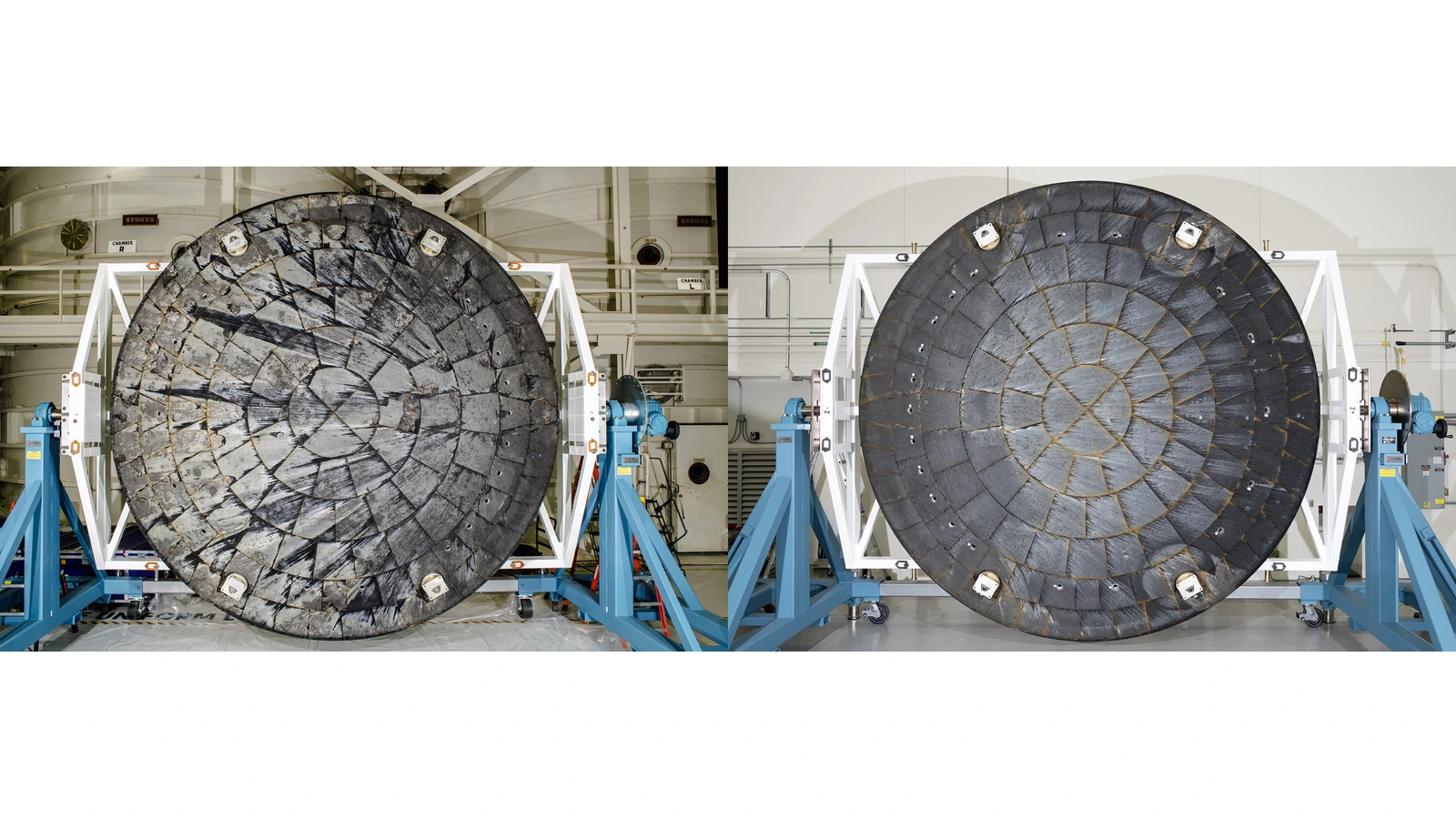
The useful conclusion is that the assessed thermal protection behaved in line with engineering expectations for this flight. “Performed as expected” does not mean a heat shield emerged untouched: an ablative shield is intended to manage extreme heating by sacrificing material.
What science could astronauts do without landing?
NASA’s preliminary lunar science release combines imagery, spoken observations and crew annotations. These records can be compared with measurements from robotic spacecraft, allowing researchers to connect what an astronaut noticed with a particular view, lighting condition and lunar location.
The crew reported five faint impact flashes while viewing the Moon. NASA explains that small rocky fragments can produce visible light when they strike the surface. The observations provide information relevant to understanding impact activity; they do not, on their own, establish a universal impact rate or prove a particular future landing site is safe.
Astronauts also described subtle surface colours and examined the boundary between day and night, called the terminator. Low-angle sunlight makes relief and shadows stand out. A visible colour or shadow is a clue to investigate alongside other data, rather than a complete chemical analysis or a direct measurement of terrain height.
For a separate example of how perception affects lunar observations from Earth, see why the Moon can appear bigger near the horizon.
What happens after Artemis II?
Use the latest programme update rather than an old launch preview. NASA’s 4 November 2026 update describes Artemis III as an Earth-orbit test mission targeted for 2027, including rendezvous and docking work involving Orion and lunar lander test vehicles. It identifies Artemis IV as the lunar landing mission targeted for 2028.
| Mission | Role in the sequence | Status as checked on 6 November 2026 |
|---|---|---|
| Artemis II | Crewed flight around the Moon and return. | Completed in April 2026. |
| Artemis III | Test rendezvous, docking and related operations in Earth orbit. | Targeted for 2027. |
| Artemis IV | Carry astronauts toward a lunar surface landing. | Targeted for 2028. |
These stages test different links in the mission chain. Flying Orion with a crew, demonstrating spacecraft transfers, and performing a surface expedition are connected goals, but they are not interchangeable. The dates and configurations of future flights can change as hardware, testing and operational plans develop.
How to read Artemis claims without mixing up missions
- Check whether a report describes a completed event, an in-flight plan, or a future target.
- Distinguish a flyby from lunar orbit and from a surface landing; “went to the Moon” is not precise enough.
- Check the publication date before repeating a claim about what Artemis III or IV will do.
- For a technical result, look for the post-flight assessment rather than relying only on a pre-launch prediction.
Sources and image credits
- NASA: Artemis II mission summary.
- NASA: Artemis II questions and answers — in-flight descriptions used for mission objectives.
- ESA: Splashdown for Artemis II — return and time-zone context.
- NASA: Artemis II heat-shield assessment, 15 October 2026.
- NASA Science: preliminary lunar science reports, images and audio.
- NASA: updated Artemis sequence, 4 November 2026.
Featured launch photograph: NASA/Bill Ingalls. Heat-shield comparison: NASA. Images are reproduced for editorial explanation; source links accompany the relevant sections. This article does not present an independent engineering assessment of the spacecraft.
You may also like
 Science & Technology
UK Polar Vortex: Does a Weakening Vortex Mean Snow?
Does a weakening polar vortex mean UK snow? Understand the November signal, the limits of snow maps and…
 Science & Technology
Can Capella-2 See Through Walls? What SAR Satellites Really Show
Capella-2 cannot see into homes. Learn why Tokyo’s radar image looked transparent, what SAR really detects, the meaning…
 Home & Living
Why Do Ceiling Fans Collect Dust Even When They Are Spinning?
A physics-backed explanation of dust buildup on spinning ceiling fan blades, plus safe cleaning methods and practical ways…