
Why Does the Moon Look Enormous Near the Horizon? The Science of the Moon Illusion
Why does the rising Moon look huge? Discover the Moon illusion, scientific explanations, easy experiments, and the difference between supermoons and perception.
Contents
- What exactly is the Moon illusion?
- Does the Moon actually get bigger at the horizon?
- Why your brain might make the horizon Moon look enormous
- 1. Apparent-distance and size-constancy explanations
- 2. The flattened-dome sky hypothesis
- 3. Surrounding objects and visual context
- 4. Eye position, gaze direction, and perception
- Try three simple experiments yourself
- Experiment 1: use your fingertip as a size reference
- Experiment 2: photograph the Moon with identical settings
- Experiment 3: view the horizon Moon without landscape cues
- Why photographs sometimes make the Moon look tiny
- Is a supermoon the same as the Moon illusion?
- What about the orange or red color near moonrise?
- How to tell a genuine size change from an illusion
- Common myths that do not explain the effect
- A useful observation plan for your next moonrise
- What scientists can say confidently—and what remains open
- Conclusion
- Sources and further reading
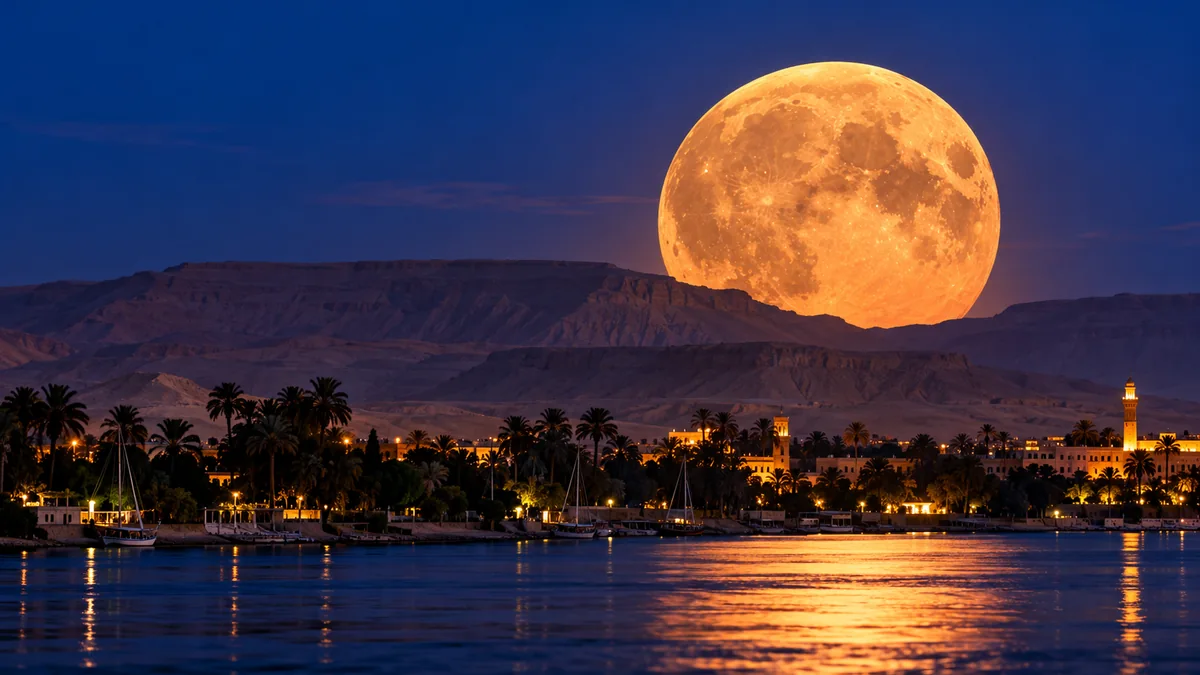
The Moon can look astonishingly large as it rises over a city skyline, mountain ridge, or distant trees. Hours later, the same Moon seems smaller when it is high overhead. Yet its actual angular diameter changes very little during that single evening. The dramatic difference is usually a perceptual effect known as the Moon illusion, not the Moon physically swelling or moving much closer.
This guide separates what astronomers can measure from what vision scientists are still investigating. You will learn how to test the effect yourself, why camera photographs often disappoint, and when a genuinely larger-looking Moon is caused by orbital geometry rather than illusion.
What exactly is the Moon illusion?
The Moon illusion is the tendency to perceive the Moon as larger near the horizon than when it is high in the sky. It can happen with a full Moon, crescent Moon, or even the Sun, though never stare directly at the Sun to investigate the effect. The impression is often strongest when the horizon contains familiar buildings, trees, hills, or a wide landscape.
The critical distinction is between perceived size and angular size. Angular size is the angle an object spans in your field of view. A typical full Moon is roughly half a degree across, about the width of a little fingernail viewed at arm’s length. Your brain can interpret that same visual angle as a surprisingly different apparent size in different scenes.
Does the Moon actually get bigger at the horizon?
No—not in the way the illusion suggests. Earth’s rotation changes the observer’s position relative to the Moon by a modest amount, and the Moon’s distance also changes gradually along its orbit. But those physical changes do not explain the striking horizon-versus-overhead size difference people report. In fact, the observer is often slightly farther from the Moon when it is on the horizon than when it is overhead, which would make its angular diameter marginally smaller, not larger.
Atmospheric refraction changes the apparent position and shape of the Moon near the horizon. It usually compresses the lunar disk vertically, sometimes making it look flattened or oval. Refraction does not magnify the Moon into the enormous disk your eyes seem to see.
Why your brain might make the horizon Moon look enormous
There is no single explanation that has conclusively accounted for every observer and every setting. Researchers have proposed several overlapping mechanisms involving perceived distance, visual context, and the geometry of the sky. The most useful approach is to treat these as scientific explanations under investigation, rather than a solved optical trick.
1. Apparent-distance and size-constancy explanations
In everyday life, the brain uses distance cues to estimate how large an object must be. A car far down the road projects a smaller image onto the retina than a nearby car, yet we recognize both as roughly car-sized. This perceptual process is called size constancy.
Some Moon-illusion explanations suggest that a horizon filled with depth cues makes the Moon appear farther away. If the brain interprets a similarly sized retinal image as more distant, it may infer a larger physical object. This is related to the Ponzo illusion, where converging lines can make equal-length objects look unequal.
However, experiments do not always find that a Moon perceived as larger is also perceived as farther away. That limitation is one reason scientists do not regard a simple size-constancy account as the complete answer.
2. The flattened-dome sky hypothesis
People may perceive the sky not as a perfect hemisphere but as a shallow dome, with the horizon seeming more distant than the point directly overhead. In that perceived geometry, an object at the horizon could appear larger even if it occupies the same visual angle. The hypothesis is intuitive, but it is difficult to make it explain every reported observation on its own.
3. Surrounding objects and visual context
A Moon framed by a tree, building, distant mountain, or skyline can look particularly impressive. These features supply size and distance cues that a Moon floating in an empty patch of overhead sky lacks. Context can alter judgments of size; it is not necessary for the Moon’s image on the retina to change.
The Moon illusion can still occur in simplified environments, so foreground objects are not the sole cause. Their contribution also varies between individuals and scenes.
4. Eye position, gaze direction, and perception
Some researchers have explored whether looking upward changes how we judge angular size or distance compared with looking straight ahead. Laboratory studies have produced mixed results, and these mechanisms do not fully replace context-based accounts. A useful reminder: a strong subjective impression is real as an experience even when its physical interpretation is misleading.
Try three simple experiments yourself
Experiment 1: use your fingertip as a size reference
At moonrise, hold a straight arm toward the Moon and compare its apparent width with the tip of your little finger. Repeat when the Moon is high in the sky, keeping your arm extended at the same distance. The Moon should span about the same portion of your fingertip both times, despite looking different against the surrounding landscape.
Avoid using your hand if the Moon is so low that a building or tree partly obscures its edge. Also remember that fingertip sizes vary; this is a personal comparison, not a precision measurement.
Experiment 2: photograph the Moon with identical settings
Take one photograph near moonrise and another several hours later using the same focal length, same camera, and no digital zoom or crop. Compare the Moon’s diameter in pixels, not its apparent size relative to the skyline. The disks should be very similar in pixel diameter, allowing for small real changes and atmospheric effects.
If you switch from a wide-angle lens to a telephoto lens, or crop one photo more tightly, the comparison is invalid. Phone cameras may silently change lenses or apply computational zoom, so verify the actual settings when possible.
Experiment 3: view the horizon Moon without landscape cues
Look at the Moon through a small tube or frame that blocks nearby trees, buildings, and the horizon. Some people report that it immediately looks smaller. Results vary, and this does not by itself establish a single mechanism. Do not point optical devices toward the Sun.
Why photographs sometimes make the Moon look tiny
A camera records angular size according to focal length and sensor geometry. A phone’s wide-angle lens captures a large portion of the sky, so a half-degree Moon occupies only a tiny fraction of the frame. Your visual experience is different: attention, context, and perception make the Moon seem dominant while you are looking at it.
To photograph a prominent Moon, photographers often use a long telephoto lens and carefully choose a distant foreground. That creates a legitimate perspective composition, but it does not mean the Moon was physically gigantic. A composite image or digitally enlarged Moon is a different technique and should be labeled honestly when presented as documentary photography.
Is a supermoon the same as the Moon illusion?
No. A supermoon is a full Moon occurring relatively near perigee, the closest point of the Moon’s elliptical orbit to Earth. The Moon’s angular size really does vary across the orbit, and a near-perigee full Moon can be modestly larger and brighter than a near-apogee full Moon. NASA commonly describes the maximum size difference between the nearest and farthest full Moons as around 14% in apparent diameter, with brightness differences of roughly 30% under ideal comparisons.
Those numbers describe extremes, not every supermoon, and they should not be confused with the often much stronger perceptual effect of seeing the Moon on the horizon. A supermoon high overhead may still appear smaller to you than an ordinary full Moon rising behind buildings.
What about the orange or red color near moonrise?
The Moon often looks yellow, orange, or red near the horizon because its light passes through a longer path of Earth’s atmosphere. Shorter wavelengths are scattered out of the direct beam more strongly, while longer reddish wavelengths can dominate the light that reaches your eyes. Dust, smoke, pollution, and haze can intensify the color.
Color and size are separate phenomena. A reddened Moon may feel especially dramatic, but atmospheric color filtering does not explain the perceived increase in diameter. Very low Moons can also appear squashed vertically because of atmospheric refraction.
How to tell a genuine size change from an illusion
Use a consistent measurement. A Moon that spans approximately the same number of pixels at the same focal length has nearly the same angular diameter, regardless of how large it looks to you. For a more precise comparison, use astronomical ephemeris data that give the Moon’s distance and apparent diameter at a particular time and location.
There are two independent effects worth separating: the Moon’s orbital distance, which changes its true angular diameter over days and weeks; and the horizon illusion, which changes how large we perceive it within minutes or hours depending on visual context. A third effect, atmospheric refraction, distorts shape and position near the horizon.
Common myths that do not explain the effect
• “The atmosphere acts like a giant magnifying glass.” Refraction mainly shifts and vertically flattens the low Moon; it does not create the dramatic enlargement.
• “The Moon comes much closer at sunset.” It does not rush toward Earth as it rises; the observer’s position often makes the horizon Moon slightly farther away.
• “It happens only during a supermoon.” The illusion can occur on ordinary lunar nights and during different phases.
• “The camera proves our eyes are wrong about everything.” Cameras and eyes answer different questions: physical angular size versus human perception.
• “One theory has definitively solved the Moon illusion.” There is still debate about the contributions of distance cues, perceived sky geometry, and other mechanisms.
A useful observation plan for your next moonrise
Find the Moon’s rise time and direction for your location using a reliable astronomy calendar. Choose a safe, open viewpoint with a clear horizon, ideally one with recognizable distant objects. Make a note of the time, weather, and whether the Moon is partly obscured. Observe it first against the skyline and then through a narrow frame. If possible, repeat the observation when it is high in the sky.
If you are taking photographs, lock focal length and record the settings. Compare pixel diameters rather than how impressive each image looks. Repeat on several nights: you may notice the strength of the illusion changes with haze, landscape, attention, and the position of the Moon.
What scientists can say confidently—and what remains open
Astronomers can calculate the Moon’s position, distance, and angular diameter with high precision. They can also model atmospheric refraction and explain why a low Moon is often orange. The harder question is why human observers perceive a nearly unchanged angular disk as much larger near the horizon.
The answer likely involves how the visual system interprets context, distance, and space. Individual variation and mixed experimental findings make it difficult to reduce the effect to a single rule. That uncertainty is not a weakness in the observation; it is part of what makes the Moon illusion an enduring question in perception science.
Conclusion
The Moon looks enormous near the horizon mainly because of how we perceive the sky, not because it suddenly becomes enormous. The disk you measure with a camera or fingertip stays close to the same angular size over a single evening, even while its perceived size changes. Try the simple tests above the next time the Moon rises over a familiar landscape: they turn a beautiful sight into an accessible experiment in astronomy and human perception.
Sources and further reading
NASA Science — The Moon Illusion
You may also like

Why Your Laptop Battery Says 100% but Dies Suddenly: Causes, Health Tests, and Fixes
Laptop battery shows 100% but turns off when unplugged? Diagnose battery wear, power issues, Windows battery reports, Mac…

How to Remove Personal Data From Data Broker Websites: Free Opt-Outs and California DROP
Learn how to remove personal information from people-search and data broker sites for free, use California DROP, request…

How to Recover Photos From a Corrupted SD Card Without Making Things Worse
Recover photos from a corrupted SD or microSD card safely. Follow practical Windows, Mac, and PhotoRec steps without…