
Why Is the Plate Hot but the Food Still Cold in the Microwave?
Find out why a microwave heats your plate while the food stays cold, how to check cookware and improve reheating, and when the oven may need service.
Contents
- How does a microwave heat food?
- Why does the plate itself get hot?
- 1. Heat transfers from the food
- 2. The dish absorbs some microwave energy
- Why does the middle of the food stay cold?
- Choose the next check from what you observe
- Improve reheating without simply adding more time
- Example: a rice mound and a large piece of chicken
- How do you check reheated leftovers?
- When should you suspect an appliance fault?
- Frequently asked questions
- Does a hot plate mean it is not microwave-safe?
- Are white or glass dishes always safe?
- Does lower power only make reheating slower?
- Related reading
- Sources
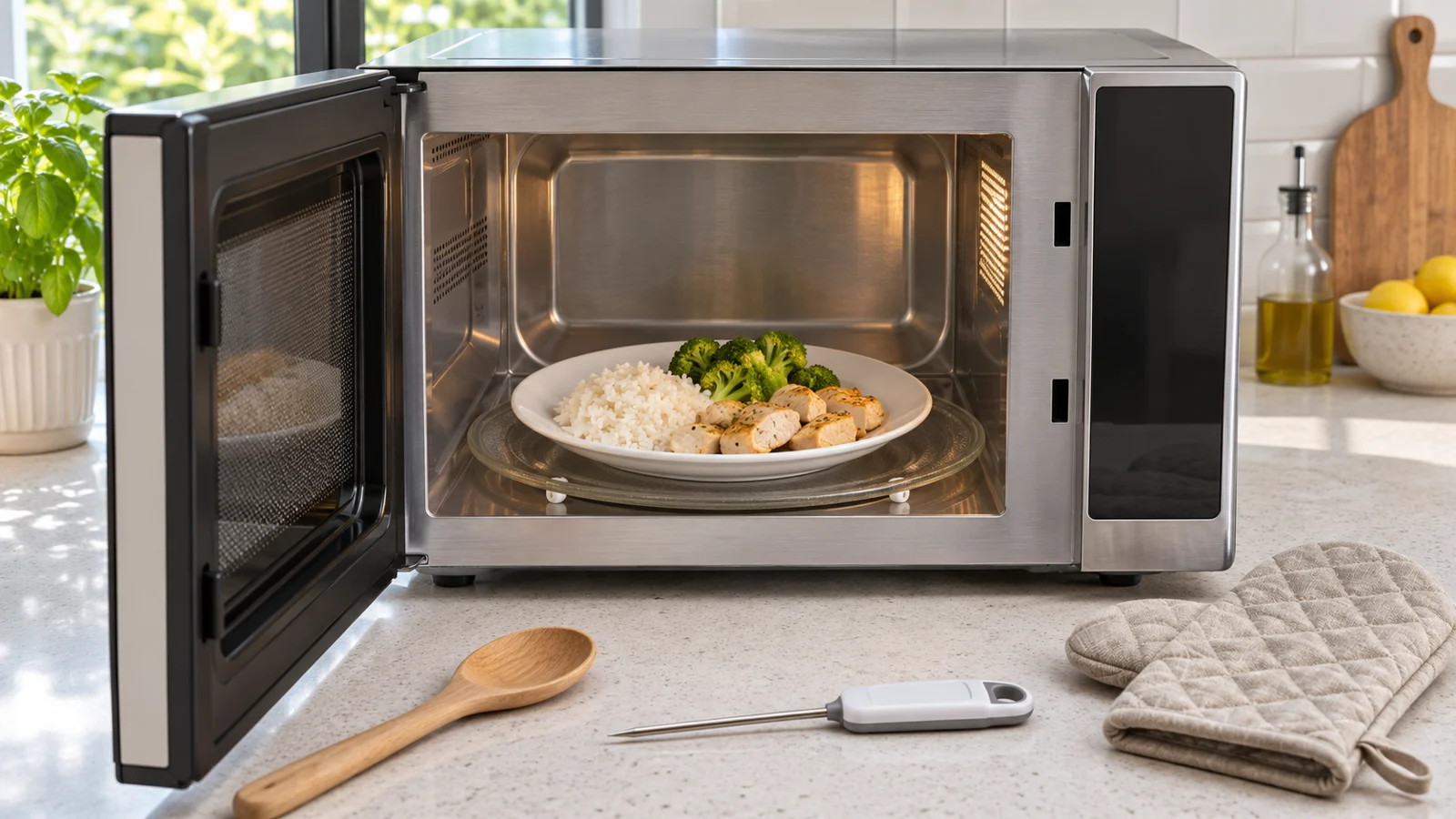
A plate can get hot in the microwave because heat moves into it from the food, because its material absorbs some microwave energy, or both. Meanwhile, the middle of the meal can remain cold because heating is uneven. A hot rim alone does not tell you the food temperature or whether the dish is suitable.
Start with an intact microwave-safe container, spread the food more thinly, stir during heating and follow the recommended standing time. If the problem happens with one particular dish, check its specifications before assuming the oven is faulty.
How does a microwave heat food?
The oven produces a changing electromagnetic field. Food absorbs some of its energy, converting it into heat; water and other polar molecules contribute. West Texas A&M: microwave heating explains this as dielectric heating, rather than an oven tuned to a special resonant frequency of water.
The practical point is that the meal and the container do not behave as a single material. Different parts of the food can respond differently, and heat can move between them after energy is absorbed. Steam at the edges can coexist with a cooler centre in a dense portion.
Why does the plate itself get hot?
1. Heat transfers from the food
Hot food transfers heat to a cooler dish it touches. A suitable container can therefore become hot during ordinary use: microwave-safe does not mean cool to handle. Use oven mitts to remove it rather than grabbing it to test its temperature.
2. The dish absorbs some microwave energy
According to IKEA: Why does my plate get hot?, moisture or minerals in some ceramics and porcelain can contribute to heating. Behaviour depends on the product: not every ceramic dish is unsuitable, and not every glass item is safe. Check the maker’s instructions and the condition of the item, especially cracks or metallic decoration.
Both mechanisms can occur in the same dish. Touch alone cannot establish how much each contributes. A hot plate does not prove that it has absorbed all the energy intended for the food; the meal’s arrangement and the selected programme also matter.
Why does the middle of the food stay cold?
Clemson University: microwave food safety notes that microwave heating can leave cold spots. A deep, full container or a thick pile needs more attention than a smaller, evenly spread portion. The timer reaching zero does not automatically mean every part has reached the same temperature.
Check for pieces of different thickness, a still-frozen section, or power and time settings unsuited to the portion. GE Appliances: uneven cooking recommends reviewing food arrangement, stirring and covering; lower power with a longer heating time can help, following the food and appliance instructions.
Choose the next check from what you observe
| Observation | Check | Next step |
|---|---|---|
| It happens with one particular dish | Cookware material and instructions | Choose another verified microwave-safe container |
| Edges are hot; centre is cooler | Food thickness and arrangement | Spread and stir the food, then continue heating |
| Meal components heat differently | Piece size and starting temperature | Heat components separately when needed |
| The tray does not rotate when it should | Seating, obstructions and settings | Consult the manual; clear obstructions with the oven stopped |
| Several suitable containers give persistently poor heating | Programme, power and overall performance | Follow model guidance, then seek service if it persists |
Improve reheating without simply adding more time
- Choose intact cookware labelled for microwave use. Oven-safe alone is not sufficient.
- Spread the meal instead of piling it up. Where appropriate, position thicker pieces towards the outside, following your oven guidance.
- Use a suitable cover that lets steam escape. Add a little liquid if the recipe or food instructions recommend it.
- Pause midway to stir or turn pieces. Before restarting, ensure the container is not obstructing the turntable.
- Follow the standing time on the package or in the manual, then check the food in several places.
University of Nebraska–Lincoln: microwave safety recommends a vented cover and stirring or rotating to improve evenness. There is no universal heating time for every oven and meal: output power, portion size and starting temperature differ.
Example: a rice mound and a large piece of chicken
This is an illustration, not a test we performed. With a rice mound and a thick chicken piece on one plate, the exposed rice cannot tell you the temperature inside the chicken. Reduce the pile, divide the piece where practical, or heat components separately. Check the cooler areas rather than repeating an arbitrary long cycle.
How do you check reheated leftovers?
USDA: reheating leftovers recommends reheating cooked leftovers to an internal temperature of at least 165°F, approximately 74°C, allowing standing time and checking several places with a food thermometer. This is a leftovers-reheating target, not a single cooking temperature for every raw food.
Use the thermometer as instructed. Do not leave an ordinary metal probe in an operating microwave unless it is specifically designed and approved for that use. Open covers carefully to avoid steam and use mitts for hot cookware.
When should you suspect an appliance fault?
If a tray designed to rotate stops, check its seating, obstructions and rotation setting. Whirlpool: turntable troubleshooting notes that some models or modes do not require rotation. This check does not apply to every flatbed oven.
If heating remains poor with suitable containers after checking settings, seek authorised service. Do not remove the outer casing to diagnose internal components. Stop using an oven that sparks or smells of burning and follow its safety guidance rather than continuing to experiment.
Frequently asked questions
Does a hot plate mean it is not microwave-safe?
Not necessarily: it may have heated through contact with the food. Unusual heating with one particular dish warrants checking its suitability. Rely on the manufacturer’s instructions and the item’s condition rather than touch alone.
Are white or glass dishes always safe?
Colour and appearance do not establish suitability. Choose a microwave-safe product and follow its restrictions; metallic decoration or damage can change whether an item should be used.
Does lower power only make reheating slower?
Longer heating at lower power can help reduce unevenness in some meals, but the result depends on the food and oven. Follow package instructions rather than a fixed guessed time, and continue stirring and checking.
Related reading
Sources
- IKEA: Why does my plate get hot?
- West Texas A&M: microwave heating
- GE Appliances: uneven cooking
- Clemson University: microwave food safety
- University of Nebraska–Lincoln: microwave safety
- USDA: reheating leftovers
- Whirlpool: turntable troubleshooting
Sources reviewed November 9, 2026. Examples are explanatory, not measurements from a home experiment or a test of a particular appliance.
You may also like
 Science
Earth’s Temporary Mini-Moon 2026 QQ8: Can You See It?
Can you see Earth’s temporary mini-moon 2026 QQ8? Find out how faint it is, how far away it…
 Science
Why Does Helium Make Your Voice Sound Higher? Pitch, Resonance and Safety
Why helium sounds squeaky without greatly changing your true pitch, how formants work, and why inhaling helium is…
 Animals
Are Dogs as Smart as Two-Year-Olds? What Research Shows
Are dogs really as intelligent as two-year-old toddlers? Learn what recent canine cognition studies reveal about words, memory,…