
Earth’s Temporary Mini-Moon 2026 QQ8: Can You See It?
Can you see Earth’s temporary mini-moon 2026 QQ8? Find out how faint it is, how far away it travels and how astronomers confirmed it was a natural object.
Contents
Contents
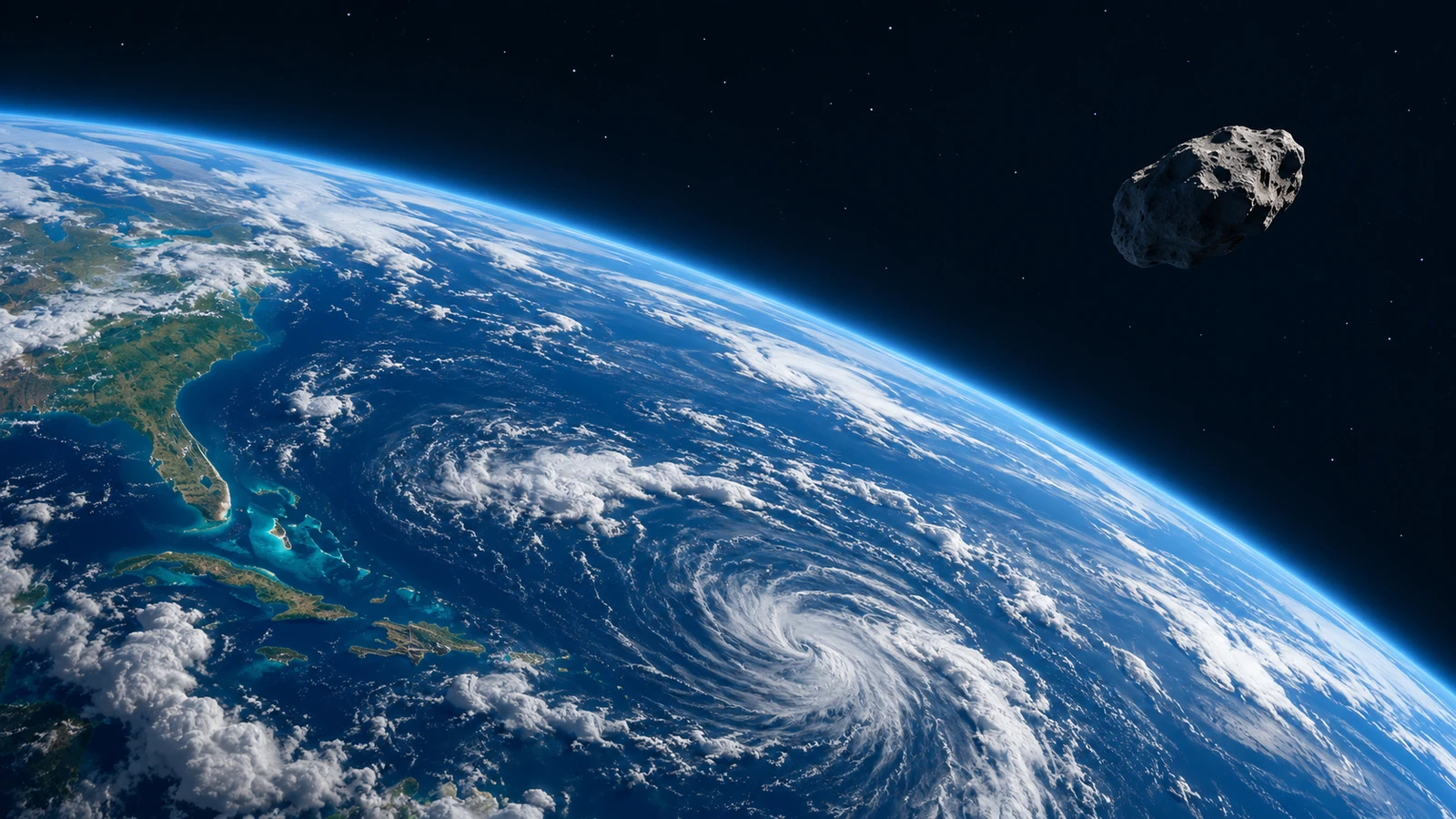
You can’t see Earth’s temporary mini-moon 2026 QQ8 with the naked eye. If you’re heading outside with binoculars or a phone, the Moon is the one to look for. The Minor Planet Center’s October forecast put QQ8 at about magnitude +25 in November, far beyond what those tools can pick up. The asteroid is roughly metre-sized, and astronomers followed it by measuring its position in telescope images.
How faint is 2026 QQ8?
On November 13 and 28, the Minor Planet Center predicted visual magnitudes of +25.2 and +25.3. On the scale NASA uses to explain star brightness, larger numbers mean fainter objects. Take a magnitude +6 star, near the faint end of what an unaided observer can see under a dark sky. At +25.3, QQ8 would deliver about one fifty-millionth as much light. That comparison comes from the standard brightness ratio: 10 raised to the power of (0.4 × 19.3).
A darker sky helps you see fainter stars, but it can’t make up a gap that large. QQ8 is a target for specialised telescope imaging. In a series of exposures it would appear as a point that changes position against the background stars.
How far away is the mini-moon?
The same forecast put QQ8 about 1.51 million kilometres (940,000 miles) from Earth on November 28. That is almost four times the Moon’s average distance of 384,400 kilometres. In late October, the forecast put QQ8 farther away, at nearly 1.94 million kilometres. The graph traces that stretch of the encounter using the distances tabulated in the October circular.
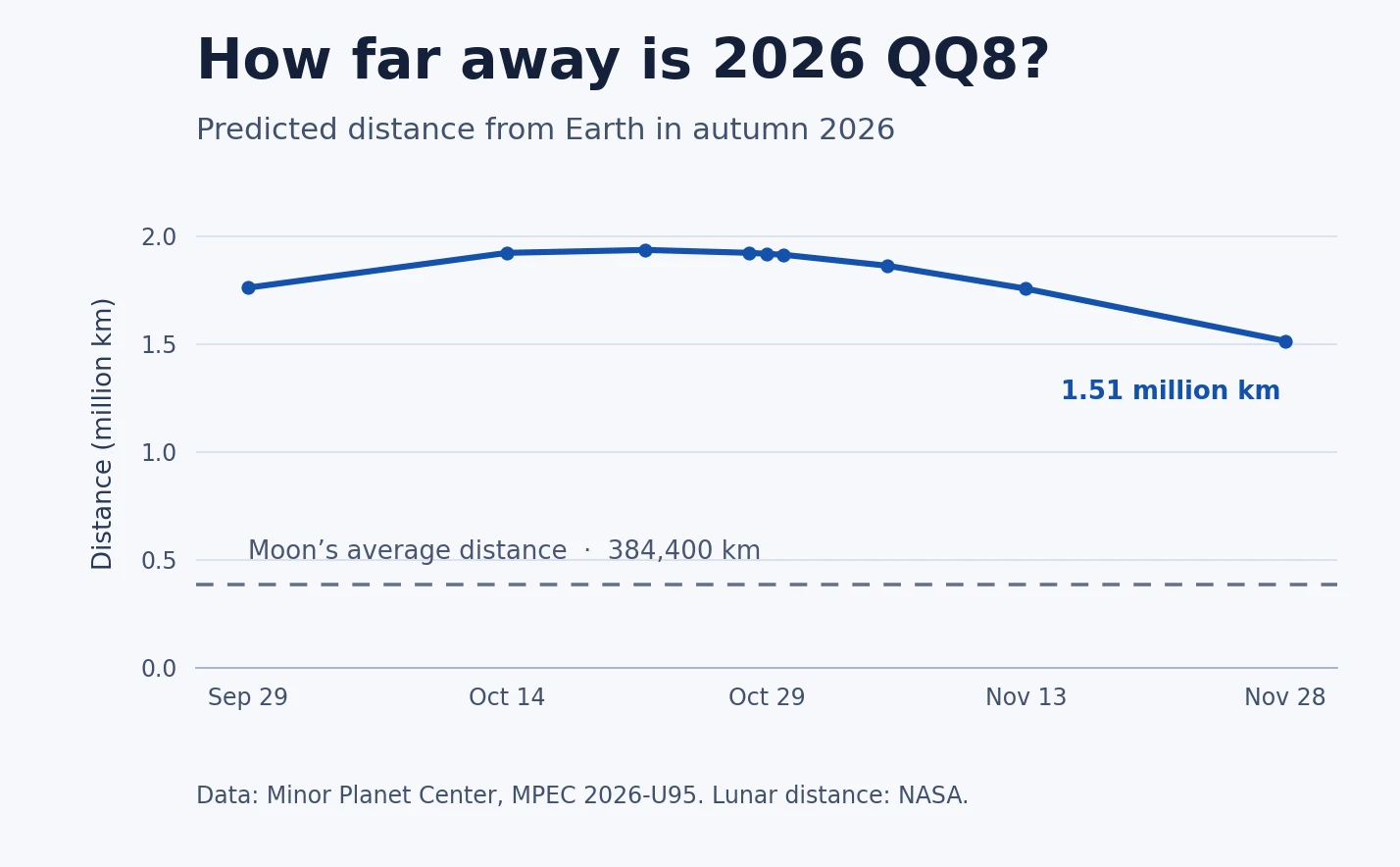
Look at November 13 and 28 together. The model had QQ8 getting closer while its predicted brightness barely changed. Distance is only part of the picture. How much of its sunlit side faces Earth matters too.
How astronomers figured out what they were tracking
When the object first turned up in August under the temporary label Sar2901, astronomers couldn’t yet tell whether they were tracking a natural object or a piece of space hardware. In its October newsletter, the Minor Planet Center described how new observations from stations G37 and T12 gave it a longer stretch of the trajectory to work with.
That longer record helped astronomers estimate how strongly sunlight was pushing on the object. A light, hollow piece of hardware can respond more strongly to the same pressure than a compact rock of similar size. The measurements, together with the orbit, let the centre rule out an artificial origin. On October 29 it issued the discovery circular for 2026 QQ8.
What it means for Earth to capture an asteroid
Earth and the asteroid both travel around the Sun. When a small asteroid passes Earth with the right speed and direction, Earth’s gravity can hold it in a temporary orbit. The Sun and Moon continue to tug on it during that encounter. Over time those pulls can change the path enough for the asteroid to slip away and continue around the Sun.
Published accounts place the start of the capture around April 2026, several months before the August observations. Reporting on the orbital estimates puts the end of the capture around December 2026 or January 2027. Treat that window as a forecast. The October circular records when the object was reported, and the European Space Agency’s object page carries later observations and updated orbit information.
What to look for instead
If you’re planning an evening outside, check the November supermoon viewing guide for moonrise where you live. That’s the bright Moon you can actually watch and photograph. If you’re following the asteroid itself, use the ESA entry to check for new observations. For technical follow-up, NASA JPL’s Horizons guide explains how to generate an observer ephemeris, a table of predicted sky positions for a specific location and time.
Sources and references
- Minor Planet Center: MPEC 2026-U95, observations and ephemeris, and its October 2026 account of the follow-up observations.
- European Space Agency Near-Earth Object Coordination Centre: 2026 QQ8 orbit and observations.
- NASA Science: Moon Facts and the visual magnitude scale.
- BBC Sky at Night Magazine: discovery context and the estimated departure window.
You may also like
 Science
Why Does Helium Make Your Voice Sound Higher? Pitch, Resonance and Safety
Why helium sounds squeaky without greatly changing your true pitch, how formants work, and why inhaling helium is…
 Science
Why Is the Plate Hot but the Food Still Cold in the Microwave?
Find out why a microwave heats your plate while the food stays cold, how to check cookware and…
 Animals
Are Dogs as Smart as Two-Year-Olds? What Research Shows
Are dogs really as intelligent as two-year-old toddlers? Learn what recent canine cognition studies reveal about words, memory,…