
Why Does Helium Make Your Voice Sound Higher? Pitch, Resonance and Safety
Why helium sounds squeaky without greatly changing your true pitch, how formants work, and why inhaling helium is unsafe.
Contents
- The quick explanation: a sound source and a resonating filter
- What exactly changes when helium is present?
- Pitch, harmonics, formants and timbre: four terms that get confused
- How much faster does sound travel in helium?
- Why does a resonant cavity respond differently?
- Does the effect last?
- Is inhaling helium safe—even from a party balloon?
- How to imitate the sound without breathing a gas
- What about gases that make voices sound deeper?
- Common myths about helium and voice
- Frequently asked questions
- Does helium actually raise the pitch of your vocal cords?
- Why does helium make speech sound like a cartoon character?
- Can inhaling helium kill you?
- How long does the effect last?
- Can software reproduce a helium voice?
- Bottom line
- Scientific and safety references

Helium makes a speaking voice sound unusually high and squeaky because it shifts the resonances of the vocal tract—not primarily because it speeds up the vibration of the vocal folds. Sound travels much faster through helium than through air, so the throat and mouth emphasize a different set of frequencies. That changes voice timbre, even when the fundamental pitch remains roughly the same. Breathing helium to reproduce this sound is unsafe: it displaces oxygen and can cause loss of consciousness; cylinders add serious pressure-related risks.
This explanation follows the acoustics guidance of the University of New South Wales and Hong Kong University of Science and Technology. For safety, New Zealand’s government product-safety authority explicitly advises people not to inhale helium from balloons or cylinders. The physics can be understood without putting gas into your lungs.
The quick explanation: a sound source and a resonating filter
Speech is produced in two connected stages. First, airflow from the lungs drives the vocal folds in the larynx to vibrate. That vibration creates a fundamental frequency (F0) and a series of harmonics. Next, the vocal tract—the throat, mouth and parts of the nasal passages—acts like a changing acoustic filter. Its resonances strengthen certain frequency bands and help determine which vowels you hear and whose voice you recognize.
These stages explain why two musical instruments playing the same note sound distinct: they can share a fundamental frequency but differ in the mix of higher harmonics. In speech, those emphasized resonant bands are called formants. The Voice Foundation’s introduction to voice production describes how vocal-fold vibration, resonance and articulation combine to create recognisable speech.
What exactly changes when helium is present?
Helium is substantially less dense than ordinary air, and sound propagates through it much faster under comparable conditions. A gas-rich change inside the vocal tract shifts its resonant frequencies upward. Higher harmonics become more prominent relative to lower ones, altering the spectrum that reaches a listener. The voice may sound thinner, sharper, brighter or cartoon-like.
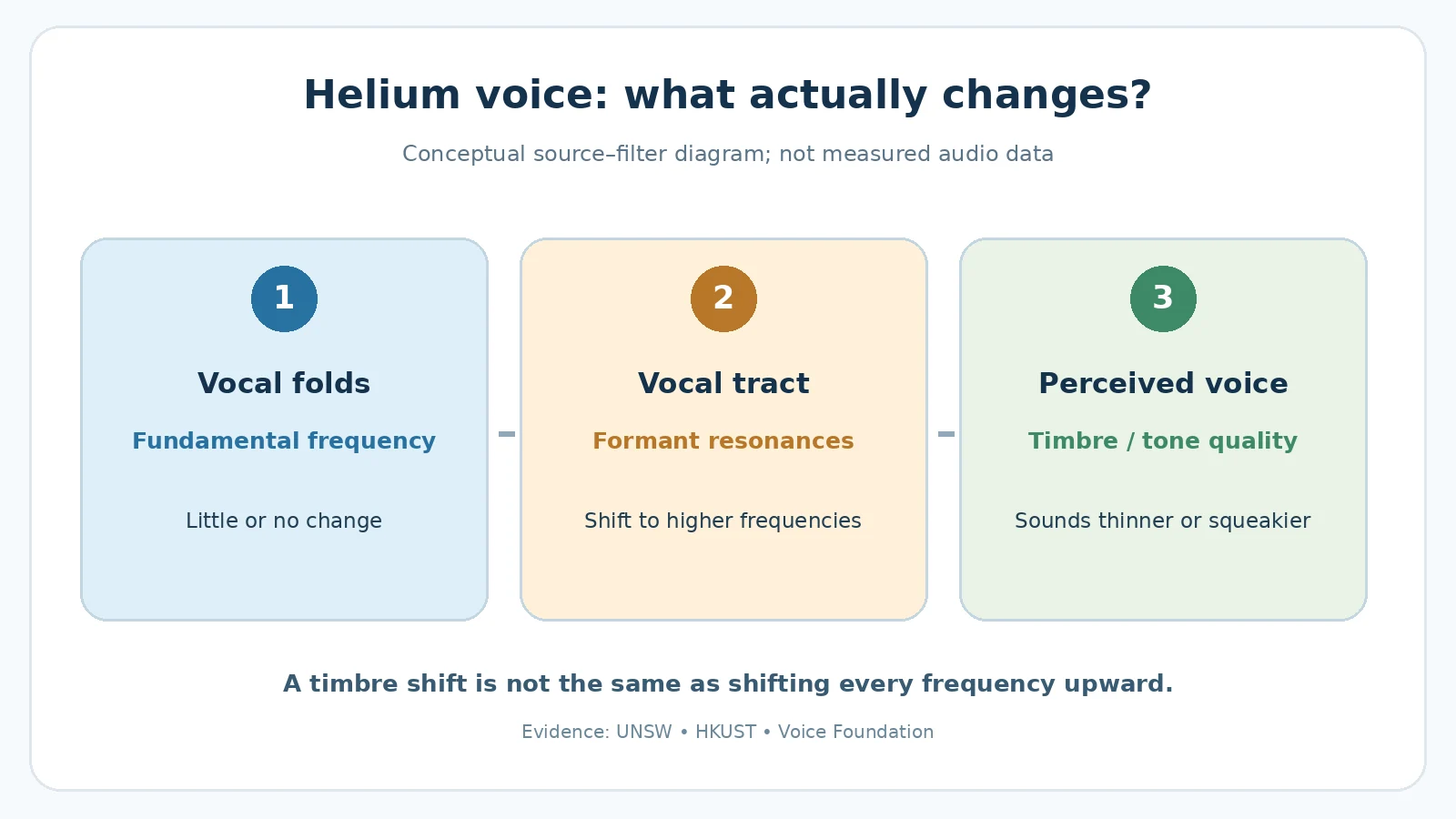
Crucially, the source of the sound has not necessarily changed its rate of vibration. The resonances of the filter have moved instead. This is the important distinction behind the popular misconception that helium directly raises pitch. Small changes in vocal-fold behaviour can happen with speaking style and breathing, but acoustic filtering explains the characteristic effect described by Scientific American.
Pitch, harmonics, formants and timbre: four terms that get confused
| Term | What it means | Typical helium effect |
|---|---|---|
| Fundamental frequency (F0) | Rate at which the vocal folds vibrate | Often approximately unchanged; not the main cause |
| Harmonics | Higher-frequency components related to F0 | Their relative strengths are redistributed |
| Formants / vocal-tract resonances | Frequency regions amplified by the vocal tract | Move to higher frequencies in helium-rich conditions |
| Timbre | Spectral character that distinguishes voices at similar notes | Shifts clearly; the voice sounds lighter or squeakier |
If every component of a voice recording were shifted up by exactly the same musical interval, that would be a true pitch shift. The helium effect is better described as changing the balance of resonant frequency bands while the vibrating source continues to generate roughly its original note. Some listeners still perceive a higher pitch; that perception does not prove a corresponding increase in F0.
How much faster does sound travel in helium?
Near room temperature, the speed of sound in ordinary air is about 343 metres per second. In pure helium it is of the order of 1,000 metres per second—roughly three times as fast. Exact values vary with temperature, gas composition and the source of the reference data. Scientific American gives a representative comparison of approximately 344 m/s for air and 927 m/s for helium under the conditions it discusses.
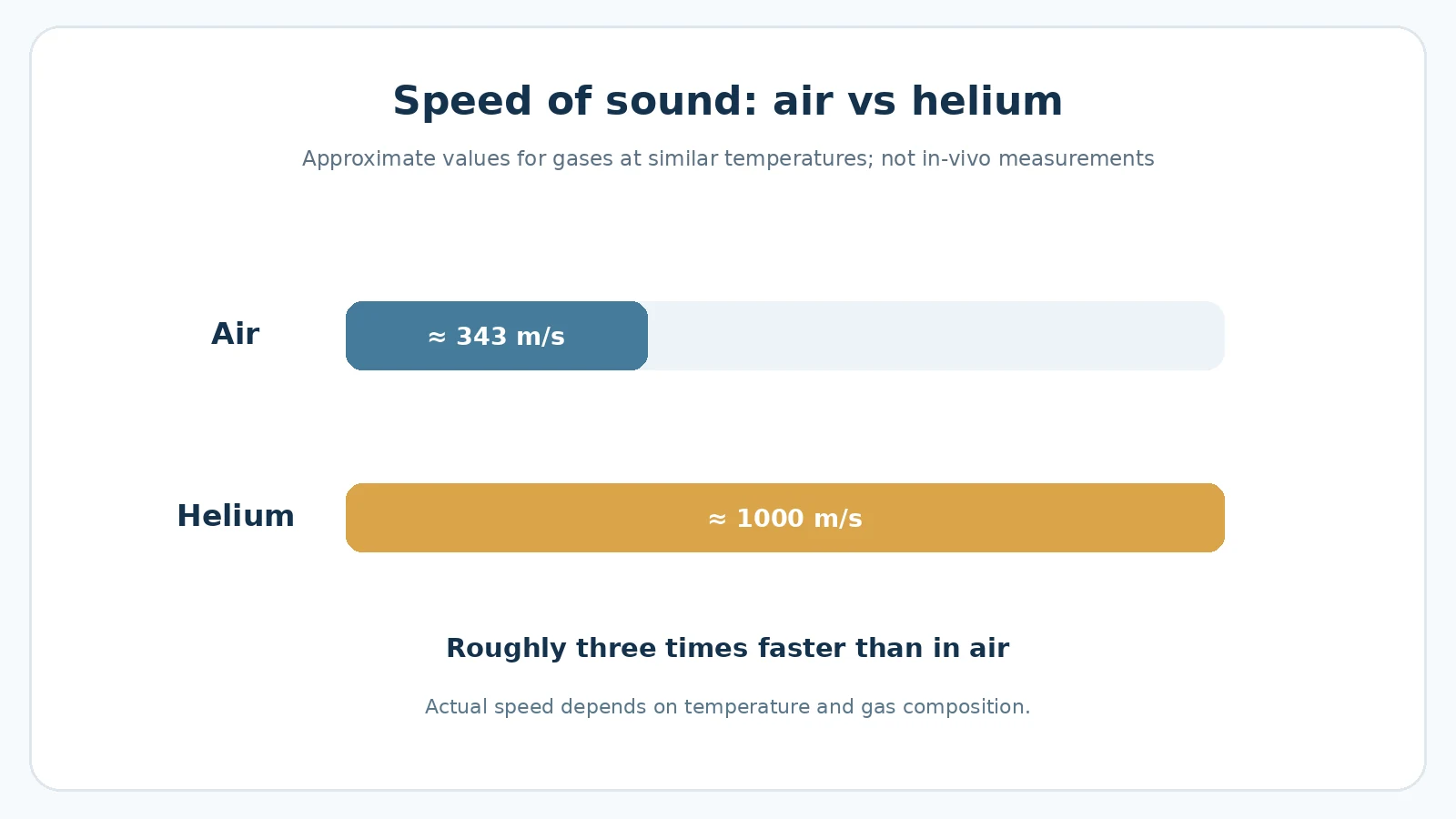
These are gas-property comparisons, not measurements of someone’s lungs or vocal tract. Real passages contain mixed gases, and their acoustic geometry is far more complicated than a uniform tube. It would therefore be misleading to multiply every formant in a real person’s voice by three as though that were a measured result.
Why does a resonant cavity respond differently?
Imagine a tube whose length stays the same while the wave speed inside it changes. The wavelengths and frequencies that fit the tube’s preferred patterns can shift. The vocal tract is not a simple open tube, but it follows the same broad principle: a faster acoustic medium changes which frequencies are reinforced. In speech, changing the position of the tongue and the shape of the lips also changes formants, even when you are breathing ordinary air.
This is why vowels sound different from each other, and why a helium-affected vowel can sound strange or less recognizable. The UNSW acoustics explanation emphasizes resonance and formants rather than a wholesale change in the vocal-fold fundamental.
Does the effect last?
The unusual sound is associated with the gas mixture present in the airway, not a permanent transformation of the vocal folds. As the usual breathing gas returns, the acoustic conditions and voice timbre ordinarily return toward normal. A brief audible effect, however, should never be used as evidence that breathing helium was harmless.
Is inhaling helium safe—even from a party balloon?
No. Do not inhale helium to change your voice. Helium is chemically inert, but it contains no oxygen for your body to use. It can displace air and rapidly deprive the brain of oxygen, leading to dizziness, confusion, fainting or asphyxiation. This is a physical suffocation hazard, not the same as conventional chemical toxicity. New Zealand government safety advice expressly warns against inhaling helium from either balloons or cylinders.
Pressurized cylinders are especially hazardous because high-pressure gas can cause severe lung injury or introduce gas into the bloodstream. The DailyMed compressed-helium warning says that inhaling helium to change the voice can be fatal. There is no generally safe amount to recommend for recreational inhalation, and children should not be encouraged to copy online demonstrations.
If an exposure has occurred, move to fresh air; seek urgent medical assistance if a person has persistent dizziness, breathing difficulty, altered consciousness or collapses. See the Missouri Poison Center’s guidance. Never enter an oxygen-deficient space to attempt a rescue without appropriate professional equipment.
How to imitate the sound without breathing a gas
If you want to understand the acoustics for a classroom, video or audio project, use a recorded voice and a digital audio editor. A processor that shifts formants or changes the spectral envelope while preserving the fundamental frequency can approximate the characteristic bright, squeaky sound. Standard pitch shifting is a separate effect: it raises or lowers the whole recorded note, rather than reproducing the same physical filtering mechanism.
This is a safer teaching method because it involves no inhaled gas. The result is a simulation, not an exact scientific reproduction of every acoustic condition in a person’s airway. For a related topic, read our guide to why your voice sounds different in recordings and the role of bone conduction.
What about gases that make voices sound deeper?
In principle, a denser gas can slow the propagation of sound and lower the resonant frequencies of the vocal tract, creating a deeper-sounding timbre. This is an acoustics comparison—not a suggestion to inhale any other gas. Some gases introduce additional chemical or respiratory hazards. Digital formant-shifting is the appropriate way to explore the contrast safely.
Common myths about helium and voice
| Claim | What the science supports |
|---|---|
| “Helium makes vocal folds vibrate three times faster.” | Sound-speed changes and vocal-fold vibration rates are different quantities. Resonance changes dominate. |
| “Helium is safe because it is non-toxic.” | Chemical inertness does not prevent oxygen displacement or pressure injury. |
| “The effect ending proves there was no danger.” | A temporary voice change cannot rule out a dangerous exposure. |
| “You must breathe helium to hear a helium-like voice.” | Digital formant and spectral processing can create a similar sound without gas. |
Frequently asked questions
Does helium actually raise the pitch of your vocal cords?
Not substantially in the usual explanation. The main change is in vocal-tract resonance and timbre; the fundamental frequency generated by the vocal folds can remain roughly unchanged.
Why does helium make speech sound like a cartoon character?
Higher resonant bands become prominent relative to lower ones. That spectral change makes vowels and voice quality sound lighter, brighter and sometimes squeaky.
Can inhaling helium kill you?
Yes. Helium can displace oxygen and cause suffocation, while compressed gas from a cylinder can injure the lungs. It should not be inhaled for entertainment.
How long does the effect last?
It ordinarily fades as the gas mixture in the airway returns to normal. This does not mean the inhalation was safe.
Can software reproduce a helium voice?
Yes. Formant shifting and spectral processing can imitate the characteristic timbre without exposing anyone to helium. Simple pitch shifting is related but not identical.
Bottom line
Helium changes the speed of sound in the vocal tract, which moves resonance bands and reshapes the harmonics you hear. The familiar “high voice” is mostly a timbre effect rather than a dramatic increase in the basic pitch produced by the vocal folds. Understanding the sound-source/filter distinction is useful—and it is much safer to demonstrate it with digital audio than by inhaling gas.
Scientific and safety references
- University of New South Wales — Acoustics FAQ and helium speech
- HKUST Science Focus — Helium and voice timbre
- Scientific American — Why inhaling helium changes voice quality
- Voice Foundation — Understanding voice production
- New Zealand Product Safety — Helium safety guidance
- DailyMed — Compressed helium safety labeling
- Missouri Poison Center — Helium exposure and first aid
You may also like
 Science
Earth’s Temporary Mini-Moon 2026 QQ8: Can You See It?
Can you see Earth’s temporary mini-moon 2026 QQ8? Find out how faint it is, how far away it…
 Science
Why Is the Plate Hot but the Food Still Cold in the Microwave?
Find out why a microwave heats your plate while the food stays cold, how to check cookware and…
 Animals
Are Dogs as Smart as Two-Year-Olds? What Research Shows
Are dogs really as intelligent as two-year-old toddlers? Learn what recent canine cognition studies reveal about words, memory,…