
Why Does Your Voice Sound Different in Recordings? The Science of Bone Conduction and Self-Perception
Discover why your voice sounds higher or unfamiliar on recordings, how bone conduction and auditory feedback work, and how to record a more natural voice.
Contents
- Introduction: the moment your recorded voice feels unfamiliar
- The short answer: you hear yourself through two routes
- How your voice is produced before anyone hears it
- Air conduction: the sound other people primarily receive
- Bone conduction: why the voice inside your head is different
- The occlusion effect: what happens when you block your ears
- Does a recording reveal your “real” voice?
- Why phone recordings can sound especially thin or strange
- Pitch versus timbre: why “higher” may not mean a higher note
- Your brain predicts the sound of your own actions
- Why you might dislike the sound of your recorded voice
- A simple experiment to compare the sound pathways
- How to make a more natural-sounding voice recording
- Why singers and speakers use monitoring headphones
- Voice notes, video calls, and social media: different processing chains
- Can you train yourself to sound better on recordings?
- When a change in voice deserves medical attention
- What the research supports—and what it does not
- Conclusion: two ways of hearing the same person
- Sources and further reading
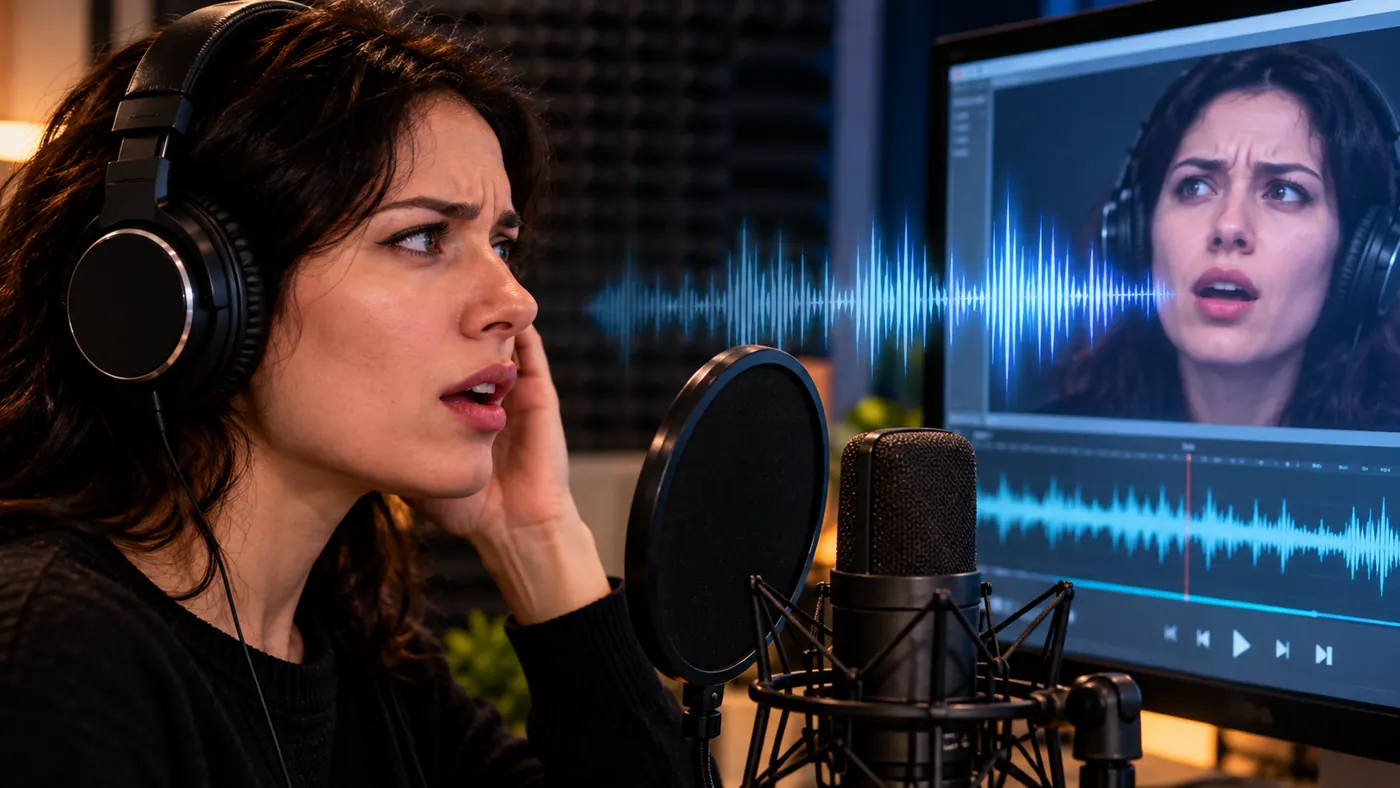
Why does your recorded voice sound so different from the voice in your head? The explanation combines air conduction, bone conduction, microphone acoustics and the brain’s expectations. This evidence-based guide explores each factor with practical listening experiments.
Introduction: the moment your recorded voice feels unfamiliar
You record a short voice message, press play, and immediately wonder: “Do I really sound like that?” The voice coming from your phone may seem thinner, higher, more nasal, or less resonant than the voice you hear while speaking. For many people, the contrast is startling.
Yet the recording is not necessarily faulty, and your hearing is not necessarily unusual. The difference arises because speaking and listening to a recording deliver sound to your auditory system in different ways. Your brain also carries a deeply familiar internal expectation of what “you” sound like.
This guide explains the acoustics, the biology, the technology, and the psychology—and separates common myths from what the evidence supports.
The short answer: you hear yourself through two routes
When another person speaks, airborne pressure waves travel through the room, enter your ear canal, vibrate your eardrum, and ultimately stimulate the inner ear. When you speak, you receive that airborne sound too, but vibrations from your vocal apparatus also travel through your head and tissues to the inner ear.
This second pathway is often called bone conduction, although its physics involves several interacting mechanisms rather than a simple vibration passing through one solid bone. The balance between air-conducted and internally transmitted sound changes the spectral character of your self-voice.
A microphone generally captures sound pressure in air at its position—not the complete internally transmitted component that you perceive while talking.
How your voice is produced before anyone hears it
Voice begins when air from the lungs passes through the larynx and sets the vocal folds into vibration. The rate of vibration contributes to fundamental frequency, commonly experienced as pitch.
The vocal tract—throat, mouth, and sometimes the nasal passages—filters this source into a recognizable pattern of resonances known as formants. Your tongue, lips, jaw, soft palate, and speaking style continually reshape that filter.
What listeners recognize as your voice is therefore more than pitch: it includes formant frequencies, articulation, rhythm, breathiness, vocal roughness, accent, and expressive habits.
Two people can speak at similar fundamental frequencies yet sound strikingly different because their vocal-tract resonances and speech patterns differ.
Air conduction: the sound other people primarily receive
In ordinary conversation, sound travels from your mouth through the air. Distance, room reflections, and the direction your face points can change the sound before it reaches a listener.
Your mouth radiates different frequencies in different directions, so a microphone near your lips may capture a different balance from a friend standing across the room. The external ear also shapes incoming sound before it reaches the eardrum.
As the eardrum and middle-ear bones transmit vibrations to the cochlea, sensory hair cells convert mechanical motion into neural signals. This airborne route dominates what a conventional microphone records, subject to the microphone’s own response and position.
Bone conduction: why the voice inside your head is different
While you speak, vibrations generated by the vocal folds and vocal tract can reach the inner ear through your skull and surrounding structures.
Research on bone-conducted hearing describes contributions from skull vibration, movement of the ear-canal walls, inertia of middle-ear structures, and pressure differences within the cochlea. The relative importance of these mechanisms depends on frequency and individual anatomy.
It is common to experience your live voice as fuller or lower than a playback, partly because internal transmission changes the balance of frequencies. However, the claim that “bone conduction simply adds bass” is an oversimplification: the actual response is frequency-dependent and varies among people.
The occlusion effect: what happens when you block your ears
Try speaking softly while gently covering your ear openings with your fingertips, without inserting anything into the canals. Your own voice may become booming or unusually loud.
This is related to the occlusion effect: closing the ear canal traps low-frequency sound pressure generated by vibration of the canal walls that would otherwise escape. Earplugs and tightly sealed earbuds can produce a similar sensation, especially when you speak or chew.
The effect illustrates why the self-voice experience is not determined by airborne sound alone. It also explains why some people find their speech unnatural while wearing sealed in-ear devices, even if the device itself is functioning correctly.
Does a recording reveal your “real” voice?
A recording is often closer to the sound others receive than the voice you hear internally, but there is no single recording that represents exactly what every listener hears.
A phone microphone placed close to your mouth, a laptop across a desk, and a studio microphone at a carefully controlled distance will produce different results. A person listening in a quiet room may also hear you differently from someone in a reverberant hall. Playback speakers or headphones introduce another filter.
The most accurate statement is that recordings remove much of your direct internal conduction while adding their own recording and playback characteristics. They are useful evidence about how your voice travels through air, not a perfect universal portrait.
Why phone recordings can sound especially thin or strange
Smartphones often prioritize intelligibility over a neutral reproduction of the entire voice spectrum. Microphone frequency response, automatic gain control, noise suppression, echo cancellation, compression, and the codec used by an app can change the result.
A voice note recorded in a quiet room may sound different from the same words recorded during a call because communication systems may use different signal processing. Close placement can exaggerate plosives or proximity effects on some microphone types; distant placement can add reverberation and reduce clarity.
Before drawing conclusions about your voice, compare the same short passage recorded with different devices and distances, at matched playback loudness.
Pitch versus timbre: why “higher” may not mean a higher note
Listeners often describe playback as “higher,” but the fundamental frequency may be essentially unchanged. What has changed may be timbre: the relative strengths of harmonics and formants. If a recording reduces low-frequency energy, the voice can feel lighter or less warm even though its fundamental pitch is the same.
Conversely, a recording with strong bass can sound deeper without changing the rate of vocal-fold vibration. Software pitch shifting really can alter fundamental frequency, but an ordinary microphone does not automatically transpose every voice upward.
Understanding this distinction helps explain why a voice may seem unfamiliar without any measurable change in its basic pitch.
Your brain predicts the sound of your own actions
Hearing your own voice is also a sensorimotor event. Your brain issues motor commands for speaking and monitors incoming auditory feedback. Researchers study how predictions linked to self-generated actions influence responses to expected sounds, including speech.
Such prediction mechanisms help distinguish self-generated sensory events from unexpected external ones and support adjustments when auditory feedback changes. A recording played back later is no longer synchronized with the act of speaking.
You hear it as an external sound without the same immediate motor signals and internal vibrations. This change in context may contribute to the sense that the voice belongs to someone else, alongside the much more direct acoustic differences.
Why you might dislike the sound of your recorded voice
Familiarity matters. You have heard your live voice for years under a very particular combination of acoustic and bodily conditions. A recording violates that expectation, which can produce surprise or discomfort.
People may also judge their own speech harshly because they notice hesitations, accent features, breath sounds, or vocal habits that are less salient while speaking.
Studies on self-voice perception and voice recognition indicate that self-voice is a special perceptual category, but reactions are not universal: some people like their recordings, and familiarity through repeated recording may reduce the surprise.
Disliking playback is not evidence that your voice sounds unpleasant to others.
A simple experiment to compare the sound pathways
Read a paragraph aloud in a quiet room and notice your live voice. Next, record the same paragraph on a phone positioned about an arm’s length away, then play it back at a comfortable level. Record a second version with the phone closer, avoiding breath blasts.
If available, compare a headset microphone and an external microphone. Keep the wording, speaking style, and approximate loudness similar. Listen for resonance, nasal quality, room echo, consonant clarity, and background noise rather than trying to decide which one is the “true” voice.
You can also gently cover the ear openings while humming to notice the occlusion effect. Do not use painful volume levels or put objects in the ear canal.
How to make a more natural-sounding voice recording
Choose a quiet room with soft furnishings that reduce strong echoes. Keep a consistent microphone distance, speak slightly off-axis if breath blasts are a problem, and avoid rubbing or covering the microphone. Record a few seconds to check the level before starting.
Disable aggressive audio enhancements when your recording app offers that choice and when intelligibility does not suffer. Compare playback through decent headphones and another speaker, keeping volume similar.
A mild equalizer adjustment may make the result more pleasing, but excessive bass boost can misrepresent the voice. If you are recording for a podcast, consistent mic technique and controlled room acoustics usually matter more than buying an expensive microphone immediately.
Why singers and speakers use monitoring headphones
Performers need to hear timing, pitch, and accompaniment while producing sound. Headphones can provide a controlled monitor mix, but they also change how the performer hears their own voice.
Closed-back headphones can reduce external sound and create some occlusion, while monitoring systems may feed the microphone signal back into the ears. If that signal is delayed, the mismatch between produced speech and heard feedback can be distracting.
Professional monitoring setups aim for low latency and a useful balance of voice and accompaniment. Some speakers prefer one ear partly uncovered, though hearing-safety considerations and the specific environment still matter.
Hearing yourself differently through headphones is not, by itself, a sign of faulty equipment.
Voice notes, video calls, and social media: different processing chains
A raw recording, a compressed messaging-app voice note, and a live video call are not acoustically identical. Call software may remove steady background noise, suppress echoes, and adjust gain dynamically. Online platforms can also re-encode audio after upload.
This means your voice may change between the original file and the version another person receives. When assessing recording quality, use an original local file where possible, then compare it with the uploaded or transmitted version.
Be cautious about judging someone else’s voice quality from a heavily processed clip, especially if the clip was edited or generated by artificial intelligence.
Can you train yourself to sound better on recordings?
You can improve clarity and consistency through practice, but “better” is subjective and does not require changing your natural identity. Record short passages, listen for one specific feature at a time, and adjust speaking rate, breath support, microphone technique, or articulation without straining.
Hydration and sensible vocal rest may support comfort, but neither guarantees a particular tone. If your work involves frequent speaking, a qualified voice coach or speech-language professional may help you develop healthy technique. Avoid forcing an artificially deep voice or speaking through persistent pain.
Many improvements listeners notice are changes in delivery and recording conditions rather than a dramatic change in vocal anatomy.
When a change in voice deserves medical attention
A voice that merely sounds odd on playback is usually not a medical warning sign. A genuinely new or persistent change in your everyday voice is different. Seek medical advice for unexplained hoarseness or a voice change lasting several weeks, especially if you smoke or have other risk factors.
Difficulty breathing, noisy breathing, coughing blood, a neck mass, or trouble swallowing warrants prompt assessment.
Clinical guidance from the American Academy of Otolaryngology–Head and Neck Surgery recommends laryngeal evaluation when dysphonia does not improve or resolve within four weeks, or sooner if a serious underlying cause is suspected. This article explains normal perception; it cannot diagnose voice or hearing conditions.
What the research supports—and what it does not
The broad distinction between air-conducted and internally conducted self-voice is well established in hearing science. The occlusion effect and the complex mechanisms of bone conduction have been investigated experimentally. Research also supports an important role for auditory feedback and motor prediction in speech.
What is less defensible is reducing every person’s discomfort to one universal cause, claiming that all recordings are perfectly accurate, or promising that a particular microphone will reveal a single “authentic” voice.
Individual anatomy, room acoustics, device processing, listening conditions, and expectations all interact. A careful explanation leaves room for these differences instead of treating a popular one-sentence myth as complete science.
Conclusion: two ways of hearing the same person
Your recorded voice sounds different because live speaking is not the same listening situation as playing back a microphone signal. When you speak, you hear sound through the air and through vibrations transmitted internally, while your brain simultaneously predicts and monitors the consequences of speaking.
On playback, most of those internal contributions are absent and the device adds its own acoustic signature. Neither experience is imaginary. Both are genuine views of the same voice under different conditions.
If a recording surprises you, experiment with microphone placement and listening conditions before assuming something is wrong. The voice familiar to other people may be far more ordinary—and more welcome—than it seems to you in that first playback.
Sources and further reading
NIDCD — Taking Care of Your Voice
AAO-HNS — Clinical Practice Guideline: Hoarseness (Dysphonia) (Update)
You may also like
 Science & Curiosities
 The Ganzfeld Experiment: Why the Brain Sees Images in Uniform Sensory Fields—and What Science Says About Telepathy
A detailed, evidence-based guide to Ganzfeld perception, brain activity, imagery and disputed telepathy claims.
 Science & Curiosities
 Why Can’t We Remember Being a Baby? The Science of Childhood Amnesia
Why can’t adults remember infancy? Explore hippocampal research, a 2026 scientific review and what early memories really mean.
 Science & Curiosities
 How False Memories Form: Why the Brain Remembers Things That Never Happened
Explore the science of false memories, source confusion, misleading questions, eyewitness testimony, and evidence-based ways to reduce memory…