
The Ganzfeld Experiment: Why the Brain Sees Images in Uniform Sensory Fields—and What Science Says About Telepathy
A detailed, evidence-based guide to Ganzfeld perception, brain activity, imagery and disputed telepathy claims.
Contents
- What Does Ganzfeld Mean?
- How Did the Idea Develop?
- How Is a Laboratory Session Conducted?
- What Might a Participant Experience?
- Why Does the Brain Generate Imagery?
- What Do Modern Brain Studies Show?
- Is Ganzfeld Similar to Dreaming?
- Is Ganzfeld Total Sensory Deprivation?
- How Did Telepathy Enter the Story?
- How Are Telepathy Trials Scored?
- What Have Conflicting Reviews Found?
- How Do Online Demonstrations Differ From Research?
- Is the Ganzfeld Procedure Safe?
- What Can Ganzfeld Research Teach Us?
- What Remains Uncertain?
- Conclusion
- Scientific References
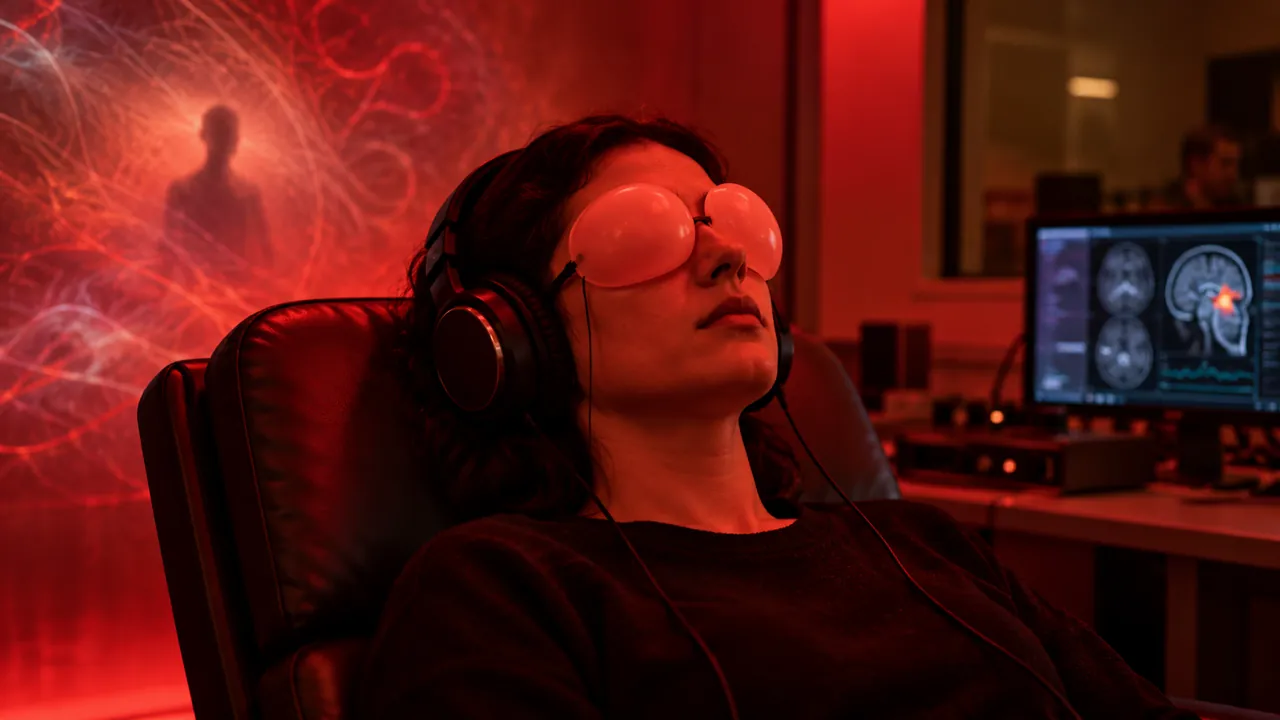
Imagine looking into a seamless field of red light with no edges, shapes, or landmarks while a steady, featureless sound fills your ears. After a while, colors, moving patterns, or dreamlike scenes may seem to appear, even though nothing in front of your eyes has changed. Researchers study this phenomenon with the Ganzfeld technique. It is not evidence of supernatural powers: it is a striking way to investigate how the brain constructs experience when structured information from the outside world becomes scarce. This comprehensive guide explains the experiment’s origins, laboratory methods, perceptual and neural findings, and the crucial distinction between scientifically studied experiences and controversial claims of telepathy.
What Does Ganzfeld Mean?
Ganzfeld is German for “whole field.” In psychology, it describes exposure to an extensive, uniform sensory field lacking edges, contrast, and spatial detail. Diffused illumination behind a translucent surface can produce this effect; the light need not always be red. A steady sound such as white or pink noise may also reduce variation in auditory input. Scientists therefore speak of sensory homogenization or perceptual deprivation, not necessarily total sensory deprivation: the participant still receives light and sound, but very little organized information. That distinction matters because a Ganzfeld session is not the same as complete isolation, darkness, or a soundproof room.
How Did the Idea Develop?
The concept grew out of Gestalt psychology and became associated with work by German psychologist Wolfgang Metzger in the early twentieth century. The original question was perceptual: what happens when a visual scene offers almost no boundaries or structure? Later investigators used homogeneous stimulation to examine subjective imagery and changes in attention. In the 1970s, parapsychology researchers adapted a multimodal version for alleged telepathy experiments. The literature thus contains two fundamentally different research questions: why do internally generated percepts emerge in a uniform field, and can a person identify a concealed target beyond chance? The controversial second question should not obscure the established scientific value of studying the first.
How Is a Laboratory Session Conducted?
A volunteer usually sits comfortably in a controlled environment. Diffuse, uniform light is presented to the eyes, sometimes through purpose-built translucent hemispheres, while headphones deliver steady noise to make outside sounds less distinguishable. Researchers specify the session duration, explain the procedure, obtain consent, and allow the participant to stop. Careful studies record lighting and sound parameters, standardize instructions and timing, and collect descriptions of subjective experience without leading participants toward a particular answer. Some studies add electroencephalography (EEG) or functional MRI, but these measurements are not required for every Ganzfeld session. A legitimate experiment is not a challenge to endure fear or forced isolation.
What Might a Participant Experience?
Reports range from shifts in brightness and color to moving dots, lines, and geometric shapes. Some participants describe fleeting faces, landscapes, or scenes reminiscent of dreams. These effects vary widely across individuals and protocols, and they are not guaranteed. Researchers sometimes call them pseudo-hallucinatory percepts when a participant recognizes the experience as internally generated rather than mistaking it for an external object. That description is not a psychiatric diagnosis. A 2008 study in Cortex reviewed a spectrum of Ganzfeld experiences, from elementary visual effects to vivid, complex dreamlike imagery. The evidence does not imply that everyone will hear voices, see people, or lose control of consciousness.
Why Does the Brain Generate Imagery?
The brain does not passively display incoming images like a screen connected to a camera. It interprets sensory signals using context, expectations, and ongoing neural activity. In ordinary vision, edges, movement, and contrast constrain and correct those interpretations. In a uniform field, structured external evidence is reduced, so internal fluctuations and expectations may exert greater influence on conscious perception. Predictive-processing accounts describe this as a changing balance between bottom-up sensory evidence and top-down influences. This does not make every perceived shape a pathological hallucination, nor does it mean researchers have identified one definitive neural mechanism for every experience. Ganzfeld is useful precisely because it lets scientists investigate perception when external constraints are unusually weak.
What Do Modern Brain Studies Show?
A 2024 Scientific Reports study compared visual experiences arising from a steady Ganzfeld with those elicited by flickering Ganzflicker stimulation. The investigators reported differences in frequency, complexity, and content, showing that the stimulation method matters and that the two procedures are not interchangeable. The paper also discusses earlier imaging work suggesting altered functional connectivity between the thalamus and primary visual cortex during homogeneous stimulation. Such observations help researchers develop hypotheses about the weighting of sensory input, but they do not establish a single definitive explanation. Functional MRI measures signals related to brain activity; it does not directly read the images a participant sees.
Is Ganzfeld Similar to Dreaming?
Some Ganzfeld imagery resembles dreams because it appears without clear external context and can unfold unpredictably. Similarity of experience does not mean identical brain states. Sleep has defined physiological stages and characteristic neural changes, whereas a Ganzfeld participant may remain awake and responsive throughout a session. Attention, boredom, relaxation, and drowsiness can overlap in different proportions. Good studies therefore distinguish wakefulness from sleepiness rather than treating every internal image as a full dream or a supernatural state of consciousness. Mental imagery while awake is a familiar human capacity; Ganzfeld provides a controlled setting in which it can become more prominent.
Is Ganzfeld Total Sensory Deprivation?
No. Ganzfeld presents homogeneous stimuli, whereas broader sensory deprivation attempts to reduce input across multiple modalities—something difficult to achieve completely in practice. It is also different from an anechoic chamber, which absorbs sound reflections but does not necessarily provide a uniform visual field. Floatation tanks alter tactile and bodily sensations, while simply closing the eyes in darkness creates yet another condition. These environments have different physical properties, risks, and experimental variables. Comparisons can be informative, but results from one setting should not automatically be applied to another.
How Did Telepathy Enter the Story?
In the 1970s, researchers began testing a separate hypothesis: could a “receiver” obtain information from a “sender” without ordinary sensory communication? A randomly selected picture or video would be shown to the sender while the receiver, in Ganzfeld conditions, described spontaneous impressions. The receiver then tried to identify the target from several choices. Supporters proposed that reducing distracting sensory input might reveal a hypothetical weak signal. But this is entirely different from the established observation that people can experience internally generated imagery in a uniform field. Seeing patterns does not prove receiving information from someone else. A telepathy claim requires rigorous independent testing that excludes sensory leakage, bias, flawed randomization, and analytical errors.
How Are Telepathy Trials Scored?
A common design asks the receiver to select one correct image from four alternatives. Under equally likely random guessing, the expected hit rate is 25%. A higher observed rate alone does not demonstrate information transfer. Researchers must examine sample size, uncertainty intervals, independence of trials, target randomization, and whether the analysis was specified before results were inspected. Multiple small experiments can yield striking findings by chance. Unintentional cues, knowledge of the target, or differences among target materials may also distort the effective probabilities. The credibility of any claim therefore depends on study design, transparency, and independent replication—not one impressive percentage.
What Have Conflicting Reviews Found?
A 1999 Psychological Bulletin meta-analysis by Milton and Wiseman examined 30 studies from seven independent laboratories and reported no replicable above-chance effect under the procedures it assessed. Other investigators have published later reviews and meta-analyses reporting small positive statistical effects, including a 2024 analysis of a larger historical database. Conflicting statistical reviews do not amount to proof of telepathy. Disagreement concerns study selection, protocol differences, randomization and blinding quality, potential bias, and whether an effect survives consistently in independent preregistered replications. The responsible conclusion is that the claim remains contested and that there is no scientific consensus establishing human telepathy through Ganzfeld experiments.
How Do Online Demonstrations Differ From Research?
Online videos sometimes show someone placing ping-pong-ball halves over the eyes under red light, followed by claims of ghosts, other dimensions, or guaranteed hallucinations within minutes. Such demonstrations are not substitutes for controlled research. Editing, suggestion, participant expectations, and missing records of lighting, sound, or health conditions can all shape the story. Dramatic titles may suggest that the procedure is universally dangerous or opens a portal to a hidden realm, but neither claim is supported by credible evidence. A sound assessment asks for published methods, sample size, controls, and a clear distinction between a personal report and a measurable, generalizable finding.
Is the Ganzfeld Procedure Safe?
It would be inaccurate to call every version safe for every person. Unusual sensory conditions may cause discomfort, anxiety, headache, dizziness, or distressing perceptual experiences in some individuals. Flickering Ganzflicker stimulation is different from steady Ganzfeld illumination and can pose particular risks to people with photosensitivity or photosensitive epilepsy. Do not attempt intense flicker or extreme isolation at home, obstruct breathing, restrict movement, or use improvised materials that could injure the eyes. Ethical laboratory studies require informed consent, immediate withdrawal options, and appropriate screening. People with active neurological or psychiatric symptoms should avoid self-experimentation and seek professional advice where appropriate.
What Can Ganzfeld Research Teach Us?
Its primary value is demonstrating that vision is not a photographic copy of the world: it is an active construction influenced by the quality of available evidence. Ganzfeld research helps investigators explore attention, mental imagery, consciousness, and the relationship between bottom-up signals and top-down expectations. Comparing steady and flickering stimulation may generate useful hypotheses about visual networks. Yet Ganzfeld should not be advertised as a proven treatment for anxiety, depression, insomnia, or hearing disorders, nor as a guaranteed way to unlock creativity or hidden mental powers. Its legitimate benefits are scientific questions that can be tested, not commercial promises.
What Remains Uncertain?
Researchers are still investigating why some people report rich imagery while others notice only subtle changes, and how duration, lighting, attention, and drowsiness influence the experience. Linking subjective reports to neural measurements requires carefully designed protocols, adequate samples, and independent replication. Claims of mind-to-mind information transfer demand stronger and more consistent evidence than a statistical difference in a historical collection of studies. Separating what has been observed, how it is interpreted, and what remains hypothetical is essential to reliable science communication.
Conclusion
Ganzfeld reveals a fascinating paradox: when structured external information becomes scarce, internally generated imagery may become more prominent. This is a legitimate perceptual phenomenon examined in published experiments. But seeing shapes or dreamlike scenes in a uniform field does not establish telepathy, ghosts, or hidden dimensions. Claims of anomalous information transfer remain disputed, while perception and neuroscience research offer more direct accounts of many observed experiences. The clearest route to understanding the mind is to distinguish compelling subjective experience from independently reproducible evidence.
Scientific References
You may also like
 Science & Curiosities
 Why Does Your Voice Sound Different in Recordings? The Science of Bone Conduction and Self-Perception
Discover why your voice sounds higher or unfamiliar on recordings, how bone conduction and auditory feedback work, and…
 Science & Curiosities
 Why Can’t We Remember Being a Baby? The Science of Childhood Amnesia
Why can’t adults remember infancy? Explore hippocampal research, a 2026 scientific review and what early memories really mean.
 Science & Curiosities
 How False Memories Form: Why the Brain Remembers Things That Never Happened
Explore the science of false memories, source confusion, misleading questions, eyewitness testimony, and evidence-based ways to reduce memory…