
Why Can’t We Remember Being a Baby? The Science of Childhood Amnesia
Why can’t adults remember infancy? Explore hippocampal research, a 2026 scientific review and what early memories really mean.
Contents
- What is childhood amnesia?
- Do babies actually form memories?
- What does the hippocampus do?
- What did researchers add in October 2026?
- Four leading explanations for missing early memories
- 1. Memories are encoded but become difficult to retrieve
- 2. Rapid brain development changes memory systems
- 3. Language and personal narrative develop later
- 4. We gradually forget details we do not revisit
- Why can a baby recognize a parent but not remember the first meeting?
- Can old photos bring back a real infant memory?
- What this means for parents
- Frequently asked questions
- At what age do first memories begin?
- Can a one-year-old remember something tomorrow?
- Does childhood amnesia mean babies cannot be affected by their experiences?
- Has science found a way to unlock lost baby memories?
- Sources and further reading
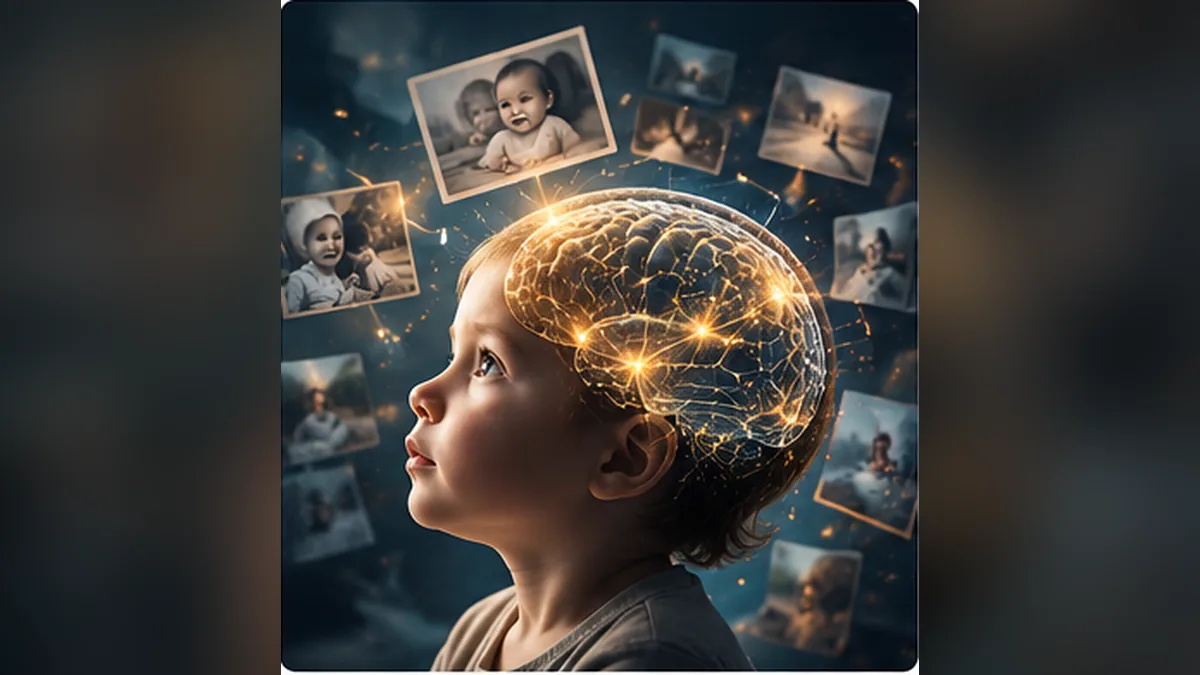
You might remember a birthday at age four, a first day of school or the smell of a childhood kitchen. But most adults cannot deliberately replay a specific event from their first two or three years. Scientists call this gap infantile amnesia (or childhood amnesia). It does not mean babies experience nothing, cannot learn or cannot recognize the people who care for them.
Research is changing the explanation. Evidence suggests infants can encode memories using brain systems involved in later episodic memory. What remains unresolved is whether many of those early traces fade, become inaccessible or change form as the developing brain matures.
What is childhood amnesia?
Childhood amnesia describes how adults generally have few accessible autobiographical memories from very early life. The age of a first remembered event varies. Many people report their earliest memories from around ages three or four, but reports are influenced by culture, family conversation, age and how a memory is dated. It is not a hard birthday cutoff.
A few kinds of memory must be distinguished: episodic memory concerns a particular event; semantic memory stores knowledge, words and facts; procedural memory supports skills; and statistical learning helps us absorb recurring patterns. Infants develop important forms of learning long before they can tell a personal story.
Do babies actually form memories?
Yes, infants can learn and remember, but measuring an infant’s event memory is difficult because they cannot describe it in words. Researchers therefore use behavior, such as whether a baby looks longer at a familiar image, alongside brain activity.
A 2025 Science study led by Tristan Yates and colleagues examined 26 awake infants, approximately four months to two years old, during a picture-recognition task and functional MRI. When hippocampal activity was stronger as an image was first viewed, infants were more likely to show later recognition. The association was especially clear in infants older than 12 months.
This supports the idea that infant brains can encode some event-specific information. Importantly, a short recognition test is not the same as demonstrating that a person can consciously recall that episode twenty years later.
What does the hippocampus do?
The hippocampus is a brain structure essential for linking together elements of experiences. It is not a single “memory storage box.” Different hippocampal circuits develop at different rates, and communication with wider brain networks changes dramatically throughout childhood.
One older hypothesis held that babies simply could not encode episodic memories because the relevant circuitry was too immature. Newer evidence weakens that simple explanation. It raises another: perhaps early experiences leave lasting traces that are difficult to retrieve later as the brain and the cues available to it change.
What did researchers add in October 2026?
A review by neuroscientist Cristina M. Alberini, published online on October 1, 2026 in the Annual Review of Developmental Psychology, discusses a model in which the infant hippocampal memory system can consolidate long-lasting but latent memories and learning schemas. This is a synthesis and theoretical interpretation of research, not a new experiment proving that adults can recover hidden baby memories on demand.
The review argues that early experiences can shape learning and hippocampal development even when a person has no later conscious recollection of the original episode. That difference—between the enduring influence of experience and the ability to narrate it—is central to understanding childhood amnesia.
Four leading explanations for missing early memories
1. Memories are encoded but become difficult to retrieve
The cues, contexts and neural pathways available to an adult are different from those present during infancy. An early trace might not be accessible to ordinary conscious recall. Human evidence for lifetime persistence of particular infant memories remains incomplete.
2. Rapid brain development changes memory systems
The hippocampus and wider cortical networks undergo dramatic developmental change. These changes may affect the stability of an early trace and the routes by which later brains retrieve it. Animal studies help develop hypotheses, but findings in rodents cannot be directly translated into a way to recover memories in humans.
3. Language and personal narrative develop later
As children acquire words, a sense of self and the ability to organize experiences into stories, they gain new tools for preserving and rehearsing autobiographical memories. Language is not the sole explanation—nonverbal memories exist—but it may affect which experiences become part of a lasting life story.
4. We gradually forget details we do not revisit
Ordinary forgetting still matters. Experiences that are never revisited may become harder to retrieve, and memories recounted repeatedly can be reshaped by later information. No single theory yet accounts for every finding.
Why can a baby recognize a parent but not remember the first meeting?
Recognition and attachment rely on learning that need not be expressible as a dated autobiographical memory. A baby can recognize a caregiver’s voice, face or routine while still being unable—years later—to describe a specific afternoon. Learning, familiarity, emotion and conscious episode recall are related but not interchangeable.
Can old photos bring back a real infant memory?
Photos can provide clues and strengthen family narratives. They also make it easy to construct a vivid mental scene you never consciously remembered. A feeling of familiarity may arise from seeing an image repeatedly rather than reliving the event. To distinguish a memory from a reconstructed story, compare details with independent records and be cautious about certainty.
What this means for parents
An experience does not need to become an adult’s explicit memory to matter. Responsive care, stable routines, play and everyday learning influence development. The science should not be used to claim a particular event will determine a child’s personality or that a child can be taught to retrieve hidden memories later.
Frequently asked questions
At what age do first memories begin?
There is no universal age. Many adult autobiographical recollections begin around three to four years, with meaningful individual and cultural variation.
Can a one-year-old remember something tomorrow?
Infants can show recognition and learning, including in research settings. The strength and duration of any memory depend on the type of task and experience.
Does childhood amnesia mean babies cannot be affected by their experiences?
No. Learning and development can be influenced by experiences even without later conscious autobiographical recall.
Has science found a way to unlock lost baby memories?
No established, reliable method can retrieve particular infant experiences as verified adult autobiographical memories.
Sources and further reading
- Yates and colleagues, “Hippocampal encoding of memories in human infants,” Science (2025).
- Yale News explanation of the infant fMRI experiment (March 20, 2025).
- Alberini, “Infantile Amnesia: The Forgetting that Shapes our Identity,” review posted October 1, 2026.
The most intriguing answer is not that babies lack memories: it is that the developing brain can learn a great deal before we acquire the lifelong ability to tell the story of how we learned it.
You may also like
 Science & Curiosities
 Why Does Your Voice Sound Different in Recordings? The Science of Bone Conduction and Self-Perception
Discover why your voice sounds higher or unfamiliar on recordings, how bone conduction and auditory feedback work, and…
 Science & Curiosities
 The Ganzfeld Experiment: Why the Brain Sees Images in Uniform Sensory Fields—and What Science Says About Telepathy
A detailed, evidence-based guide to Ganzfeld perception, brain activity, imagery and disputed telepathy claims.
 Science & Curiosities
 How False Memories Form: Why the Brain Remembers Things That Never Happened
Explore the science of false memories, source confusion, misleading questions, eyewitness testimony, and evidence-based ways to reduce memory…