
Are Dogs as Smart as Two-Year-Olds? What Research Shows
Are dogs really as intelligent as two-year-old toddlers? Learn what recent canine cognition studies reveal about words, memory, social cues and gifted dogs.
Contents
- Where did the “intelligence of a two-year-old” claim originate?
- What does canine intelligence actually measure?
- The strongest findings from recent research
- 2024: Brain responses suggest that familiar nouns refer to objects
- 2024: Flexible responses to human pointing
- 2025: Why are some dogs exceptional at learning toy names?
- January 2026: Gifted dogs learn words by overhearing people
- Which dog breed is the smartest?
- Can dogs count or do arithmetic?
- Do dogs understand human emotions?
- Five safe activities to build your dog’s learning skills
- Five common claims, checked against the evidence
- Frequently asked questions
- Are dogs smarter than two-year-olds?
- How many words can dogs really learn?
- Do dogs understand the names of their toys?
- Is the Border Collie the smartest dog?
- Can I test my dog’s intelligence at home?
- Does ignoring a command mean a dog is unintelligent?
- Bottom line
- Original research and expert sources
- Related articles
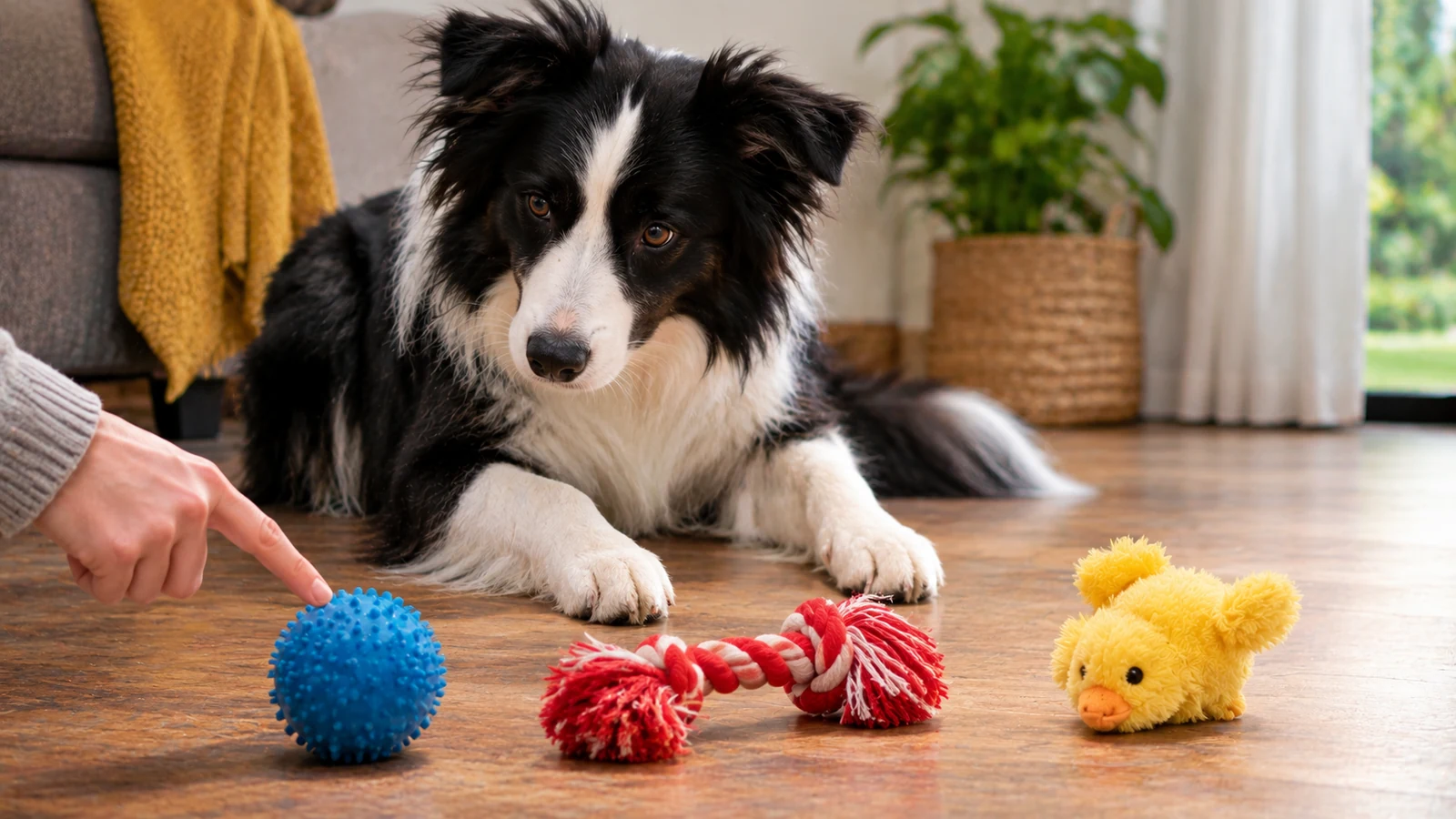
Are dogs as intelligent as two-year-old children? The familiar comparison comes from a broad overview of canine research, not from a universal IQ scale that assigns every dog a human mental age. Dogs can learn cues, recognize some familiar object names, interpret human gestures and solve practical problems, yet those abilities do not mean they share a toddler’s full language, reasoning or social development.
Recent discoveries have made the comparison more interesting—and more precise. A 2024 brain-recording study identified evidence that dogs associate certain spoken words with mental representations of objects. In January 2026, researchers showed that a rare group of gifted word-learning dogs could acquire new toy names simply by overhearing conversations. Neither result means that all dogs learn language like children.
Where did the “intelligence of a two-year-old” claim originate?
The widely quoted figure comes from psychologist Stanley Coren, who summarized multiple canine cognition studies at the American Psychological Association’s 2009 convention. According to that overview, dogs perform roughly like children aged two to two-and-a-half on some behavioral measures. It was not a single standardized child-versus-dog intelligence test, nor a claim that a dog’s overall intellectual capacity maps onto a human age. Read the APA’s original 2009 news release.
The same summary suggested that a typical dog could learn around 165 words and signals, while especially skilled dogs might learn around 250. Those are historical estimates from different tasks, not validated universal vocabulary limits. Whether an animal has learned a command, an object label or a more abstract word matters greatly when interpreting the number.
What does canine intelligence actually measure?
Researchers study several partly distinct abilities: learning, memory, social cognition, inhibitory control, spatial problem-solving, sensory skills and adaptation to unfamiliar situations. A dog may excel at reading a human gesture while another works independently or has exceptional scent-tracking skills. Fast obedience does not equal total intelligence.
| Cognitive domain | What a dog may demonstrate | What the task cannot establish alone |
|---|---|---|
| Human gestures | Following pointing or looking toward a hidden reward | Full comprehension of human intentions |
| Words and objects | Linking some familiar labels to objects | Human-like grammar or general language comprehension |
| Memory | Remembering locations and names over time | Identical memory systems to those of children |
| Problem-solving | Finding a detour or opening a food puzzle | An overall age-equivalent IQ |
| Inhibitory control | Waiting or changing a response | Superior intelligence in every domain |
The strongest findings from recent research
2024: Brain responses suggest that familiar nouns refer to objects
Researchers recorded event-related brain activity from 18 dogs as each heard a familiar object name followed by either the corresponding object or a different one. A mismatch-related brain response supported the idea that the spoken name activated a representation of a known object. The finding goes beyond a simple obedience cue, but it does not show that dogs understand complex sentences or conversations in the human sense. Original Current Biology paper (2024).
2024: Flexible responses to human pointing
In another study involving 70 companion dogs, researchers tested responses to pointing gestures in several settings, including using a gesture to choose a path around a barrier. Performance was consistent with flexible use of communicative cues, rather than simply being drawn to a nearby hand. Earlier experience and task details still matter. Original study on gesture comprehension (2024).
2025: Why are some dogs exceptional at learning toy names?
A small study compared 11 gifted object-label learners with 11 control dogs. The gifted group differed in measures involving interest in new objects, targeted interest in objects and inhibition. This offers clues about the individuals who acquire unusually large toy-name vocabularies; it cannot identify a universal cause or establish a ranking of breeds. Scientific Reports research (2025).
January 2026: Gifted dogs learn words by overhearing people
A study published in Science on January 8, 2026 tested ten dogs already identified as exceptional toy-name learners. Some successfully learned names for new objects when owners spoke to another person rather than addressing the dog directly. The dogs could also learn under conditions separating the spoken name and visual presentation of the toy. This performance resembles one component of word learning in toddlers as young as 18 months, not the entirety of toddler intelligence. Original Science study (2026); the participating university’s explanation.
These were deliberately selected, unusually gifted dogs. The findings should not be projected onto ordinary dogs. A related 2024 experiment with five gifted dogs found that they still remembered the names of between three and nine out of twelve objects after two years, demonstrating striking but variable long-term retention in a very small sample. Biology Letters study on long-term word memory.
Which dog breed is the smartest?
A standardized battery of cognitive tasks involving 1,002 dogs from 13 breed categories detected group differences in social cognition, spatial problem-solving and inhibitory control. It did not identify significant breed differences in the memory and logical-reasoning tests used in that study. The authors also cautioned that participants did not represent all dogs and that training history and other experiences could have influenced performance. Scientific Reports, 2022.
A Border Collie may be exceptional at responding to commands and collaborating with people; a scent hound may excel at odor discrimination; another dog may perform better when a task demands independent exploration. The phrase “smartest breed” depends on the skill tested, and individual differences within breeds remain important.
Can dogs count or do arithmetic?
Evidence suggests some dogs can discriminate small quantities or detect certain numerical changes under experimental conditions. That is different from performing school-style arithmetic or handling abstract number symbols. Claims that dogs can “add and subtract to five” should always be tied to the design of a specific study, rather than treated as a universal mathematical ability.
Do dogs understand human emotions?
Dogs can respond to human voices, movements, facial and bodily cues, and smells. In a functional MRI study, the scent of a familiar person was associated with stronger activation of a brain region involved in positive associations than several unfamiliar scents. This shows an important response to familiarity, not an MRI-based proof of a particular human-like emotion. Original study of familiar odors and canine brain activity.
Likewise, behavior that looks like jealousy may reflect competition for attention or another motivation. Avoid assuming that an apparently recognizable action establishes the same internal experience in a dog and a person.
Five safe activities to build your dog’s learning skills
The goal of enrichment is confident, healthy learning—not getting a dog to achieve a particular “human age.” Choose short sessions appropriate to the animal’s age, health, interest and stress level.
- Reward a consistent cue: Start with a familiar action such as sit, give the same cue and reward the correct response promptly.
- Teach one toy label: Name one item during play, ask for it among two distinct options, then increase difficulty slowly.
- Try scent-based searching: Hide an appropriate reward in an easy location and gradually make the search more interesting.
- Offer a supervised puzzle: Let the dog investigate an age-appropriate enrichment toy without creating prolonged frustration.
- Watch for distress: Stop if the dog withdraws, freezes, seems overwhelmed or cannot succeed; avoid small objects that could be swallowed.
The American Veterinary Society of Animal Behavior recommends reward-based methods and advises against aversive training devices or punitive handling. A sudden change in responsiveness, fear or behavior may require veterinary or qualified behavioral assessment, not an intelligence test. AVSAB’s humane training guidance.
Five common claims, checked against the evidence
| Claim | More accurate interpretation |
|---|---|
| Dogs have the IQ of a two-year-old | A rough comparison of selected tasks, not overall mental age |
| Every dog understands 250 words | An old estimate, with substantial variation across individuals and types of cues |
| Dogs understand everything we say | Evidence supports processing of some familiar words and gestures, not general human language comprehension |
| The most obedient breed is always the smartest | Obedience is only one aspect of cognition |
| Dogs can learn toy names by listening to any conversation | This has been demonstrated clearly in specially selected gifted dogs |
Frequently asked questions
Are dogs smarter than two-year-olds?
There is no validated single comparison covering all abilities. A dog may match a toddler on a particular task while showing very different language, sensory and social skills. The task and its design define the comparison.
How many words can dogs really learn?
There is no single number for all dogs. A 2009 research overview estimated roughly 165 words and signals for an average dog, but rare gifted dogs have learned far more object names. Definitions and testing methods vary.
Do dogs understand the names of their toys?
Some dogs do. A 2024 EEG experiment found evidence that hearing familiar object names evokes corresponding mental representations. A smaller, highly gifted group can learn and retain large numbers of toy labels.
Is the Border Collie the smartest dog?
The breed is well known for trainability and includes exceptional word learners, but broader intelligence depends on the task. Other dogs may perform better in scent-based or independent activities.
Can I test my dog’s intelligence at home?
You can observe learning through simple positive-reinforcement games, but this is not a standardized intelligence score. Age, physical health, motivation, training and familiarity all affect performance.
Does ignoring a command mean a dog is unintelligent?
No. A dog may be distracted, frightened, tired, untrained on that cue or affected by hearing or health issues. Consider the context rather than interpreting obedience as IQ.
Bottom line
Dogs show sophisticated, varied forms of cognition, especially in their relationships with humans. The famous “two-year-old” analogy captures some similarities in particular tasks but should never be treated as a complete measure of canine intelligence. Studies from 2024 through 2026 strengthen evidence for object-word understanding and extraordinary learning in a small subset of dogs. Practical training and welfare matter more than assigning a dog a human-age label.
Original research and expert sources
- American Psychological Association: Stanley Coren’s 2009 overview
- Boros et al., 2024: Neural evidence for object-word representations
- 2024 study: Understanding human pointing across contexts
- 2025 Scientific Reports: Cognitive differences in gifted label learners
- Dror et al., Science 2026: Learning by overhearing
- Dror et al., 2024: Long-term retention of object labels
- Junttila et al., 2022: 1,002 dogs in cognitive tests
- American Veterinary Society of Animal Behavior: humane training statement
Related articles
For another careful cross-species comparison, see our explanation of the crow intelligence and child-age claim. For family contexts, also read our discussion of dogs and children.
You may also like
 Psychology
The Illusory Truth Effect: Why Repeated Claims Seem More Believable
Why does a repeated statement start to feel true? Explore the illusory truth effect, what 182 studies reveal,…
 Psychology
Why Do We Feel Nostalgic for a Time We Never Lived? The Psychology of Anemoia
Why do we miss decades we never experienced? Explore anemoia and historical nostalgia, the role of family stories…
 Psychology
What Happens When Actions Have No Consequences? Psychology Explained
Does a lack of punishment cause misconduct? Explore research on rule-following, accountability, behavior reinforcement and practical nonviolent boundaries.