
The Illusory Truth Effect: Why Repeated Claims Seem More Believable
Why does a repeated statement start to feel true? Explore the illusory truth effect, what 182 studies reveal, and practical ways to check claims and correct misinformation.
Contents
- What is the illusory truth effect?
- Why can familiarity feel like accuracy?
- What does the scientific evidence show?
- Prior knowledge does not always prevent the effect
- More repetitions do not produce equal gains in perceived truth
- A 2026 meta-analysis confirms the effect, while showing its limits
- Do ten webpages mean ten independent sources?
- Five steps to check a claim that feels familiar
- How to correct misinformation without amplifying it
- How does it differ from false memories and confirmation bias?
- Frequently asked questions
- Is every frequently repeated statement suspicious?
- Does the effect apply only to false statements?
- Is there a fixed percentage of people affected?
- Sources and image credits

Repeated information can start to feel more believable, even when no new evidence supports it. Previous exposure makes a statement more familiar and often easier to process, and people may mistake that ease for accuracy. Psychologists call this the illusory truth effect. It describes a potential shift in perceived truth—not a false claim becoming true or a guarantee that repetition will persuade everyone.
The practical problem is confusing two very different statements: “I have heard this many times” and “I have checked independent evidence supporting it.” One claim can appear across dozens of accounts yet trace back to a single unverified post. Conversely, a true statement can also be repeated and supported by solid evidence. Repetition alone establishes neither truth nor falsehood.
What is the illusory truth effect?
In experiments, researchers typically compare participants’ truth ratings for statements they have encountered before with ratings for new statements. When familiar statements receive higher truth ratings because of prior exposure, that supports an illusory truth effect under the conditions tested. A person need not move from complete disbelief to certainty; even a modest change in the rating can reveal the effect.
This does not mean everything we believe is an illusion or that education is useless. The effect is one influence on judgment among many, including prior knowledge, the credibility of the source, context and the wording of a question.
Why can familiarity feel like accuracy?
One leading explanation is processing fluency: a previously seen statement may be easier to read or understand the next time, and that ease can be mistaken for a sign of truth. Research published in Cognitive Research in 2020 also discusses related explanations, including familiarity and the way information is represented in memory. There is no justification for reducing the phenomenon to a single, conclusively established neural mechanism.
Consider a hypothetical example: you receive a message claiming that the deadline for a public service has changed. Later, you see the same claim in another group and in a short video. When it appears again, it may feel familiar—even though you have never read an official notice. The example illustrates a possible error in judgment; it does not show that you believed the message or that the deadline actually changed.
What does the scientific evidence show?
Prior knowledge does not always prevent the effect
A 2015 study by Fazio and colleagues tested the assumption that knowing the correct answer automatically protects people from repetition. The effect appeared even when participants had relevant prior knowledge. The researchers suggested that stored knowledge is not always brought to mind during a truth judgment, while processing fluency may still influence the response.
There is a difference between possessing information and retrieving it at the right moment. These findings do not mean that experts and nonexperts perform equally in every domain, or that knowledge never helps: the study did not test every kind of expertise under every possible condition.
More repetitions do not produce equal gains in perceived truth
In a study published on May 13, 2021, Aumyo Hassan and Sarah J. Barber presented general-knowledge statements up to nine times in one experiment and up to 27 times in another. Average truth ratings rose with repeated exposure, but not in a straight line: the largest increase came when a statement was encountered for the second time, with generally smaller gains after further repetitions.
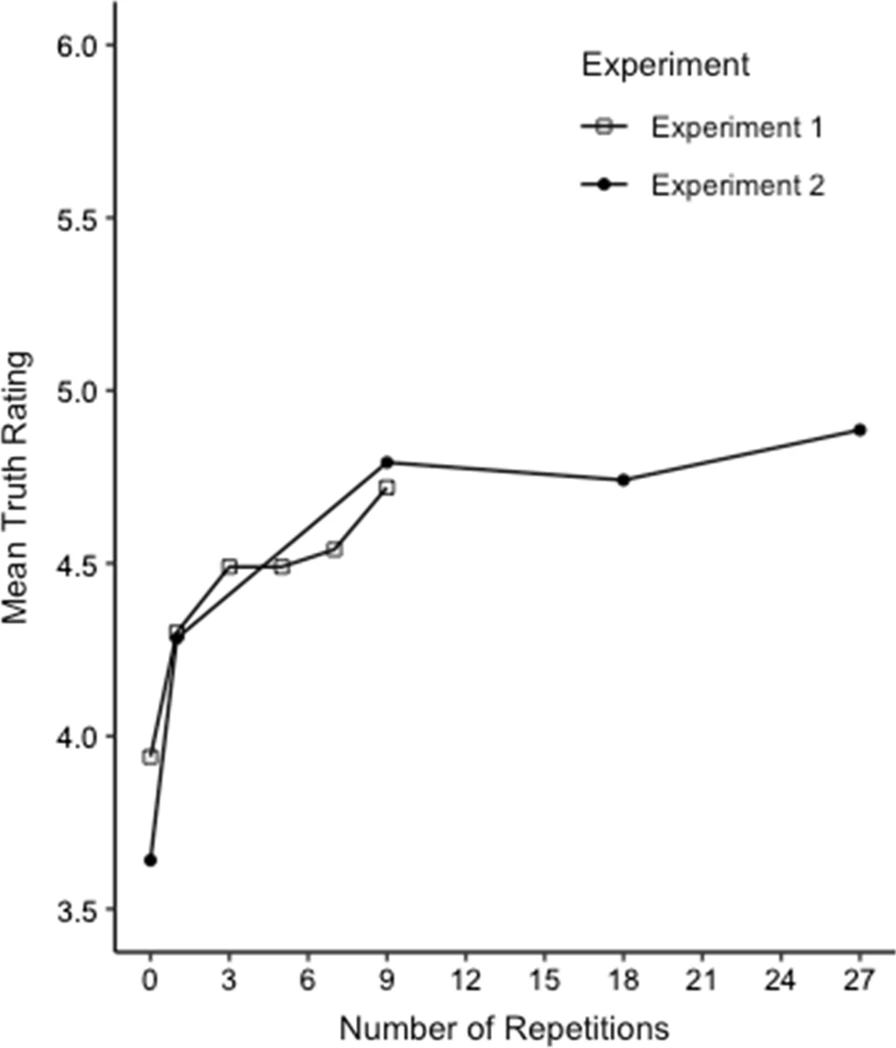
In the original figure, the horizontal axis records previous exposures during the experiment; zero refers to new statements at the final rating stage. The vertical axis shows the mean truth rating, not the percentage of people who believed a statement. The findings do not identify a magic number of repetitions that will make an audience believe any claim.
A 2026 meta-analysis confirms the effect, while showing its limits
A systematic review and meta-analysis published in Nature Communications on February 27, 2026 brought together 182 studies involving 31,184 participants. After correcting for small-study effects, the authors found a small average effect (Hedges’ g = 0.37), with substantial variation within and between studies. Factors linked to that variation included the type of material, instructions at first exposure, cues about truthfulness and how long statements were initially displayed.
This synthesis provides broader evidence than any single experiment, but it cannot tell you the probability that you will believe a particular story merely from the number of times you see it. An average statistical effect size is also not the percentage of people who will accept misinformation.
Do ten webpages mean ten independent sources?
Trace a claim backward. Do the pages cite separate documents or independent witnesses—or do they all copy the same original post? If ten links ultimately lead to one undated screenshot, you have ten copies of a claim, not ten independent verifications.
| What did you find? | What does it establish? | Your next step |
|---|---|---|
| Many accounts share the same wording | Shows that the wording spread, not that the claim is true | Find the earliest accessible source |
| An article links to a dated original document | Lets you check the claim and its context | Read the document; check the issuing body and scope |
| Independent sources offer verifiable evidence | Provides multiple routes to verification | Compare details and investigate discrepancies |
| A cropped image with no date or link | Lacks essential context | Locate the complete original before sharing |
Finding the earliest source does not automatically make it reliable; it may be where the error began. The goal is to assess evidence rather than count reposts. Repetition alone also does not prove that a coordinated campaign or deliberate deception is involved.
Five steps to check a claim that feels familiar
- Identify the exact claim: What can you verify—a number, deadline, quotation or research finding? Do not treat every assertion in a long post as one indivisible claim.
- Ask about accuracy at first exposure: What evidence is available now? Do you know where the claim came from, or only that you have seen it before?
- Go to the original source: Check the full text, date, country and affected group. A statement that was once accurate may be misleading when shared in a new context.
- Check whether the evidence is independent: Compare what the sources actually rely on rather than counting websites or accounts repeating the same words.
- Allow for uncertainty: If evidence is insufficient, do not share the claim yet. “Unverified” does not automatically mean “true” or “false”.
The value of considering accuracy early is supported by two experiments by Calvillo and Smelter (2020) involving 575 participants. They compared initial judgments about how interesting headlines were with judgments about whether the headlines were accurate. Focusing on accuracy reduced the effect of prior exposure under the study conditions. Related research by Brashier and colleagues linked the benefit of an initial accuracy focus to having relevant knowledge. These findings are encouraging, but they are not a guarantee against error.
How to correct misinformation without amplifying it
The American Psychological Association recommends making corrections prominent, briefly identifying a false claim when needed, and supplying a trustworthy explanation and source. Corrections are generally useful, but they may not remove every mistaken belief; accurate information may also need to be repeated.
A practical approach is to lead with the fact you can document. Then explain precisely what is wrong with the circulating post and link to the dated evidence. If the mistake is an old announcement being shared as though it were new, point out the date rather than merely stamping “fake” on the image.
Avoid reposting a claim on its own simply to mock it or generate engagement; some readers may encounter the claim without the explanation that challenges it. At the same time, fear of repetition should not prevent a clear and well-supported correction. What matters is making the verified information and evidence prominent.
How does it differ from false memories and confirmation bias?
The illusory truth effect concerns judgments of a statement’s truth after repeated exposure. Confirmation bias involves favoring information that fits an existing belief or interpreting evidence in ways that support that belief. The processes can overlap, but repetition alone does not establish the presence of confirmation bias.
Believing a statement also does not necessarily mean forming a personal memory of an event that never happened. Our guide to how false memories form explains the difference between memory errors and confusion about the source of information. These distinct phenomena should not be treated as interchangeable.
Frequently asked questions
Is every frequently repeated statement suspicious?
No. Repetition is not evidence that something is false. Well-supported facts are often repeated. Check the underlying source and evidence rather than accepting or rejecting a statement just because it is familiar.
Does the effect apply only to false statements?
No. Experiments have used both true and false statements, and previous exposure can increase perceived truth ratings for either type. The concern is that an unsupported or false statement may gain credibility without gaining new evidence.
Is there a fixed percentage of people affected?
No single percentage applies to every audience, subject and platform. Findings depend on experimental design, the claims used and their context. A study’s average effect size should not be converted into a certain prediction about the behavior of an individual reader.
Sources and image credits
- Fazio et al. (2015), “Knowledge does not protect against illusory truth”, Journal of Experimental Psychology: General.
- Hassan and Barber (2021), “The effects of repetition frequency on the illusory truth effect”. Source of the original study figure.
- Ye et al. (2026), “Systematic review and meta-analysis of the evidence for an illusory truth effect and its determinants”, Nature Communications.
- Calvillo and Smelter (2020), “An initial accuracy focus reduces the effect of prior exposure on perceived accuracy of news headlines”.
- Brashier et al. (2020), “An initial accuracy focus prevents illusory truth”, Cognition.
- American Psychological Association, “Recommendations for countering misinformation”.
- Featured image: Newspaper Titles, photograph by m01229 (2012), CC BY 2.0. Cropped, resized and converted to WebP under the license. It illustrates news circulation, not the accuracy or inaccuracy of the newspapers shown.
- Figure 1: Hassan and Barber (2021), CC BY 4.0. Converted to WebP without altering chart values or axes.
Sources checked on November 7, 2026. The public-service deadline example is hypothetical and does not describe a real policy change.
You may also like
 Psychology
Why Do We Feel Nostalgic for a Time We Never Lived? The Psychology of Anemoia
Why do we miss decades we never experienced? Explore anemoia and historical nostalgia, the role of family stories…
 Psychology
What Happens When Actions Have No Consequences? Psychology Explained
Does a lack of punishment cause misconduct? Explore research on rule-following, accountability, behavior reinforcement and practical nonviolent boundaries.
 Animals
Are Dogs as Smart as Two-Year-Olds? What Research Shows
Are dogs really as intelligent as two-year-old toddlers? Learn what recent canine cognition studies reveal about words, memory,…