
Why Does Metal Spark in a Microwave If the Walls Are Metal?
Why do forks and foil spark in a microwave when the oven walls are metal? The science, safe-rack exceptions, and what to do if you see sparks.
Contents
- Why are the inside walls of a microwave oven metal?
- Why do forks and aluminum foil spark?
- What about the metal rack that came with the microwave?
- What can and cannot go in the microwave?
- Grill and convection settings are not the same as microwave mode
- What should you do if the microwave starts sparking?
- Frequently asked questions
- Is a round metal spoon safe because it has no sharp points?
- Does sparking make the food radioactive?
- Why can you see through the metal mesh in the door?
- Can a microwave spark even without a fork or foil?
- A quick safety check before pressing Start
- Sources and manufacturer guidance
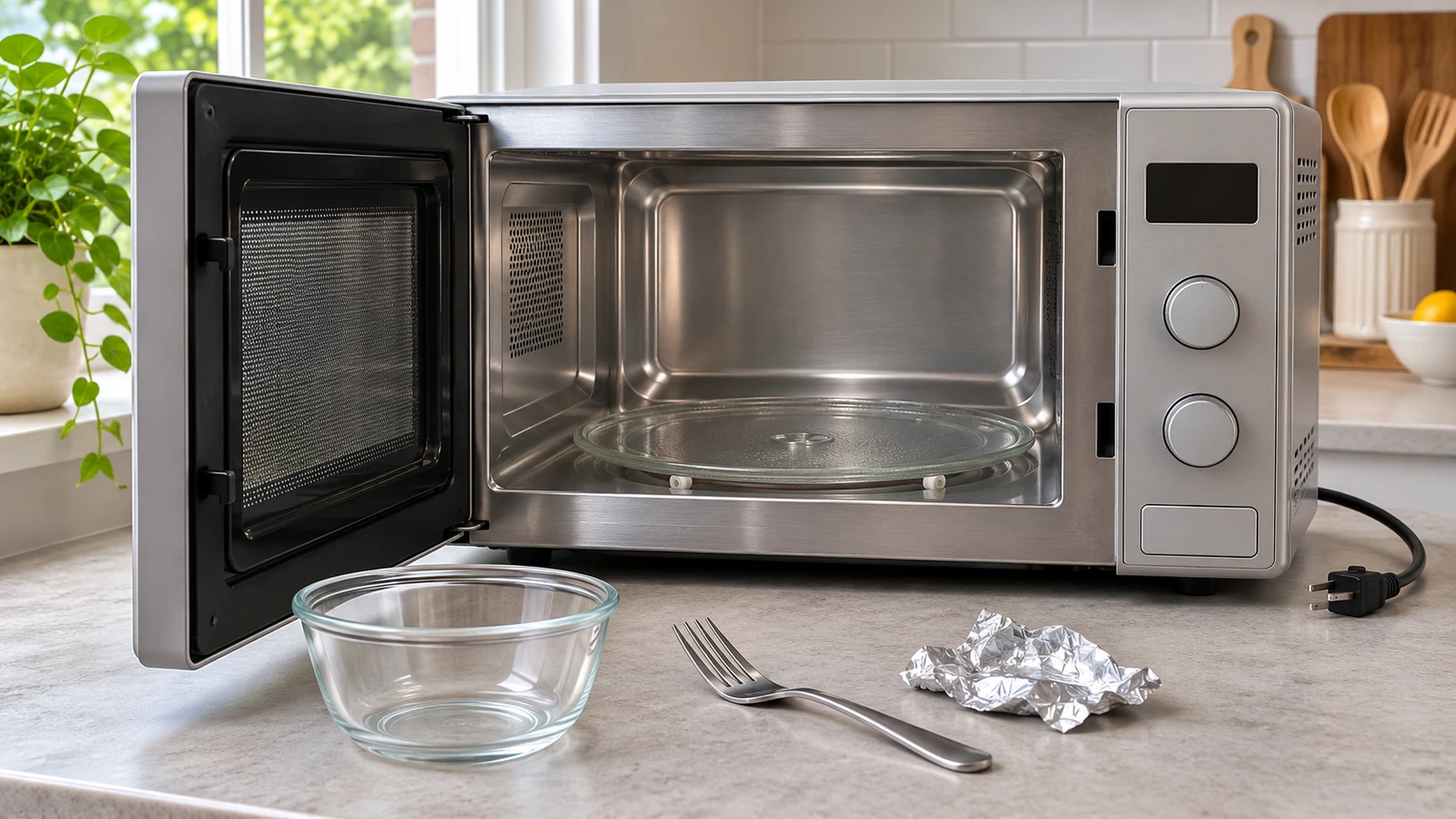
Microwave ovens have metal walls because metal reflects microwaves and helps contain the energy inside the cooking cavity. A loose fork, crumpled aluminum foil, or metal-trimmed plate can behave differently: electric fields may become concentrated near sharp edges or small gaps, causing an electrical arc (a visible spark). That is why the walls can be metal without making every metal object safe to put inside.
The practical rule: use microwave-safe cookware. Only put metal or metal accessories inside when the manual for your exact oven model explicitly permits that item in the cooking mode you are using. Not every piece of metal will spark, but a spark-free attempt does not prove it is safe.
Why are the inside walls of a microwave oven metal?
A magnetron generates microwave-frequency electromagnetic energy. Food absorbs some of that energy and heats up, while the oven’s metal lining reflects much of it back into the cavity. This makes the metal enclosure part of the appliance’s engineered design rather than an object accidentally introduced into the cooking space. MIT School of Engineering explains both the reflective walls and the hazards of placing some metal objects inside.
A metal pan may also shield the food from microwave energy, leading to uneven heating even when no visible sparking occurs. Microwave-safe glass and certain ceramics allow microwave energy to reach the food, but they can still become hot from contact with the food. Check the cookware’s labeling and the oven manual.
Why do forks and aluminum foil spark?
The changing electric field causes charges in a conductor to move. Near the pointed tines of a fork, a thin foil edge, or a narrow gap between metal surfaces, the electric field can become especially strong. If it is strong enough to ionize nearby air, electricity jumps across the gap as an arc. The flash and popping sound resemble a tiny lightning strike.
Wrinkles in foil create many thin edges, and two pieces of metal close together can also form a gap where arcing occurs. The smooth, fixed cavity walls are designed as part of the appliance. Their existence is not evidence that a utensil or foil wrapper will behave safely. Do not deliberately test metal objects to see whether they spark.
What about the metal rack that came with the microwave?
Some microwave ovens include a specially engineered rack. Its geometry, insulating spacers, clearance from the cavity walls, and intended cooking modes may make it suitable for particular uses. Frigidaire describes how the shape and plastic spacers of a supplied rack are designed to help prevent arcing. This is a model-specific exception, not permission to use an ordinary metal cooling rack.
Look up the exact model instructions: Is the supplied rack allowed for microwave-only cooking, grilling, convection, or a combination setting? Must it sit on specific supports? Zanussi’s guidance illustrates how a combination oven may require removing metal shelves for one cooking mode while permitting a shelf for another.
What can and cannot go in the microwave?
| Item | Safer choice / what to check |
|---|---|
| Fork, metal skewer, or bread-bag twist tie | Remove it before using microwave mode. |
| Gold- or silver-rimmed plate; metallic glaze | Do not use for microwave heating; metallic decoration can arc. |
| Ordinary stainless-steel bowl or metal food tin | Move the food to microwave-safe cookware unless your exact equipment and packaging expressly allow it. |
| Aluminum foil covering a dish | Do not use it as a general-purpose microwave cover; choose an approved microwave cover. |
| Small piece of foil to shield part of the food | Only if the manual specifically permits this technique, with its stated placement and clearance rules. |
| Original rack or metal tray supplied with the oven | Verify the allowed mode, position, and condition of the insulating supports. |
| Glass or ceramic bowl with no metal decoration | Check that it is labeled microwave-safe and free of damage. |
This distinction matters: Whirlpool’s manufacturer guidance allows certain supplied accessories and limited foil shielding on specified models, while prohibiting many metal pans, skewers, twist ties, and metallic decorations. Those allowances are not universal. Do not copy a clearance measurement or foil technique from another oven model.
Grill and convection settings are not the same as microwave mode
A metal tray may be appropriate in a grill-only or conventional convection setting yet unsuitable when microwave energy is active. Combination (Combi) modes have their own rules because they may use microwave energy together with another heat source.
For example, if the manual says a metal baking tray is approved only for Grill, do not assume it is safe for Microwave or Combi. Being oven-safe at high temperatures and being microwave-compatible are two different requirements.
What should you do if the microwave starts sparking?
- Stop the oven immediately. Do not run it again just to check whether the sparks return.
- If food is burning or there is a fire, keep the door closed. Turn the oven off and disconnect power only if it is safe to do so. Do not open the door to retrieve burning contents. If a fire continues or spreads, move away and contact local emergency services.
- If there is no fire, let the appliance and cookware cool before handling them. Avoid burns from hot dishes or surfaces.
- After disconnecting power, check only visible, accessible causes: foil, a forgotten utensil, metallic trim, a misplaced rack, or food residue. Follow the manual for cleaning the cavity.
- Stop using the appliance and arrange professional inspection if arcing continues with approved cookware, or if there are burn marks, cavity damage, or damage to the door or seals.
Whirlpool advises switching the oven off immediately when arcing occurs. Do not open the outer casing or attempt an electrical repair: GE Appliances warns that a microwave’s high-voltage capacitor may retain a dangerous charge even after the unit has been unplugged.
Frequently asked questions
Is a round metal spoon safe because it has no sharp points?
Rounded edges may reduce electric-field concentration compared with sharp points, but that does not make a spoon universally safe. Unless your oven’s instructions specifically allow the spoon for that use, remove it before heating.
Does sparking make the food radioactive?
No. The microwaves used for cooking are non-ionizing, and cooking food in a microwave does not make it radioactive, as the US Food and Drug Administration explains. This does not mean food that has burned or been contaminated by damaged packaging is necessarily safe to eat.
Why can you see through the metal mesh in the door?
The holes allow short-wavelength visible light to pass through while the metal mesh helps block much longer microwave wavelengths. The door, hinges, latch, and seals must remain intact. Do not operate a microwave with a damaged door.
Can a microwave spark even without a fork or foil?
Yes. Deposits on the cavity walls or accessories, an unsuitable container, or even certain foods can contribute to arcing. Whirlpool’s troubleshooting guidance lists food residue and particular vegetables among possible causes. If cleaning and switching to approved cookware do not resolve it, stop using the oven and seek service.
A quick safety check before pressing Start
Check the cooking mode, container, and accessories in that order. Remove loose metal cutlery and unapproved foil or metal decorations. Use only cookware and racks permitted by the manufacturer for that mode. Never run an empty microwave to test whether it will spark; check your model’s instructions instead.
Sources and manufacturer guidance
- MIT School of Engineering — Why can’t we put metal objects in a microwave?
- US FDA — Microwave ovens: how they work and how to use them safely
- Whirlpool — Using aluminum foil and metal in microwave ovens
- Frigidaire — Why a supplied microwave rack is different from other metal objects
- Zanussi — Sparks in conventional and combination microwave ovens
- Whirlpool — General microwave arcing and sparking troubleshooting
- GE Appliances — Microwave do-it-yourself repair recommendations
You may also like
 Psychology
What Is the Flynn Effect? Why IQ Scores Rose—and Why Some Have Fallen
The Flynn effect describes historical rises in IQ test scores. Explore the evidence behind the reverse Flynn effect…
 Science
Ancient Lakes in the Empty Quarter: Why Water Alone Was Not Enough
An archaeological survey found ancient lakes across the Rub' al Khali but no stone tools at the locations…
 Science
Thermal Grill Illusion: Why Warm and Cool Can Feel Burning Hot
How can alternating warm and cool surfaces feel burning hot? Explore the thermal grill illusion, spinal-cord research, and…