
Thermal Grill Illusion: Why Warm and Cool Can Feel Burning Hot
How can alternating warm and cool surfaces feel burning hot? Explore the thermal grill illusion, spinal-cord research, and the distinction between pain and injury.
Contents
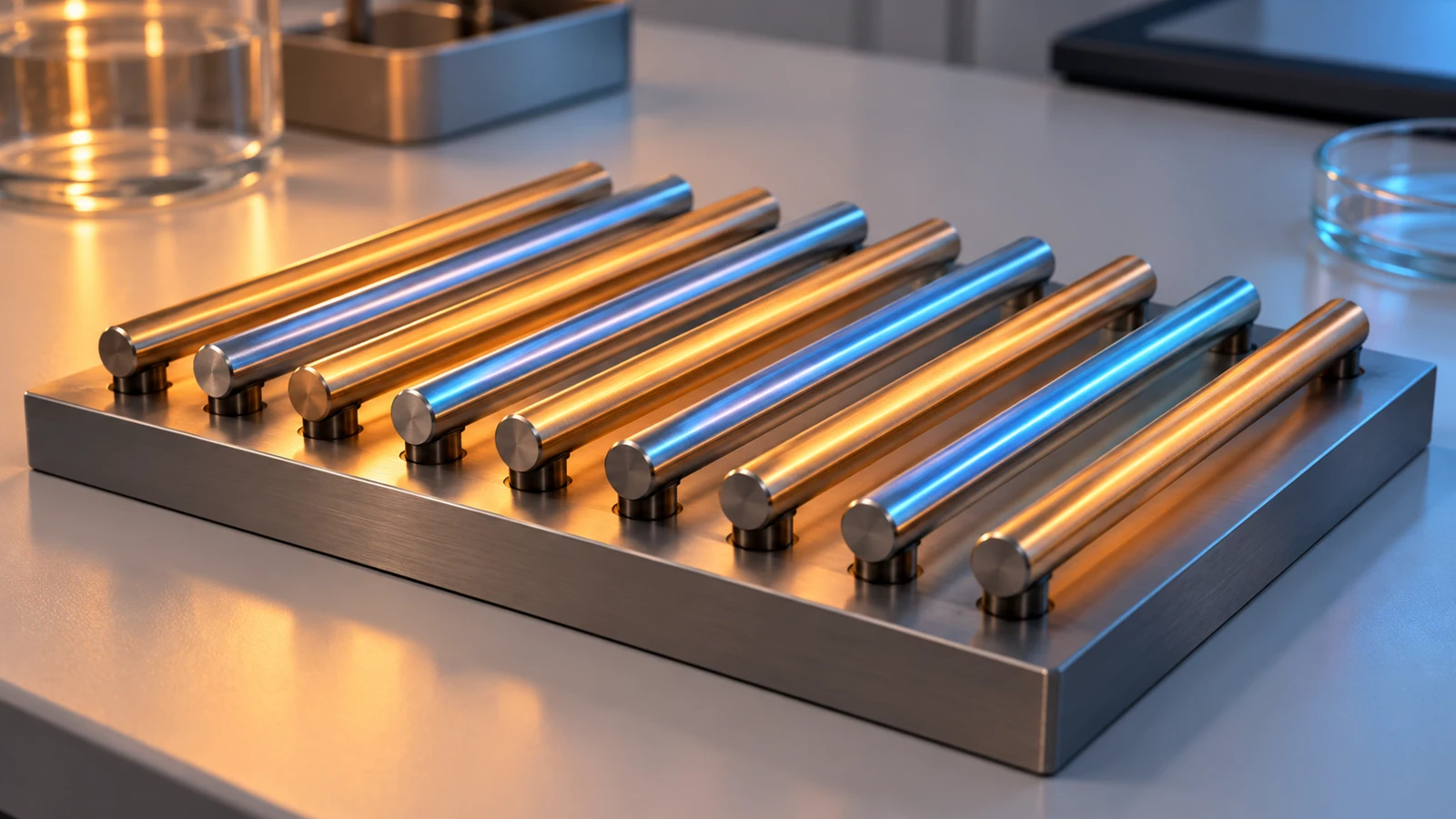
The thermal grill illusion can make interlaced warm and cool stimulation feel burning, prickling or painful, even when each component is innocuous on its own under controlled experimental conditions. The effect does not require a hidden rise in metal temperature: it reveals how the nervous system combines thermal information.
The surprise is not simply an inaccurate temperature estimate. Combining two sensations can produce an experience unlike either alone. People do not all report the same pain, however, and calling the effect an illusion does not mean someone is pretending or inventing what they feel.
Why call it a grill?
The name refers to an arrangement of interlaced bars or tubes resembling a grid. Some parts are warm and others cool, with the patterns applied beside each other on the skin. A 1994 Science paper records the illusion’s first demonstration in 1896.

Colors in the diagram identify the two stimulus types; they do not depict glowing metal. The hero is conceptual, not a photograph of a research apparatus. Explaining the comparison does not require pretending that we carried it out.
What do researchers actually compare?
| Condition | Question being tested |
|---|---|
| Warm stimulation alone | How is the separate warm stimulus described? |
| Cool stimulation alone | How is the separate cool stimulus described? |
| Interlaced warm and cool pattern | Does spatial combination change the description? |
| Hot comparison stimulus within a study | Does the mixed pattern resemble actual heat in every quality? |
The question is more specific than whether someone felt anything. A 2011 study compared the sensory qualities of the mixed pattern with a single thermal stimulus and found a complex experience distinguishable from the hot comparison. “Cool plus warm always equals burning” therefore misses part of the finding.
How do scientists explain it?
Craig and Bushnell’s 1994 work proposed central disinhibition, or unmasking: interactions between sensory pathways could alter which signals dominate the resulting experience. This is an evidence-based neural model, more specific than saying the brain simply becomes confused.
A review in the January 2020 issue discussed limitations of addition and disinhibition theories and proposed a population-coding perspective. In plain language, an experience may depend on distributed patterns of activity rather than each pathway carrying one fixed quality that is interpreted independently.
Reading a sentence rather than isolated words is a useful analogy for the importance of patterns. It is only an analogy, not a literal account of neurons or proof that the mechanism is fully settled.
What did spinal-cord research add in 2024?
A 2024 Pain paper investigated two experiments with 80 participants in total. Researchers changed the arrangement of warm and cool stimulation across skin regions associated with different spinal nerves. Spatial and segmental arrangement influenced warmth and burning ratings, supporting a role for spinal interactions in the illusion’s early stages.
That makes “your brain tricks you” incomplete if it suggests that everything happens in one place inside the head. Sensory processing across a system is a more accurate framing, with continuing questions about how its levels interact.
Does illusory pain mean unreal pain?
No. Illusion here describes a mismatch between experience and a simple reading of the thermal input, not the absence of an experience. A participant’s report concerns what they feel; tissue damage is a separate question requiring its own evidence.
Controlled research can study pain perception without relying on an injury. That does not mean every pain without a visible wound is a thermal grill illusion, or that chronic pain is imaginary. This is a research model, not a diagnostic test for readers.
Why do descriptions differ?
A 2021 review discusses multiple factors associated with variation in responses, including stimulus design and individual differences. Separate three questions when reading an experiment: did the person perceive heat, was it unpleasant, and did they describe it as painful? Those answers need not be identical.
- “Some participants felt it” does not mean everyone did.
- A self-reported pain score is not a surface thermometer.
- Different responses do not let a video diagnose someone’s nerves.
- Evidence about perception does not by itself establish a treatment or clinical outcome.
Should you try to recreate it at home?
This article does not provide a recipe for producing burning sensations. Heating some objects, cooling others and pressing them against skin can cause actual harm; the word illusion does not make an improvised setup safe. The comparison can be understood from diagrams and research without testing pain tolerance, particularly in children or people with reduced sensation.
For an everyday reflection, distinguish “this surface feels cold” from “this surface measures colder.” The important skill is separating an observation from its explanation; different sensory illusions do not necessarily share the same mechanism.
The thermal grill illusion’s scientific value is that it separates a thermal source, neural signaling and conscious experience. It does not make pain less important; it makes the question of how pain arises more precise. This is an educational explanation, not a diagnosis for persistent burning or a replacement for assessing it.
Explore more explanatory science articles in Horus Valley’s English section. The images here are explanatory illustrations, not documentation of a completed experiment.
Sources and research
You may also like
 Science
Ancient Lakes in the Empty Quarter: Why Water Alone Was Not Enough
An archaeological survey found ancient lakes across the Rub' al Khali but no stone tools at the locations…
 Science
Why Does Metal Feel Colder Than Wood at the Same Temperature?
Metal and wood can share a temperature yet feel different. Understand heat flow, why the effect reverses when…
 Science
Is Glass a Liquid? Why Old Windows Have Uneven Thickness
Glass is an amorphous solid at room temperature. Discover why old panes are uneven, what research found, and…