
Why Does Metal Feel Colder Than Wood at the Same Temperature?
Metal and wood can share a temperature yet feel different. Understand heat flow, why the effect reverses when hot, and try a safe room-temperature comparison.
Contents
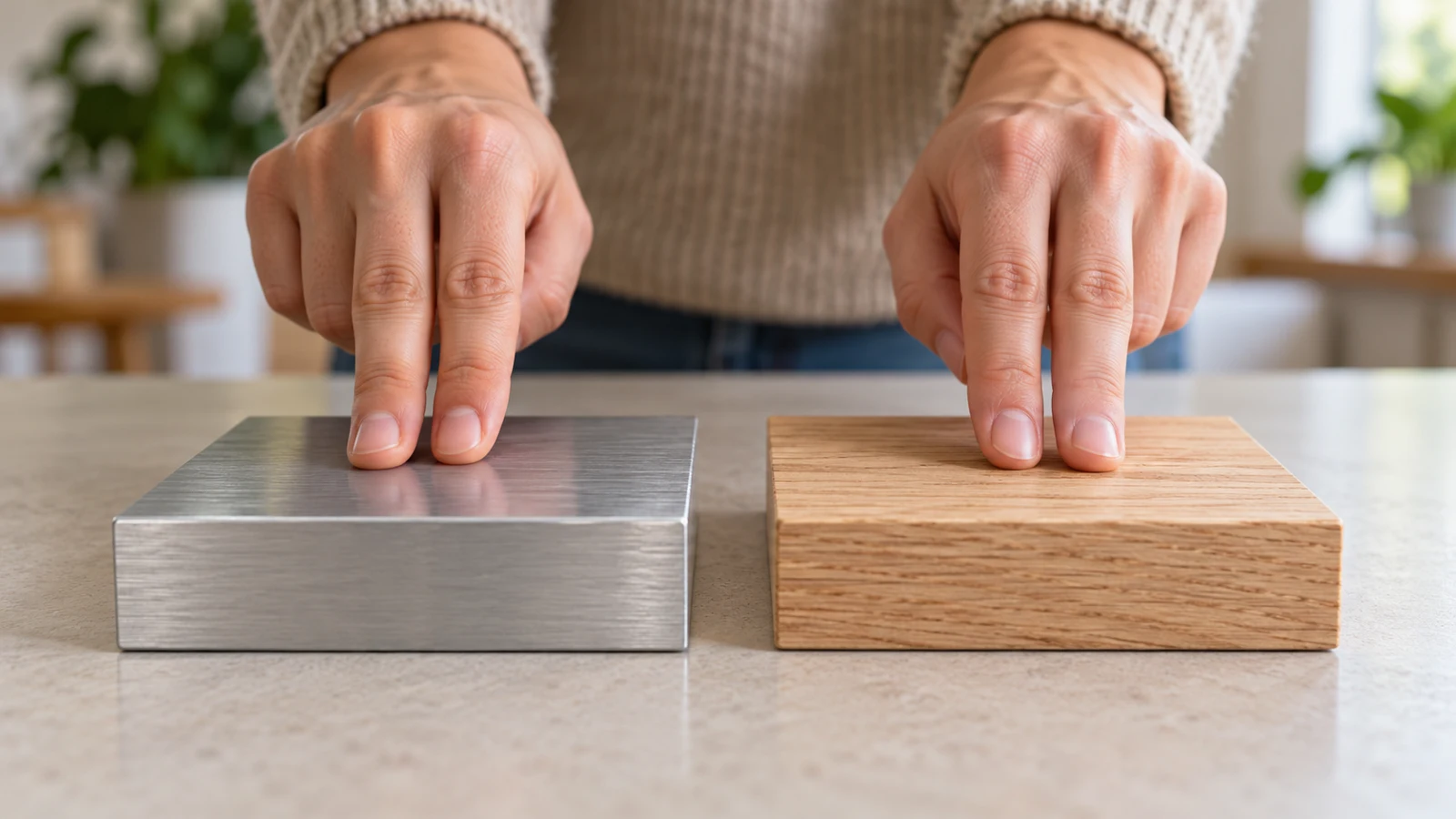
Metal usually feels colder than wood because it draws heat from warmer skin more rapidly under ordinary conditions, cooling the contact area faster. Both samples can genuinely have the same temperature: a difference in sensation does not prove a difference in thermometer readings.
Think of a metal door handle beside a wooden surface on a cool morning. Your hand is not reading a number on a thermometer. It responds to what happens to its own skin during contact. That is where temperature and energy transfer become different questions.
Does being in the same room prove equal temperature?
A useful comparison starts with samples that have settled under similar conditions, away from sunshine, heaters and other heat sources. Exploratorium’s Cold Metal exhibit combines touching different materials with temperature measurement to show how different sensations can persist at thermal equilibrium.
But “in the same room” is not a certificate that two surfaces match. A sunlit desk differs from a shaded handle, while an object just brought indoors has not necessarily settled. For a test, control the comparison first and then measure; do not assume the outcome.
What happens when you touch the metal?
If your skin is warmer than the object, energy moves toward the cooler object. A good metal conductor carries that energy away from the contact region more effectively than wood, allowing a clearer cooling effect on the skin. Wood limits heat transfer comparatively and feels less cold.
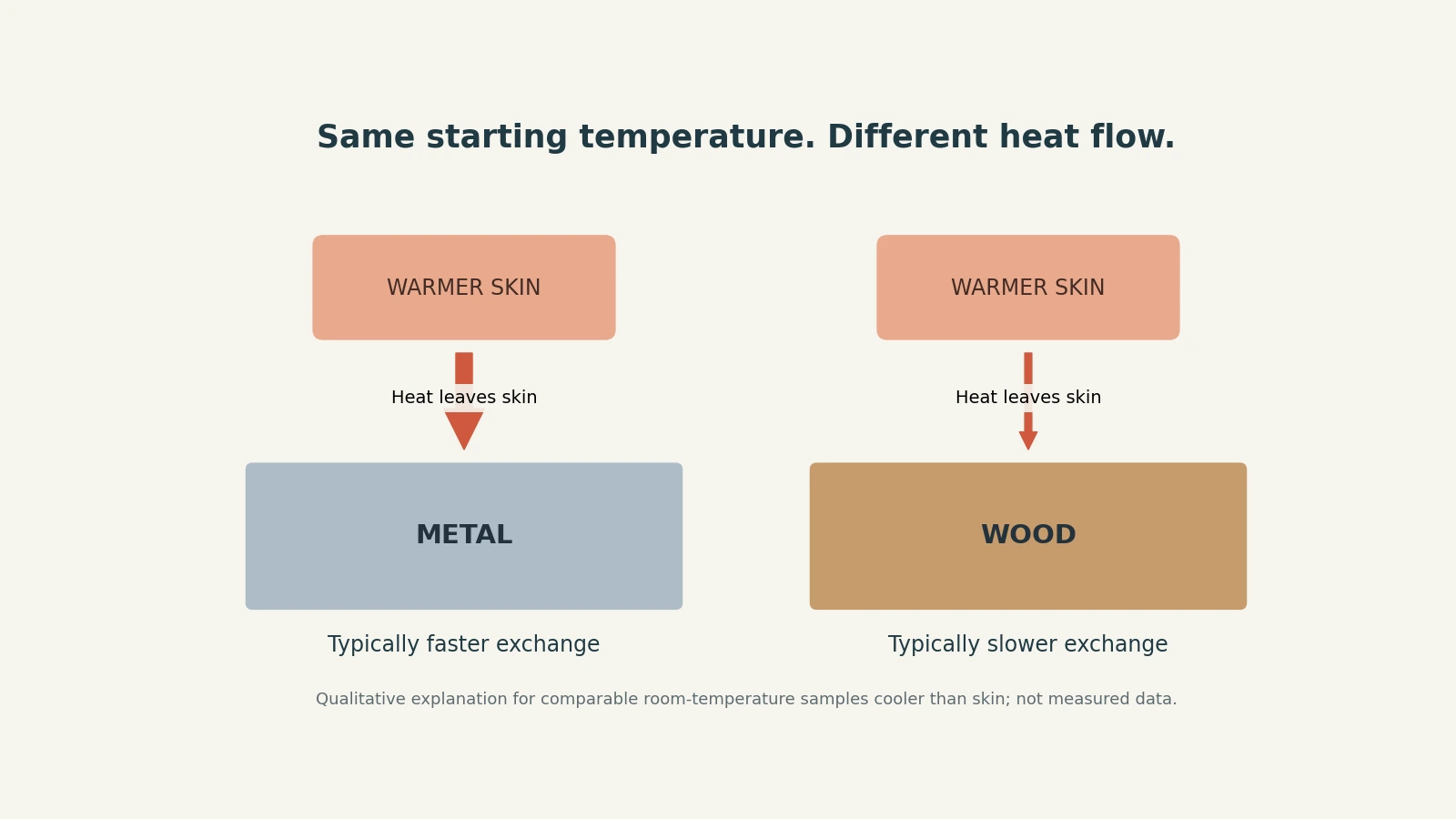
The metal is not manufacturing cold and sending it into your hand. Follow the energy from warmer to cooler. That approach is more useful than sorting everyday materials into objects that are inherently cold and objects that are inherently warm.
Conductivity is not the whole story
Purdue’s teaching material describes thermal effusivity, a contact-related property combining thermal conductivity, density and specific heat capacity. Conductivity alone therefore cannot describe every sensation produced by touching a real object.
The useful idea is that a material exchanging heat more strongly with skin has more influence on the short-contact surface state. MIT illustrates the same principle with stone flooring that feels colder than wood at the same temperature. You do not need to memorize an equation to understand why floor surfaces feel different.
Try a room-temperature comparison
This is a proposed reader activity, not an experiment we performed or a table of measured results. Choose clean, dry objects that are safe to touch, such as smooth metal and splinter-free wood. Do not use frozen metal or hot utensils.
- Place both samples together away from sunshine and heat sources, allowing them to settle.
- Write down your prediction before touching: which will feel colder, and do you expect a measured temperature difference?
- Touch each briefly, then reverse the order for the next comparison.
- If you have a suitable contact surface-temperature instrument, follow its instructions and record the reading and measurement location. Touch is not a substitute for measurement.
- Compare your sensation notes with the readings. Keep discrepancies rather than adjusting numbers to fit your expectations.
| Record your own observations | Metal sample | Wood sample |
|---|---|---|
| Location and conditions | Write here | Write here |
| Instrument reading, if available | Your reading | Your reading |
| First-touch sensation | Your description | Your description |
| What changed when order was reversed? | Your observation | Your observation |
Without an instrument, this remains a useful sensory activity, but it does not establish that the surface temperatures matched. That is a limitation of the test rather than a failed result. With a child, ask what they noticed before discussing which claims would require measurement.
Why can metal also feel hotter?
The University of Illinois explains that the direction reverses when the metal is hotter than your skin: energy flows into the hand and may do so rapidly. “Metal feels cold” describes common conditions, not a safety rule. Never test a hot pan or unknown surface with your hand.
As a thought experiment, imagine the same material first cooler than your hand and then warmer. The direction of the temperature difference changes; the material has not switched from manufacturing cold to manufacturing heat. This reversal exposes the weakness of explaining temperature through touch alone.
Interpret the comparison without overgeneralizing
- Do not turn two samples into a permanent ranking of all metals and woods under every condition.
- Do not compare a thick object with a thin one and attribute every difference solely to the material name.
- Record coatings, moisture or obvious surface differences; make them questions for a later comparison rather than ignoring them.
- Change one factor at a time in any follow-up, using safe room-temperature surfaces.
If you notice little difference, do not immediately conclude that the explanation is wrong. Return to what you actually tested: were the samples under comparable conditions, were the touches similar, and did you have an independent measurement? Those questions matter more than forcing a particular sensation.
A distinction worth keeping
“This surface feels cold” describes your skin’s experience. “This surface measures colder” needs temperature evidence. Keeping the two separate turns a door handle or floor into a useful physics lesson instead of treating touch as the final authority.
For another everyday science explanation, visit Horus Valley’s English articles. The hero is conceptual and the diagram explains a mechanism; neither documents a completed experiment or actual readings.
Scientific sources
You may also like
 Science
Why Does Metal Spark in a Microwave If the Walls Are Metal?
Why do forks and foil spark in a microwave when the oven walls are metal? The science, safe-rack…
 Science
Ancient Lakes in the Empty Quarter: Why Water Alone Was Not Enough
An archaeological survey found ancient lakes across the Rub' al Khali but no stone tools at the locations…
 Science
Thermal Grill Illusion: Why Warm and Cool Can Feel Burning Hot
How can alternating warm and cool surfaces feel burning hot? Explore the thermal grill illusion, spinal-cord research, and…