
Is Glass a Liquid? Why Old Windows Have Uneven Thickness
Glass is an amorphous solid at room temperature. Discover why old panes are uneven, what research found, and how to separate flow from weathering.
Contents
- What does “amorphous solid” mean?
- Why are some old windows thicker at one edge?
- Why modern float glass looks different
- What did the Westminster Abbey research find?
- Why can hot glass be blown and shaped?
- Glass can deteriorate without flowing
- How to assess the claim when looking at an old window
- What the photograph in this article does—and does not—show
- The answer to keep
- Sources and image credits
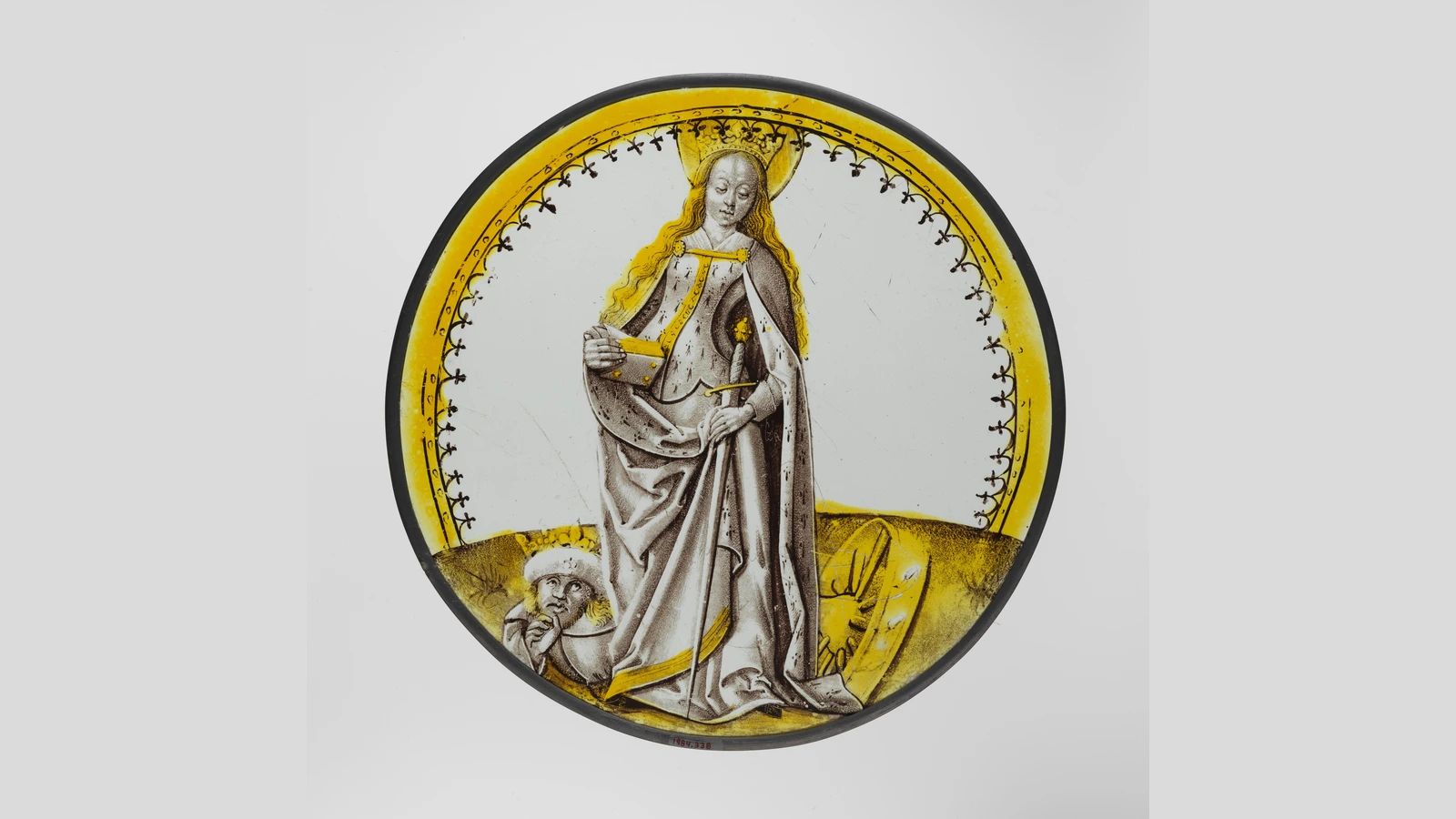
Ordinary window glass is an amorphous solid at room temperature, not a liquid slowly pooling at the bottom of the frame. Some old panes have uneven thickness because of how they were made. Their shape is not evidence that centuries of gravity have made the glass visibly run downhill. The Corning Museum of Glass explains the misconception.
There is a real scientific subtlety behind the myth: a glass can have a liquid-like disordered structure and undergo extremely slow structural relaxation. That does not make a cold window behave like water or syrup. To understand the difference, separate three questions: how its atoms are arranged, how it responds to a force, and how much time the process takes.
What does “amorphous solid” mean?
A crystal has a repeating atomic arrangement extending over long distances within the material. In a glass, that long-range repetition is absent. Calling a structure disordered describes its arrangement; it does not mean the atoms can easily move past one another as they do in an ordinary liquid.

In the sketch, the left-hand dots repeat regularly and the right-hand dots do not. It is a conceptual two-dimensional comparison, not an atomic photograph, an accurate silicate network or a measurement of a particular pane. Its purpose is to show why “not crystalline” and “liquid” are not interchangeable descriptions.
Penn State’s account of glass research makes the distinction explicit: glass has a liquid-like atomic arrangement but responds mechanically as a solid on usual experimental timescales. Discussions of its nonequilibrium nature add detail to this answer; they do not establish observable flow in a medieval window. Read the researcher’s explanation.
Why are some old windows thicker at one edge?
Historical glassmakers could produce a usable pane without producing the uniform sheet expected today. In its June 23, 2026 overview of flat-glass technology, the Corning Museum describes blown globes or cylinders being worked into sheets, with uneven thickness and distortions among the results. Those variations could therefore exist from manufacture. The museum’s manufacturing history.

One method, crown glassmaking, used a spun glass disk from which panes were cut. The schematic illustrates how an uneven original sheet could yield an uneven pane; it does not claim that every old window used the same technique. Different dates and workshops used different methods.
The Institute of Physics also describes fitting the thicker part toward the bottom as a historical explanation for the orientation of some panes. Avoid turning that into a universal rule: the presence of a thick lower edge alone cannot tell you the maker’s intention or reconstruct the full installation history. IOP’s teaching note.
Why modern float glass looks different
In modern float manufacture, hot glass spreads across molten tin to form a flat sheet. The uniformity is engineered during production. Comparing a modern pane with a wavy historic pane can reveal different manufacturing histories; it is not a time-lapse experiment showing the old one flowing. MIT’s explanation of old and modern fabrication.
What did the Westminster Abbey research find?
Gulbiten, Mauro, Guo and Boratav studied a typical medieval composition used in Westminster Abbey. Their paper, Viscous flow of medieval cathedral glass, appeared in the January 2018 issue of the Journal of the American Ceramic Society, after online publication in 2017. The institutional abstract reports a calculated maximum flow of about one nanometre over a billion years for the modelled conditions. Read the research abstract.
That is a calculation, not the result of watching a window for a billion years. It is also not a universal rate for every substance called glass. Composition and thermal history matter. The relevant result is that even the revised estimate remains far too small to explain a visibly thickened lower edge over historical time.
A nanometre is one billionth of a metre. That conversion helps put the number in perspective, but does not justify predicting the precise future thickness of a specific window. We use the published institutional abstract and the researchers’ public explanation here; we do not claim to have reproduced the full experiment or inspected the original windows.
Why can hot glass be blown and shaped?
Temperature changes the rate at which a material can rearrange. Corning explains that glass viscosity decreases as temperature rises, allowing glassworkers to choose conditions for blowing, drawing and moulding. A furnace demonstration concerns hot material under controlled working conditions, not an ordinary window at room temperature. Corning’s glass-science guide.
There is no single working temperature that can be assigned to all glasses regardless of composition and process. Likewise, the glass transition should not be pictured as every atom suddenly becoming mobile at one universal temperature. The useful practical point is that temperature and observation time must accompany any claim that a glass “flows.”
Glass can deteriorate without flowing
A second mistake is to replace “glass flows” with “glass never changes.” MIT notes that stress, abrasion and chemical attack can affect glass, including the role of water at flaws. CORDIS separately discusses environmental deterioration of historical glass. These are reasons to examine an object’s condition, not evidence of gravity turning it into a puddle. The archaeological perspective from CORDIS.
A crack is a fracture. A weathered surface concerns chemical and physical alteration. A distorted view may involve surface shape or thickness. Before calling any of these “flow,” identify the mechanism and the evidence connecting it to the observed change. The same visible symptom can have more than one possible cause.
How to assess the claim when looking at an old window
- Identify the object and its history. Is it an original pane, a later repair or a modern reproduction?
- Separate the observation from its cause. “Uneven” describes a shape; “flowed over time” asserts a process.
- Ask for a baseline. Without an earlier measurement, present thickness alone does not establish a change.
- Check manufacture, repairs, weathering and the supporting frame before assigning one explanation.
- Match the timescale and temperature to the scientific source. A hot-glass experiment cannot be transferred directly to a cold window.
You can observe a window without touching, heating, scratching or removing its glass. Do not treat a visual check as a structural safety assessment or proof of a pane’s authenticity. For an installed historic window, conservation records and appropriate measurements are more useful than a dramatic caption.
What the photograph in this article does—and does not—show
The cover shows a real museum object: Roundel with Saint Catherine of Alexandria, South Netherlandish, about 1500, in The Metropolitan Museum of Art. The record identifies colourless glass, vitreous paint and silver stain, object number 1984.338a, b. The image is public domain. View the object and image rights.
It illustrates surviving historical glass. It is not the Westminster Abbey glass used in the research, and its photograph does not measure edge thickness or prove the absence of flow. The two diagrams are original explanatory sketches. None of the images is presented as new laboratory evidence.
The answer to keep
For ordinary windows at room temperature, glass behaves as a rigid amorphous solid. Its disordered structure and slow relaxation are genuine topics in materials science, but neither explains visibly thicker bottoms in centuries-old panes. Manufacturing history is the starting point for that observation; a photograph is the starting point for a question, not the end of the investigation.
For another aspect of historic glass, read how ancient Egyptian glass got its colours.
Sources and image credits
- Corning Museum of Glass: room-temperature flow myth
- MIT: how glass changes over time
- Corning Museum: flat-glass technology, June 23, 2026
- Gulbiten et al.: institutional research abstract and bibliographic record
- Original paper DOI: 10.1111/jace.15092
- Penn State: researcher explanation, January 25, 2018
- Institute of Physics: historical window thickness
- Corning Glass Class: viscosity and hot working
- CORDIS: structure, production and deterioration
- The Met: roundel, public-domain image and object record
Photograph: The Metropolitan Museum of Art, The Cloisters Collection, 1984; public domain. Resized onto a neutral 16:9 background without altering the object. Diagrams: original conceptual illustrations prepared for this article, not measured data. Sources checked November 1, 2026; no laboratory experiment or site visit is claimed.
You may also like
 Science
Thermal Grill Illusion: Why Warm and Cool Can Feel Burning Hot
How can alternating warm and cool surfaces feel burning hot? Explore the thermal grill illusion, spinal-cord research, and…
 Science
Why Does Metal Feel Colder Than Wood at the Same Temperature?
Metal and wood can share a temperature yet feel different. Understand heat flow, why the effect reverses when…
 Science
Why Do Flight Paths Look Curved on Maps? The Shortest Route Explained
Why curved flight paths can be shorter on Earth: great circles, map projections, calculated examples and the difference…