
Secrets of Ancient Egyptian Glass: How Did Its Colors Survive for Thousands of Years?
Explore the science of ancient Egyptian glassmaking: cobalt blue, copper turquoise, opaque pigments, and the workshops of Malkata and Amarna—and why some colors survived for millennia.
Contents
- When did the Egyptians begin making true glass?
- Malkata and Amarna: Two workshop sites that changed the story
- What was ancient Egyptian glass made from?
- Did they use desert sand alone?
- How did ancient Egyptian glass get its colors?
- Deep blue: Cobalt and the color of lapis lazuli
- Turquoise: When copper becomes color
- Yellow and white: Colors created by tiny crystals
- Red: A difficult color to control
- How did they melt glass without modern electric furnaces?
- From raw ingredients to decorated glass: The production sequence
- What did experimental glassmaking at Amarna reveal?
- How were striped bottles made before glassblowing?
- An original museum object: A four-handled flask
- Glass, faience, and Egyptian blue: What's the difference?
- Why have some ancient glass colors stayed bright for thousands of years?
- Five factors that determine whether ancient colors survive
- What role did Egypt's oases play in producing blue?
- Egyptian glass, royal courts, and international trade
- Was glass merely a substitute for precious stones?
- How can scientists identify an original color or source today?
- Common misconceptions about ancient Egyptian glass
- Why was opaque color different from transparent color?
- Can conservators restore glass that has lost its color?
- A timeline of glassmaking in ancient Egypt
- What can we learn from ancient Egyptian glass?
- Scientific studies and museum sources
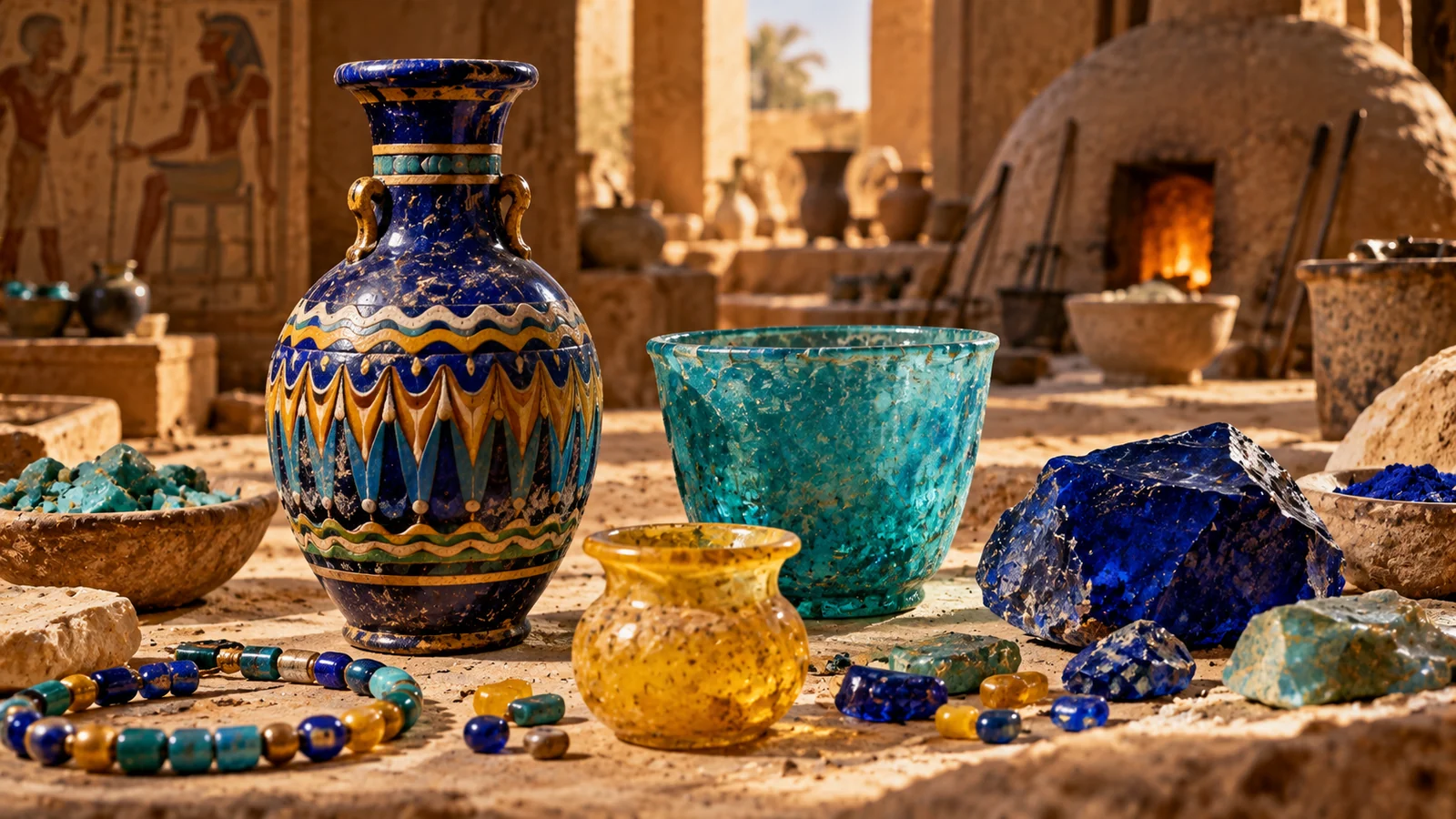
In a workshop in New Kingdom Egypt, a craftsperson could transform powdered quartz, alkalis, and coloring minerals into a small vessel resembling lapis lazuli or turquoise. It might emerge from the fire in deep blue or brilliant turquoise, with yellow and white trails curling around its surface. More than three thousand years later, some of these objects are still displayed in museums with striking colors, despite the scratches and deterioration that others have suffered.
How did the ancient Egyptians produce such colors from comparatively simple ingredients, and how did they control the melting and shaping of glass? Is blue glass the same thing as Egyptian faience or the pigment known as Egyptian blue? To answer those questions, we need to visit the furnaces of Malkata and Amarna, then the modern laboratories that analyze the chemical elements in ancient glass.
The scientific takeaway: There was no “magic ingredient” that preserved these colors for millennia. Their survival reflects the structure of silicate glass, mineral colorants, and burial and conservation conditions. A surviving color does not mean every object remained unchanged: archaeological glass can crack, flake, and undergo chemical corrosion.
When did the Egyptians begin making true glass?
Egyptians were familiar with brightly colored, glossy materials long before the New Kingdom, particularly Egyptian faience. But the production of vessels made from true glass developed prominently during the Eighteenth Dynasty, around the middle of the second millennium BCE. Studies published by The Metropolitan Museum of Art place the emergence of this industry within Egypt’s interactions with the ancient Near East, while showing that the question of the technology’s earliest origins remains complex.
It would therefore be inaccurate to claim that Egyptians invented glass for the first time in human history. Evidence points to early developments in both western Asia and Egypt, within networks of technological and commercial exchange. What is clear is that Egyptian workshops achieved remarkable precision and artistic sophistication during the reigns of Amenhotep III, Akhenaten, and their successors.
Malkata and Amarna: Two workshop sites that changed the story
At Malkata, the royal palace complex of Amenhotep III west of Luxor, and at Tell el-Amarna in Minya, Akhenaten’s capital, archaeologists have found remains associated with glass production and working. These include fragments of crucibles or melting vessels, lumps of glass, partly processed materials, furnace waste, and tools used in workshops.
Crucially, researchers no longer assume that every glass object found in Egypt was an import. A study published in Archaeometry presented direct evidence for early stages of glass production at Amarna itself, based on the chemical composition and microscopic structure of materials left incompletely processed. Read the original study.
What was ancient Egyptian glass made from?
Common types of New Kingdom glass consist of a network based on silica, the principal component of sand and quartz. Melting pure silica, however, requires much higher temperatures than ancient furnaces could readily achieve. Glassmakers therefore used alkaline materials to lower the temperature needed for melting, along with lime, which helps stabilize the glass.
| Ingredient | Function in the mixture | Historical note |
|---|---|---|
| Silica (SiO₂) | Forms the main glass network | Could come from sand or crushed quartz pebbles |
| Sodium-rich alkali | Helps reduce the temperature required for reactions and melting | Possible sources include the ash of salt-tolerant plants; recipes varied by time and place |
| Lime (calcium oxide) | Helps stabilize the chemical structure | Some may have entered with other raw materials |
| Coloring minerals | Produce blue, green, red, and other colors | The outcome depends on concentration and heating conditions |
| Opacifying agents | Make glass opaque rather than transparent | Antimony compounds were used in many kinds of ancient glass |
University College London’s material on Egyptian glass notes that impurities can give the base glass a greenish or brownish tinge, and that colorless glass was less common than colored glass in some early Egyptian periods.
Did they use desert sand alone?
Sand is one possible source of silica, but it is not a complete recipe by itself. Sand grains contain impurities that vary from one location to another, while the added alkali affects the makeup of the mixture. Artisans could also work with ready-made glass or soften raw glass again to finish production. Researchers therefore distinguish between making glass from raw ingredients and shaping glass already produced in a specialized workshop.
How did ancient Egyptian glass get its colors?
Glass can incorporate certain metallic elements into its structure or contain tiny dispersed crystals. Color appears because those components alter the light that is absorbed, transmitted, or reflected. The same metal can produce different hues depending on its concentration, chemical state, interactions with other substances, and the rate of cooling.
| Color | Material associated with certain Egyptian examples | Explanation and limitations |
|---|---|---|
| Deep blue | Cobalt | Produces deep blues; analyses link the color to cobalt-rich minerals |
| Turquoise blue | Copper | Contributes greenish-blue or turquoise shades, depending on glass composition |
| Opaque yellow | Lead antimonate | Fine particles produce opaque yellow in many recipes |
| Opaque white | Calcium antimonate | Dispersed crystals help scatter light through the glass |
| Opaque red | Copper under particular reducing conditions | Sensitive to melt chemistry, copper state, and particle size |
| Green | Copper or mixtures of color-producing ingredients | Several mechanisms exist; no single recipe applies to all artifacts |
Deep blue: Cobalt and the color of lapis lazuli
Deep blue was one of the most arresting colors used for New Kingdom vessels. The Metropolitan Museum of Art attributes the striking blue of a glass flask dating to the reigns of Amenhotep III and Akhenaten to cobalt, noting that it is deeper than the blue achieved with copper alone.
There is also a fascinating Egyptian geographical connection. Research published in the Journal of Archaeological Science examined cobalt-bearing raw materials and proposed alum deposits rich in cobalt from the Western Desert oases as a source, with Dakhla and Kharga among the potential regions. This is an archaeological and chemical inference about raw materials—not proof that every blue vessel used mineral resources from one exclusive location. Read the published study.
Turquoise: When copper becomes color
Copper contributes to turquoise-blue hues, colors that in Egyptian culture echoed prized materials such as turquoise stone. Copper alone did not guarantee an identical shade every time: the surrounding glass composition, impurities, and working conditions all affected the final result.
The Metropolitan Museum holds a turquoise glass cup from the Amarna period, dated approximately 1347–1328 BCE. It is a clear example of a deliberately chosen color that formed part of the object’s beauty rather than a mere by-product of manufacture.
Yellow and white: Colors created by tiny crystals
Some opaque colors do not result simply from dissolved coloring ions; they depend on fine particles or crystals that scatter light passing through glass. Many ancient opaque yellow glasses contain lead antimonate compounds, while forms of opaque white glass are associated with calcium antimonate. Publications from the Getty Conservation Institute describe ways to analyze such materials.
This matters for understanding multicolored vessels. An artisan was not limited to placing green or blue color into transparent glass: distinctly contrasting opaque trails could also be produced, standing out against a dark background.
Red: A difficult color to control
Opaque red was among the more technically demanding colors. Its production depended on controlling copper, reactions in the furnace atmosphere, and cooling conditions. If those conditions were unsuitable, the glass could emerge in a completely different color from the one intended.
One especially revealing modern study, Simply red, published in 2023, examined an ancient glass fragment from Amarna that looked like muddy turquoise. Chemical analysis suggested that it represented an unsuccessful attempt to make opaque red glass. An object that seems less attractive to the eye thus became evidence of the experiments—and mistakes—made by ancient craftspeople. Read the scientific paper.
How did they melt glass without modern electric furnaces?
Ancient artisans used furnaces, fire pits, and containers relatively resistant to heat. Fuel, airflow, and furnace design were crucial to heating. Not every task required the same temperature: making a bead from pre-existing glass was different from making a glass mass from silica and alkalis.
From raw ingredients to decorated glass: The production sequence
- Prepare the silica: crush sand or quartz pebbles according to the recipe and source of materials.
- Mix the powder with an alkaline substance and other ingredients that support the reaction and formation of glass.
- Heat the mixture gradually to initiate reactions; a partly fused material resembling a stage close to “frit” may appear.
- Continue heating and melting to obtain a more uniform mass, within the capabilities of the workshop.
- Obtain raw colored glass or reheat existing glass lumps until they can be shaped.
- Form beads, vessels, or decorative elements, and cool them in a way that limits cracking.
- Apply colored decoration or finish the surface according to the object and its intended use.
These steps are a general interpretive reconstruction, not a verbatim transcription of a single ancient Egyptian recipe. Practices varied between workshops and across periods.
What did experimental glassmaking at Amarna reveal?
Researchers with the Amarna Project carried out practical experiments in 2017 and 2019 to make beads from existing glass in small hearths. Some experiments reached more than 900°C and produced beads, showing that glass could be worked in workshops smaller than researchers had once imagined.
A different experiment in 2023 tried to manufacture glass from raw ingredients in a small pit furnace. One attempt briefly reached 1,300–1,400°C without successfully fusing the ingredients. In a subsequent attempt, with steadier temperatures of 900–1,200°C, the result was a thin layer of partially fused material—not finished glass. That finding is important because it shows why the process cannot be reduced to “sand + fire = glass.” Details are available from the Amarna Project.
How were striped bottles made before glassblowing?
Many small Egyptian vessels were not blown in the manner familiar from later glass workshops. Instead, makers used core-forming: a temporary core of material that could later be broken up or removed was prepared, and softened glass was wound around it to form the vessel’s body. Once the object cooled, the core was removed to leave a hollow interior.
The Metropolitan Museum’s description of a surviving flask explains how white, yellow, and turquoise glass rods were applied over a dark-blue body, then drawn and smoothed to make zigzag and feather-like patterns. The decoration can resemble finely painted lines, even though it was produced by manipulating colored glass while it remained soft.
An original museum object: A four-handled flask
Documentary photograph of an Egyptian Eighteenth Dynasty glass flask, dated approximately 1386–1330 BCE; accession number 26.7.1177. Source: The Metropolitan Museum of Art. Image designated Public Domain.
This flask displays the technique beautifully: a deep-blue body carries alternating white, yellow, and turquoise patterns. It was made in the period spanning the reigns of Amenhotep III and Akhenaten. It should not be confused with this article’s illustrative featured image: the museum photograph shows a documented original artifact.
Glass, faience, and Egyptian blue: What’s the difference?
It is a common mistake to label every turquoise bead or blue figurine from ancient Egypt as “glass.” Three important classes of material can look similar, yet differ in structure and application.
| Material | How is it made? | How can it be recognized? | Common uses |
|---|---|---|---|
| True glass | Silicate ingredients are melted into a relatively homogeneous glass mass | May be transparent or opaque; shaped from a body of glass | Flasks, cups, beads, and decorations |
| Egyptian faience | A quartz-rich body coated with a glossy glaze | Its core is often relatively granular or porous | Amulets, shabti figures, beads, and tiles |
| Egyptian blue pigment | A calcium copper silicate crystalline or partly glassy material is manufactured and ground up | Usually a powder pigment mixed with a binding medium for painting | Wall paintings, coloring objects, and other applications |
The Metropolitan Museum of Art explains that Egyptian faience is not glazed clay pottery, despite what its name might suggest. It consists of a quartz-rich, silica-based body with a glassy surface layer. The CAMEO reference maintained by the Museum of Fine Arts, Boston identifies Egyptian blue as a synthetic calcium copper silicate pigment—not simply ordinary blue glass.
A crucial distinction: The age of Egyptian faience or Egyptian blue production cannot be treated as the age of true glass-vessel production. These technologies are related, but they are not identical, and each has its own developmental history and archaeological evidence.
Why have some ancient glass colors stayed bright for thousands of years?
When the ingredients melt and glass forms, color-producing elements can become incorporated into the silicate structure or remain in tiny particles distributed through it. This can preserve a degree of color for a very long time if the object avoids destructive conditions. Some opacifying or coloring compounds are comparatively stable under favorable circumstances.
Dry conditions at many Egyptian sites helped preserve archaeological objects, but dryness alone guarantees nothing. Glass surfaces may deteriorate when exposed to moisture, salts, or varying burial conditions. Alkali can leach out and crusts or cloudy layers may form. Chemical changes can also alter the appearance of colors over the centuries.
Five factors that determine whether ancient colors survive
- The composition and type of glass: different recipes have different chemical resistance.
- The coloring element and its state in the material, whether dissolved or present as particles.
- The moisture, water, salts, and acids that contacted the surface after burial.
- Original cracks, bubbles, and impurities that might become weaknesses over time.
- Preservation and conservation conditions after excavation, including cleaning and display.
So the accurate claim is not that Egyptians invented “colors that never deteriorate.” Rather, they developed materials and methods that allowed some objects to remain astonishingly vivid after millennia, while other objects reached us altered or badly damaged.
What role did Egypt’s oases play in producing blue?
Research into cobalt suggests that minerals from Egypt’s Western Desert may have supplied some colorants. Scholars have proposed that cobalt-rich alum salts from oasis regions were a source of blue glass color during the Eighteenth Dynasty, before usage patterns changed in later periods.
This link tells us more than where minerals were found. It suggests that luxury production in royal cities may have depended on desert resources, long-distance movement of raw materials, and cooperation among miners, pigment preparers, glassmakers, and vessel-makers.
It does not, however, allow the entire supply chain of every glass object to be reconstructed. Scientists compare trace elements, isotopic evidence, and chemical compositions across groups of artifacts and possible raw-material sources.
Egyptian glass, royal courts, and international trade
Colored glass vessels were products of considerable skill and luxury in the New Kingdom. They appeared in settings associated with palaces, perfumes, personal adornment, gifts, and rituals, alongside beads and other decorative elements. Glass also circulated through exchange networks around the Mediterranean and the Near East.
The Uluburun shipwreck in the Mediterranean provides famous evidence of glass-ingot trade during the Late Bronze Age: dozens—indeed, hundreds—of colored glass ingots were found among its varied cargo. This does not establish that every ingot was made in Egypt, but it shows how glass itself became a commodity transported between workshops and kingdoms.
Was glass merely a substitute for precious stones?
Blue and turquoise colorants could imitate the appearance of lapis lazuli and turquoise, both valued aesthetically and symbolically in the ancient world. Yet it would be misleading to dismiss finely made glass vessels as “cheap imitations.” Elaborately colored glass required difficult manufacturing and specialized skills; in some contexts, it was a luxury material in its own right.
How can scientists identify an original color or source today?
Researchers examine artifacts using detailed imaging and analytical methods, including microscopy, X-ray fluorescence (XRF) to detect elements near the surface, and other techniques for studying composition, crystals, and trace elements. Some methods are nondestructive, while others require tiny samples and can be used only after careful conservation assessment.
Despite the power of these instruments, interpretation remains scientific rather than automatic. Finding copper in an object does not prove that copper alone causes its visible color. Likewise, similar-looking colors do not establish that two objects came from the same workshop.
One particularly illuminating discovery is that “manufacturing failure” can itself be evidence. The Amarna glass fragment thought to have been intended as red shows the consequences of changing production conditions, helping us understand choices made by an ancient artisan whose name we do not know.
Common misconceptions about ancient Egyptian glass
- “Egypt invented glass first”: Archaeological evidence points to interwoven developments in Egypt and western Asia; no simple consensus supports this sweeping statement.
- “Everything blue in ancient Egypt was glass”: The object might be faience, Egyptian blue pigment, or a natural stone.
- “Blue glass was always colored with copper”: Cobalt was also responsible for important examples of deep-blue glass.
- “The colors survived because they never changed chemically”: Many artifacts suffered deterioration; good survival depends on multiple factors.
- “Every vessel was blown”: Core-forming and decorative glass rods characterize early Egyptian vessels made before glassblowing became widespread.
Why was opaque color different from transparent color?
Hold up a transparent blue glass cup and some light passes through it, with particular wavelengths absorbed. An opaque blue glass object, by contrast, can resemble a colored stone that you cannot see through. The distinction does not depend on the amount of colorant alone; fine crystals, bubbles, or particles may scatter light in many directions.
Making glass opaque was therefore a separate skill in some workshops. Specific crystalline phases account for opaque white and yellow colors in numerous studied samples. A craftsperson needed to keep such components well distributed in the glass and avoid heat treatments that destroyed the desired effect. That helps explain the difficulty of creating crisp decorative trails on a deep-blue vessel.
Colors also reveal the limits of judging artifacts by appearance alone. Two objects may look like the same shade of turquoise, while analysis shows different colorant sources or opacifying agents. One color should never automatically be assigned a single fixed recipe across all historical periods.
Can conservators restore glass that has lost its color?
The answer starts with understanding an object’s condition. As moisture or soil salts alter its outer layer, the surface color may drift away from its original appearance. Microscopy, imaging, and chemical analysis can sometimes reveal less-affected areas or interior layers that better represent the original material. For some objects, however, the precise original color may remain impossible to establish.
Responsible conservation does not mean repainting an artifact in colors that viewers merely imagine it once had. Modern pigments could cover genuine evidence of production and deterioration, complicating later research. Conservation typically prioritizes stabilizing weak areas, protecting the object from harmful conditions, and documenting interventions and materials so future scholars can evaluate them.
When a museum displays a vividly decorated flask, reading the object’s label matters: it can identify the date, material, and provenance, and may explain whether the surface has been cleaned or consolidated. Visual beauty is no substitute for documentation of the artifact’s condition.
A timeline of glassmaking in ancient Egypt
- Long before the New Kingdom: Glazed silicate materials, including Egyptian faience, were already widespread, but they should not be confused with fully melted glass vessels.
- Eighteenth Dynasty: The production of colored glass vessels becomes much more visible, associated with sophisticated royal-court objects.
- Reigns of Amenhotep III and Akhenaten: Malkata and Amarna workshops flourished, leaving evidence for manufacturing, shaping, and decoration.
- Ramesside period: Production continued, with changes in output, methods, styles, and colors according to site and date.
- Modern archaeological research: Failed batches, furnace debris, and chemical analysis have become as important to understanding craft workshops as luxury finished products.
What can we learn from ancient Egyptian glass?
Ancient Egyptian glass brings together materials science, art, and economic history. The deep-blue body of a small flask is more than an aesthetic choice: behind it lay a mineral resource, a mixture of ingredients, a furnace operated within a controlled temperature range, and skilled hands capable of drawing colored trails at precisely the moment the glass was soft enough to work.
Research at Amarna also reminds us that understanding historical technology requires comparing surviving artifacts with laboratory analysis and practical reconstruction—and that unsuccessful experiments can be as informative as successful ones. Reaching a high temperature does not necessarily mean producing usable glass.
More than three thousand years later, some of these vessels still reveal the skill behind them: precisely arranged zigzag trails, dazzling turquoise shades, and deep blues resembling precious stones. Their colors were not supernatural secrets but the result of sophisticated practical knowledge of materials, heat, and craft. That alone makes ancient Egyptian glass one of history’s most compelling stories of innovation.
Scientific studies and museum sources
- The Metropolitan Museum of Art — Eighteenth Dynasty Egyptian glass flask (26.7.1177); color, dating, decoration, and an artifact image designated Public Domain.
- The Metropolitan Museum of Art — Amarna-period turquoise glass cup (26.7.1178); an original artifact illustrating colored vessel production.
- The Metropolitan Museum of Art — Studies in Early Egyptian Glass; the development of glassmaking and debate over its origins.
- The Amarna Project — Experimental Glasswork; furnace experiments and attempts to make beads and glass from raw ingredients.
- University College London — Glass: The Material; core ingredients and coloring agents.
- Abe and colleagues — Transition in the Use of Cobalt-Blue Colorant; Eighteenth Dynasty cobalt and possible oasis sources.
- Jackson and Nicholson — Simply Red; chemical analysis of an Amarna glass fragment.
- The Metropolitan Museum of Art — Egyptian Faience: Technology and Production; differences between faience and glass.
- Museum of Fine Arts, Boston — Egyptian Blue (CAMEO); composition of the synthetic Egyptian blue pigment.
- Getty Conservation Institute — Noninvasive Analytical Strategies for Archaeological Glass; color-producing mechanisms and scientific analysis.
You may also like
 History & Civilizations
How Do Archaeologists Date Ancient Artifacts? Radiocarbon, Layers, Pottery and the Limits of Scientific Dating
How do archaeologists date ancient artifacts? Compare carbon-14, stratigraphy, tree rings and pottery dating with practical examples and…
 History & Civilizations
Where Was Ancient Egypt Born? The Archaeological Evidence Before the First Pharaohs
Was ancient Egypt born in Abydos, Hierakonpolis, Naqada or the Nile Delta? Compare Predynastic archaeological evidence and discover…
 History & Civilizations
Ancient Objects Emerging From Melting Glaciers: What Scientists Are Finding
Stone Age arrows, forgotten mountain routes and fragile tools are emerging as ice retreats. Explore discoveries in Norway,…