
Ancient Objects Emerging From Melting Glaciers: What Scientists Are Finding
Stone Age arrows, forgotten mountain routes and fragile tools are emerging as ice retreats. Explore discoveries in Norway, the Alps and North America—and what scientists can learn before they disappear.
Contents
- The discovery changing the story in 2026: 48 arrows in Norway
- Why a surge of Stone Age finds matters
- Glaciers versus ice patches: the distinction most headlines miss
- Lendbreen: the mountain pass that preserved a forgotten traffic route
- Shoes, mittens and a wool tunic
- A real archaeological object recovered from Lendbreen
- A reindeer trap revealed in western Norway
- Ötzi: the Alpine discovery that changed the field
- North America: thousands of years of Indigenous hunting technology
- What has actually been found? A regional comparison
- Why wood, leather and feathers can survive in mountain ice
- What happens when an artifact thaws?
- How scientists determine an artifact's age
- What ice archaeology tells us about past travel and trade
- Climate change is revealing evidence—and destroying its protection
- How researchers rescue fragile finds
- What should a hiker do after seeing a possible ancient object?
- Common misconceptions about artifacts emerging from ice
- “Every object in the ice is a Viking artifact”
- “If something was discovered in 2026, it was buried in 2026”
- “Ice always preserves every object perfectly”
- “A single arrow proves there was a large settlement”
- The future of glacial archaeology
- Conclusion: the past comes out of the ice only once
- Sources and further reading
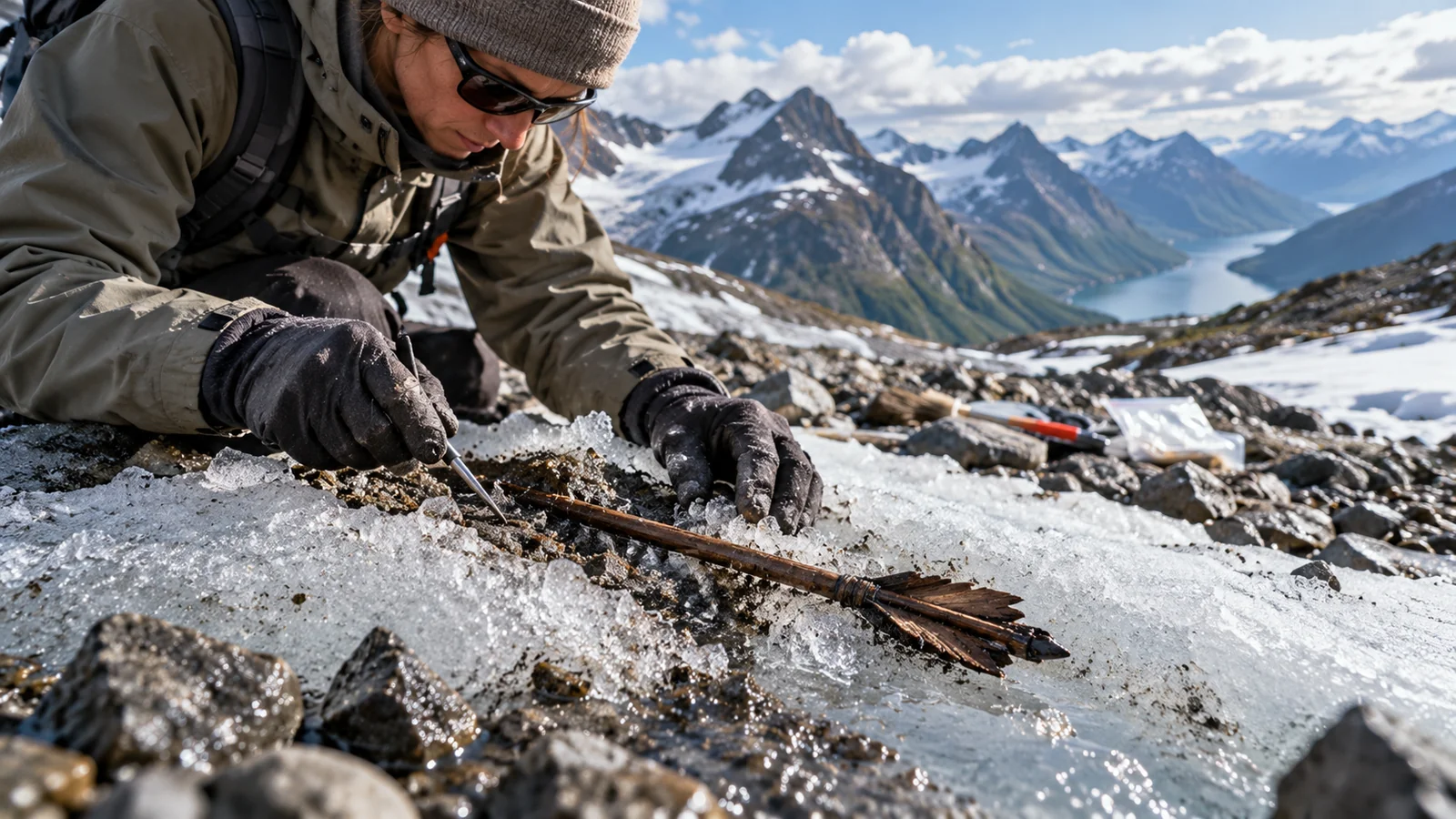
A wooden arrow lies where ice had covered it for millennia. Nearby, a fragile fragment of textile begins to dry in the mountain air. Far below, a hiking trail crosses a landscape that looks remote today but once carried hunters, pack animals and traders. These are not scenes from a lost civilization invented for a documentary. They are the kinds of discoveries being made as ice retreats in Norway, the Alps and northern North America.
Glacial archaeology is revealing everyday belongings that ordinary archaeological soils rarely preserve: wooden weapons, leather shoes, woven clothing, travel equipment and sometimes animal remains. Each object can tell us something about a person's work, movements or technology. The discovery comes with a serious paradox: the same thaw that exposes an artifact can quickly destroy it.
In September 2026, Norway's Secrets of the Ice team reported recovering 48 prehistoric arrows after fieldwork in the Jotunheimen mountains. Some newly emerging objects belong to the Stone Age, including an arrow with a slate point and wooden shaft estimated to be about 5,000–6,000 years old. Those are reports of actual discoveries, not a claim that one single glacier has suddenly released an entire prehistoric settlement. University of Oslo, Museum of Cultural History.
This guide explains what researchers are finding, where the discoveries come from, how the objects survive, and why the archaeological record is at risk. The newest finds are presented alongside older, scientifically established discoveries so that the history does not get confused with the date of a news report.
The discovery changing the story in 2026: 48 arrows in Norway
The Museum of Cultural History at the University of Oslo reported on September 23, 2026 that field teams had recovered 48 prehistoric arrows during three weeks of work at the retreating ice. The announcement described a striking change in what is emerging: archaeologists have increasingly encountered material from the Stone Age and Bronze Age, not just the Viking Age and Middle Ages.
Among the discoveries was an arrow with a slate arrowhead and a surviving wooden shaft, dated broadly to around 5,000–6,000 years ago. A separate complete arrow with a bone arrowhead and wooden shaft was described as approximately 1,800 years old. Such differences matter: an arrow's date belongs to that particular object and cannot be applied to every find from the same mountain.
The Norwegian museum also reported that several artifacts were moved to a cooled exhibition case at the Norwegian Mountain Centre in Lom shortly after recovery. That detail captures the conservation problem. An object can withstand millennia in a cold environment, yet become vulnerable to microbial decay, drying or physical damage once the protecting ice disappears.
Why a surge of Stone Age finds matters
An arrow from early prehistory provides a rare view of materials that usually disappear in the ground. Archaeologists can examine the shaft's wood, the shape and material of the point, how the parts were joined and, where preserved, the traces of bindings or adhesives. These details reveal manufacturing choices and can sometimes be compared with younger hunting technology.
A concentration of arrows does not automatically prove a battle, a mass death or a forgotten city. In the Norwegian mountains, hunters targeted reindeer that sought relief from biting insects on snow and ice. Arrows could be lost during hunts over hundreds or thousands of years, eventually entering ice and reappearing during warmer periods. Pilø, 2026, Annals of Glaciology.
Glaciers versus ice patches: the distinction most headlines miss
The phrase “objects emerging from melting glaciers” is convenient, but it can be scientifically misleading. Many remarkably intact finds come from ice patches: relatively stable accumulations of snow and ice in sheltered high-mountain terrain. They do not generally flow downhill in the same way as a major glacier.
A glacier moves under its own weight. Its ice can deform, crush objects, and transport them away from where they were lost. A relatively stationary ice patch may preserve a dropped arrow, mitten or wooden tool close to its original location, although meltwater and wind can still move artifacts after exposure. The distinction affects both preservation and how precisely archaeologists can reconstruct past behavior.
| Feature | Ice patch | Flowing glacier |
|---|---|---|
| Typical movement | Relatively stable, though some deformation is possible | Flows downhill under gravity |
| Artifact condition | Organic objects may survive remarkably well | Motion and debris can damage or move finds |
| Finding an object in place | Sometimes possible, but context still needs checking | Much less likely after substantial transport |
| Main archaeological risk | Rapid exposure, weathering and loss | Melting plus mechanical disturbance |
An important 2026 academic review by Lars Holger Pilø emphasizes this methodological distinction and documents finds from Norway, the Alps and North America. It argues for closer collaboration between archaeology, glaciology and climate research rather than treating every melting-ice discovery as the same kind of site. Read the open-access review.
Lendbreen: the mountain pass that preserved a forgotten traffic route
One of the best-studied ice archaeology sites is Lendbreen in Norway's Jotunheimen region. This site did more than preserve hunting tools. It preserved evidence for a high mountain route used over many centuries by people moving between valleys, seasonal farms and trading networks.
A peer-reviewed study in Antiquity reconstructed use of the pass from approximately AD 300 to AD 1500, with a peak around AD 1000, the Viking Age. Its authors identified roughly 800 artifacts in the assemblage available for the study, alongside bones, antlers, cairns and a stone shelter. These are figures from that research, not an up-to-date count of everything ever recovered in the wider mountain region. Pilø, Finstad and Barrett, 2020.
Shoes, mittens and a wool tunic
The Lendbreen finds include footwear, a mitten, textile fragments and a wool tunic associated with the Roman Iron Age. The tunic came to prominence after discovery in 2011, when ice retreat exposed clothing and other organic materials. The survival of stitched and woven materials can tell specialists about fiber selection, construction and repairs—evidence that often vanishes in ordinary burial conditions.
These are traces of daily life, not royal treasures. A patched garment may say more about reuse and resourcefulness than a precious ornament. A shoe can hint at how travelers managed slippery, snowy terrain. A horse-related object may document transport through a high pass that would seem impractical in some modern seasons.
A real archaeological object recovered from Lendbreen
Image credit: Photograph by Vegard Vike, Museum of Cultural History, University of Oslo; reconstruction drawing by Ingvild Tinglum Bøckman. Source: Wikimedia Commons – Lendbreen ski/snowshoe. License: CC BY-SA 4.0. The original image is shown without cropping or recoloring; the top panel is a real photograph and the lower panel is a reconstruction drawing.
The photograph documents a wooden ski- or snowshoe-like object, while the drawing helps explain its form. Researchers do not have to reconstruct a full journey from this one object; rather, they evaluate it alongside dated equipment, the landscape and other discoveries. The nearby remains of cairns and a shelter strengthen the interpretation of Lendbreen as a route traversed by humans and animals.
A reindeer trap revealed in western Norway
Recent ice-melt archaeology is not limited to individual lost possessions. In western Norway's Vestland County, archaeologists documented a reindeer trapping installation at high elevation, involving wooden fences that directed animals into a confined area. The find was reported in an archaeology roundup published in March–April 2026.
Associated evidence included numerous antlers, iron spearheads, bows and arrows. Researchers also encountered an intricately carved wooden object described as an oar, which may have served as a tool in constructing the trap. Radiocarbon dates on sampled organic materials indicate a trapping system dating to approximately AD 500. Archaeology magazine, 2026.
The wider lesson is that mountain ice can preserve the infrastructure of economic activities, not just a stray arrow. Herding and hunting required planning, materials carried uphill, and knowledge of how reindeer used the landscape. Still, an archaeologist's suggested function for an unusual wooden object should be presented as an interpretation, not a proven fact.
Ötzi: the Alpine discovery that changed the field
One of the world's best-known ice finds is Ötzi, the Copper Age man discovered in the Ötztal Alps in September 1991. His body and associated objects survived for more than five millennia. This is not a new 2026 discovery; it is an earlier example that illustrates both the possibilities and the complexity of preservation in high mountain ice.
According to the South Tyrol Museum of Archaeology, hikers Erika and Helmut Simon noticed a body partly emerging from ice on September 19, 1991 near the Tisenjoch pass, around 3,210 meters above sea level. The remains were initially mistaken for those of a recent mountaineering accident before their antiquity became apparent.
The museum explains that Ötzi lay in a protective depression in the landscape. The combination of location and preservation conditions matters: his survival cannot simply be generalized to every body or object that enters a moving glacier. Clothing and equipment recovered with the body offered evidence of clothing technology, tools and daily life around 5,300 years ago. Museum exhibition and original finds.
North America: thousands of years of Indigenous hunting technology
Far from Norway, ice patches in Canada's Yukon and Alaska have also yielded preserved hunting equipment. Canada's official description of the Yukon Ice Patches recognizes a record of cultural and technological traditions spanning more than 7,500 years, with research involving Yukon First Nations and archaeologists. Parks Canada.
The finds connect people, caribou and high-elevation landscapes. Hunters used seasonal animal movements and developed tools that could be made from wood, stone, bone, antler, sinew and other materials. These organic components are especially valuable because they commonly decay at other archaeological sites.
A Yukon government heritage publication describes a remarkable approximately 6,000-year-old throwing dart recovered in 2018 from the Friday Creek ice patch. The reported object consisted of a roughly two-meter birch shaft made in three sections, with stone point and feather fletching still attached. Such completeness allows researchers to examine not merely an isolated projectile tip but how the entire hunting weapon was assembled. Government of Yukon heritage report.
In Alaska, the US National Park Service has reported ice-patch projectile points that combine antler with copper end-blades. Researchers used X-ray fluorescence analysis to investigate traces of copper, revealing how small composite components were manufactured and maintained. The NPS emphasizes that these sites preserve technology and skills that are otherwise difficult to document. National Park Service.
The discovery is not simply that ancient people lived near ice. It is that ice can preserve the materials, construction techniques and travel patterns that ordinary archaeological deposits often erase.
What has actually been found? A regional comparison
| Region or site | Examples of finds | Approximate age or period | What they reveal |
|---|---|---|---|
| Jotunheimen, Norway — 2026 fieldwork | Prehistoric arrows, including slate and wooden components | Some roughly 5,000–6,000 years old | Stone Age hunting technology and loss of older ice |
| Lendbreen, Norway | Wool clothing, shoes, mitten, skis, horseshoes and transport traces | Mostly Roman Iron Age through medieval period; older finds also exist | High-mountain routes, mobility and seasonal farming |
| Vestland, western Norway | Reindeer fencing, antlers and hunting equipment | A trapping complex dated around AD 500 | Organized mountain hunting and material transport |
| Ötztal Alps, Italy | Ötzi’s body, clothing and equipment | About 5,300 years old | Individual life and material technology in the Copper Age |
| Yukon, Canada | Darts, arrows and organic hunting components | Multi-millennial record; some finds thousands of years old | Indigenous hunting practice and technological change |
| Alaska, United States | Composite antler-and-copper projectile points | Different periods including near early European contact | Evidence of ingenious composite weapon construction |
The dates in this table refer to individual finds, groups or particular site phases; none is a universal age for all artifacts exposed by a glacier or ice patch. The time an object is discovered also differs from the time it was made or lost.
Why wood, leather and feathers can survive in mountain ice
Most archaeological sites favor durable materials: stone, pottery, fired clay and metal. Organic items are more vulnerable to fungi, microorganisms, moisture changes and insects. Persistent cold can slow many decay processes, while a frozen setting may physically protect delicate objects from environmental exposure.
Ice patches are therefore unusually good at preserving wood, hide, textiles and organic bindings. Preservation is still selective. Some objects may have been damaged before freezing, and others may have deteriorated during earlier thaws or after exposure. Scientists should not assume that a blank patch of ground means no activity occurred there.
What happens when an artifact thaws?
- Exposure: melting ice no longer shields the object from oxygen, water, sunlight, wind and temperature fluctuations.
- Movement: rain, meltwater, gravity and people may displace fragile pieces and complicate their original archaeological context.
- Deterioration: textiles can dry and fragment; wood may crack; microbial activity can accelerate where conditions allow.
- Documentation: specialists photograph, map and record an artifact's precise position before removal when it is safe and lawful to do so.
- Conservation: recovered objects require appropriate packaging, temperature control and professional treatment, with methods adapted to their material.
A short press report may focus on the dramatic moment of discovery. The scientific value often depends just as much on the quiet work done afterward: documentation, material analysis, dating, conservation and publication.
How scientists determine an artifact's age
A date estimate is not printed on a prehistoric arrow. Archaeologists rely on converging evidence that may include radiocarbon dating, tool construction, historical comparison and the physical context of discovery.
Radiocarbon dating is particularly valuable when an object contains organic material. It measures remaining carbon-14, then converts the result into a calibrated probability range using appropriate curves. A published age may therefore appear as an approximate number, a set of calendar-year ranges or a broad period.
There are important limits. Dating the timber of a tool can indicate when the tree grew, which may not be exactly when the tool was used. A piece of wood reused much later than it formed may create an “old-wood” problem. Glacial melt may also bring objects of very different ages onto the same exposed surface.
| Evidence | What it can tell researchers | Important limitation |
|---|---|---|
| Radiocarbon date of wood, fiber or bone | Age of the sampled organic material | Need not equal the exact year of use |
| Arrowhead style and construction | Possible technological tradition | Similar styles may persist or recur |
| Nearby objects and terrain features | Possible activity areas or travel routes | Meltwater and wind can rearrange finds |
| Fiber or wood analysis | Manufacturing materials and possible sourcing | Conservation and sampling may constrain analysis |
| Documentary or oral histories | Historical use of the place and cultural context | Must be related carefully to the actual artifacts |
A credible account should separate the measured evidence, the interpretation and the remaining uncertainty. A 6,000-year-old arrow is evidence of ancient hunting technology, not proof that every story associated with a mountain location is true.
What ice archaeology tells us about past travel and trade
The finds challenge an assumption that the high mountains were mainly barriers. Routes such as Lendbreen could connect farms, summer grazing areas and distant markets. Footwear, packhorse gear, walking sticks and marked paths show people adapting to seasonal terrain.
Reindeer traps and arrows suggest repeated hunting in particular landscapes. Animal dung, bones and lost harness equipment can also help distinguish a transport corridor from a hunting zone. At Lendbreen, the strongest argument for use as a mountain pass comes from many different categories of evidence taken together, including the pattern of dated finds. The peer-reviewed Lendbreen study.
Some objects pose new puzzles. Why was a particular wooden tool left at a high-altitude trap? Did a traveler discard a damaged shoe, or accidentally lose it? Archaeologists can propose explanations, but the object itself does not preserve a complete personal biography.
Climate change is revealing evidence—and destroying its protection
Glacial archaeology has become an urgent field partly because warming and ice loss are exposing archaeological material faster than researchers can necessarily recover it. A 2026 review in Annals of Glaciology synthesizes thousands of finds dating back as much as about 10,000 years and explains why the field depends on both archaeological surveys and an understanding of ice conditions. Pilø, 2026.
This does not mean more discoveries are an uncomplicated benefit of a warming world. Once ice disappears, irreplaceable objects may be lost before anyone sees them. An exposed artifact is a one-time opportunity, not a renewable source of historical evidence.
There is also a scientific nuance: exposure today does not guarantee an artifact lay frozen continuously since it was discarded, and different ice patches have distinct histories of growth and melting. Climate trends help explain why more sites are threatened, while the age of a particular object must be established separately.
How researchers rescue fragile finds
Fieldwork often focuses on short windows when snow is absent, ice edges are accessible and weather conditions allow safe movement. Teams may use satellite imagery, maps and earlier site records to identify where fresh melt is most likely to expose material. They then survey on foot and record each discovery in place.
Typical priorities include:
- Mapping an object's location before it is moved, using coordinates and photographs with a scale.
- Recording whether it lies on ice, on recently exposed rock or in sediment washed by meltwater.
- Protecting fragile organic components from unnecessary handling, heat or drying.
- Consulting conservators about safe packing, transport and storage conditions.
- Using appropriate analytical and dating methods after recovery.
- Working with local heritage authorities and, where applicable, Indigenous communities with enduring connections to the landscape.
What seems like a simple act of picking up an arrow can permanently destroy evidence about where, how and why it was lost. Location and surrounding material are part of the historical record.
What should a hiker do after seeing a possible ancient object?
Hikers and climbers can help by reporting a suspected find rather than treating it as a souvenir. Local laws differ, and archaeological objects may be protected even when they appear exposed on the ground.
- Keep yourself safe. Do not approach unstable ice, crevasses or steep terrain to inspect an object.
- If possible without disturbing anything, take photographs showing the object and its surroundings.
- Note your position using a phone or GPS, and record the time and approximate conditions.
- Do not clean, bend, detach or remove the object, unless local authorities explicitly instruct otherwise in an urgent preservation situation.
- Contact the appropriate regional heritage or archaeological authority. In Norway, follow local cultural-heritage reporting procedures; in North America, relevant park services, territorial agencies or Indigenous authorities may be involved.
Reporting preserves evidence and helps qualified researchers judge whether immediate conservation is necessary. Avoid sharing a sensitive, unprotected site location publicly if doing so could encourage unauthorized collecting.
Common misconceptions about artifacts emerging from ice
“Every object in the ice is a Viking artifact”
No. Finds span distinct periods, and some Norwegian discoveries reported in 2026 reach back thousands of years before the Viking Age. Individual objects need their own dating and context.
“If something was discovered in 2026, it was buried in 2026”
The date of discovery says nothing about the age of the object. A 2026 news report might describe a Stone Age arrow or a medieval shoe that researchers exposed and recovered much earlier or more recently.
“Ice always preserves every object perfectly”
No. Preservation depends on ice movement, temperature history, material composition and how quickly artifacts are recovered after thaw. Glaciers can crush and carry finds, whereas relatively stable ice patches may preserve them more completely.
“A single arrow proves there was a large settlement”
Not by itself. A hunting tool can have been lost on a seasonal trip, far from any permanent homes. Researchers look for repeated evidence, dated assemblages and landscape clues before identifying long-term activity.
The future of glacial archaeology
The field is growing because it combines urgent rescue work with broader historical questions: where people traveled, how they hunted, what they wore, how they moved supplies and how climate changes shaped access to mountain routes.
Newly exposed objects can revise an earlier chronology, reveal a previously unknown material choice or change the interpretation of a site. Equally important, the absence of a find does not mean ancient people stayed away. What survives is only a fragment of what they once carried.
Researchers face a race between changing landscapes and slow, careful science. The goal is not simply to accumulate striking photographs of ancient possessions. It is to preserve the context and evidence before they disappear again—this time not into ice, but into ordinary weathering and decay.
Conclusion: the past comes out of the ice only once
From Stone Age arrows recently found in Norway to a long-used Viking Age mountain pass, from Ötzi in the Alps to intricately assembled Indigenous hunting equipment in the Yukon, melting ice is revealing unexpected details of human history. The finds are extraordinary precisely because they preserve fragile things people used, lost and repaired.
The story is both an archaeological discovery and a conservation warning. Ice acted as an archive; once that archive opens, its contents need expert care. Understanding what the objects mean requires reliable dates, careful excavation and a willingness to acknowledge uncertainty—before the next season of melt removes evidence that cannot be replaced.
Sources and further reading
- Museum of Cultural History, University of Oslo — Year of the Arrows: Now the Stone Age Is Melting Out. Primary institutional announcement, September 23, 2026, including the recovery of 48 arrows.
- Lars Holger Pilø — The Archaeology of Glaciers and Ice Patches (Annals of Glaciology, 2026). Peer-reviewed synthesis on preservation, discovery and field methods.
- Pilø, Finstad and Barrett — Crossing the Ice: Lendbreen, Norway (Antiquity, 2020). Peer-reviewed study of the pass and associated archaeological finds.
- Archaeology Magazine — Reindeer Harvest. March–April 2026 report on the Vestland reindeer-trapping complex.
- South Tyrol Museum of Archaeology — The Discovery of Ötzi. Original museum account of the 1991 discovery and its location.
- South Tyrol Museum of Archaeology — Permanent Exhibition. Ötzi's clothing and equipment.
- Parks Canada — Yukon Ice Patches. Multi-millennial Indigenous hunting and archaeological record.
- Government of Yukon — Heritage Conversations, Volume 2. Case study of a well-preserved throwing dart.
- US National Park Service — Bone and Copper Arrows Found in Melting Ice Patches. Composite hunting points and materials analysis.
- Wikimedia Commons — The Lendbreen Ski/Snowshoe Photograph and Drawing. Rights and attribution for the real image included in the article; CC BY-SA 4.0.
You may also like
 History & Civilizations
How Do Archaeologists Date Ancient Artifacts? Radiocarbon, Layers, Pottery and the Limits of Scientific Dating
How do archaeologists date ancient artifacts? Compare carbon-14, stratigraphy, tree rings and pottery dating with practical examples and…
 History & Civilizations
Where Was Ancient Egypt Born? The Archaeological Evidence Before the First Pharaohs
Was ancient Egypt born in Abydos, Hierakonpolis, Naqada or the Nile Delta? Compare Predynastic archaeological evidence and discover…
 History & Civilizations
Secrets of Ancient Egyptian Glass: How Did Its Colors Survive for Thousands of Years?
Explore the science of ancient Egyptian glassmaking: cobalt blue, copper turquoise, opaque pigments, and the workshops of Malkata…