
How Do Archaeologists Date Ancient Artifacts? Radiocarbon, Layers, Pottery and the Limits of Scientific Dating
How do archaeologists date ancient artifacts? Compare carbon-14, stratigraphy, tree rings and pottery dating with practical examples and scientific limits.
Contents
- Why an artifact may have more than one legitimate age
- Relative dating: reading the ground before the laboratory
- Stratigraphy and the superposition principle
- Cross-dating, typology and coins
- Carbon-14: what the radioactive clock actually measures
- A worked half-life calculation—and why it is not a real calendar date
- Why radiocarbon dates must be calibrated
- The four traps that can make a sample older or younger than its context
- Old wood and recycled materials
- Reservoir effects in water and aquatic food chains
- Contamination and conservation chemicals
- Intrusive or redeposited objects
- Tree-ring dating: when wooden objects can be dated to a year
- Pottery and burned materials: dating the last heating event
- OSL: when sediment last saw daylight
- Dating stone, metal, inscriptions and pigments without misusing carbon-14
- An authentic case study: putting ancient Egyptian dynasties on a timeline
- A hypothetical excavation decision: which sample should the team send?
- How Bayesian chronological models strengthen a site timeline
- Why two reports on the same object may disagree
- A reader's checklist for evaluating archaeological age claims
- Final perspective: archaeology dates events, not just things
- Scientific references and further reading
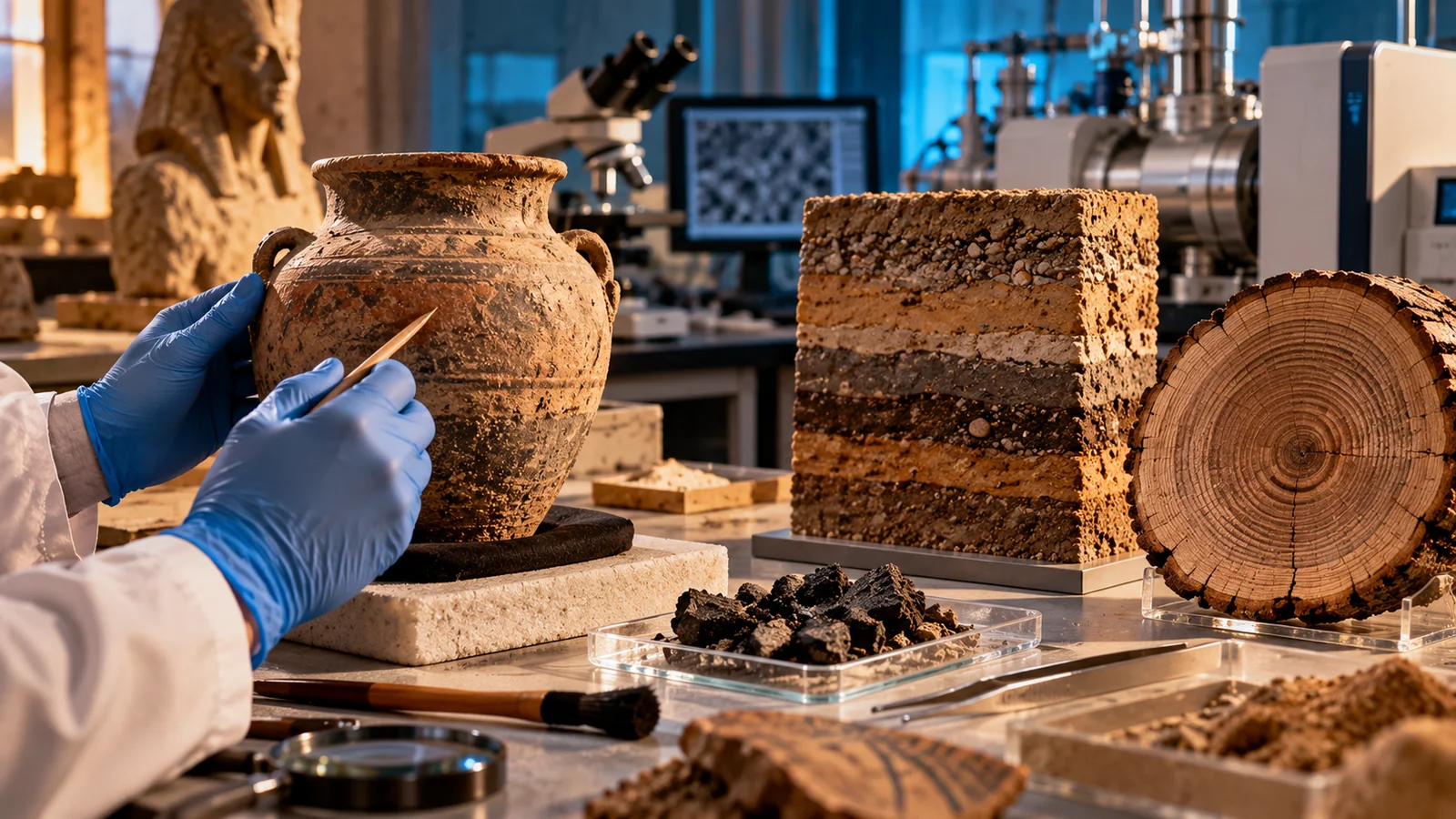
A stone statue cannot simply be put into a carbon-dating machine and assigned a birthday. When archaeologists estimate the age of an artifact, they first ask what event needs dating: when a tree grew, a clay pot was fired, a tomb was sealed, or an object was deposited in the ground. These events can be separated by years or centuries. Reliable archaeology combines physical measurements with the context in which objects were found, rather than relying on one miraculous laboratory test.
The short answer is that scientists use two complementary approaches. Relative dating establishes which objects or layers are earlier and later; chronometric dating estimates calendar-age ranges by testing appropriate material. Radiocarbon is especially useful for once-living remains. Tree rings, luminescence, geology, inscriptions and well-documented excavation layers answer different questions. This guide explains how those clues fit together, with a worked calculation, a sample-selection matrix and a documented example from ancient Egypt.
Why an artifact may have more than one legitimate age
Imagine a wooden box made from an old beam, repaired many years later, placed in a tomb, and finally excavated today. A radiocarbon date on the oldest surviving wood could tell you approximately when those tree tissues formed, not when the box was assembled. A repair may be centuries younger. The grave might have been used after the box was made. Archaeologists therefore describe the event being dated instead of attaching a single date to the entire history of an object.
This distinction also matters in museums. A catalog entry saying “third century BCE” may reflect a stylistic attribution supported by comparable finds, not a direct scientific measurement on that exact object. Conversely, a precise laboratory result on charcoal found near a pot does not automatically establish the pot’s manufacture date. The relationship must be documented. For a useful introduction to these distinctions, see the US National Park Service overview and the University of Oxford archaeology dating guide.
Relative dating: reading the ground before the laboratory
Stratigraphy and the superposition principle
An excavation often exposes layers: a natural soil, an occupation floor, a rubbish pit, a collapsed wall and a later fill. In an undisturbed sequence, material deposited lower down tends to predate overlying deposits. Yet a pit cut through older layers introduces younger material below them. Roots, burrowing animals, rebuilding and erosion can also move objects. The principle is powerful only when archaeologists record cuts, interfaces, seals and disturbances as carefully as the objects themselves.
Imagine three undisturbed deposits called A, B and C, stacked from bottom to top. If A contains charcoal, B contains a pot and C contains a coin, the observation initially establishes an order, not exact dates. If a later trench dug from C down into A contains another coin, that coin cannot safely be used to date the original A layer. The drawing of the excavation sequence matters as much as a photograph of the find.
Cross-dating, typology and coins
Well-studied pottery shapes, tool designs and inscriptions can indicate a likely period when compared with securely dated parallels. A coin may establish a terminus post quem: the associated deposit cannot have been laid down before the coin was minted, if the coin genuinely belongs to that deposit. But the coin could have remained in use or circulated for decades before burial. The latest possible date of deposition is not established merely by reading a mint date.
| Clue found in a layer | What it supports | What it does not prove |
|---|---|---|
| Lower intact occupation floor | Earlier than the overlying floor | An exact year of occupation |
| Coin minted in 150 CE | Deposit is unlikely to predate its minting | Deposit was made in 150 CE |
| Pottery matching a dated regional style | A plausible production or use interval | That every matching pot is the same age |
| Timber reused in a later doorway | The wood existed before the doorway was built | The doorway was built when the tree grew |
Carbon-14: what the radioactive clock actually measures
Living organisms exchange carbon with their surroundings. Some carbon is the radioactive isotope carbon-14, which decays after that exchange ends. Its physical half-life is approximately 5,730 years. Laboratories measure the carbon-14 content of carefully prepared materials, often using accelerator mass spectrometry. The results are interpreted with calibration and site information. The Oxford Radiocarbon Accelerator Unit emphasizes that a radiocarbon age generally marks the age of biological material, not automatically the manufacture or use of an object.
Good candidates include charred seeds, short-lived twigs, some bone collagen when adequately preserved, textile fibers, papyrus and other material derived from living organisms. Testing a clean stone blade or bronze bracelet directly with carbon-14 will not tell the object’s age. Organic residue stuck to a pot may be testable, but that residue needs separate assessment; contamination, conservation treatments and aquatic dietary effects can invalidate a simple reading. Egypt’s National Museum of Egyptian Civilization documents radiocarbon work on archaeological organic materials, including papyrus and wood.
A worked half-life calculation—and why it is not a real calendar date
For a teaching example, assume a hypothetical sample began with a reference carbon-14 concentration and retains 25% of it, without contamination or other adjustments. After one half-life, 50% remains; after two, 25%. The simple decay estimate is therefore 2 × 5,730 = 11,460 years. More generally, the idealized model is t = 5,730 × log₂(1/f), where f is the remaining fraction. This is a mathematical demonstration, not a laboratory determination, and it deliberately ignores how the original carbon-14 concentration changed over history.
| Remaining fraction in the model | Number of half-lives | Illustrative elapsed time |
|---|---|---|
| 100% | 0 | 0 years |
| 50% | 1 | 5,730 years |
| 25% | 2 | 11,460 years |
| 12.5% | 3 | 17,190 years |
| 6.25% | 4 | 22,920 years |
The figures cannot simply be stamped onto an artifact label as calibrated calendar ages. Laboratories report measured radiocarbon results with uncertainties using established reporting conventions; calibration turns those measurements into possible calendar-age distributions. A small amount of younger contamination can also bias very old samples, making sample pretreatment central to the result.
Why radiocarbon dates must be calibrated
The atmosphere has not contained an unchanging amount of carbon-14. Production, circulation and exchange vary, so an uncalibrated radiocarbon age is not identical to a calendar age. Researchers compare measurements with independently dated natural archives, notably tree rings, to create calibration curves. The IntCal working group published IntCal20 for Northern Hemisphere atmospheric samples, SHCal20 for the Southern Hemisphere and Marine20 for marine material. Selecting a suitable curve and considering local reservoir effects requires specialist interpretation.
Calibration may produce a broad range or several disjoint ranges rather than one neat date. A reported 95% probability interval is a modeled range, not an assertion that an individual event definitely happened in its midpoint year. Historic England’s guidance on radiocarbon dating and chronological modeling explains why archaeologists integrate measurement uncertainty and archaeological constraints instead of treating the central number as final truth.
Radiocarbon is widely applicable back to approximately 50,000 years for suitable samples, with practical limits depending on preservation, laboratory methods and background contamination. Calibration datasets can extend further than the age range in which a particular specimen can be measured reliably. Radiocarbon is not the method for determining whether a rock formed millions of years ago; other isotopic systems address those geological timescales.
The four traps that can make a sample older or younger than its context
Old wood and recycled materials
A long-lived tree incorporates carbon into its central growth rings long before it is felled. A beam may then be stored, reused or burned much later. The radiocarbon date of the original wood can therefore be older than the building or hearth where archaeologists discovered it. Short-lived seeds from a sealed context usually have a closer relationship to one growing season. Historic England calls this the old-wood effect.
Reservoir effects in water and aquatic food chains
Shellfish and other aquatic organisms may incorporate carbon that does not match the atmosphere at the same moment. Marine and freshwater reservoir effects can cause an apparent age offset. A human bone sample can also reflect diet. It is therefore risky to apply a terrestrial atmospheric calibration curve automatically to a marine shell or an individual whose diet was dominated by fish.
Contamination and conservation chemicals
Modern glue, handling residues, soil carbon or museum treatments can introduce foreign carbon. A tiny amount can matter greatly in very old material, where little original carbon-14 survives. Laboratories use pretreatment methods, but a result still has to be examined against the sample’s condition and conservation history. An attractive number is not a substitute for a well-chosen specimen.
Intrusive or redeposited objects
A bone can fall into a later animal burrow, while an older charcoal fragment can be reworked into a newer fill. A laboratory may measure the bone or charcoal perfectly but answer the wrong archaeological question. This explains why sampling strategy, excavation documentation and a record of the object’s precise association are indispensable.
Tree-ring dating: when wooden objects can be dated to a year
Dendrochronology compares the width patterns of successive annual growth rings with reference sequences from the appropriate species and region. When the outer ring survives and the pattern matches, investigators may identify the calendar year when that ring formed. If bark edge and waney edge evidence are absent, the felling date may only be estimated as a range, sometimes with many missing rings. Storage and reuse separate felling from building construction.
Tree-ring chronologies also provide an independent calendar framework for radiocarbon calibration. Their regional and species requirements explain why they are not a universal solution for every piece of archaeological wood. The technique is especially well established in suitable historic buildings and timber structures, but not every archaeological environment supplies sufficient preserved wood or long reference series. Historic England’s scientific dating team describes both its applications and limits.
Pottery and burned materials: dating the last heating event
Thermoluminescence (TL) is based on trapped charges in minerals exposed to natural background radiation. When suitable material is heated in a laboratory, emitted light provides information that can be combined with environmental dose-rate measurements to estimate how long radiation has accumulated. Properly applied to a fired ceramic, the method may estimate the time since sufficiently intense firing reset the signal. It does not mean that any ancient-looking pot can be dated accurately by touching it with a handheld scanner.
For TL, the dose absorbed by a sample and the local radiation dose rate both matter. Groundwater changes, variable burial conditions, incomplete resetting and inappropriate collection can increase uncertainty. Sampling can be destructive, so conservation specialists and laboratories decide whether the expected knowledge justifies removal of material. The National Park Service comparison of methods describes this heating-based technique, and Historic England’s methods guidance explains the underlying charge-and-dose logic.
OSL: when sediment last saw daylight
Optically stimulated luminescence (OSL) often dates quartz or feldspar grains from sediments. Exposure to sufficient light can reset a mineral’s trapped-charge signal; subsequent burial allows a new signal to accumulate. Measuring the equivalent dose and reconstructing the dose rate can estimate the time since the last effective light exposure. This may help date deposits that surround a stone tool or a buried occupation surface, not the age of the stone from which the tool was made.
OSL results require special care when grains were incompletely exposed to daylight before burial. Disturbed sediments, changes in dose rate and mixing can complicate interpretation. Archaeologists may therefore sample under controlled light conditions and compare the outcome with sedimentology and excavation records. A directly dated sediment layer and a nearby artifact should never be assumed contemporaneous without an argument connecting them.
Dating stone, metal, inscriptions and pigments without misusing carbon-14
A stone statue’s raw rock may be vastly older than the carving. Geologists can sometimes date when minerals formed, but that is not the sculptor’s working date. A bronze object similarly may be made from much older metal and cannot usually be directly carbon-dated. Archaeologists turn to manufacturing techniques, associated organic material, inscriptions, mining and production evidence, and the dateable sequence of the findspot.
Written dates can provide a powerful anchor, but their meaning depends on what they record. A ruler’s name may refer to a reign, later copying or imitation. An inscription dated in a local calendar needs interpretation before comparison with the modern calendar. Scientific composition tests such as X-ray fluorescence can identify alloys or pigments and constrain provenance or technological possibilities; they generally do not return the date when an artist applied a layer of paint.
| Object or context | Useful approaches | Event most likely dated | Principal caution |
|---|---|---|---|
| Papyrus sheet | Radiocarbon on fibers; writing style | Plant death or fiber formation | Text may be written later |
| Pottery vessel | Typology; TL where appropriate; associated charcoal | Firing, style range or nearby organic material | Each dates a different event |
| Wooden beam | Tree rings; radiocarbon | Ring formation, potentially felling | Old wood or later reuse |
| Stone statue | Context, inscriptions, tool marks, stylistic parallels | Carving interval inferred indirectly | The stone is much older |
| Bronze object | Context, production evidence, inscriptions | Manufacture or deposition inferred | Alloy chemistry is not a clock |
| Sediment covering a tool | OSL, stratigraphy | Last effective exposure of grains to light | Deposition and artifact use may differ |
| Human remains | Radiocarbon where collagen survives | Biological death | Diet, preservation and contamination |
An authentic case study: putting ancient Egyptian dynasties on a timeline
A 2010 study by Bronk Ramsey and colleagues in Science combined 211 radiocarbon measurements from short-lived plant material with a Bayesian model informed by historical evidence about rulers’ reigns. Its estimates placed the start of the New Kingdom between 1570 and 1544 BCE and the beginning of Djoser’s reign between 2691 and 2625 BCE under that study’s model. The paper also discussed a small Nile Valley radiocarbon offset, probably connected to the growing season.
This example matters because the researchers did not simply carbon-date a pyramid or announce that every pharaoh had an exact birthday. They selected samples with relevant historical associations, measured organic material, considered regional carbon conditions and combined those results with independent chronological evidence. Some estimates differed from earlier historical chronologies; the model and its assumptions remain part of how the results should be described. Oxford’s published account of the work likewise emphasizes the combination of scientific and historical evidence.
A hypothetical excavation decision: which sample should the team send?
Suppose a sealed ancient Egyptian storeroom contains a short-lived charred seed, a wooden ceiling beam, a pot and a bronze fastening. No testing has been performed; this is an instructional scenario. If the question is when the storeroom burned, a short-lived seed clearly embedded in the burn layer might be a better radiocarbon target than a long-lived timber with unknown reuse. If the question is when the ceramic was fired, TL may be more directly relevant than the date of a seed next to it. And if the question is how old the bronze was when it entered the room, a radiocarbon result on nearby organic material offers context, not a direct manufacture date.
| Research question | First sample or evidence to prioritize | Why |
|---|---|---|
| When did the burn event happen? | Short-lived, securely associated charred remains | Biological age may be close to the event |
| When was the pot last fired? | Ceramic material for specialist TL assessment | Signal may relate to the last relevant heating |
| When was the roof built? | Timber rings plus carpentry and stratigraphy | Felling is only one constraint on construction |
| When did the bronze fastener enter the room? | Sealed layer relationships and associated finds | Bronze does not contain a built-in carbon clock |
How Bayesian chronological models strengthen a site timeline
Instead of treating dates as unrelated numbers, researchers can express known archaeological relationships: one floor precedes a wall, a burial follows the construction of a tomb, and a sealed deposit predates a later renovation. Bayesian statistical models combine those independently justified relationships with measured date distributions. When the assumptions are sound, the model may narrow plausible timing for sequences; it can also expose conflicts between samples and the recorded stratigraphy.
Bayesian modeling does not magically repair a contaminated sample or validate an invented sequence. If a proposed order is wrong, a mathematically elegant model may still mislead. A trustworthy publication therefore describes the sampled contexts, analytical assumptions and uncertainty ranges as well as the results. Historic England’s Bayesian-process guidance is a detailed reference.
Why two reports on the same object may disagree
Two specialists may be estimating different events—felling versus construction, manufacture versus burial—or applying updated calibration datasets. They may also have tested different components, handled contamination differently or revised the excavation interpretation. Some differences reveal genuine historical complexity. Others flag a sample-association or laboratory problem needing further investigation. It is poor practice to average conflicting dates without understanding their relationship.
A credible report will identify its sampling location, the context number, laboratory reference, tested material, result and uncertainty, calibration assumptions and relevant comparative evidence. A viral headline saying “artifact is exactly 8,000 years old” without these details may conceal a broad probability distribution or merely repeat an estimate from the surrounding sediment. The right question is not only “what date?” but “what exactly was dated, by which method and with what confidence?”
A reader’s checklist for evaluating archaeological age claims
- Identify the object and the archaeological event the date is supposed to represent.
- Ask whether the tested material was once alive, last heated, last exposed to daylight or formed geologically.
- Check whether the object was recovered in a documented, intact layer or from a disturbed context.
- Look for a laboratory identifier, method, sample description and uncertainty range.
- Check calibration if the figure is a radiocarbon result and watch for regional or aquatic reservoir effects.
- Compare the result with independent evidence such as coins, tree rings, pottery series or inscriptions.
- Separate a proposed reconstruction from the surviving physical evidence.
- Prefer the original study and museum documentation over a single-sentence age claim on social media.
These steps are useful when reading about newly excavated objects as well as iconic museum pieces. They also clarify why uncertainty is not a weakness to hide: honest ranges describe what the surviving evidence can actually support. For a related Horus Valley examination of an ancient object reconstructed from incomplete evidence, see the Antikythera mechanism investigation. The article on Egyptian Blue offers another illustration of how materials analysis can identify ancient technology without directly dating every manufacturing event.
Final perspective: archaeology dates events, not just things
The most scientifically useful answer is often a range linked to a precise question: the organism died within one interval, the pot was fired within another, and the object entered its final archaeological context later still. Carbon-14, tree rings, luminescence, inscriptions, layers and historical documents become more convincing when they independently support the same sequence. Treat a single exact-looking date as the start of a conversation about evidence, not the end of it.
Scientific references and further reading
- US National Park Service: relative and absolute dating methods.
- Historic England: radiocarbon dating and chronological modeling guidelines.
- Historic England: luminescence and other scientific dating methods.
- IntCal Working Group: calibration-curve publications.
- Oxford Radiocarbon Accelerator Unit: what radiocarbon dating measures.
- Bronk Ramsey et al. (2010): radiocarbon-based chronology for dynastic Egypt.
- National Museum of Egyptian Civilization: carbon-14 laboratory.
You may also like
 History & Civilizations
Where Was Ancient Egypt Born? The Archaeological Evidence Before the First Pharaohs
Was ancient Egypt born in Abydos, Hierakonpolis, Naqada or the Nile Delta? Compare Predynastic archaeological evidence and discover…
 History & Civilizations
Ancient Objects Emerging From Melting Glaciers: What Scientists Are Finding
Stone Age arrows, forgotten mountain routes and fragile tools are emerging as ice retreats. Explore discoveries in Norway,…
 History & Civilizations
Secrets of Ancient Egyptian Glass: How Did Its Colors Survive for Thousands of Years?
Explore the science of ancient Egyptian glassmaking: cobalt blue, copper turquoise, opaque pigments, and the workshops of Malkata…