
Where Was Ancient Egypt Born? The Archaeological Evidence Before the First Pharaohs
Was ancient Egypt born in Abydos, Hierakonpolis, Naqada or the Nile Delta? Compare Predynastic archaeological evidence and discover how the first Egyptian state emerged.
Contents
- What does 'the birth of ancient Egypt' actually mean?
- Timeline: from prehistoric communities to the First Dynasty
- The geographical puzzle: Upper Egypt is south, Lower Egypt is north
- Evidence site 1: Abydos and the growth of royal power
- Evidence site 2: Hierakonpolis, or Nekhen, and the Narmer Palette
- Evidence site 3: Naqada and the archaeological culture named after it
- Evidence site 4: the Nile Delta was not an empty stage
- Comparison: what the major sites tell us
- Did King Narmer unify Egypt in one great battle?
- Narmer, Menes and Aha are not automatically interchangeable names
- The evidence test: how to read a claim about Egypt's origins
- What pottery can reveal that royal monuments cannot
- Why writing and administration mattered before the pyramids
- Was unification peaceful, violent, or both?
- Why Memphis became important after unification
- Five myths worth retiring
- Myth 1: Egyptian civilization began with the pyramids
- Myth 2: The Narmer Palette is proof of one exact battle
- Myth 3: Upper Egypt means the north
- Myth 4: Only the south mattered
- Myth 5: Narmer, Menes and Aha are proven to be one man
- A reader's itinerary through the evidence—not just the monuments
- So where was ancient Egypt born?
- Sources and research method
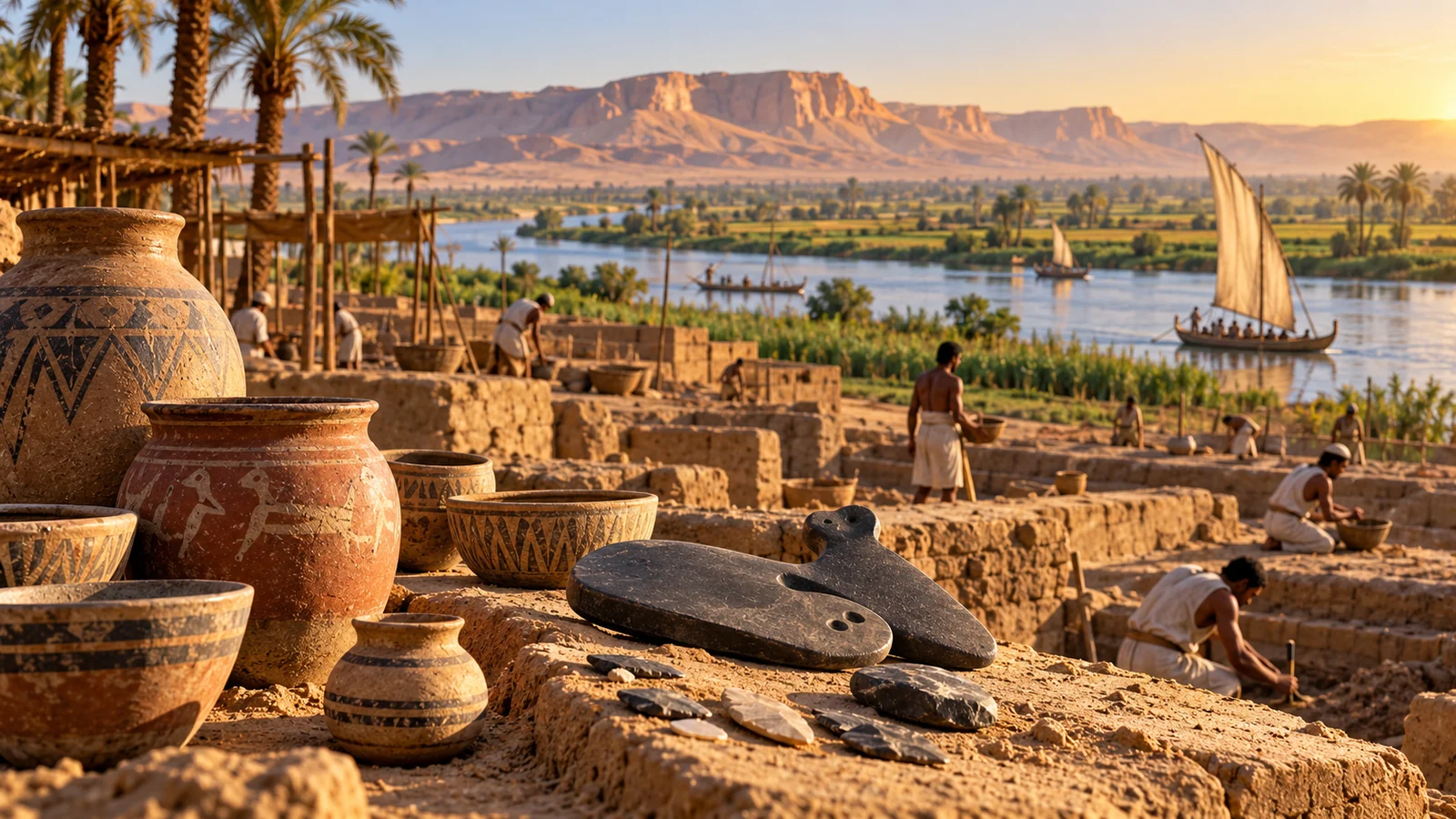
If you want to find the birthplace of ancient Egypt, should you travel to Abydos, Hierakonpolis, Naqada, or the Nile Delta? A quick online answer will often name one city and one unifying king. Archaeology gives a more interesting—and more defensible—answer: Egypt emerged through centuries of changes across a network of Nile communities, and the evidence for an emerging state is distributed across multiple regions and sites.
Long before the Giza pyramids, large royal tombs, decorated pottery, elite burials, early written labels, ceremonial objects, and administrative practices reveal the development of hierarchy, exchange networks and kingship. By around 3100 BCE, a unified Egyptian state was taking recognizable form. Yet the Narmer Palette, perhaps the most famous object associated with this transition, should not be treated as a video recording of one battle that created the country overnight.
This guide follows the archaeological evidence from Upper Egypt to the Delta, explains what each famous discovery can and cannot demonstrate, and offers an evidence-ranking framework that helps distinguish what excavators found from what historians infer.
The short answer: There is no archaeologically established single ‘birthplace’ of Egyptian civilization. Abydos, Naqada and Hierakonpolis were major centers of late Predynastic political development in Upper Egypt. Communities in Lower Egypt and the Nile Delta also contributed to the social and economic transformation. The state became politically unified through a gradual process culminating around 3100 BCE, associated with Narmer and the start of the First Dynasty.
What does ‘the birth of ancient Egypt’ actually mean?
Three different historical questions are often bundled together. They do not have the same answer.
- Where did people first live along the Nile? The valley has a much longer prehistoric record than the pharaonic state. Settlement and earlier human activity do not automatically equal state formation.
- Where did the distinctive cultures of Predynastic Egypt develop? Different areas had different local traditions before greater cultural connections and standardization emerged.
- Where did the first kingdom ruled by a single pharaoh form? This is a political history question answered through elite cemeteries, inscriptions, control of resources, royal iconography and settlement evidence.
If an article claims that the civilization was ‘founded in one afternoon’ or ‘invented by one village’, ask which definition it is using. Archaeologists often discuss state formation rather than one founding moment, because the available evidence is material, unevenly preserved and open to interpretation.
Timeline: from prehistoric communities to the First Dynasty
Dates are approximate. Chronological systems vary, especially for the subdivisions of the Naqada sequence. The Metropolitan Museum of Art places the Egyptian Predynastic Period at roughly 4500–3100 BCE and the Early Dynastic Period at approximately 3100–2649 BCE. Egypt’s Ministry of Tourism and Antiquities uses the same broad unification boundary around 3100 BCE.
| Approximate period | Developments | Why it matters |
|---|---|---|
| Around 5500–4000 BCE | Badarian and other late prehistoric cultural traditions in the Nile region | Long roots of farming, craft and burial customs precede kings |
| Around 4000–3500 BCE | Naqada I and neighboring Lower Egyptian cultural traditions | Distinct local material cultures and emerging social differentiation |
| Around 3500–3200 BCE | Naqada II, expansion and interaction across the Nile Valley | Increasingly complex settlements, exchange and elaborate elite burials |
| Around 3300–3100 BCE | Late Naqada III / ‘Dynasty 0’ in many descriptions | Early royal names, symbols of kingship, writing and administration |
| Around 3100 BCE | Transition to the First Dynasty; Narmer associated with unification | A politically unified Egyptian state is clearly recognizable |
| First and Second Dynasties | Early Dynastic royal institutions and major tombs | Greater standardization, monumental building and royal administration |
The date bands overlap because archaeological phases are scholarly classifications, not universally agreed calendar years. The Ministry’s Predynastic overview and the Metropolitan Museum chronology are good starting points for readers who encounter differing dates.
The geographical puzzle: Upper Egypt is south, Lower Egypt is north
The names can be counterintuitive. Upper Egypt refers to the southern, upstream part of the Nile Valley. Lower Egypt is the northern, downstream Delta toward the Mediterranean Sea. The Nile flows north, so ‘upper’ means higher along the river’s course, not higher on a modern map.
This distinction is essential when reading about the White Crown of Upper Egypt and the Red Crown of Lower Egypt, or when sources describe the unification of the ‘Two Lands’. The terms reflect ancient geography and political symbolism, not two separate modern countries.
Evidence site 1: Abydos and the growth of royal power
Abydos, near modern Sohag in Upper Egypt, is one of the strongest candidates for a major center of early kingship—not because it is the only important settlement, but because of the extraordinary archaeological record around its elite and royal cemeteries.
The area of Umm el-Qa’ab contains burials associated with rulers before and during the First Dynasty. The spectacular Tomb U-j, a late Predynastic elite burial, is frequently discussed in connection with early administration and some of the earliest writing-related evidence in Egypt. The labels and administrative materials associated with this general context raise questions about ownership, goods, place names and systems for tracking resources. They should not be presented as a complete narrative text describing a nation’s founding.
Later, the First Dynasty’s kings were buried at Abydos. The scale and layout of these royal monuments signal concentrated resources, labor organization and enduring royal authority. University College London’s Abydos introduction and early dynastic overview document the site’s importance.
What the evidence supports: Abydos became a central place in the development and display of political power and royal burial.
What it does not prove on its own: every institution of Egyptian civilization originated there, or its rulers gained power through one historically documented battle.
Evidence site 2: Hierakonpolis, or Nekhen, and the Narmer Palette
Hierakonpolis, also called Nekhen or Kom el-Ahmar, lies farther south near Edfu. It was a major Predynastic settlement and ceremonial center. The Met describes it as the largest known Predynastic settlement, while noting that Abydos and Naqada were important too. This is a statement about the known archaeological record, not proof that other settlements did not exist.
The most famous object associated with the site is the Narmer Palette, discovered at Hierakonpolis and now held in the Egyptian Museum in Cairo. Dated approximately to the beginning of the First Dynasty, it shows Narmer wearing different crowns on opposite sides, captives and enemies, and distinctive symbols of power. The Egyptian Ministry of Tourism and Antiquities explains the imagery as connected to the unification of Upper and Lower Egypt. Official Narmer Palette catalogue entry.
The palette is important for another reason: it shows that royal imagery was developing conventions that lasted for millennia. A ruler shown striking a captive became a recurrent icon of kingship. An image designed to proclaim authority is therefore not necessarily a photographically literal record of the single event that made a kingdom.
What the evidence supports: kingship and the ideology of power were sophisticated by Narmer’s time, and Hierakonpolis was a major religious and political center.
What it cannot settle on its own: whether unification happened through one campaign, successive alliances, administrative absorption, warfare spread across generations, or a combination of processes.
Evidence site 3: Naqada and the archaeological culture named after it
Naqada is more than a place on the map. It is also the name given to the dominant archaeological sequence used to describe much of late Predynastic Upper Egypt. The phases Naqada I, II and III are recognized through changes in material culture, including pottery types, burial practices, tools, ornamentation and social inequality.
The region’s cemeteries reveal the emergence of larger and wealthier burials. These patterns suggest that some individuals and groups accumulated greater status and resources, although a rich tomb does not hand us a written constitution or the exact boundaries of its owner’s political territory.
Naqada matters especially because it allows archaeologists to ask how changes unfolded over time: Did craft styles spread? Did elite tombs become more concentrated? Was there increasing competition or consolidation among local centers?
University College London’s account of the Naqada chronology explains how pottery typology became essential to this relative dating system.
Evidence site 4: the Nile Delta was not an empty stage
Stories that focus exclusively on southern rulers can make the northern Delta sound passive or uninhabited until a pharaoh arrived. The archaeological record argues against such a simple picture. Lower Egypt had its own communities and material traditions, including the Maadi cultural complex and sites such as Buto.
The Egyptian Ministry of Tourism and Antiquities specifically identifies Maadi, Badarian and Naqada traditions when describing Predynastic Egypt. Archaeologists study northern settlement layers, pottery and exchange evidence to understand how Delta communities interacted with and were progressively linked to the southern cultural and political world.
A site like Tell el-Farkha, in the Delta, is important because it illuminates local developments, trade and changing material culture. It is not enough to use one find as a declaration that the Delta ‘founded everything’; instead, it demonstrates why a south-only history would omit relevant evidence. Scholarly archaeological publications include studies of Tell el-Farkha’s stratigraphy and Lower Egyptian material culture.
The stronger interpretation: the eventual state unified distinct regions. Northern communities were part of the story, even when particular southern centers appear especially powerful in late Predynastic evidence.
Comparison: what the major sites tell us
| Site or region | Key type of evidence | Strong conclusion | What remains uncertain |
|---|---|---|---|
| Abydos / Umm el-Qa’ab | Elite and royal tombs, labels, early administrative material | Major focus of emerging and First Dynasty kingship | Exact route to power and full political reach |
| Hierakonpolis / Nekhen | Large Predynastic settlement, ceremonial artifacts, Narmer Palette context | Important political and ideological center | Literal reading of victory imagery as a one-day conquest |
| Naqada | Cemeteries, pottery sequence and signs of elite differentiation | Long social and cultural transformation before kings | Whether one center governed other sites at a given date |
| Buto and the northern Delta | Settlements and shifting pottery/material traditions | The north had its own communities and histories | The speed and mechanism of political integration |
| Tell el-Farkha | Settlement stratigraphy and regional interaction evidence | Delta participation in Predynastic development | How local changes map onto specific named rulers |
| Memphis area | Later central capital region and surrounding early cemeteries | Strategic focus of the unified kingdom | Founding narratives may simplify a changing administrative landscape |
The comparison is the key point: different site types answer different questions. A burial can tell us much about elite status; a settlement can reveal production and daily life; an administrative label can indicate controlled resources; an icon of conquest can advertise a ruler’s legitimacy. None should automatically be treated as a complete account of how the kingdom formed.
Did King Narmer unify Egypt in one great battle?
Narmer is a central figure in accounts of Egypt’s political unification. The palette bearing his name visually links northern and southern symbols. Egypt’s Ministry dates the Early Dynastic transition to about 3100 BCE and says the unification process was very gradual, with a final stage apparently occurring during Narmer’s reign. That is much more cautious than the popular phrase ‘Narmer conquered the entire country in a day’.
Why the caution? A royal monument has a purpose. It celebrates kingship and power. Its images are evidence that this ideology existed, but scholars still have to interpret whether a scene records an actual campaign, a ritual, a symbolic victory, a general political message, or several of these at once.
The unification question is therefore not ‘Was Narmer real?’ but rather what kind of political process made it possible for someone like Narmer to rule as king of the Two Lands?
Narmer, Menes and Aha are not automatically interchangeable names
Later king lists identify Menes as the first ruler in traditional accounts. Contemporary archaeological sources, however, do not resolve his identity without controversy. UCL’s overview notes that scholars have commonly connected Menes with Narmer or Aha, while acknowledging that there is no firm consensus. The name Menes in a later tradition is not a license to assume that every early ruler in modern reconstructions was definitely the same individual. UCL: Early Dynastic Egypt.
The evidence test: how to read a claim about Egypt’s origins
Here is a practical framework you can apply to a museum label, documentary, viral history video or online article. Rather than counting how impressive an artifact looks, ask what chain of inference is being made.
| Claim | Direct evidence needed | Cautious interpretation |
|---|---|---|
| ‘This site had wealthy rulers’ | Elite tombs, grave goods, burial investment | Supports inequality and political complexity, not a named national government |
| ‘There was centralized administration’ | Labels, seals, storage systems and repeated organizational practices | Suggests resource accounting, but extent of central control must be investigated |
| ‘This object records a conquest’ | Image or inscription, securely dated and contextualized | May communicate propaganda, ritual or historical events; compare other evidence |
| ‘This ruler governed both lands’ | Royal titles, inscriptions, distribution of administrative materials | Stronger than a single image, but chronology and reach still matter |
| ‘All of Egypt began at this one site’ | Broad, comparative evidence excluding alternatives | Rarely supportable given multiple important centers and incomplete excavation |
Practical example: A richly equipped grave in Naqada does not prove that its occupant was king of the entire Nile Valley. A cluster of royal tombs at Abydos is much stronger evidence for a durable elite tradition there, yet it still does not mean ordinary village life or regional innovations elsewhere had no role.
This way of ranking evidence is the article’s central added value: it gives readers a method for assessing spectacular ‘first pharaoh’ claims rather than simply memorizing rival site names.
What pottery can reveal that royal monuments cannot
Pottery is often less photogenic than a carved palette, but it is indispensable for establishing relative chronology. Egyptologist Flinders Petrie developed a technique called sequence dating, comparing pottery types found together in graves and arranging assemblages into a relative sequence. Later scholars refined his scheme into the well-known Naqada phases.
A pottery sequence may reveal that a particular ceramic tradition spread into new regions over time. That pattern can reflect exchange, migration, social prestige, local imitation, political expansion or some combination. Pottery alone cannot distinguish these causes without settlement evidence, burials, environmental context and other artifact types.
For a worked account of how grave pottery underpinned sequence dating, read UCL’s explanation of Petrie’s sequence dates. It is a useful antidote to stories that pretend one spectacular object can settle every question.
Why writing and administration mattered before the pyramids
Early writing in Egypt did not begin as lengthy histories for modern readers. Some early labels and inscriptions are associated with names, commodities, places and administration. The appearance of these marks around the late Predynastic transition is significant because complex political systems increasingly need ways to account for resources and authority.
It is tempting to say that writing caused the state, but the evidence supports a more careful relationship: administrative complexity, political centralization, exchange and systems of notation likely evolved together in interacting ways. A small label tied to a valuable product is not less important than a royal monument—each reveals a different mechanism of state power.
University College London documents First Dynasty tablets and their economic uses and early labels and possible meanings.
Was unification peaceful, violent, or both?
Royal imagery often features bound enemies, violence and triumphant kings. Conflict likely played some role in political consolidation. Yet archaeological evidence also points to exchange networks, the spread and blending of material culture, administrative systems, and local elite relationships. Historians disagree about how to reconstruct the relative contributions of these forces across the late fourth millennium BCE.
UCL summarizes competing models: one associates the expansion of Naqada culture with an already politically unified formation; another treats major centers such as Hierakonpolis, Naqada, Hu and Abydos as possible regional centers of power before consolidation. These are historical models, not directly photographed borders. UCL: state formation models.
The most defensible answer is not that there was definitely no war—or that one famous battle explains everything—but that the available evidence is consistent with a complex, multi-stage process whose exact political history is still debated.
Why Memphis became important after unification
The area around Memphis, near the meeting of the valley and the Delta, was strategically well placed for a state that needed to govern both northern and southern regions. Egyptian official heritage materials associate the unified kingdom with the founding of Memphis, or Ineb-Hedj, and UCL notes the region’s extensive Early Dynastic cemeteries around Saqqara and Helwan.
This geographical logic helps explain the later political importance of Memphis without claiming it was the birthplace of every aspect of Egyptian civilization. A new capital and the long development of a state are different phenomena.
Five myths worth retiring
Myth 1: Egyptian civilization began with the pyramids
The Giza pyramids belong to the Old Kingdom, many generations after state formation around 3100 BCE. Predynastic communities developed arts, rituals, agriculture, trade networks and increasingly complex social structures long before these monuments.
Myth 2: The Narmer Palette is proof of one exact battle
It is evidence for early royal ideology and a ruler associated with the unification story. The direct historical meaning of every scene is interpretive; monumental images do not function like modern photographs or eyewitness reports.
Myth 3: Upper Egypt means the north
It means the south, upstream on the Nile. The north is Lower Egypt, including the Delta. Misunderstanding this reverses the geography of the political story.
Myth 4: Only the south mattered
Abydos, Hierakonpolis and Naqada are prominent in the record, but northern communities such as Maadi, Buto and Tell el-Farkha belong in any convincing reconstruction of how the Two Lands became one.
Myth 5: Narmer, Menes and Aha are proven to be one man
These names are linked in historical scholarship and later traditions, but the precise identity of the legendary Menes remains debated. Present reconstructions as interpretations, not settled biographical facts.
A reader’s itinerary through the evidence—not just the monuments
You can explore this topic in museum and academic collections even without traveling to each excavation. Begin with the Egyptian Ministry’s Predynastic overview, then read its Early Dynastic overview. Compare the famous Narmer Palette with UCL’s Abydos material and Naqada state formation models. Finally, use the Metropolitan Museum’s chronological overview to place these developments before the pyramids.
When an article gives a firm first-king date or names one ‘first city’, check whether it cites excavated objects and scholarly analysis, and whether it distinguishes cultural similarity from political control. Those are the questions that change a catchy origin story into meaningful historical understanding.
For a related Horus Valley perspective on how later Egyptians used astronomy and seasonal cycles, read How Ancient Egyptians Used Sirius to Anticipate the Nile Flood. The Nile shaped both the early environment of settlement and later systems of knowledge, but those subjects belong to different periods and kinds of evidence.
So where was ancient Egypt born?
If by ‘birth’ you mean the growth of the institutions that eventually produced pharaonic kingship, Upper Egypt’s centers—especially Abydos, Hierakonpolis and Naqada—are central to the story. If you mean the history of communities, culture and trade that became part of Egypt, the answer extends across the Nile Valley and Delta. And if you mean the political emergence of a state ruled as the Two Lands, that process reached a major turning point around 3100 BCE, during the transition associated with Narmer and the early First Dynasty.
One birthplace makes for an easy headline. A network of places, a gradual political transformation, and different types of archaeological evidence make for a much more accurate history.
Sources and research method
- Egyptian Ministry of Tourism and Antiquities — Predynastic Period: Predynastic cultures, geographical distinctions and transition to statehood.
- Egyptian Ministry of Tourism and Antiquities — Early Dynastic Period: gradual unification, Narmer, Memphis and First Dynasty royal burial at Abydos.
- Egyptian Ministry of Tourism and Antiquities — Narmer Palette: official artifact description, iconography and provenance.
- The Metropolitan Museum of Art — Egypt, 8000–2000 B.C.: comparative regional chronology and Predynastic material culture.
- University College London — State formation in Naqada Egypt: contrasting scholarly models of political development.
- University College London — Early Dynastic Egypt: First Dynasty institutions, Abydos and the debated identification of Menes.
- University College London — Sequence dating: how archaeological ceramics underpin relative chronology.
- Heidelberg University scholarly publication — Lower Egyptian materials and Tell el-Farkha: evidence for studying the Delta as part of state formation.
Editorial approach: Reviewed against institutional archaeology resources in October 2026. Dates remain approximate and differ across chronologies; material evidence, scholarly hypotheses and royal narratives are deliberately separated. The featured illustration is an interpretive visualization, not a photograph of an excavated settlement.
You may also like
 History & Civilizations
How Do Archaeologists Date Ancient Artifacts? Radiocarbon, Layers, Pottery and the Limits of Scientific Dating
How do archaeologists date ancient artifacts? Compare carbon-14, stratigraphy, tree rings and pottery dating with practical examples and…
 History & Civilizations
Ancient Objects Emerging From Melting Glaciers: What Scientists Are Finding
Stone Age arrows, forgotten mountain routes and fragile tools are emerging as ice retreats. Explore discoveries in Norway,…
 History & Civilizations
Secrets of Ancient Egyptian Glass: How Did Its Colors Survive for Thousands of Years?
Explore the science of ancient Egyptian glassmaking: cobalt blue, copper turquoise, opaque pigments, and the workshops of Malkata…