
How to Chill Drinks Fast With Ice, Water and Salt: The 2-Minute Test
A practical, evidence-based way to cool cans with ice, water and salt, including a measured 330 mL two-minute test, comparative timings and safety tips.
Contents
- What you need for a fast ice bath
- How to chill a can quickly: step-by-step
- Does the two-minute claim really work? What was measured
- Why salt, ice, and water work together
- Small aluminum can vs. 1.5-liter bottle
- Ice bath, fridge, or freezer: which should you choose?
- Six mistakes that make chilling slower or less safe
- A fair home experiment you can run
- Frequently asked questions
- How long does it take to chill a soda in ice water and salt?
- Can I just put salt on a can?
- Does this work for a large bottle?
- Is a wet paper towel in the freezer faster?
- Will the salt get into my drink?
- Related guides on Horus Valley
- Sources and methodology
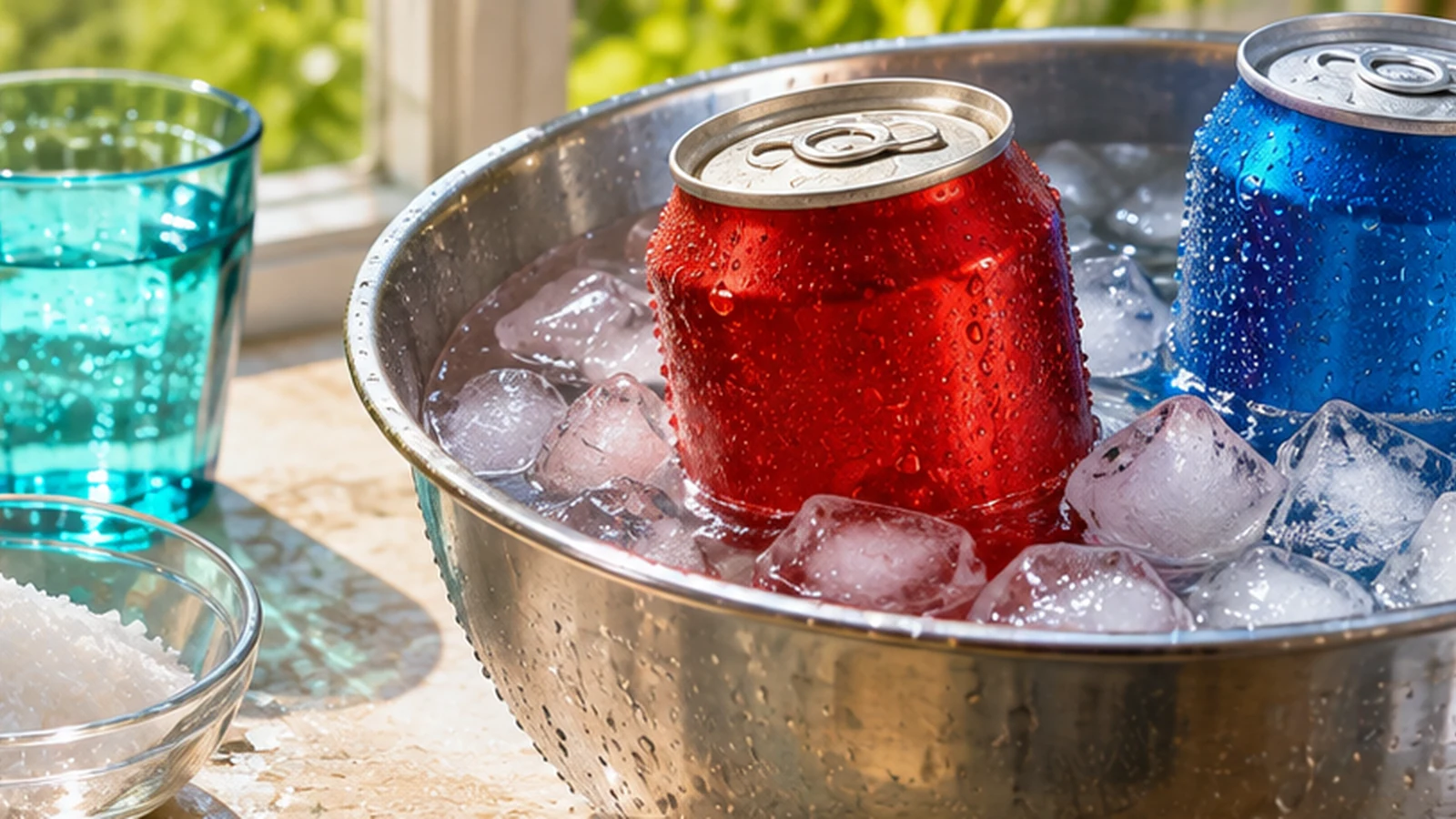
An ice-water-salt bath can chill a small sealed can surprisingly fast—but “two minutes” is a measured example, not a universal promise. In a test published by SINTEF in December 2025, a 330 mL container that started at 21°C reached about 9°C after two minutes in a salted ice-water bath. It reached 5°C after about 2.5 minutes. See the original methods and results.
The practical trick is to surround the container with very cold liquid rather than leaving it in cold air or pressing a few dry ice cubes against it. Below are clear instructions, an apples-to-apples comparison of cooling times, and the limitations that most quick hacks leave out.
What you need for a fast ice bath
- A deep bowl, bucket, or small cooler with enough space for a sealed drink container.
- Plenty of ice, ideally enough to cover most of the can.
- Cold water to fill the gaps between the ice cubes.
- Ordinary table salt, a spoon for stirring the bath, and optionally a thermometer and timer.
Use the salt outside the can, in the cooling bath. The Australian National University demonstration uses a half-cup of table salt for a large ice-filled container in a classroom comparison, but the ideal amount depends on how much ice and water you use. A smaller kitchen bowl is not automatically equivalent to a research setup.
How to chill a can quickly: step-by-step
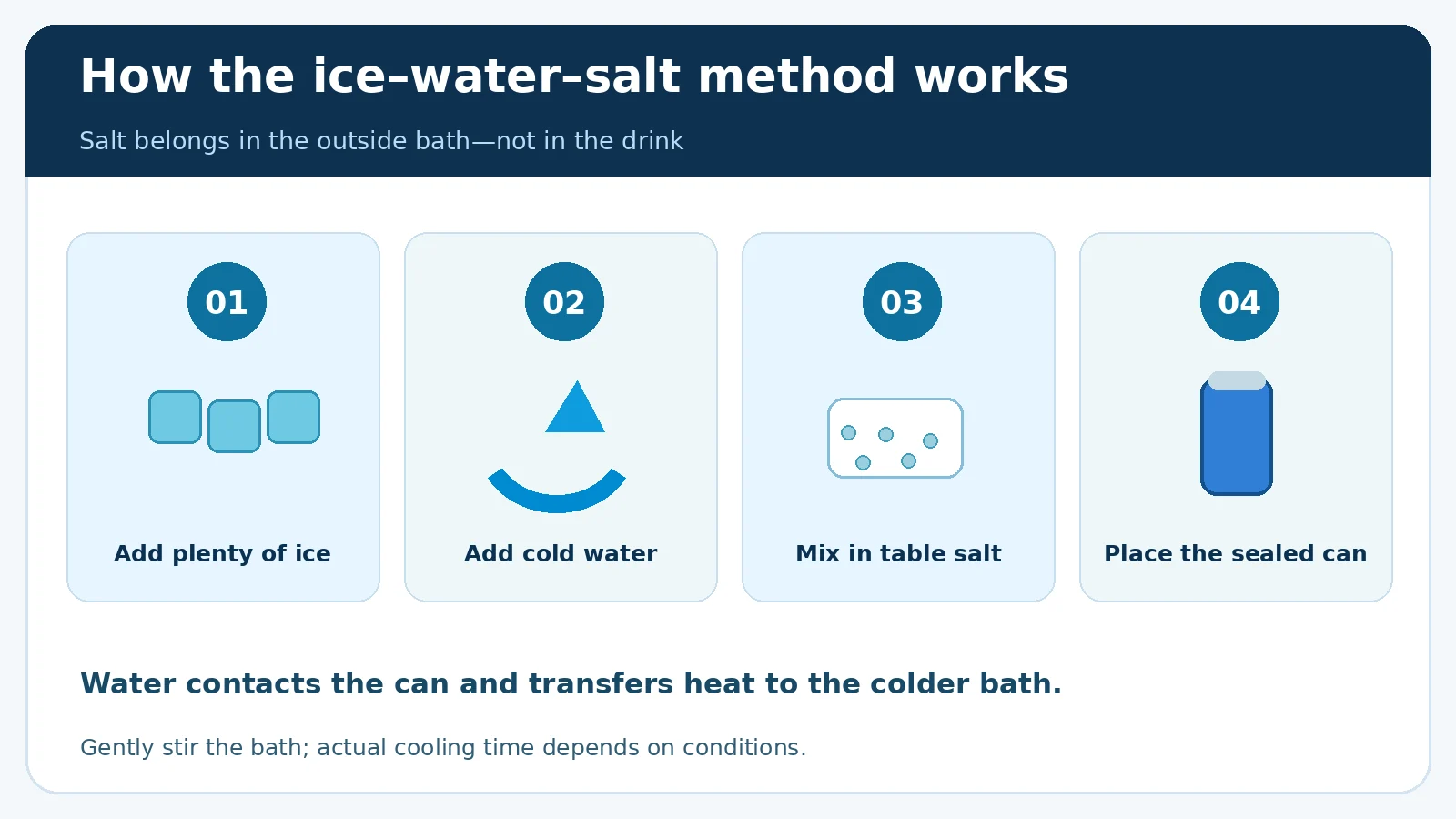
- Fill the bowl with plenty of ice. Pour in enough cold water to surround most of the can and fill the spaces between cubes.
- Sprinkle ordinary table salt into the ice-water mixture and stir it. The salt is for the bath, not the beverage.
- Set a clean, tightly closed aluminum can into the bath, keeping as much of its body in contact with the liquid as practical.
- Stir the bath gently from time to time to circulate cold water. Do not vigorously shake a carbonated drink.
- Check the temperature or coldness after roughly two minutes. Continue cooling if the can is not cold enough; the clock alone is not a reliable measurement.
- Remove the can, rinse its lid area and dry it before opening.
If you are chilling juice, water, or soda in a large plastic bottle, expect a different result. Container size, material, starting temperature, ice quantity, salt concentration, and mixing all affect cooling time.
Does the two-minute claim really work? What was measured
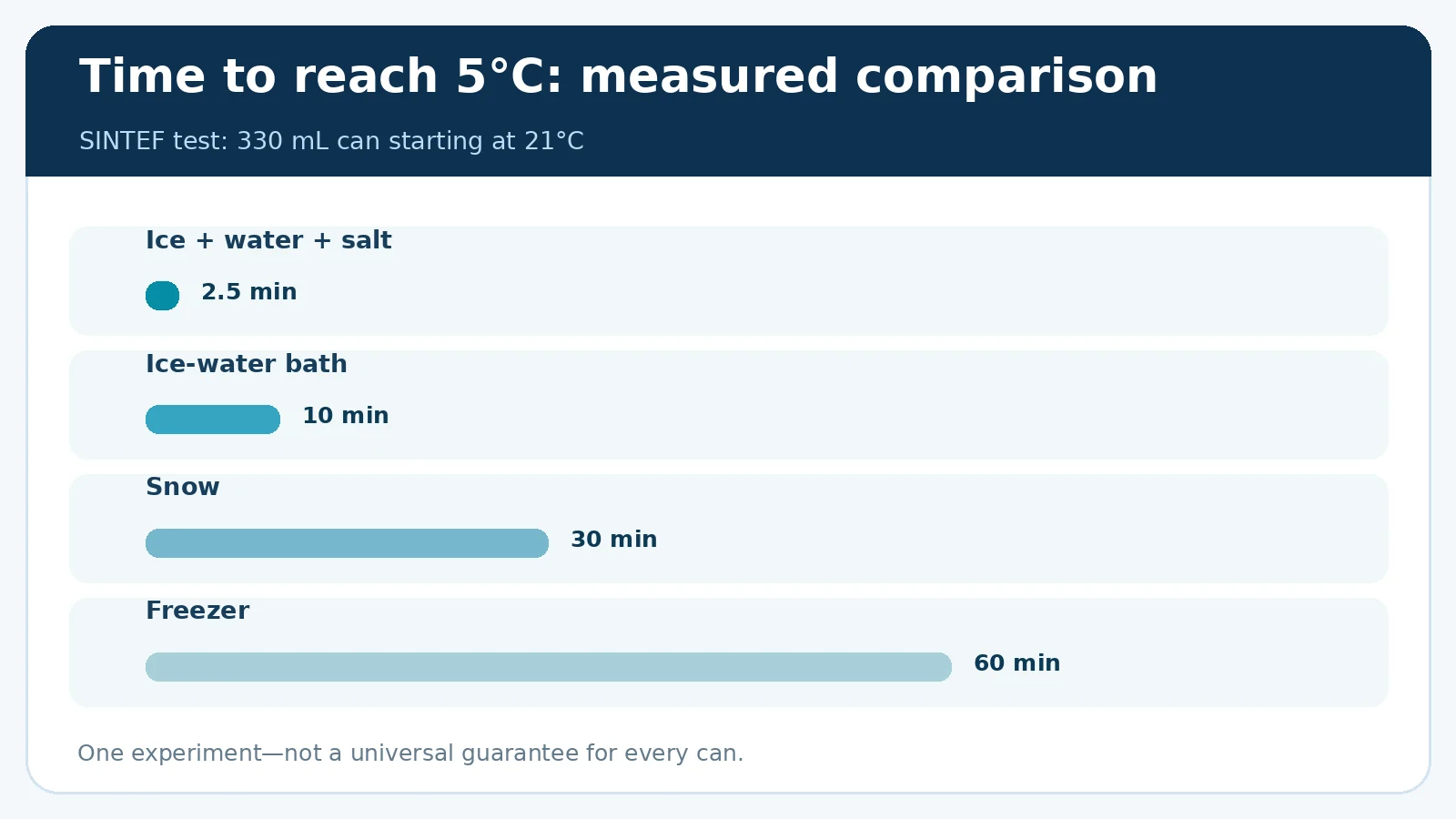
Research scientist Kristian Solheim Thinn compared several methods in a 19 December 2025 SINTEF home experiment. Both a 330 mL can and a larger bottle began at 21°C and were filled with water for measurements. In the salt-ice-water setup, the small can reached 9°C in about two minutes, and 5°C in 2.5 minutes. These are results under particular experimental conditions, not a guarantee for your kitchen.
| Method | Time to reach 5°C | What the number means |
|---|---|---|
| Ice + water + salt | 2.5 minutes | Fastest in this controlled comparison |
| Ice-water bath, no salt | 10 minutes | Cold-water contact without the colder brine |
| Snow | 30 minutes | Slower heat removal in the tested setup |
| Freezer at −20°C | 60 minutes | Cold air removed heat more slowly than the baths |
| Fridge, about 4°C | 10 hours | Time to 5°C in this experiment; not a universal fridge rule |
The SINTEF salted-bath test used 5 liters of water and 1.25 kg of salt, producing a notably cold bath. That ratio is an experimental condition, not a budget-friendly household recipe or a requirement for every attempt. A household bowl with a few spoonfuls of salt may help but should not be assumed to reproduce the exact two-minute result.
Why salt, ice, and water work together
Ice absorbs heat as it melts; water contacts the can more completely than scattered cubes; and dissolved salt lowers the freezing point of the surrounding water. The ice-and-salt mixture can therefore drop below the usual 0°C temperature of melting ice and water. A larger temperature difference encourages heat to leave the warmer drink faster. University of Washington demonstrates this freezing-point depression with a thermometer, while the Museum of Science explains the beverage application.
This does not mean salt mysteriously creates cold. The surrounding ice-water system and the energy involved in melting matter. Nor does “more salt” produce unlimited cooling: how much ice remains and the resulting mixture temperature impose practical limits.
Small aluminum can vs. 1.5-liter bottle
The two-minute headline applies to a small can in a specific bath. In the same SINTEF experiment, a 1.5-liter bottle needed approximately 20–25 minutes to reach 5°C in a regular ice bath; the 330 mL can took 10 minutes in the comparable ordinary ice bath. Crucially, SINTEF did not report a corresponding salted-ice-bath time for the large bottle, so assigning it a two-minute result would be misleading.
| Container or condition | Reason the time changes |
|---|---|
| 330 mL aluminum can | Small liquid volume and can geometry; the published two-minute result concerns this size. |
| 1.5 L plastic bottle | Much more liquid to cool; 20–25 minutes to 5°C in regular ice water in SINTEF’s data. |
| Different plastic or glass packaging | Wall thickness and shape affect heat transfer; no single exact multiplier applies. |
| Multiple warm cans in one small bowl | They warm the bath and may block circulation; use enough ice and space. |
Ice bath, fridge, or freezer: which should you choose?
For a can you want to drink soon, ice water with salt is typically the practical speed option. For storing drinks cold for hours, a fridge is simpler. A freezer may help but must be monitored; forgotten sealed drinks can freeze and expand. Consumer advice from The Kitchn and Food & Wine describes damp-towel and ice-bucket alternatives, but those articles are not a controlled head-to-head replication of SINTEF’s measurements.
- No salt available: a water-and-ice bath still provides broad contact with the container.
- No ice available: use a fridge or cold-water bath and plan for a longer wait.
- Trying to keep drinks cold: move chilled cans to a refrigerator or insulated cooler rather than leaving them in sunlight.
Six mistakes that make chilling slower or less safe
- Adding salt to the drink instead of to the surrounding ice-water bath.
- Using very little ice for several warm cans; the bath rapidly warms up.
- Shaking a sealed carbonated drink hard, which can cause foaming when opened.
- Leaving sealed drinks in a freezer unattended, where freezing and expansion can damage the container.
- Treating two minutes as a guaranteed time for all drink sizes and starting temperatures.
- Using cracked glass bottles or exposing glass to abrupt temperature shocks.
A fair home experiment you can run
Try three equally sized containers of water that start at the same temperature. Surround one with ice only, one with ice and water, and one with ice, water, and salt. Use comparable bowls and ice quantities, measure at consistent intervals, and record conditions. This is a suggested educational comparison—not a test carried out by Horus Valley. ANU provides a classroom protocol with controlled starting temperatures and side-by-side measurements.
Frequently asked questions
How long does it take to chill a soda in ice water and salt?
In one measured test, a 330 mL water-filled can went from 21°C to roughly 9°C in two minutes and 5°C in 2.5 minutes. Your drink can take longer or shorter, depending on the actual bath, packaging and starting temperature.
Can I just put salt on a can?
Not as an equivalent method. Salt works by changing the properties of the ice-water bath surrounding the sealed can. You still need enough ice and water for effective heat transfer.
Does this work for a large bottle?
The same physics applies, but the bottle usually takes longer. SINTEF measured 20–25 minutes for a 1.5 L bottle in normal ice water and did not publish a matching salted-bath result for that size.
Is a wet paper towel in the freezer faster?
It is a popular trick, but in SINTEF’s test adding a wet covering did not improve cooling time versus the uncovered container in the freezer. Do not assume it is the fastest method in every home.
Will the salt get into my drink?
Not if the container remains sealed and undamaged. Keep the outside bath separate from the drink, and rinse and dry the opening area before drinking.
Related guides on Horus Valley
For more on why temperature does—and does not—change our experience of food, see Is Hot Food More Filling Than Cold?. If you are using a cold bath because of an appliance outage, check our fridge and freezer food-safety guide; chilling a beverage is not a substitute for safe perishable-food storage.
Sources and methodology
- SINTEF: measured cooling times for 330 mL cans and 1.5 L bottles
- Australian National University: salt-and-ice chilling demonstration
- University of Washington: freezing-point depression demonstration
- Museum of Science, Boston: quick drink-cooling explanation
- American Chemical Society: chemistry life-hack infographic
Editorial note: All specific temperature and timing claims are attributed to the cited published tests. Horus Valley did not conduct these tests. The featured visual is illustrative; the original diagrams were prepared from the methods and source measurements.
You may also like
 Science & Curiosities
How Red-Billed Oxpeckers Warn Black Rhinos: What a Field Study Found
A 2020 black-rhino study tested 86 human approaches. Learn what oxpecker alarm calls reveal, what the 23% versus…
 Science & Curiosities
Do Jumping Spiders Dream? Two Sleep Stages and a REM-Like Discovery
A 2026 PNAS study finds two regulated sleep stages in a jumping spider, including REM-like behaviour—without proving that…
 Science & Curiosities
Invictibellatrix amberina: New Dinosaur Discovered in Britain After 100 Years in a Museum
A fossil stored since 1924 has revealed Invictibellatrix amberina, an early megaraptoran from the Isle of Wight. Explore…