
How Red-Billed Oxpeckers Warn Black Rhinos: What a Field Study Found
A 2020 black-rhino study tested 86 human approaches. Learn what oxpecker alarm calls reveal, what the 23% versus 100% result means, and what remains unproved.
Contents
- What bird warns a rhino when a person approaches?
- How researchers tested the warning-call idea
- The headline result: 23% versus 100% detection
- How does a rhino react to an oxpecker alarm call?
- Do oxpeckers deliberately protect rhinos?
- Can oxpeckers stop rhino poaching?
- Is removing ticks the bird’s only benefit?
- Claims versus what the evidence actually shows
- Why the research matters
- Frequently asked questions
- What is the name of the bird riding on a rhino?
- Are black rhinos blind?
- Did the study prove that birds warn rhinos about poachers?
- When was the study published?
- Real photographs and identification resources
- Sources and further reading
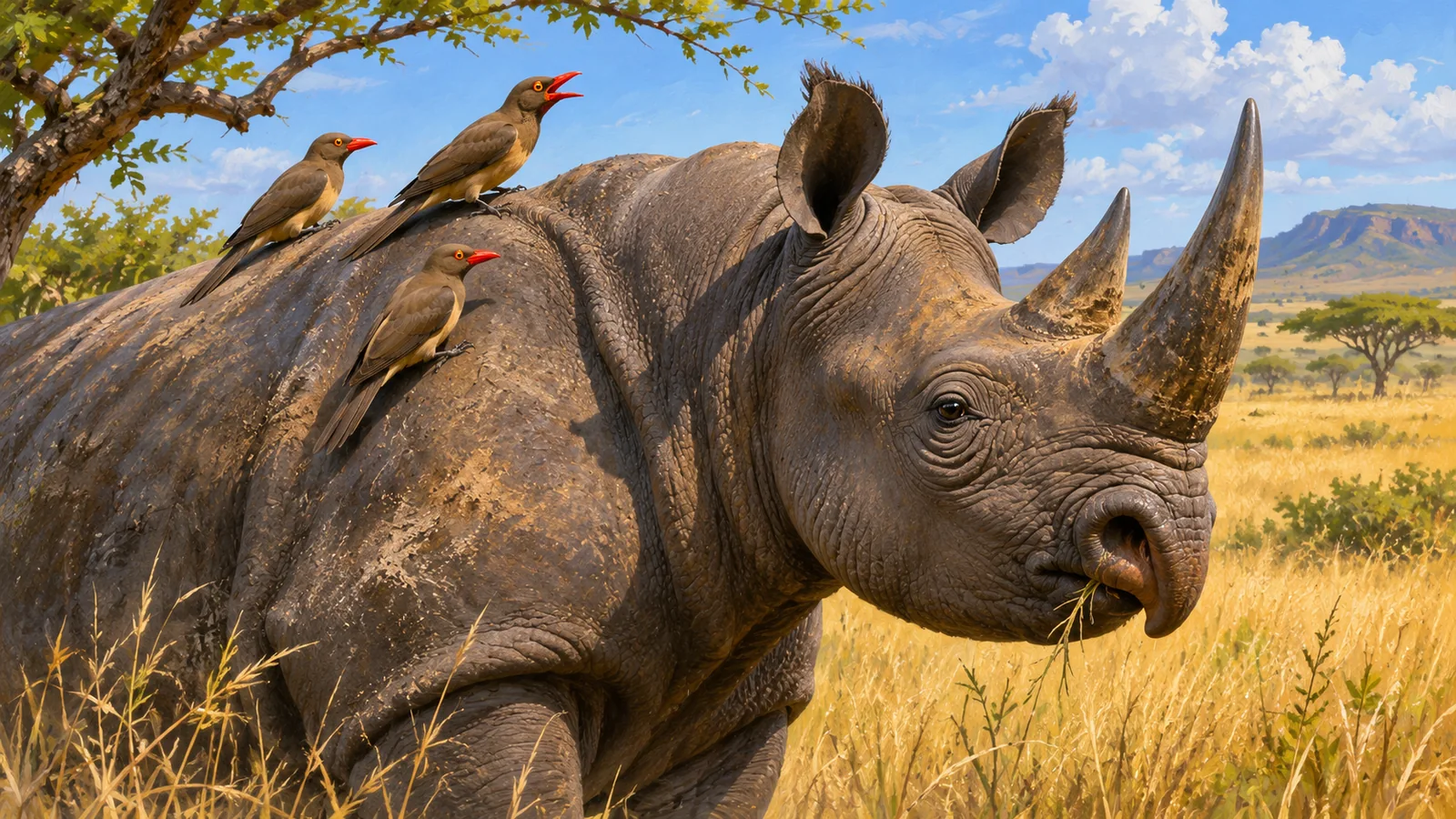
Red-billed oxpeckers can help black rhinoceroses detect approaching humans by giving sharp alarm calls. In a 2020 field study, rhinos accompanied by these small birds noticed approaching researchers more often and from farther away than rhinos without them. That is striking evidence of an early-warning benefit—but not proof that the birds consciously warn rhinos, or that they have been shown to prevent poaching deaths.
This guide separates the observations from the tempting headlines. Its primary source is the peer-reviewed Current Biology paper, “Oxpeckers Help Rhinos Evade Humans”; the underlying approach-trial dataset is also openly available. The findings were published in 2020, not newly discovered in 2026.
What bird warns a rhino when a person approaches?
The bird is the red-billed oxpecker (Buphagus erythrorhynchus), a small African species often seen perched on large mammals. Its red bill and yellow eye-ring make it recognizable. Oxpeckers search hosts for ticks and other parasites, and sometimes feed on blood or open wounds. Their relationship with mammalian hosts is therefore not always purely beneficial.
Its Swahili name, Askari wa kifaru, translates approximately as “the rhino’s guard.” That traditional name long preceded the experiment, giving researchers a testable question: Do these birds make it easier for rhinos to detect people?
How researchers tested the warning-call idea
Roan Plotz and Wayne Linklater worked in South Africa’s Hluhluwe–iMfolozi Park. Over 27 months, the team tracked and sought black rhinos, then carried out 86 controlled human-approach trials involving 11 rhinos. The researchers documented whether one or more resident oxpeckers were present, whether and when a rhino detected a person, and the distance at detection. These were field approaches by researchers—not controlled encounters with actual poachers.
The species matters. The experiment concerned black rhinos (Diceros bicornis) in one reserve. Its detection figures should not be presented as confirmed results for white rhinos, other rhinoceros species, or every habitat.
The headline result: 23% versus 100% detection
| Measure | Without oxpeckers | With oxpeckers |
|---|---|---|
| Detection of approaching humans in the trials | 23% | 100% |
| Average detection distance | 27 ± 6 m | 61 ± 4 m |
| Study scope | Part of 86 approaches to 11 rhinos | Part of 86 approaches to 11 rhinos |
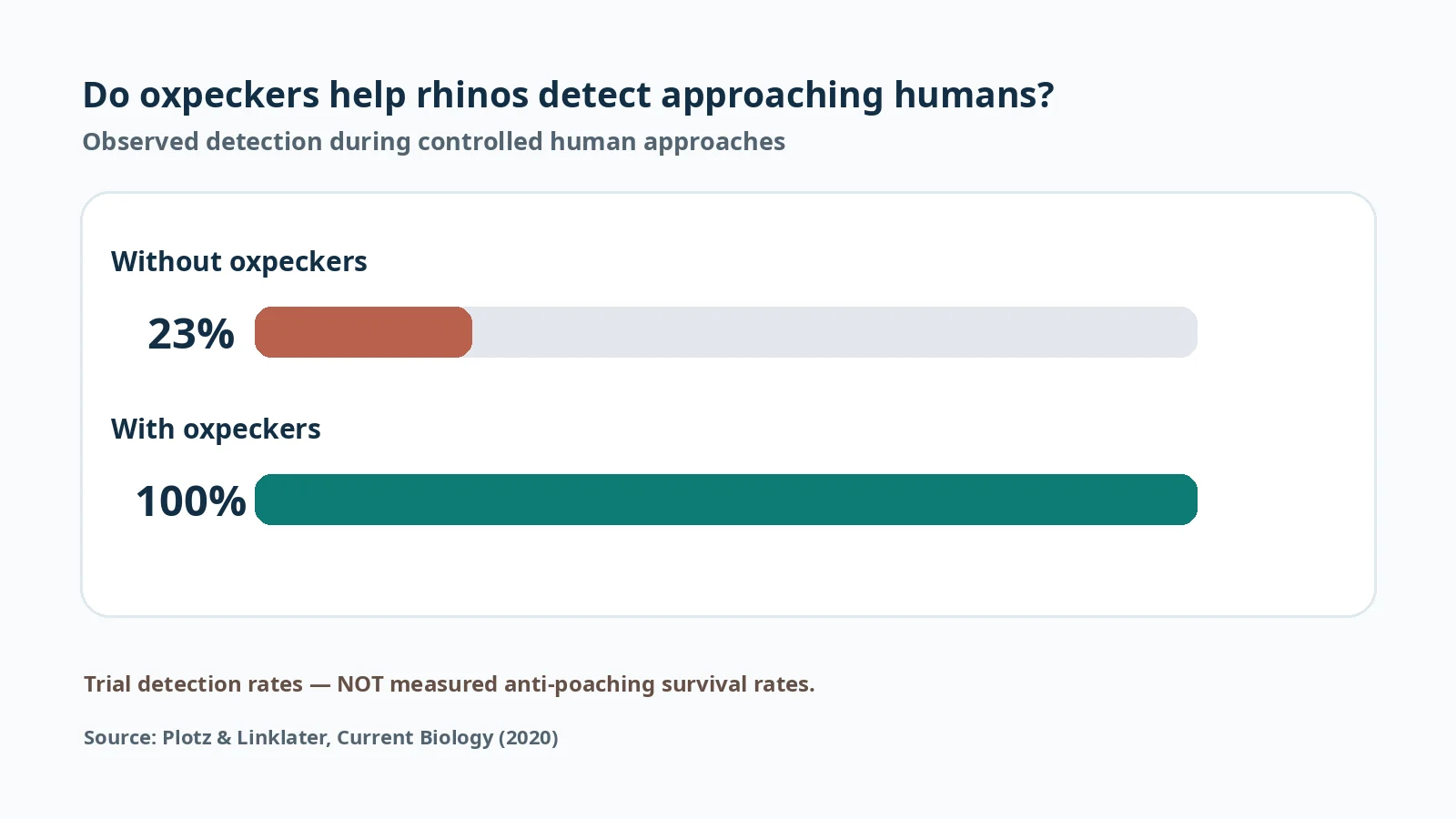
The analysis also linked each additional oxpecker with approximately 9 meters of extra human-detection distance. Using observations of tagged and untagged rhinos, the authors estimated that oxpeckers may have allowed rhinos to escape detection in roughly 40–50% of potential encounters. That is an estimate of avoided human sightings; it is not a finding that poaching mortality fell by 40–50%.
How does a rhino react to an oxpecker alarm call?
The rhinos often became vigilant and oriented themselves downwind, the direction from which approaching humans may be harder to smell. This behavior is consistent with the animals checking a sensory blind spot. They did not reliably turn toward the actual researcher, suggesting the bird’s call communicates that a potential threat is nearby rather than pinpointing its direction.
Black rhinos have comparatively poor eyesight but useful hearing and smell. The bird detects activity and makes a call; the rhino hears that signal and changes its behavior. In behavioral ecology, this kind of use of another species’ signals is called heterospecific eavesdropping. It does not require a shared language or an intentional message directed at a rhino.
Do oxpeckers deliberately protect rhinos?
Intentional protection has not been demonstrated. The calls may be warnings to other oxpeckers, with rhinos benefiting because they overhear them. National Geographic reported outside scientists’ reservations about calling this intentional cooperation. The experiment establishes a rhino response to calls, not what the bird is thinking.
Can oxpeckers stop rhino poaching?
Better and earlier detection of approaching humans could plausibly help endangered black rhinos avoid some dangerous encounters. That makes oxpeckers an interesting conservation consideration. However, the study did not record changes in poaching fatalities, compare reserves with versus without oxpecker restoration, or test nighttime conditions and other hunting methods. Protecting habitat, reducing illegal hunting, and effective ranger work remain necessary; birds should not be marketed as a proven replacement.
The researchers raised the possibility of reintroducing oxpeckers where populations have declined. This is a proposal for further conservation study, not evidence that a restoration program already saves a measured number of rhinos.
Is removing ticks the bird’s only benefit?
No. Oxpeckers may remove ticks and other external parasites, and the warning-call experiment adds a distinct potential service. But the relationship can be complicated: the birds sometimes probe wounds and feed on blood, as Audubon’s coverage explains. Whether their net effect is positive can vary with host, context, and behavior. Calling the relationship always “mutualistic” oversimplifies the evidence.
Claims versus what the evidence actually shows
| Common claim | More precise interpretation |
|---|---|
| Oxpeckers intentionally warn rhinos | Rhinos respond to calls; the calls’ intended audience is not proved |
| Birds have been proved to save rhinos from poachers | Field trials measured detection of researchers, not survival during poaching |
| Oxpeckers cut poaching by 50% | 40–50% refers to an estimate of undetected human encounters avoided |
| Every rhino species benefits equally | The 2020 trials involved black rhinos in one South African park |
| Rhinos are completely blind | Their eyesight is poor, not absent |
Why the research matters
- Indigenous knowledge: The Swahili name “rhino’s guard” already recognized an association that scientists later tested.
- Animal communication: A predominantly solitary mammal can act on an alarm signal produced by a different species.
- Study interpretation: A compelling observation need not imply intention or prove a conservation outcome.
- Conservation questions: The findings suggest a testable reason to investigate the ecological cost of lost oxpecker populations.
Frequently asked questions
What is the name of the bird riding on a rhino?
Often it is an oxpecker. The warning-call study focused specifically on the red-billed oxpecker rather than every bird associated with rhinoceroses.
Are black rhinos blind?
No. Their vision is limited compared with the other senses they use in many situations, but they are not literally blind.
Did the study prove that birds warn rhinos about poachers?
It documented alarm calls and black-rhino responses during researcher approaches. It did not directly measure the outcome of illegal hunting or prove that birds directed their calls to rhinos.
When was the study published?
The paper was published online in April 2020 and appeared in Current Biology volume 30, issue 10, dated May 18, 2020.
Real photographs and identification resources
A real photograph of a black rhinoceros is available on Wikimedia Commons under CC BY-SA 4.0, and a real photograph of red-billed oxpeckers on a white rhino is available under CC BY 2.5 (Lee R. Berger). The latter shows a white rhino and is not a photo of the black-rhino field experiment. The cover image in this article package is an editorial illustration, not a field photograph.
For another example of how evidence gets interpreted across long periods in biology, read our guide to the Big Five mass extinctions and the limits of fossil data.
Sources and further reading
- Plotz & Linklater (2020), Oxpeckers Help Rhinos Evade Humans, Current Biology — DOI: 10.1016/j.cub.2020.03.015.
- PubMed record and abstract.
- Original human-approach trial data on Mendeley Data — CC BY 4.0.
- Victoria University research statement.
- Science News: independent reporting on the experiment.
- Audubon: oxpecker–mammal interactions and wound feeding.
You may also like
 Science & Curiosities
How to Chill Drinks Fast With Ice, Water and Salt: The 2-Minute Test
A practical, evidence-based way to cool cans with ice, water and salt, including a measured 330 mL two-minute…
 Science & Curiosities
Do Jumping Spiders Dream? Two Sleep Stages and a REM-Like Discovery
A 2026 PNAS study finds two regulated sleep stages in a jumping spider, including REM-like behaviour—without proving that…
 Science & Curiosities
Invictibellatrix amberina: New Dinosaur Discovered in Britain After 100 Years in a Museum
A fossil stored since 1924 has revealed Invictibellatrix amberina, an early megaraptoran from the Isle of Wight. Explore…