
Invictibellatrix amberina: New Dinosaur Discovered in Britain After 100 Years in a Museum
A fossil stored since 1924 has revealed Invictibellatrix amberina, an early megaraptoran from the Isle of Wight. Explore its anatomy, discovery and significance.
Contents
- What Is Invictibellatrix amberina?
- A Fossil Found in 1924—And Recognized in 2026
- Why Is the Isle of Wight Important for Dinosaur Discoveries?
- What Did This Dinosaur Look Like?
- Was It Related to Tyrannosaurus rex?
- What Did Invictibellatrix Eat?
- Why the Discovery Matters: The First Megaraptoran Evidence in Europe
- What Does the Name Invictibellatrix amberina Mean?
- How Scientists Identify a New Species From a Partial Skull
- 1. Establish provenance and geological age
- 2. Study the preserved anatomy
- 3. Compare it with other theropods
- 4. Test its evolutionary relationships
- 5. Publish a formal scientific description
- What Remains Unknown?
- Could There Be More Unknown Dinosaurs in Museum Collections?
- How to Separate the Science From Viral Dinosaur Headlines
- The Bigger Picture: A More Complicated History of Predatory Dinosaurs
- Original Research and Authoritative Sources
A fossil acquired by London’s Natural History Museum in 1924 has turned out to belong to a previously unknown meat-eating dinosaur. On October 14, 2026, a University College London (UCL)-led research team announced Invictibellatrix amberina, a small, early member of the megaraptoran group. The find came from the Isle of Wight in southern England and is described as the first definitive evidence of this dinosaur group in Europe. The discovery shows why scientists still study old museum collections: the material may have been collected a century ago, but new comparisons and imaging can change what it means.
What Is Invictibellatrix amberina?
Invictibellatrix amberina is a newly described theropod dinosaur—a member of the broad group that includes many predatory, two-legged dinosaurs and modern birds. Researchers place it among megaraptorans, carnivores known from fossils in several parts of the world. The new British species lived roughly 120 million years ago during the Early Cretaceous, when the geography, climate and ecosystems of Britain were very different from today.
According to UCL, the animal is estimated to have been approximately three to four metres long and just over 1.5 metres tall. Those dimensions are estimates inferred from relationships to better-known relatives, not direct measurements of a complete skeleton. The fossil itself preserves only part of the rear of the skull, so the exact body proportions, colour and covering remain uncertain.
A Fossil Found in 1924—And Recognized in 2026
The skull fragment was acquired by the Natural History Museum in 1924 after being collected on the Isle of Wight. It remained in the museum’s care for about a century without being identified as this new species. Scientists revisited the material and compared its anatomical characteristics with other theropod fossils. Modern analytical methods, including CT imaging, helped them examine structures that are difficult to understand from the outer surface alone.
It is misleading to imagine a perfectly complete dinosaur sitting unseen in a box. The actual specimen is a fragment of the braincase, a complex portion of the skull that encloses and supports the brain and associated structures. In palaeontology, even a fragment can carry important diagnostic evidence when its features can be compared carefully across known species.
Why Is the Isle of Wight Important for Dinosaur Discoveries?
The Isle of Wight preserves Early Cretaceous sedimentary rocks that record ancient rivers, floodplains and ecosystems. Erosion along its coast can expose fossils of dinosaurs, crocodile relatives, turtles, fish and other organisms. Over generations, amateur collectors, museum specialists and university researchers have built an exceptionally valuable record of prehistoric British life.
A fossil’s geological context is essential: where it was found and which rock unit it came from help scientists estimate age and reconstruct the habitat. The new dinosaur adds another predator to an already diverse picture of Early Cretaceous life in southern Britain.
What Did This Dinosaur Look Like?
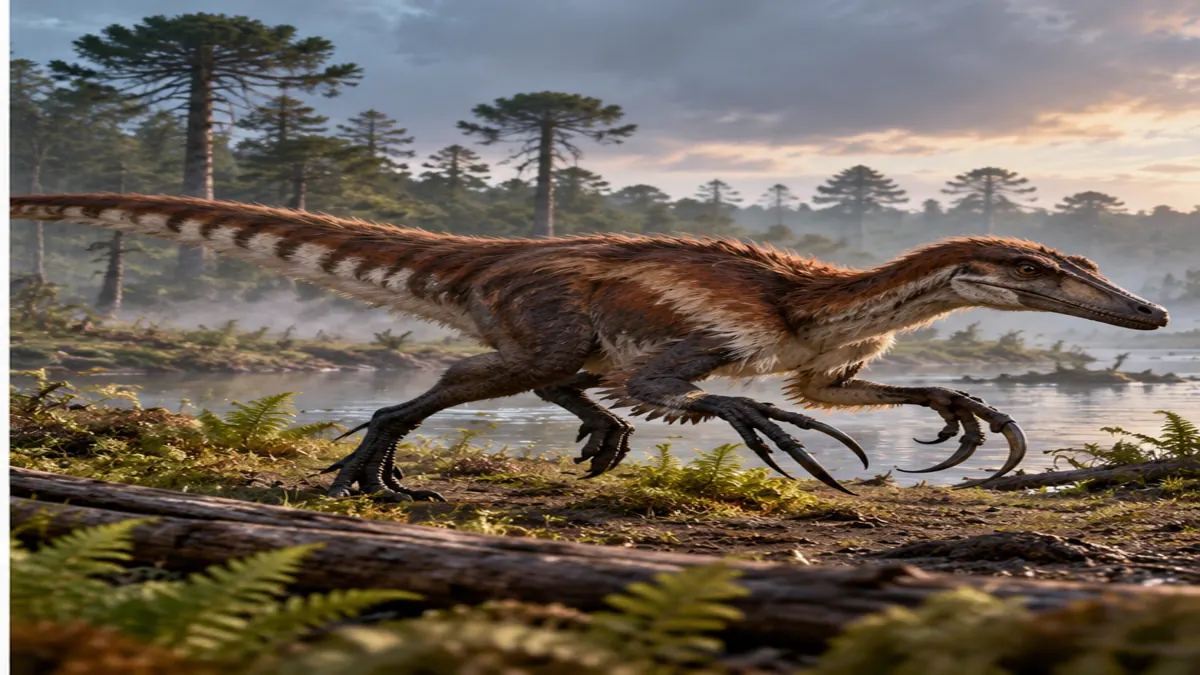
Researchers describe megaraptorans as relatively agile theropods with narrower heads and powerful forelimbs bearing large curved claws. Based on relatives, the new species may have carried feather-like body coverings. UCL suggested claws approximately 10–20 centimetres long, but those figures are reconstructions, not measurements of preserved claws from this particular specimen.
Popular artwork often shows the animal running through a green landscape, with detailed colours and feathers. Such images are scientific interpretations that combine fossil evidence with informed speculation. The shape of the braincase can support taxonomic identification, but it cannot tell us the exact pigmentation, skin pattern or behaviour of an individual dinosaur.
Was It Related to Tyrannosaurus rex?
Megaraptorans have been discussed in relation to the wider tyrannosauroid evolutionary tree, although their precise relationships have been debated across different phylogenetic analyses. It is safer to say that Invictibellatrix was a theropod related within the broader evolutionary history of large predatory dinosaurs than to describe it as a miniature T. rex.
The animals also represent contrasting hunting adaptations. Tyrannosaurus rex is famous for its robust skull and powerful bite, whereas megaraptorans are associated with relatively slender heads and strong, claw-bearing arms. Those differences are relevant to how scientists reconstruct possible feeding strategies, although direct evidence of specific hunts is absent for the new British species.
What Did Invictibellatrix Eat?
The researchers suggest that a predator of this size could have hunted smaller dinosaurs and other vertebrates, potentially including lizards and mammals. That is an ecological inference from its estimated size and the anatomy of relatives—not a stomach-content fossil or a documented kill. It may also have scavenged opportunistically, as many modern predators do.
UCL compared its likely ecological role with that of a modern hyena. This is a helpful analogy for readers, but it should not be taken to mean the dinosaur had identical social behaviour, speed or feeding habits.
Why the Discovery Matters: The First Megaraptoran Evidence in Europe
Before this identification, the clearest megaraptoran record was associated with other landmasses. A specimen in Britain changes the geographical evidence available to researchers studying where the group originated and how it spread. The new find does not by itself settle all migration routes; those hypotheses must be tested against fossil ages, geological geography and evolutionary analyses.
Early Cretaceous continental arrangements were unlike the modern world. Land connections and separations changed through time, and gaps in the fossil record can make an apparent absence misleading. A single well-identified fossil can therefore change the map of a group’s known distribution without proving that it originated at the new location.
What Does the Name Invictibellatrix amberina Mean?
UCL explains that Invictibellatrix translates approximately as “unconquered female warrior,” a reference to the group’s later evolution into formidable predators. The species epithet amberina refers both to amber associated with the geological setting and to a female name. Scientific names often preserve details about a fossil’s location, distinctive features or the researchers’ chosen dedication.
How Scientists Identify a New Species From a Partial Skull
1. Establish provenance and geological age
Museum records and geological information help establish where a fossil came from and which time interval it represents. An uncertain locality can weaken a taxonomic interpretation.
2. Study the preserved anatomy
Researchers document ridges, openings, surfaces and internal structures. CT scans can reveal features that are obscured or difficult to view directly, without requiring the fossil to be cut apart.
3. Compare it with other theropods
A fossil is not automatically a new species just because it looks unusual. Scientists assess whether a combination of anatomical traits distinguishes it from already described animals and whether the differences could reflect age, individual variation or damage.
4. Test its evolutionary relationships
Researchers use anatomical character datasets and evolutionary analyses to compare alternative placements on the dinosaur family tree. These results can change when additional specimens or improved datasets become available.
5. Publish a formal scientific description
A new scientific name requires a formal description that other specialists can inspect, challenge and build upon. The work on Invictibellatrix appeared in the peer-reviewed journal Royal Society Open Science.
What Remains Unknown?
- The precise colour, feather arrangement and appearance of the animal.
- Its exact adult mass and the full range of body sizes across its species.
- Whether it hunted alone or in groups.
- How fast it ran and how it used its claws in particular encounters.
- Whether additional fossils from the Isle of Wight will clarify its anatomy and evolutionary relationships.
The absence of those details is normal. Palaeontologists work with incomplete records and distinguish observations from reconstructions. A dramatic illustration is not the same as direct evidence.
Could There Be More Unknown Dinosaurs in Museum Collections?
Almost certainly there are specimens awaiting re-examination, although it is impossible to know in advance which will represent new species. Collections assembled over decades can become newly informative when scientific questions change, reference specimens expand and technologies improve. Museum conservation, accurate labels and long-term access are therefore part of active scientific research, not merely public display.
This case also highlights the value of collaborations among museums, universities and collectors. A fragment collected in one era can become a major discovery in another because scientists have developed new methods and accumulated better comparative evidence.
How to Separate the Science From Viral Dinosaur Headlines
Headlines describing a “new dinosaur found after 100 years” refer to a new identification, not a newly excavated complete skeleton. Likewise, claims that it “would hunt humans” are imaginative comparisons of body size and potential predatory behaviour; humans did not coexist with non-avian dinosaurs 120 million years ago. Estimates of feathers, claws and body length should be labelled as reconstructions.
The Bigger Picture: A More Complicated History of Predatory Dinosaurs
The discovery of Invictibellatrix amberina widens the known geographical range of early megaraptorans and adds detail to Britain’s Cretaceous ecosystem. More importantly, it demonstrates how scientific understanding evolves: the specimen was physically present in a collection for decades, but its significance depended on later expertise, comparative data and new technology.
Original Research and Authoritative Sources
- University College London: Original October 14, 2026 discovery announcement
- Natural History Museum: Official description and museum context
- Royal Society Open Science: Peer-reviewed research paper (DOI)
Last reviewed October 14, 2026. Illustrations are reconstructions; estimates and evolutionary interpretations may change as further fossils are studied.
You may also like
 Science & Curiosities
Why Does Your Voice Sound Different in Recordings? The Science of Bone Conduction and Self-Perception
Discover why your voice sounds higher or unfamiliar on recordings, how bone conduction and auditory feedback work, and…
 Science & Curiosities
The Ganzfeld Experiment: Why the Brain Sees Images in Uniform Sensory Fields—and What Science Says About Telepathy
A detailed, evidence-based guide to Ganzfeld perception, brain activity, imagery and disputed telepathy claims.
 Science & Curiosities
Why Can’t We Remember Being a Baby? The Science of Childhood Amnesia
Why can’t adults remember infancy? Explore hippocampal research, a 2026 scientific review and what early memories really mean.