
Do Jumping Spiders Dream? Two Sleep Stages and a REM-Like Discovery
A 2026 PNAS study finds two regulated sleep stages in a jumping spider, including REM-like behaviour—without proving that spiders dream.
Contents
- The discovery in five carefully defined findings
- Meet Portia fimbriata: the spider selected for this test
- How did researchers distinguish real sleep from simply resting?
- Test 1: Does the spider have an internal day–night rhythm?
- Test 2: What did infrared cameras reveal?
- Test 3: Could sound wake them as easily as when awake?
- Test 4: Would the animals make up for lost sleep?
- What are the two spider sleep stages?
- Can spider eyes really move while the body stays still?
- What did the 2026 study add to the 2022 spider-sleep discovery?
- Do spiders dream? Why science still cannot answer
- Three levels of confidence: seen, inferred, unknown
- Why the discovery matters for the evolution of sleep
- Could streetlights and habitat changes alter spider sleep?
- Do all spiders sleep in this way?
- Five claims to treat carefully
- What could future experiments reveal about spider sleep?
- A practical guide to reading the real evidence
- Conclusion: the answer is fascinating even without confirmed dreams
- Original sources and footage
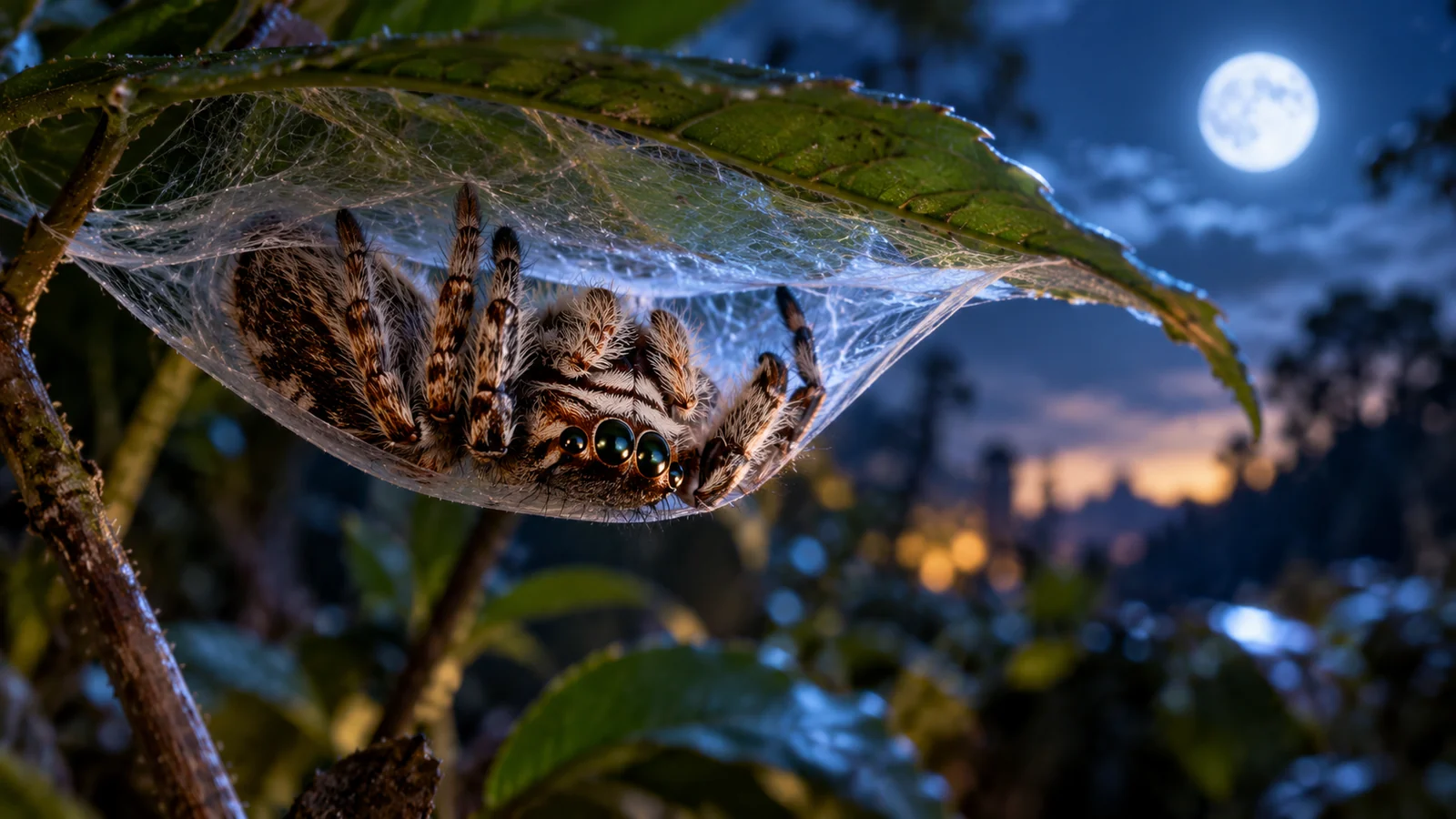
Do jumping spiders dream like humans? The accurate scientific answer as of 27 October 2026 is that nobody has established whether spiders have subjective dreams. Yet a study published online in the journal Proceedings of the National Academy of Sciences (PNAS) on 26 October 2026 offers much stronger experimental evidence for something remarkable: an Australian jumping spider genuinely sleeps, and its sleep includes two recurring behavioural states, one resembling aspects of rapid-eye-movement (REM) sleep. Researchers led by the University of Bonn filmed Portia fimbriata at night, tested how readily individuals responded to sound, and checked whether they compensated for disturbed sleep. Read the original study and the University of Bonn announcement.
This is more than a striking video of a spider twitching beneath a delicate silk hammock. The case rests on converging evidence: a characteristic sleeping posture, a daily rest–activity rhythm, reduced sensitivity to disturbance, organised episodes of tiny movements, and a compensatory response after sleep interruption. None of those measures records a dream, and no direct measurement of spider brain waves was made. This guide explains what researchers observed, what those observations support, and what remains unknown—and compares the 2026 work with an earlier 2022 discovery.
The discovery in five carefully defined findings
- The species: Portia fimbriata, an Australian member of the jumping-spider family Salticidae—not every spider species.
- Two behavioural phases: a quiet, relatively motionless phase and an active REM-like phase marked by retinal and limb movements.
- Harder to awaken: acoustic stimuli produced delayed or absent responses during rest, particularly the REM-like state, compared with wakefulness.
- Compensation after disruption: the spiders showed rebound in sleep-related behaviours following disturbed rest, a sign of regulation rather than random inactivity.
- Still unproven: the study does not establish conscious dreams or that spider REM-like activity has exactly the same neural mechanisms as human REM sleep.
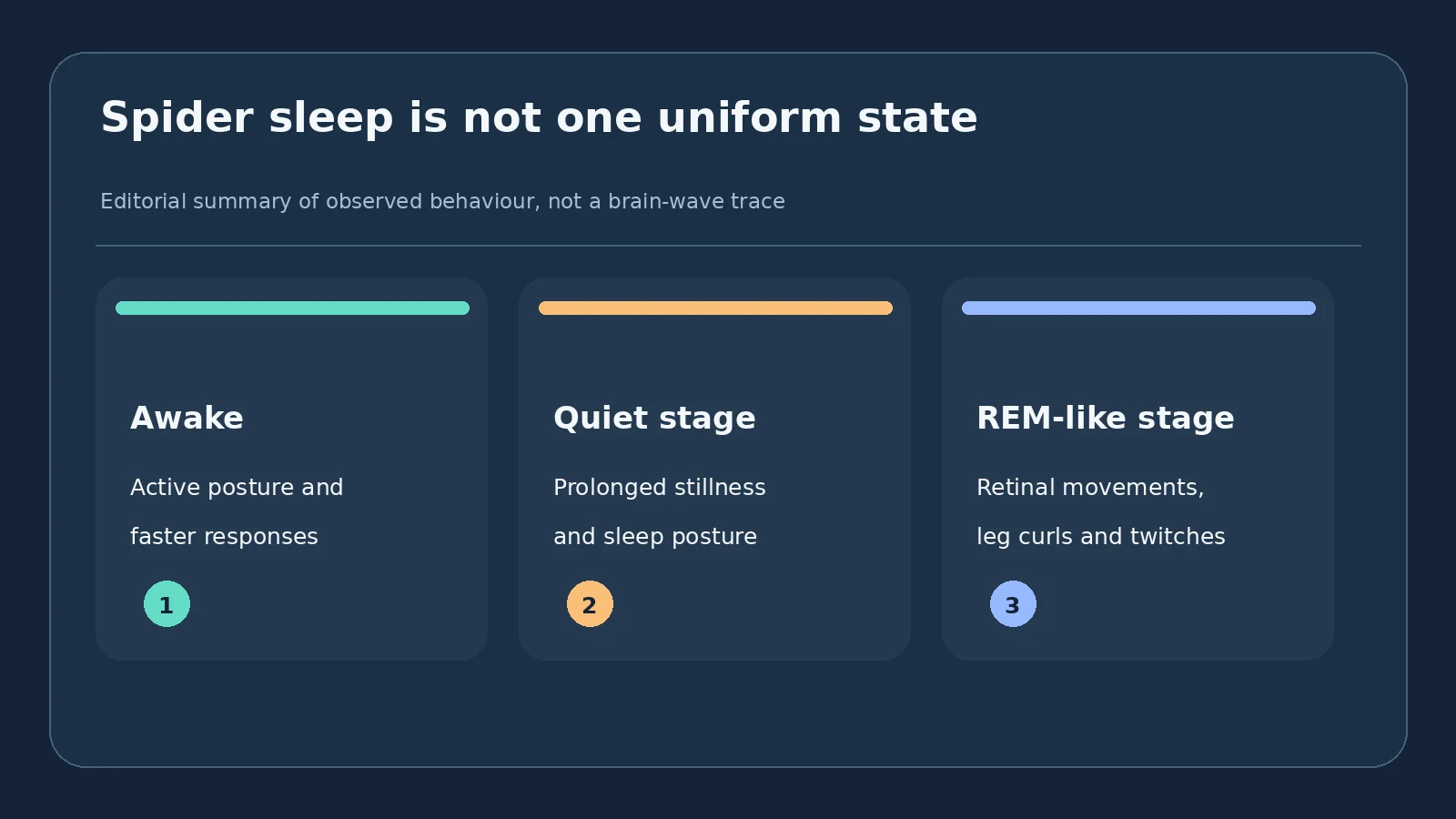
Meet Portia fimbriata: the spider selected for this test
Portia fimbriata is a predatory jumping spider noted for impressive visual abilities and specialised hunting behaviour. Members of the genus Portia can exploit the webs of other spiders, sometimes sending carefully varied vibrations through the silk that resemble the movements of trapped prey. Their flexible hunting strategies are relevant to studies of sensory processing, learning and decision-making, although it would be misleading to translate their abilities directly into a human IQ score.
The choice was practical as well as fascinating. This predominantly day-active spider rests overnight in a characteristic upside-down posture under a small structure of its own silk. Researchers can therefore compare night-time rest with wakefulness, observe transitions, and film a relatively small animal without fitting it with a bulky tracking device. According to the University of Bonn, individual spiders were monitored in dishes around 12 centimetres across under different light conditions.
The spider’s eyes are also useful to science. Jumping spiders possess retinal tubes that can shift the direction of gaze inside the head. Those movements, alongside curls of the legs and mouthpart twitches, supply visible clues to changes in state. Yet seeing a retina move is not equivalent to seeing what the animal experiences.
How did researchers distinguish real sleep from simply resting?
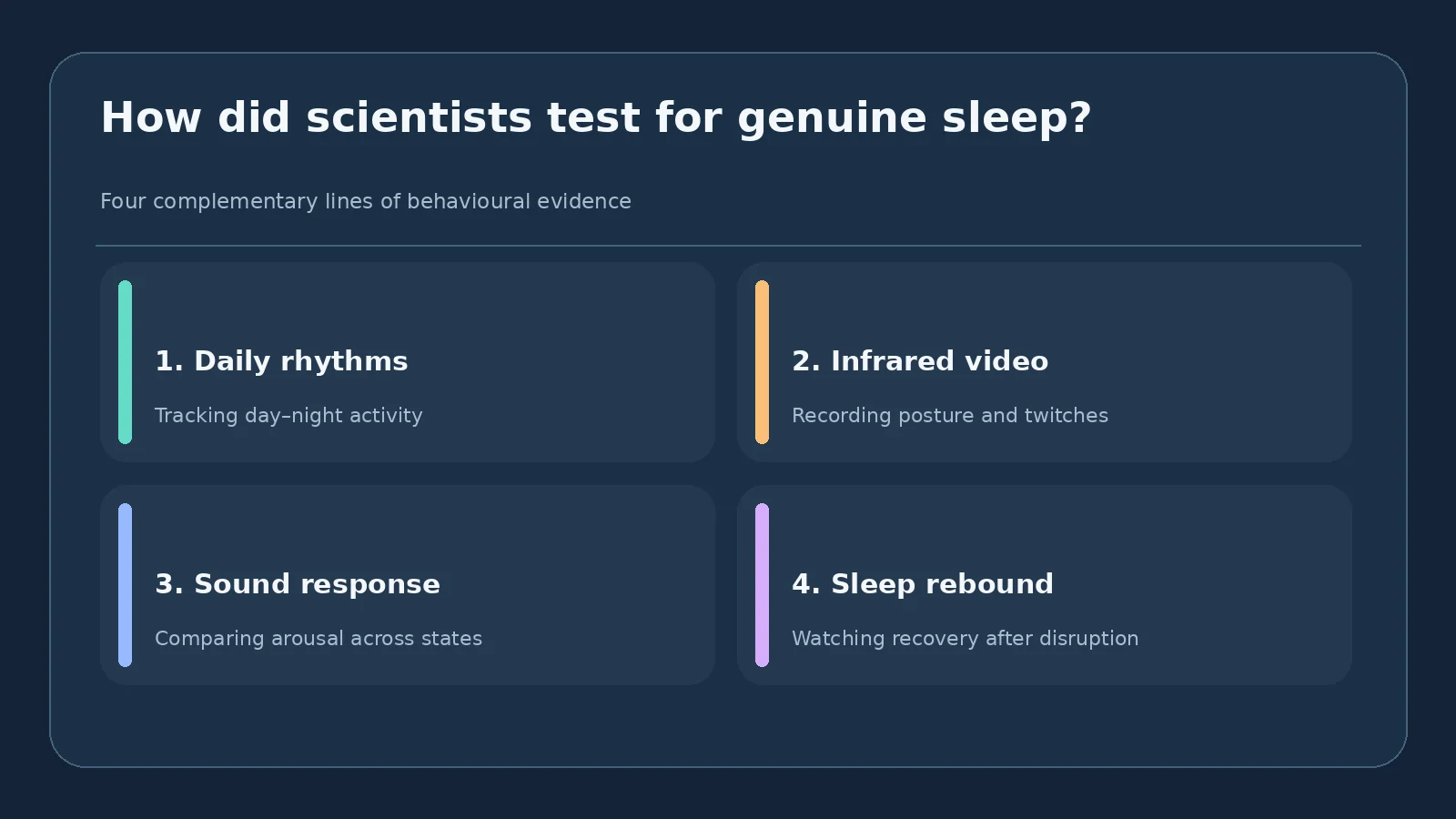
Stillness alone proves very little. An animal may freeze while waiting for food, avoiding a threat, conserving energy, or resting without entering a regulated sleeping state. Sleep researchers instead look for a combination of features: recognisable posture, rhythms, reduced responsiveness, and a biological pressure to recover lost rest. The Bonn team combined recordings with carefully planned disturbances to test those criteria.
Test 1: Does the spider have an internal day–night rhythm?
The spiders’ activity was monitored across light–dark schedules and differing illumination conditions. A rest–activity pattern that persists when external cues change is evidence consistent with an internal circadian organisation. That matters because a spider becoming quiet merely because a room goes dark would be a weaker finding. It does not mean artificial light is irrelevant: the relationship between lighting and sleeping patterns remains a valuable research question.
Test 2: What did infrared cameras reveal?
Night recording let the team follow individual spiders without constantly shining visible light on them. The footage showed prolonged quiet phases interrupted by shorter, repeatable bouts of movements: curled legs, trembling structures around the mouth, and retinal movement. Researchers identified an organised sequence rather than treating every twitch as a random isolated event. These are behavioural observations; they should not be confused with electroencephalography in humans.
Test 3: Could sound wake them as easily as when awake?
The researchers compared how quickly spiders reacted to acoustic stimuli in wakefulness, quiet rest and REM-like episodes. Responsiveness slowed during resting states and was especially reduced in the REM-like phase. A higher arousal threshold is a recognised behavioural criterion for sleep. Crucially, comparing the very same kind of stimulus across states helps rule out the mistaken assumption that a spider failed to react simply because it never detects that kind of disturbance. The ABC Science report contains interviews with the researchers about this experiment.
There are limits. An acoustic response is not a perfect measurement of awareness, and results in a limited laboratory sample do not reveal how a spider behaves in every wild environment. A sleeping animal can still register stimuli, and the behavioural data are not an inside view of its experiences.
Test 4: Would the animals make up for lost sleep?
A second key feature of sleep is regulation. Following disruption, many animals compensate by resting more or by changing the structure of subsequent sleep. In the spider experiments, disturbances involving live flies interrupted ordinary night-time rest. When the animals could recover, REM-like episodes increased, consistent with sleep rebound. This is a much stronger argument for genuine sleep than the presence of curled legs by itself.
Sleep rebound does not prove a dream was interrupted. Nor does a single laboratory disruption establish the consequences of lifelong or chronic sleep restriction. It demonstrates that the observed state is not merely a decorative posture or an accidental pattern of stillness.
What are the two spider sleep stages?
| State | Observed signs | What the signs support |
|---|---|---|
| Awake | Active body posture and comparatively fast response to sound | Baseline against which resting behaviour can be assessed |
| Quiet or quiescent stage | Characteristic drooping rest posture with limited movement | A consolidated quiet sleep-like phase |
| REM-like active stage | Repeated retinal movement, limb curls and muscular twitches | A distinct active phase within behavioural sleep |
| After sleep disruption | Extra episodes or time in sleep-related behaviour | Homeostatic regulation, or compensation for interrupted rest |
The human term REM stands for rapid eye movement. Human REM sleep is characterised using a combination of brain activity, eye movements and muscle tone. In spiders, this study identifies a REM-like behavioural stage, not a full human-style diagnostic profile. Describing it as REM-like preserves the important resemblance without hiding the difference in what researchers could measure.
Can spider eyes really move while the body stays still?
To understand the findings, it helps to picture a camera whose sensor can swivel behind a fixed front element. A jumping spider does not need to rotate its entire head in order to redirect every aspect of its visual sampling. Movable retinal tubes within the principal eyes can shift their orientation. The researchers monitored associated movements while the body was in a typical resting position.
Human eyes move in their sockets in REM sleep; spiders have a different anatomical arrangement. The comparison is therefore functional and behavioural, not an assertion that the two species’ eye structures are identical. Importantly, the animal was not known to be responding to a visible object during each nocturnal movement.
This observation is compatible with several explanations, such as internally generated sensory activity, but it alone cannot settle which explanation is right. Asking why these movements happen is distinct from measuring that they occur.
What did the 2026 study add to the 2022 spider-sleep discovery?
A 2022 PNAS study by Daniela Rößler and colleagues examined a different jumping spider, Evarcha arcuata. The team reported repeated retinal movements, leg curls and twitching during nocturnal rest. Newly emerged spiders were particularly informative because parts of their developing bodies made retinal movements easier to observe.
The central unanswered question in 2022 was whether these visual markers occurred during a true, regulated sleep state. Fascinating movements are suggestive but cannot independently satisfy the behavioural definition of sleep. The 2026 paper went further by systematically examining the day–night rhythm, sleep posture, response thresholds, the sequence of phases and compensation after disruption in Portia fimbriata.
| Research question | 2022 jumping-spider study | 2026 Portia fimbriata study |
|---|---|---|
| Species | Evarcha arcuata | Portia fimbriata |
| Main observation | Recurring retinal movements, twitches and leg curls at night | Distinct quiet and REM-like stages |
| Tested awakening response? | Not the main experimental demonstration | Yes, using acoustic stimuli |
| Demonstrated sleep rebound? | Not established in that work | Yes, after disrupted rest |
| Showed that spiders dream? | No | No |
The most consequential upgrade was not a prettier video. It was an experimental framework: a plausible sleep signal in 2022 became a considerably stronger behavioural demonstration in 2026. This is how science often progresses—from an interesting observation to a controlled test of alternative explanations.
Do spiders dream? Why science still cannot answer
A dream is a subjective experience, not a particular movement of an eye or leg. People can often describe a dream after waking, and researchers can combine those reports with recordings of brain activity. A jumping spider cannot provide a verbal account. Its retinal movements might be consistent with internally generated visual processing, but they cannot tell us whether it sees images of prey, replays a hunting route, or experiences anything analogous to a dream.
A tempting headline might claim that scientists filmed a spider “dreaming about its next meal”. That is speculation, not an observed result. The study did not decode neural images, read dream content or prove conscious experience. REM-like movements also do not guarantee dreams in every animal, and human dreams are not confined exclusively to REM sleep.
Three levels of confidence: seen, inferred, unknown
- Directly observed: hanging posture, recurring movement patterns, retinal shifts, delayed sound responses and compensation following disruption.
- Supported inference: Portia fimbriata undergoes regulated behavioural sleep with distinct quiet and active phases.
- Unknown: whether spiders experience dreams, what such experiences would contain, and whether their underlying neural signatures resemble those of vertebrate REM sleep.
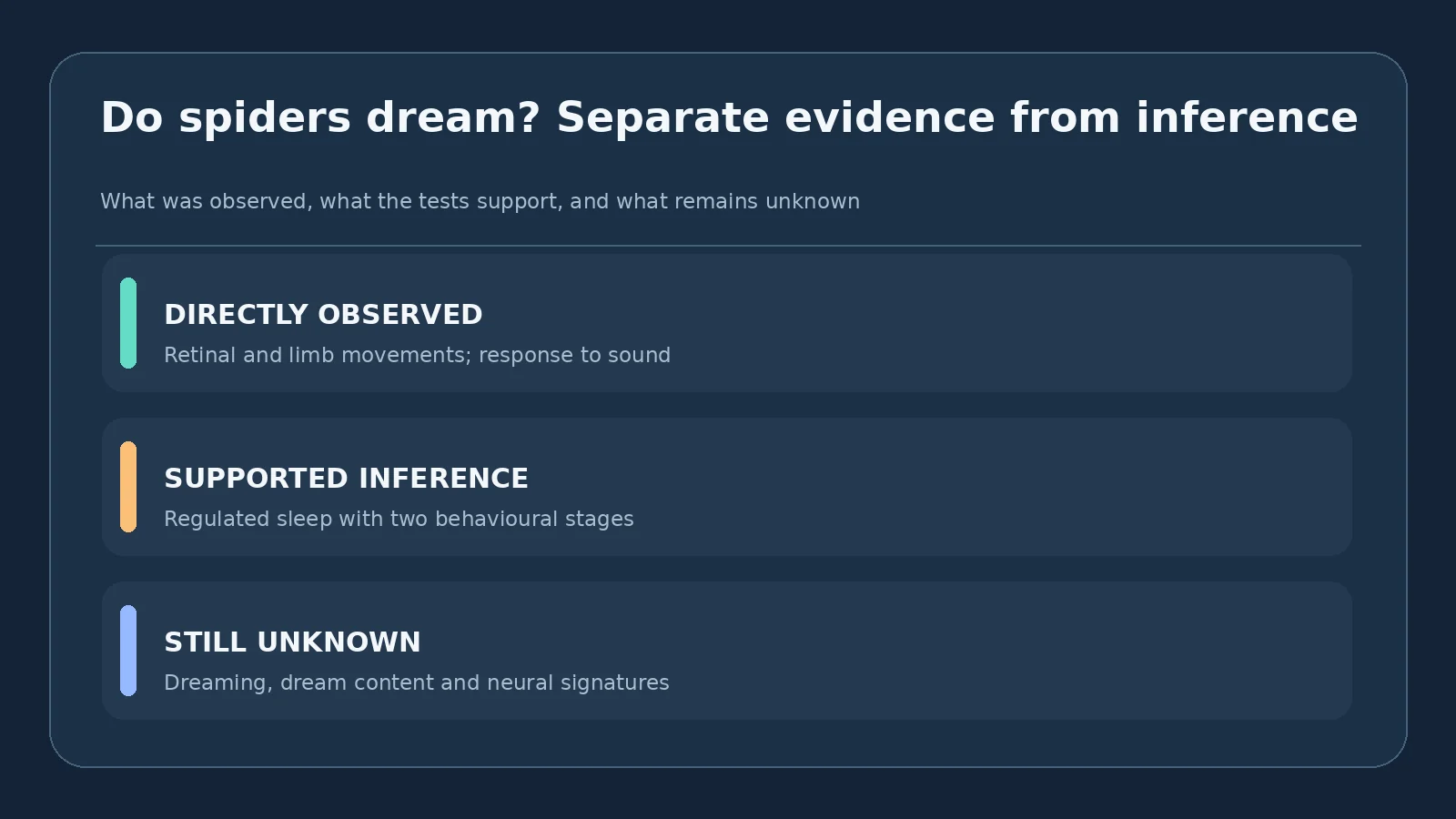
This three-level framework is useful whenever a scientific news story moves from data to interpretation. Readers can ask: was a property directly measured, indirectly inferred from a model, or proposed as a possibility for future investigation?
Why the discovery matters for the evolution of sleep
Spiders and vertebrates belong to evolutionary lineages that diverged very long ago. Finding structured sleep and an active REM-like phase in such different nervous systems raises questions about whether some sleep mechanisms have ancient origins, whether they evolved independently more than once, or whether similar functions drive different animals toward comparable patterns.
The study cannot choose between these evolutionary scenarios by itself. Establishing common ancestry of a neural mechanism requires more than comparing movements; researchers need broader sampling across species and, ideally, cellular or physiological data. But the finding challenges any simple assumption that a large mammalian-style brain is required for all the behavioural hallmarks of complex sleep.
Researchers may eventually ask whether sleep assists memory, learning, sensory recalibration or other processes in spiders. These are testable directions rather than results already demonstrated by the new experiment. Even if sleep helps learning, dreaming itself would remain a separate question.
Could streetlights and habitat changes alter spider sleep?
Artificial light at night can alter natural environmental signals for a wide variety of species. The new laboratory study, however, did not demonstrate that urban streetlights cause insomnia in Portia fimbriata. Light pollution, temperature and natural habitat conditions are among the questions the researchers want to examine in future fieldwork.
That distinction matters. A spider in a controlled dish encounters a far simpler environment than a spider balancing nocturnal temperature, humidity, predators and artificial lighting in the wild. The next step is to compare laboratory findings with natural populations without assuming the same timetable applies everywhere.
Do all spiders sleep in this way?
No single experiment can establish that all spider species share two identical sleep stages. This work concerns Portia fimbriata. Other spiders use their senses differently, hunt on different schedules and occupy different habitats. Some respond primarily to web vibrations; others are visual hunters. Their resting posture and arousal thresholds may vary. Broader research is necessary before assigning a universal architecture of spider sleep.
The new work therefore supports a specific conclusion: a studied jumping-spider species exhibits regulated two-stage behavioural sleep. It does not prove that every house spider dreams, that every arachnid sleeps in a silk hammock, or that all spiders follow a human sleep schedule.
Five claims to treat carefully
- “Scientists proved spiders dream.” They proved a more limited, well-supported case for sleep and a REM-like behavioural state; dream experiences remain unknown.
- “Spider brain scans match human sleep.” These experiments did not directly record spider brain waves.
- “A non-response proves deafness.” The work compared responsiveness across behavioural states, including wakefulness.
- “Sleep rebound means human REM sleep.” Compensation indicates regulation, not identical anatomy or neurobiology.
- “Every spider has the same sleep stages.” One species was thoroughly studied; others need testing.
What could future experiments reveal about spider sleep?
A powerful next step would be non-invasive or minimally disruptive measurements of neural activity in tiny animals during clearly identified sleep states. Another is to test how a spider learns a visual task, then examine whether interrupting its quiet or REM-like stages changes later performance. Field research is also essential: natural light cycles, predator activity and variable weather could all influence the expression of rest.
Such work should not be equated with proving dreams. Evidence of sleep-related memory processing would clarify function, but subjective experience presents a distinct philosophical and experimental difficulty. The question is especially interesting precisely because spiders have bodies and perceptual systems unlike ours.
There is no meaningful reason for readers to capture or repeatedly disturb wild spiders to perform a household “sleep test.” The study’s conclusions arise from controlled comparisons, not a single startled reaction, and unnecessary handling can stress or harm animals.
A practical guide to reading the real evidence
Start with the 2026 PNAS paper, which frames the conclusion as behavioural evidence. Then consult the University of Bonn research summary for the observation and testing method. To see actual video rather than a recreation, watch the 46-second footage presented by ABC Science. This video is linked, not re-hosted in our article.
A genuine photograph of Portia fimbriata, credited to Donald Hobern, is available at Wikimedia Commons under CC BY 2.0.jpg). It shows the species but was not taken during the 2026 sleep experiment. The featured illustration and explanatory diagrams accompanying this article are editorial graphics, not camera images or scientific records of a sleeping spider.
For readers interested in another aspect of REM research, Horus Valley also covers the energy balance paradox in mouse brains during REM sleep. Do not confuse physiological findings in mice with what has been demonstrated in spiders.
Conclusion: the answer is fascinating even without confirmed dreams
Portia fimbriata is now a compelling example of an invertebrate with organised, regulated behavioural sleep. Its quiet phases and REM-like periods—complete with movements and a higher threshold for awakening—open a surprising window into the evolution of rest across the animal kingdom. Whether spiders dream remains unanswered. Respecting that uncertainty makes the real discovery more interesting, not less.
Original sources and footage
- Geiger and colleagues, 2026, PNAS: Behavioral evidence for two-stage sleep in spiders, published online 26 October 2026.
- University of Bonn: Wie tief schlafen Spinnen?, institutional research announcement dated 27 October 2026.
- Leibniz Institute: Spiders have different sleep phases, research partner’s summary.
- Rößler and colleagues, 2022, PNAS: Regularly occurring bouts of retinal movements, earlier study in a different jumping-spider species.
- ABC Science: 46-second original footage, real video, linked for viewing rather than copied.
- Donald Hobern’s Portia fimbriata photograph.jpg), Creative Commons Attribution 2.0 license; linked with credit, not presented as a sleep-experiment image.
You may also like
 Science & Discoveries
First Fully Marine Amphibian? The 237-Million-Year-Old Gerrothorax Discovery
Two remarkably complete Chinese fossils suggest an armored early amphibian spent its life in the sea. Here is…
 Science & Nature
Four-Winged Norellraptor: Did Dinosaur Flight Evolve More Than Once?
A new feathered dinosaur from China suggests flight-related anatomy evolved along more than one route, but the fossil…
 Science & Nature
Why Are Butterflies So Hard to Catch? Their Wing Optical Illusion Explained
A 2026 Nature study explains how butterfly wing patterns and flight alter motion cues and can misdirect attempts…