
First Fully Marine Amphibian? The 237-Million-Year-Old Gerrothorax Discovery
Two remarkably complete Chinese fossils suggest an armored early amphibian spent its life in the sea. Here is the evidence—and what remains unknown.
Contents
- The discovery at a glance
- Why a marine amphibian is such a surprising claim
- Who was Gerrothorax maritimus?
- Two fossils, not just one odd bone
- What the ancient seafloor reveals
- The evidence ladder: which claims are strongest?
- Why strontium isotopes matter
- Could its armour have been the evolutionary breakthrough?
- How might it have handled salt and breathing?
- A bottom-dweller that may have swallowed passing prey
- What did the animal share with ichthyosaurs—and what not?
- Did it live in the sea from birth to death?
- The most common misunderstandings
- A comparison: modern amphibians and their ancient relative
- How researchers test alternative explanations
- Could we calculate how large it was compared with a person?
- What would make this finding stronger?
- Where to see the real fossils and the original science
- What this changes about amphibian evolution
- Sources and further reading
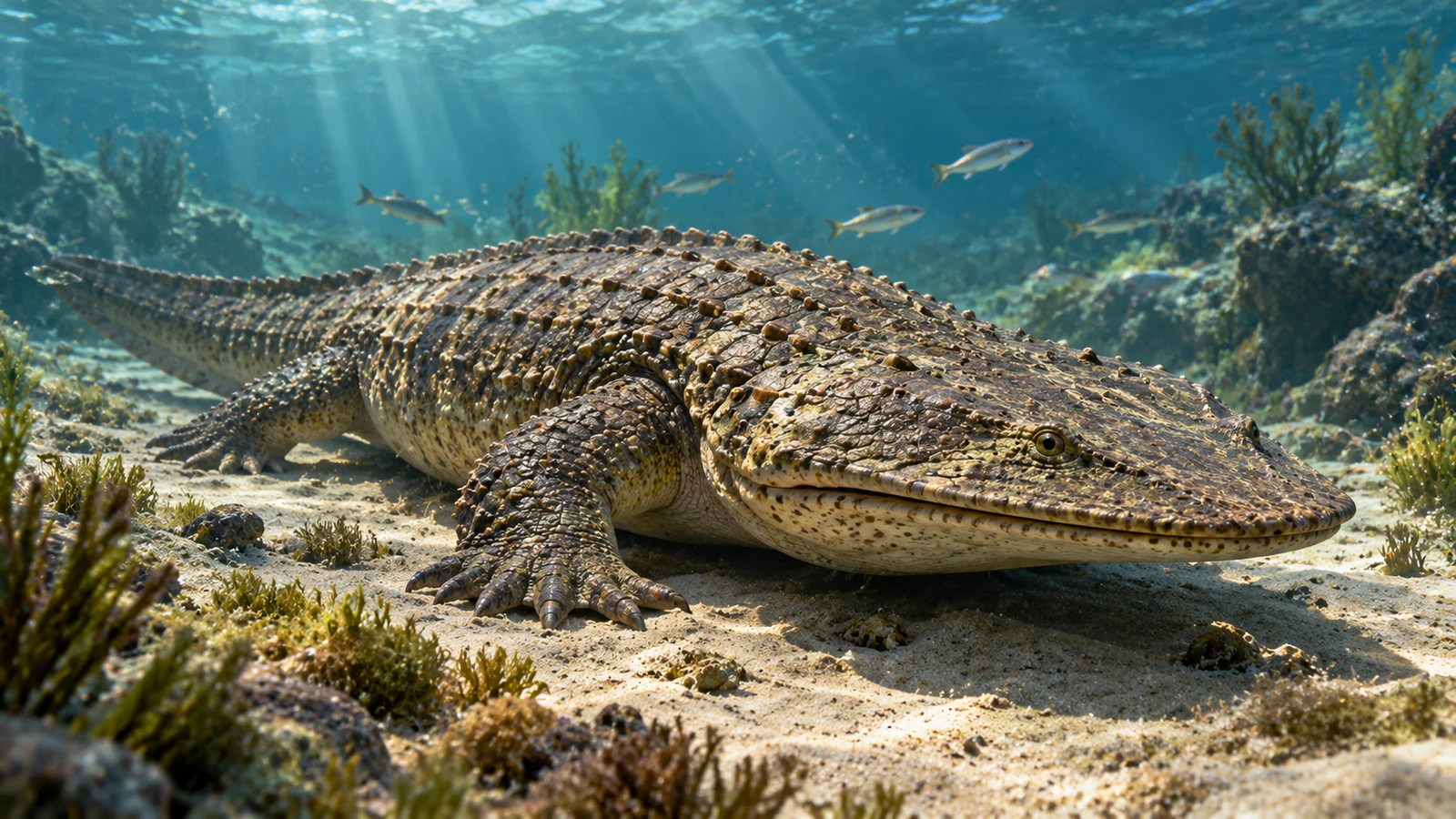
An armored amphibian appears to have lived its entire life in the sea about 237 million years ago—an adaptation no living amphibian is known to possess. In a paper published on 26 October 2026 in Nature Ecology & Evolution, a team led by Lipin Diao and Ryosuke Motani described two remarkably complete fossils from Guizhou Province, China. The newly named Gerrothorax maritimus challenges a long-standing expectation: amphibians, with their generally permeable skin, cannot normally make a permanent home in salty open-ocean water.
Yet the headline needs one important qualification. The fossil skeletons, their geological setting and bone chemistry together make a strong case for a fully marine habitat; the exact way this animal processed salt, breathed and reproduced is not directly observed. The following evidence-by-evidence guide separates anatomical observations from plausible physiological explanations. Read the original research and the UC Davis research announcement.
The discovery at a glance
| Question | What the evidence supports | Important limit |
|---|---|---|
| Which animal? | Gerrothorax maritimus, a newly named stem amphibian | Not a modern salamander or a reptile |
| When and where? | Around 237 million years ago, in marine rocks of present-day Guizhou, China | Geological ages are approximate |
| How large? | At least 737 millimetres in the reconstructed specimen | Not necessarily the maximum adult size |
| Why is it unusual? | Strong evidence for a life far from freshwater or dry land | Its whole life cycle is not directly preserved |
| How did it survive salt? | Bony body armour may have limited skin exchanges | Salt-handling organs and soft tissues are unknown |
Why a marine amphibian is such a surprising claim
There are more than 8,000 living amphibian species: frogs and toads, salamanders and newts, and limbless caecilians. Their diversity is extraordinary, but no known living species spends its whole existence in normal seawater without requiring freshwater or land. Some tolerate salty or brackish places temporarily; that is not equivalent to an entirely marine life cycle. The Nature Portfolio summary distinguishes these two very different situations.
For many amphibians, skin does far more than cover muscles. It participates in exchanging water and gases with the surroundings. A saltier external environment can draw water out of the body and create problems with dissolved ions. A fish, marine reptile or mammal has evolved ways to manage seawater; it is risky to assume an amphibian could use the same solution. This is why the discovery is an evolutionary question rather than simply a new fossil of a strange-looking predator.
Who was Gerrothorax maritimus?
Gerrothorax belonged to a broader, extinct temnospondyl lineage on the amphibian family tree. In plain terms, it was an early relative outside the group containing all living amphibians—a stem amphibian. Calling it a 'giant frog' or 'sea salamander' would be catchy but misleading: its shape, ancestry and biology were different from those animals alive today.
The new species name maritimus refers to its inferred sea-going lifestyle. It was broad and flattened, about three-quarters of a metre long in the preserved specimens, with a wide skull, short-looking body proportions and extensive bony armour. Researchers infer that it remained low in the water column and may have waited near the seabed. The body outline comes from fossils; its exact skin colour, behavior and appearance in life are artistic inference.
Two fossils, not just one odd bone
The study is based on two nearly complete, articulated skeletons, much more informative than an isolated tooth or a fragment of vertebra. In an articulated skeleton, bones retain much of their original arrangement, allowing researchers to reconstruct anatomy without relying as heavily on guesses about disconnected parts. The research identifies specimens housed in the Geological Museum of Guizhou, including the holotype (GMG 1119) and paratype (GMG 35).
Multiple specimens help test whether an odd structure is characteristic of the species or a distortion of a single fossil. Nevertheless, two individuals remain a small sample. They do not establish a complete range of ages, the shape of newborns, sexual differences or the population's geographical distribution. See the actual fossil photographs and anatomical drawings in the research paper and the UC Davis fossil image. Images hosted by those organisations are linked for scientific verification rather than reproduced without a confirmed reuse licence.
What the ancient seafloor reveals
The fossils come from Late Triassic sedimentary rocks in what is now southwestern China. About 237 million years ago, this area was submerged, and the researchers reconstruct the fossil site as being at least 30 kilometres from possible islands. A marine rock alone would not be enough: an animal that died in a river could conceivably have floated out to sea, or remains could have been transported before burial.
The crucial extra clue is preservation. The skeletons are unusually complete and associated in ways the researchers interpret as burial close to where the animals died, making long-distance transport less plausible. This does not turn a geological reconstruction into eyewitness certainty, but it strengthens the argument when considered alongside the chemistry and armour. The publisher's research summary makes this combined interpretation explicit.
The evidence ladder: which claims are strongest?
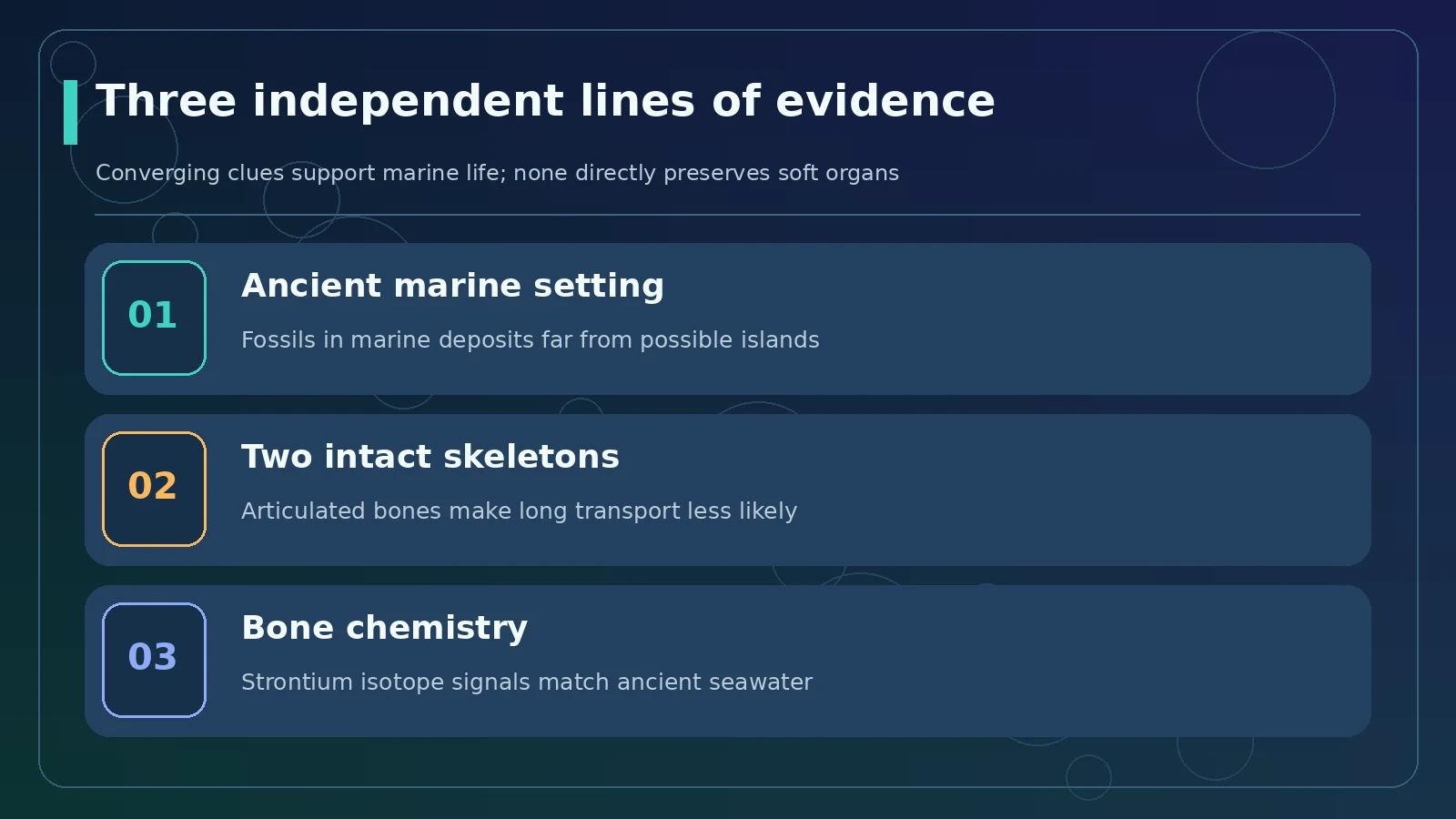
The most persuasive conclusion is not based on the creature having 'ocean-looking' features. It comes from independent lines of evidence pointing in the same direction. Understanding that distinction helps readers judge future fossil discoveries more critically.
| Evidence | Direct observation | Interpretation | Confidence boundary |
|---|---|---|---|
| Rock and geography | Fossils in marine sediment; reconstructed distance from possible islands | A sea environment, away from reliable freshwater | Ancient geography is reconstructed, not photographed |
| Preservation | Two articulated, nearly complete skeletons | Little evidence for long transport from land | Burial history still has uncertainties |
| Strontium isotopes | Bone chemistry compatible with the period's seawater | Organism experienced marine water over life | Chemistry is an indirect environmental tracer |
| Skeleton and armour | Many preserved bony plates around the body | Reduced exposed skin may have helped salt tolerance | No preserved membrane permeability measurements |
| Feeding anatomy | Broad head and mouth | Possible suction feeding near the bottom | No direct observation of feeding |
Why strontium isotopes matter
Different forms of strontium occur naturally in rocks and water. Their relative abundance can preserve information about the environment with which a growing animal exchanges minerals. The team compared signals in the fossil bones with seawater signatures appropriate to the geological period. The match is one reason the researchers argue the animal grew up using marine water, rather than simply ending up in marine mud after death.
Isotope data are not an ancient GPS tracker. They do not show every movement the animal made, identify each prey item, or directly reveal its organs. They are strongest when geological context supports the same story. It would also be inaccurate to equate the study with DNA sequencing: no 237-million-year-old DNA was extracted here; the chemical investigation concerned fossil material and strontium signatures.
Could its armour have been the evolutionary breakthrough?
Modern amphibian skin is relatively permeable. Researchers propose that extensive bony armour over the trunk could have reduced the amount of body surface available for the water, gas and salt exchanges on which amphibians commonly rely. That would change the physiology the animal needed to survive. An ancestral defensive feature might have become useful in a second role: limiting contact with seawater.
This mechanism is compelling but remains a hypothesis about function. Bones are preserved; soft tissues and their actual permeability are not. The armour may also have offered protection against predators. The idea illustrates evolutionary reuse, sometimes called exaptation, but it is not proof that the animal suddenly evolved a watertight suit. The study suggests the lineage inherited substantial armour before adopting a marine lifestyle.
How might it have handled salt and breathing?
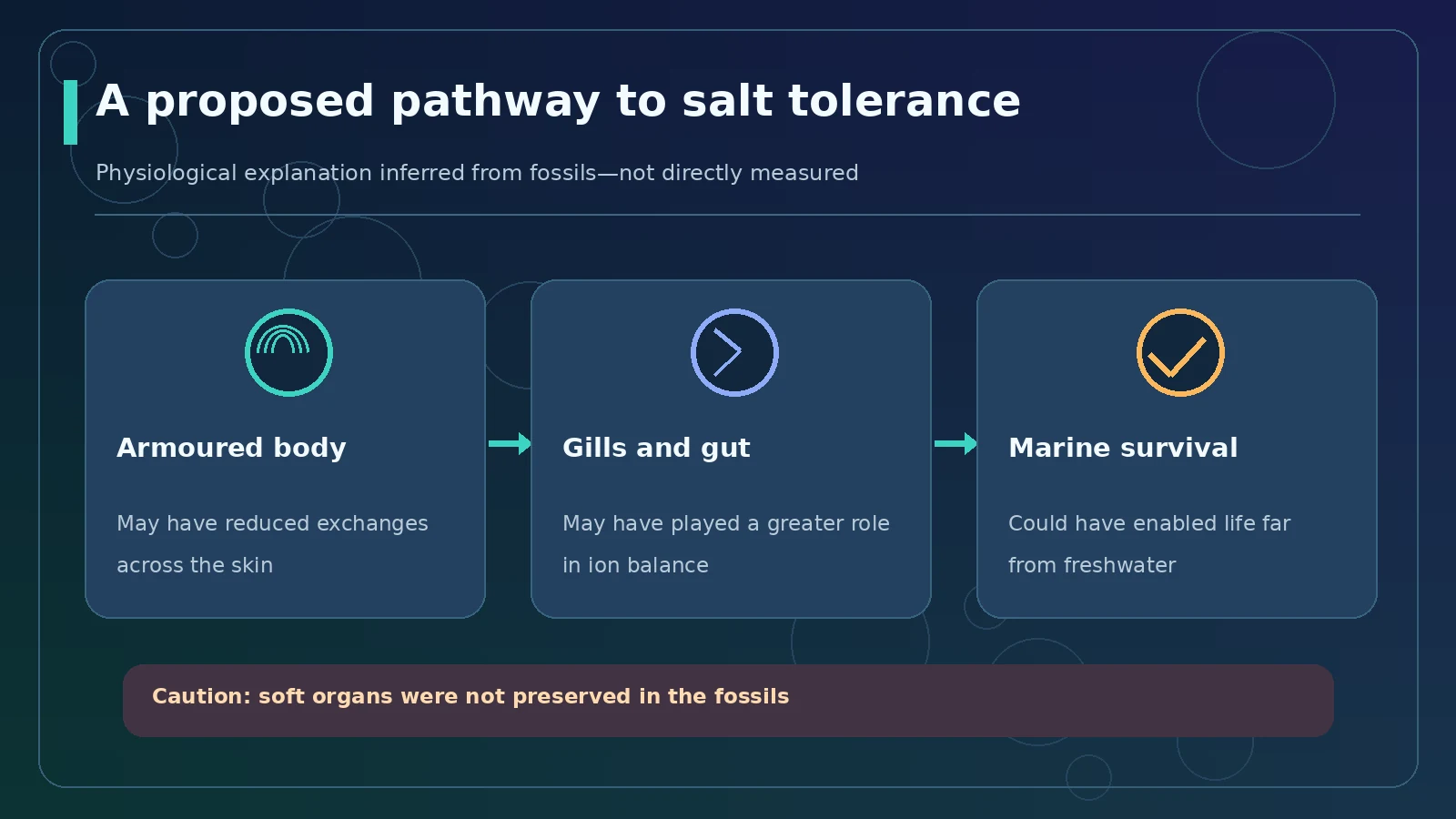
If the body surface exchanged less water, the animal may have depended more on gills and the digestive tract. The researchers suggest those organs could have become better at tolerating seawater and dealing with salt. In one proposed scenario, the animal swallowed seawater, absorbed needed water and used specialized physiology to regulate ions. The exact pathway remains unknown because kidneys, gill tissues and gut tissue do not survive in the fossils.
Readers should resist the tempting but unsupported shortcut: 'its gills filtered the salt, therefore we know how it drank'. The paper proposes plausible physiological adaptations; it does not document a preserved salt gland or a measured salt-excretion rate. Even the relative importance of respiration through the body surface cannot be reconstructed with complete confidence from bones alone.
A bottom-dweller that may have swallowed passing prey
A broad skull and very wide mouth support a picture of a predator feeding close to the seabed. In a suction-feeding strike, expansion of the mouth and throat draws surrounding water—and often a small prey animal—toward the opening. The UC Davis account compares the proposed ambush strategy to a modern wobbegong carpet shark.
That is an ecological analogy, not proof that the Triassic animal behaved exactly like a shark. We lack direct video, preserved stomach contents from these individuals or documented feeding movements. Its likely diet was marine prey available in its habitat; the exact menu and hunting frequency are open questions.
What did the animal share with ichthyosaurs—and what not?
Ichthyosaurs were marine reptiles, not amphibians. Their streamlined aquatic forms represent one of several independent returns to ocean life among terrestrial-vertebrate descendants. Gerrothorax maritimus followed a different anatomical route: a low, armoured body rather than a dolphin-like silhouette. The fossils occur in an ecosystem that also included marine reptiles and fish, but that does not imply a close evolutionary relationship.
This is a useful example of convergent ecological outcomes without identical solutions. Two distant lineages can occupy the same marine environment while differing markedly in skeleton, feeding method and possible salt regulation. It also shows why saying 'it was a sea dinosaur' would be wrong: it was neither a dinosaur nor a marine reptile.
Did it live in the sea from birth to death?
Here the wording matters most. The evidence supports the researchers' interpretation of a fully marine lifestyle rather than occasional shoreline visits. Still, the fossils are not embryos, eggs or witnessed breeding events. Many amphibians today have life stages with different habitat requirements. Researchers therefore cannot directly establish whether this ancient species laid eggs in the sea, gave birth to live young, or had another reproductive strategy.
For a claim of fully marine life, a future discovery of juveniles or reproductive structures would be especially useful. An absence of proof of freshwater reproduction is not, by itself, proof that freshwater reproduction was impossible. At present, marine habitat is strongly supported and life-cycle details remain unresolved, as Nature Portfolio acknowledges.
The most common misunderstandings
- "It's the first creature ever to live at sea." No. Sea life predates land vertebrates by hundreds of millions of years; the claim concerns amphibian ancestry.
- "Modern frogs evolved from this exact fossil." No. It is an extinct stem-group relative, not a demonstrated direct ancestor of living frogs.
- "The study proved gills removed salt." No. Salt-handling organs were not preserved; this is a mechanism proposed to explain its habitat.
- "Two fossils prove there were millions of them." No. They establish a species description and provide evidence of habitat, not census size.
- "The fossil is a photograph of how it looked alive." No. Fossil photos show bones; life reconstructions are scientific art informed by anatomy.
A comparison: modern amphibians and their ancient relative
| Feature | Living amphibians | Gerrothorax maritimus |
|---|---|---|
| Typical habitat | Freshwater, land, sometimes brackish areas | Strongly inferred open marine setting |
| Full-time ocean species | None currently known | Proposed first fossil example |
| Skin and body covering | Usually permeable skin | Extensively armored trunk, inferred role |
| Salt-handling strategy | Varies; no known fully marine adaptation | Proposed gill/gut adaptations; unconfirmed |
| Evidence available | Anatomy, laboratory physiology and life observation | Skeletons, sedimentology and bone chemistry |
| Reproductive biology | Directly studied in living species | Unknown for this fossil species |
This side-by-side view explains why the discovery matters more than a novel creature name. It challenges assumptions about the range of body plans that could cross a major ecological boundary, without claiming that a fossil reveals every biological detail.
How researchers test alternative explanations
What if the amphibian was simply washed out into the sea? That hypothesis would need to account for two relatively intact skeletons, ancient marine rocks distant from likely islands, and bone chemistry close to the seawater signal. Each point alone has exceptions, but the alternative becomes less economical as evidence accumulates. The logic is similar to triangulation: separate measurements narrow the range of plausible explanations.
What if it entered the sea only for food? Periodic foraging visits would be less surprising than full residence, but still need to fit the evidence about burial away from possible freshwater sources and the inferred lifelong chemical record. Researchers favour permanent marine living, while acknowledging indirect inference. Science gains strength by describing rival explanations rather than pretending none exist.
Could we calculate how large it was compared with a person?
A reconstructed length of at least 737 millimetres equals 73.7 centimetres, or about 29 inches. On a simple length scale, that is shorter than a typical adult person's lower leg-to-floor height, but its wide, chunky torso would make it appear much more substantial than a narrow eel of the same length. Length alone cannot determine mass; doing so would require volume, tissue and anatomical assumptions.
If a drawing uses a 10-centimetre reference ruler, a 73.7-centimetre body would cover approximately 7.37 such ruler lengths. This basic conversion is useful for interpreting fossil plates, but should not be presented as a laboratory measurement of the animal's total life size. The minimum measurement is what the authors report; individuals could have varied.
What would make this finding stronger?
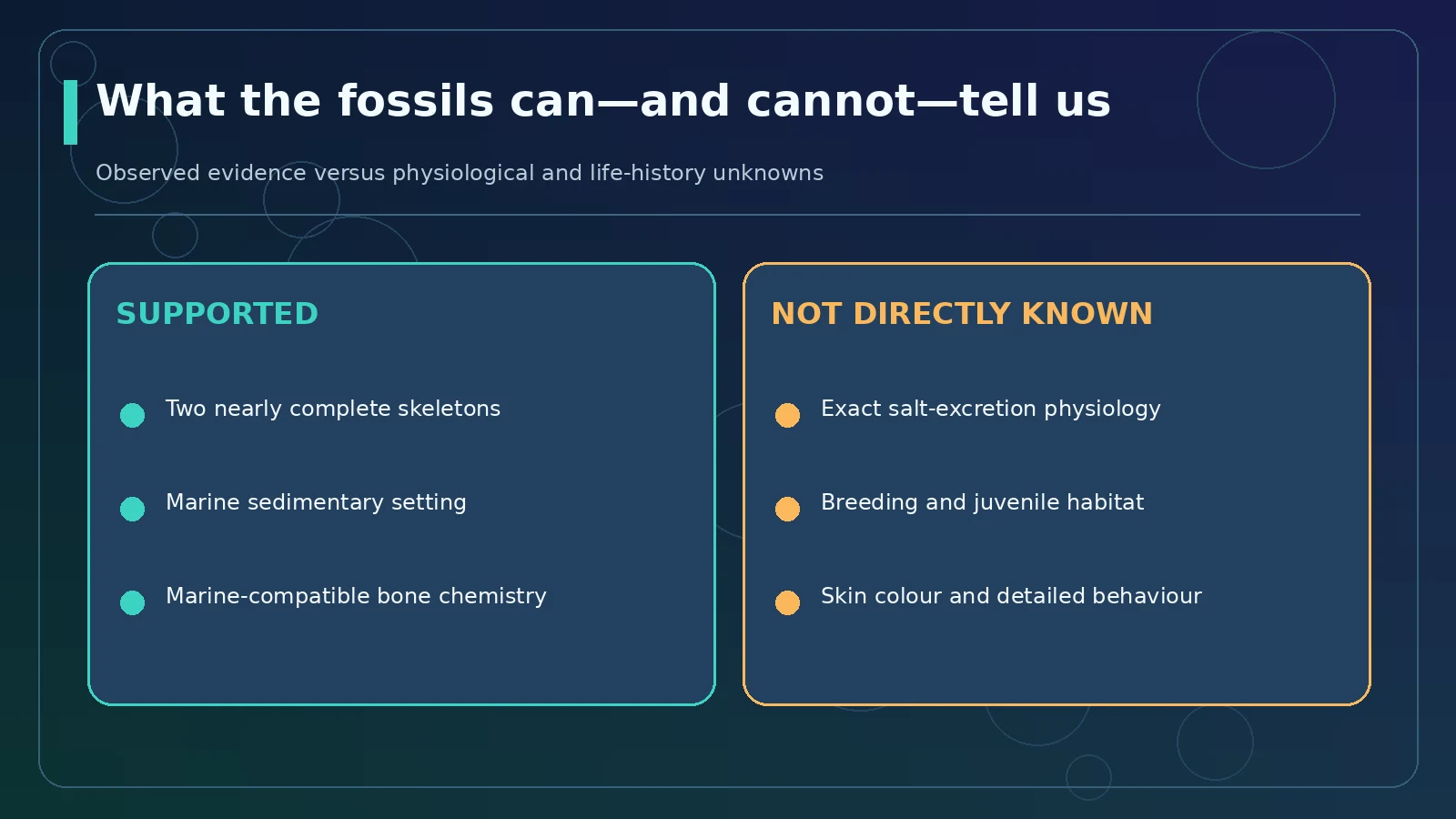
Future researchers could test this hypothesis by finding more articulated skeletons from different ages, additional isotope samples, sediment records from other sites, and any evidence of juvenile or breeding stages. Improved comparisons with related freshwater temnospondyls may show which armour features came first and which changed in seawater. Geochemical work should also consider diagenesis—later mineral changes that might alter fossil signatures.
None of these future tests diminishes the current discovery. They define what the present data cannot yet settle. A carefully qualified interpretation is more persuasive than claiming every feature of an extinct animal has already been proved.
Where to see the real fossils and the original science
The genuine photographs of specimens and mapped skeletal drawings are available in the published paper, figures 2 and 3. A representative fossil photograph appears in the UC Davis press release of 26 October 2026, credited there to Ryosuke Motani; a scholarly Nature news report reproduces further published figures. These are original fossil images, not illustrations of living animals. They are linked rather than republished here because their reuse permission was not confirmed.
The large featured underwater image in this article is a conceptual artistic reconstruction inspired by the description, not an official reconstruction or an authenticated photograph. Readers should rely on the published fossil plates for anatomical verification and view all artistic colour, background scenery and surface textures as interpretive choices.
What this changes about amphibian evolution
The broader scientific lesson is that the apparent limits of a living group do not always describe everything its extinct relatives achieved. Present-day amphibians are strongly constrained by saltwater physiology; an extinct armoured stem amphibian may have found a viable route into the open sea. Armour, perhaps inherited for protection, may have helped a very different lifestyle become possible.
This does not mean today's amphibians are about to adapt to oceans or that researchers have settled the physiology of every Triassic stem amphibian. It means a well-supported exception has been proposed, with several testable lines of evidence. Understanding that distinction is the most durable value of the find.
Sources and further reading
- Diao et al., A fully marine stem amphibian from the Late Triassic of China, Nature Ecology & Evolution, 26 October 2026 — original peer-reviewed research.
- University of California, Davis, Researchers Unearth Fossil Evidence of First Fully Marine Amphibian, 26 October 2026 — researchers' account and authentic fossil photography.
- Nature Portfolio press release, 27 October 2026 — evidence summary and stated limitations.
- Nature News: Evolutionary 'game-changer', 26 October 2026 — independent expert context.
- More on how ecosystems can operate in the sea — related background on marine environments, not a source for the fossil discovery.
You may also like
 History & Archaeology
Who Killed the Roman Soldier in the Well? Inside a 2,000-Year-Old Cold Case
A Roman-era skeleton from Velsen has been re-examined with modern forensic science. Explore the dagger, injuries, tooth isotopes…
 Science & Nature
Four-Winged Norellraptor: Did Dinosaur Flight Evolve More Than Once?
A new feathered dinosaur from China suggests flight-related anatomy evolved along more than one route, but the fossil…
 Science & Nature
Why Are Butterflies So Hard to Catch? Their Wing Optical Illusion Explained
A 2026 Nature study explains how butterfly wing patterns and flight alter motion cues and can misdirect attempts…