
Who Killed the Roman Soldier in the Well? Inside a 2,000-Year-Old Cold Case
A Roman-era skeleton from Velsen has been re-examined with modern forensic science. Explore the dagger, injuries, tooth isotopes and competing explanations without confusing hypothesis with proof.
Contents
- The ancient Roman cold case in one minute
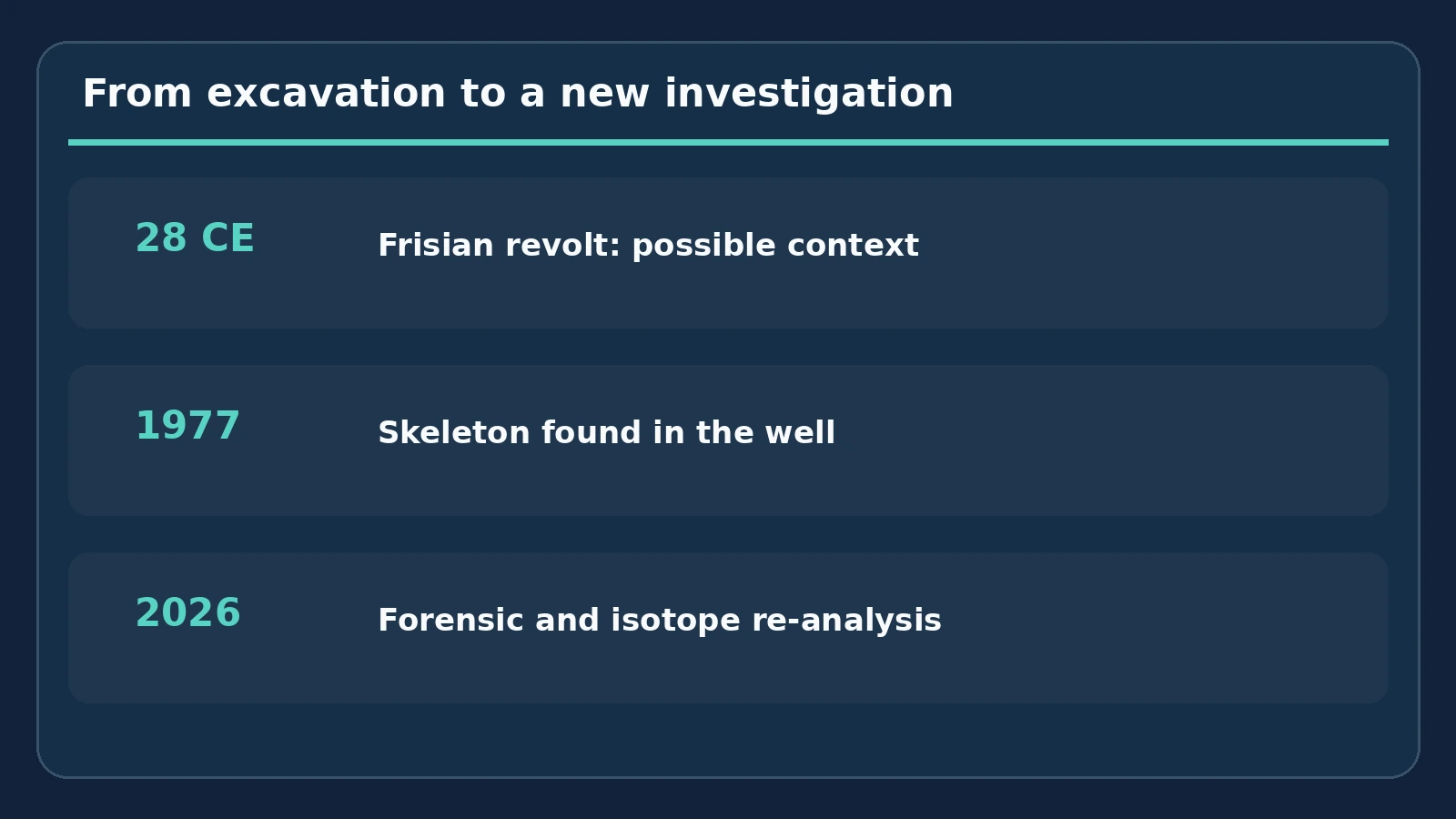
- A discovery in 1977, a new investigation in 2026
- Where was Velsen, and why were Romans there?
- What did the investigators actually find?
- Why the wounds point to repeated stabbing
- The dagger: likely weapon or only an associated object?
- Why did the body end up in a well?
- The surprising evidence in his teeth
- What about the two other people in a nearby well?
- Was the Frisian uprising of AD 28 the motive?
- Four leading explanations — and what would test them
- How strong is each kind of evidence?
- What can 3D reconstruction tell us — and what can it not?
- What isotope analysis tells us — and why it is not DNA
- Timeline of the case
- Why the investigation matters even without a culprit
- Where are the actual photographs and artefacts?
- Questions the evidence still cannot answer
- A simple evidence checklist for readers
- The conclusion: much clearer violence, still an unsolved murder
- Primary sources and further reading
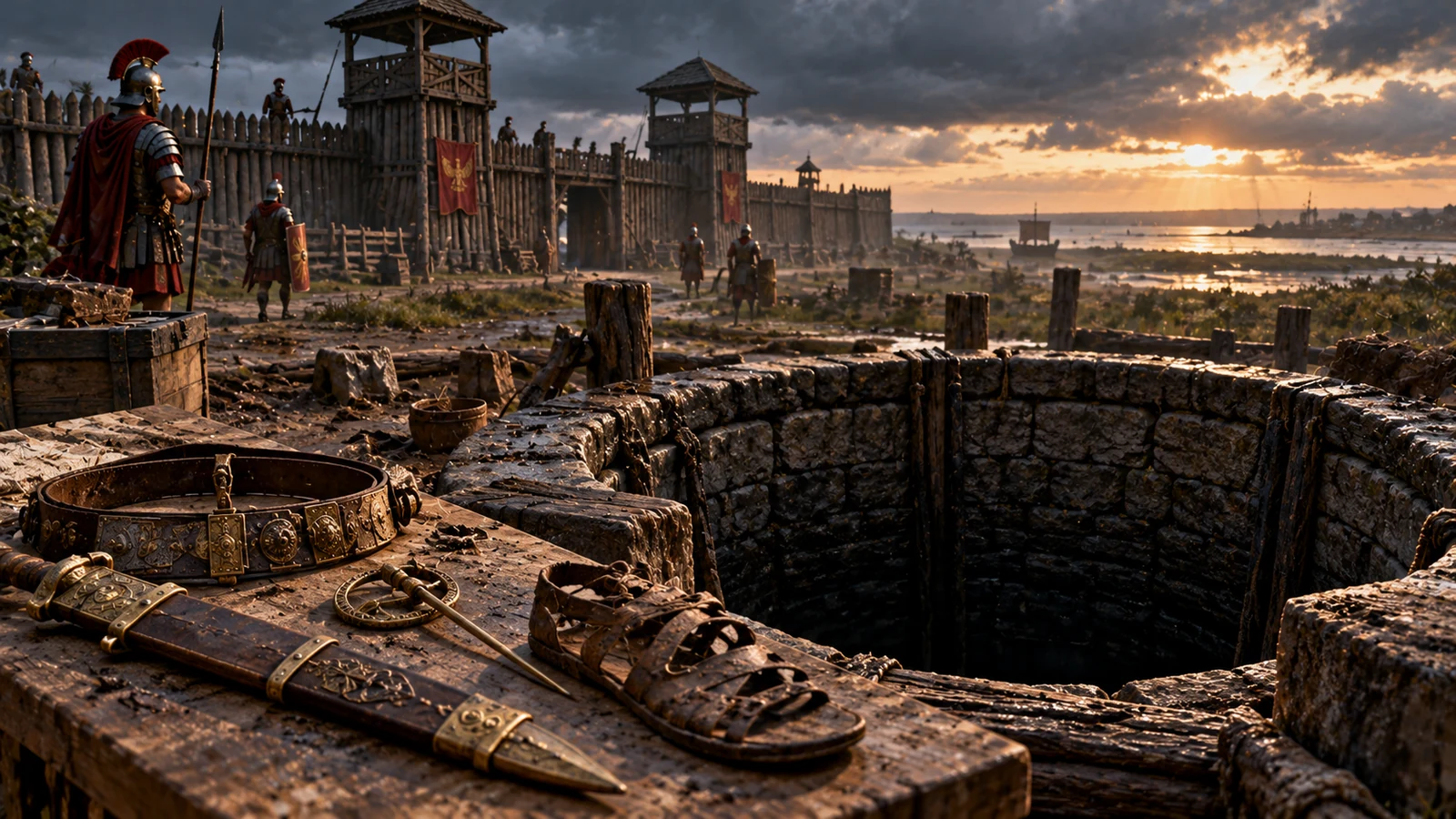
A nearly complete skeleton lying at the bottom of an ancient well, a Roman military dagger and a series of severe skeletal wounds sound like the opening of a detective novel. But the case is real. Archaeologists uncovered the remains at Velsen, in the Netherlands, in 1977. Researchers at Leiden University revisited the evidence with modern forensic methods, and announced the findings on 26 October 2026. Their conclusion is forceful about the violence but cautious about the killer: this man was repeatedly stabbed, yet the identity and motive of those responsible remain unproven.
There is more to the story than the dramatic headline. The investigation links bones, objects, tooth chemistry and early Roman history, but none of these sources can independently name a culprit. The research, collected in the 2026 scholarly volume Victims of Violence from the Early Roman Fort Velsen 1, asks readers to compare several possible scenarios rather than claim a crime has been conclusively solved. This guide follows that evidence-first approach, adds a practical test for each hypothesis, and separates what scientists observed from what they infer.
The ancient Roman cold case in one minute
| Item | Verified account | Not established |
|---|---|---|
| Site | Velsen 1, Netherlands; human remains discovered in a well in 1977 | The precise identity of the attacker |
| Period | Early Roman era, around 2,000 years ago | A proven death date tied to AD 28 |
| Victim | Adult male, approx. 1.90 m, likely military | His name, rank and unit |
| Injury | Multiple penetrating wounds; 3D examination | Exact blow-by-blow reconstruction |
| Origins | Tooth-enamel isotopes suggest childhood in southern Europe | A single town, nationality or DNA ancestry |
| Research | 2026 edited interdisciplinary study and Leiden news release | A court-level solution to the crime |
A discovery in 1977, a new investigation in 2026
Amateur archaeologists working at the site of the early Roman fort Velsen 1 uncovered a well in 1977. The remains of a man lay at its bottom, associated with a military belt, a dagger and sheath, a ring, a brooch, and footwear consistent with a soldier’s sandal. This was not an ordinary modern crime scene: centuries of water, sediment, disturbance and archaeological excavation affected how the deposit could be read. Objects found together can offer clues, but their exact positions and the sequence in which they reached the well matter as much as their names.
The 2026 project was not the discovery of a new body. It was a re-examination of old evidence by archaeologists, specialists in human skeletons, forensic experts and scientists using isotopic chemistry and three-dimensional modelling. Some of the conclusions changed because previously overlooked or poorly understood marks could be analysed in greater detail. The book’s publication and the university’s October announcement brought that reassessment to a wider audience.
Where was Velsen, and why were Romans there?
Velsen lies in the present-day Netherlands, in a landscape shaped by waterways close to the North Sea. In the early first century CE it occupied a strategically sensitive northern frontier of Roman activity. A fort could support military movements, transport, supply, and interactions with nearby communities. The location matters because it places the death inside a frontier society, where friction might have involved soldiers, local residents and imperial demands.
There is an easy geographical trap here: this is the Velsen well case, not the Roman grave discovered at Heerlen in 2024 and not the group of soldiers found in a Croatian well. Those are different excavations in different places and centuries. Mixing them together can create a compelling but false narrative. The Velsen investigation concerns a particular skeleton from a 1977 find and a newly published interpretation of that individual.
What did the investigators actually find?
| Clue | What was found / observed | Interpretation to keep conditional |
|---|---|---|
| Skeleton | Nearly complete remains with trauma | The person was killed violently |
| Dagger and sheath | Roman military-associated equipment | Dagger plausibly linked to injuries |
| Belt and sandal | Items consistent with army material culture | Likely ordinary soldier |
| Tooth enamel | Non-local isotopic signature | Childhood likely in southern Europe |
| Well deposit | Body and objects from one archaeological context | Reason and timing of disposal uncertain |
The objects alongside the body support a military connection. A dagger, a decorated sheath, a belt assembled from different pieces, a brooch, a ring and a soldier-style sandal all feature in the published account. The investigators lean towards a rank-and-file soldier rather than a high-ranking officer. Yet no surviving label spells out his unit, personal name or exact rank. Military-looking equipment does not, by itself, prove which side someone was on at the instant of death.
The body is equally revealing and equally limited. The skeleton is unusually complete for the period, allowing researchers to assess injuries in several regions rather than infer an entire event from one fragment. It gives the investigation a rare human focus: we are examining damage experienced by one person, not simply a weapons inventory. But bone cannot preserve every movement, word or encounter leading up to the attack.
Why the wounds point to repeated stabbing
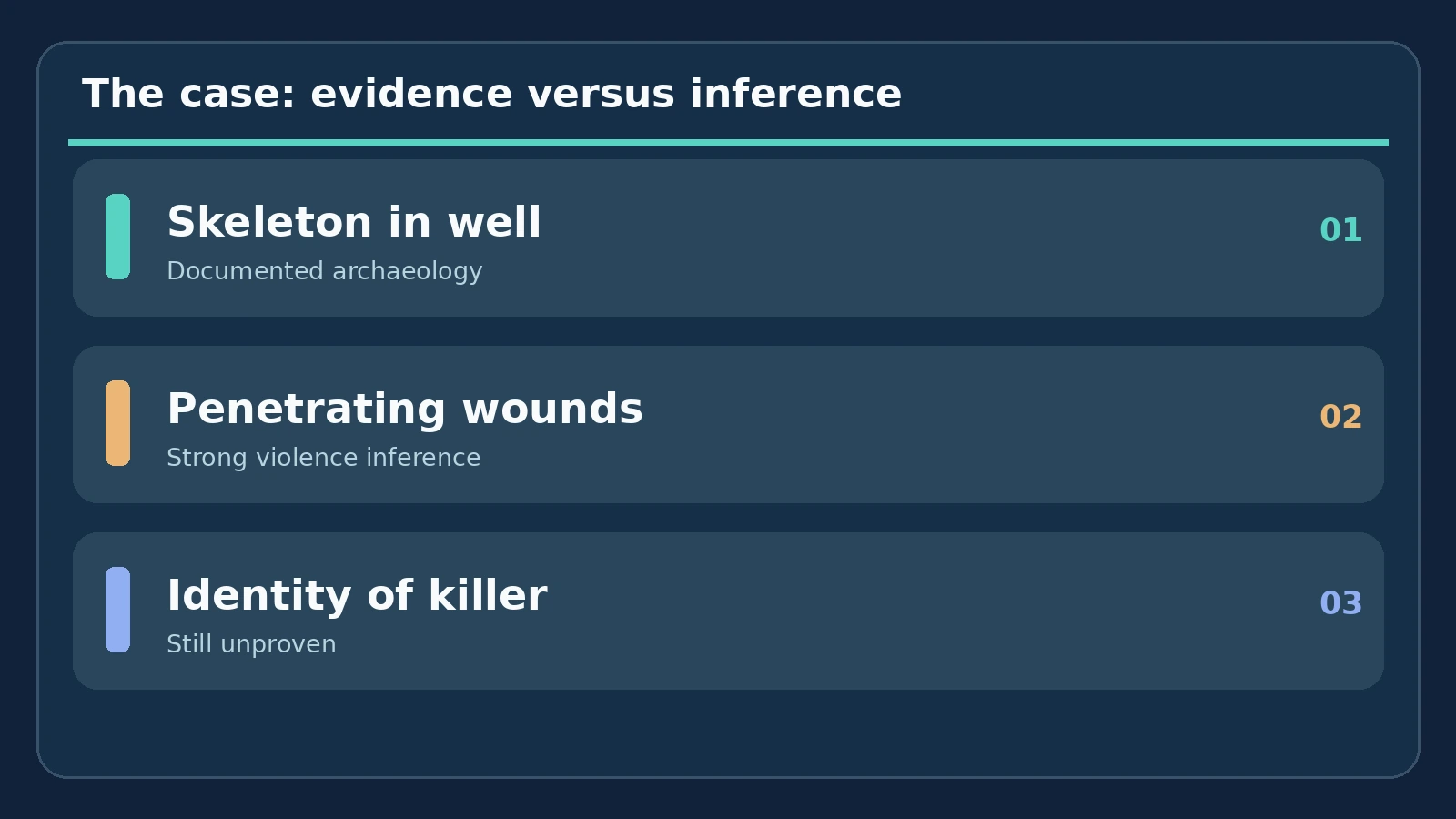
The team documented further evidence of penetrating trauma, including marks on the inner side of the rib cage and multiple perforations in the pelvis. A 3D reconstruction helped them evaluate shapes and trajectories and compare these with the kind of weapon recovered nearby. According to the researchers, a Roman military dagger offers a plausible explanation for at least some of the injuries. The sheer concentration of wounds led consulted forensic specialists to describe an unusually violent attack.
That assessment supports a targeted assault more readily than a simple account of a man falling in combat at the perimeter of a fort. Still, forensic pattern analysis is not a time machine. A wound can support a particular instrument or movement without identifying the person’s hand that held it. Nor does the presence of a dagger in a well demonstrate that it was used for every injury. A careful account should speak of strong consistency, not absolute proof.
The dagger: likely weapon or only an associated object?
A Roman dagger beside the remains is a powerful clue because the 3D analysis linked certain punctures to a weapon of that general form. The book also evaluates the decorated sheath and how its construction fits with dating and military equipment. An object inside the same archaeological feature can be related to the death, to later disposal or to an episode of filling the well. Those possibilities are not equally likely, but they should not be silently collapsed into one.
There is no forensic chain of custody equivalent to a contemporary crime scene: no recoverable modern fingerprints, admissible testimony or reliable sequence of every attacker’s action. This is why the research can strengthen an interpretation of a stabbing without transforming an archaeological context into a solved prosecution. The right question is how well the weapon explanation fits both the bone damage and the associated artefacts.
Why did the body end up in a well?
The location and manner of deposition pose a question separate from the cause of death. A violent death does not automatically explain why a body was left at the bottom of a water well. Concealment, punishment, disposal after a military emergency, or a hurried response to violence could produce superficially similar deposits. Stratigraphy, the position of objects, and evidence of decomposition or movement matter when discussing these scenarios.
The published volume includes detailed examinations of the well structure, botanical and insect remains, the associated artefacts, and processes that can move bones after a body is deposited. These chapters are a reminder that a skeleton’s final arrangement need not reproduce the last seconds of life. It is possible to identify a wound in bone while remaining uncertain about whether the body entered the well immediately after death or later.
The surprising evidence in his teeth
In the 1980s, some scholars suggested the man might have belonged to the local Frisian population. His unusual stature, approximately 1.90 metres, was one of the features that attracted attention. The latest isotope study points instead towards a childhood spent in southern Europe. The chemical signatures incorporated into tooth enamel while teeth are forming can reflect the landscape, water and diet of early life. Comparing those signatures with known regional patterns can distinguish broadly between a person who grew up locally and someone who moved across regions.
This is not a passport test. Isotopes do not name a birthplace, ethnicity, first language or military allegiance. Regional chemical values can overlap and depend on multiple environmental factors. Nor does being raised in the south prove the man was born in Rome itself. The defensible conclusion is that the enamel points away from a local childhood and towards a southern European origin, as the research team interprets it.
What about the two other people in a nearby well?
The scholarly volume discusses two further male individuals recovered from another well at Velsen. Isotope measurements indicate that these men were not local to the area either. That raises questions about recruitment, travel, shared military supply routes and how diverse the population around the fort may have been. It is useful background for understanding mobility in the Roman frontier.
It does not establish that all three men died together, knew one another, served in the same military unit or were killed for the same reason. The temptation to join separate skeletons into a single dramatic event is understandable, but each well’s date, context and injuries need independent analysis. This is an example of the broader rule guiding the whole investigation: connection is a hypothesis until the context can support it.
Was the Frisian uprising of AD 28 the motive?
The Roman historian Tacitus recorded a Frisian revolt in AD 28 associated with Roman demands for tribute. That account has long influenced interpretations of military finds in the area. It supplies a plausible historical setting: a garrison in a tense province could have faced attacks, rebellion or retaliation. But it does not mention this specific man in this specific well, and texts written about politics and war are not neutral eyewitness statements about every excavated death.
The Leiden researchers caution that archaeological evidence can complicate narratives inferred from classical writers. For example, the sequence of Roman activity north of the Rhine is not always as simple as an immediate or total retreat in AD 28. Therefore, dating the body and the related equipment is not the same as proving it died during the revolt. The revolt belongs in the story as a context and possible scenario, not as a solved motive.
Four leading explanations — and what would test them
| Possible scenario | What makes it conceivable | What remains unproven |
|---|---|---|
| Frisian uprising / assault | Military frontier and AD 28 account | Whether this man was killed then |
| Local revenge | Tensions around a fort | Specific grievance or local attackers |
| Disciplinary execution / deserter | Military chain of command could punish desertion | No documented charge or order |
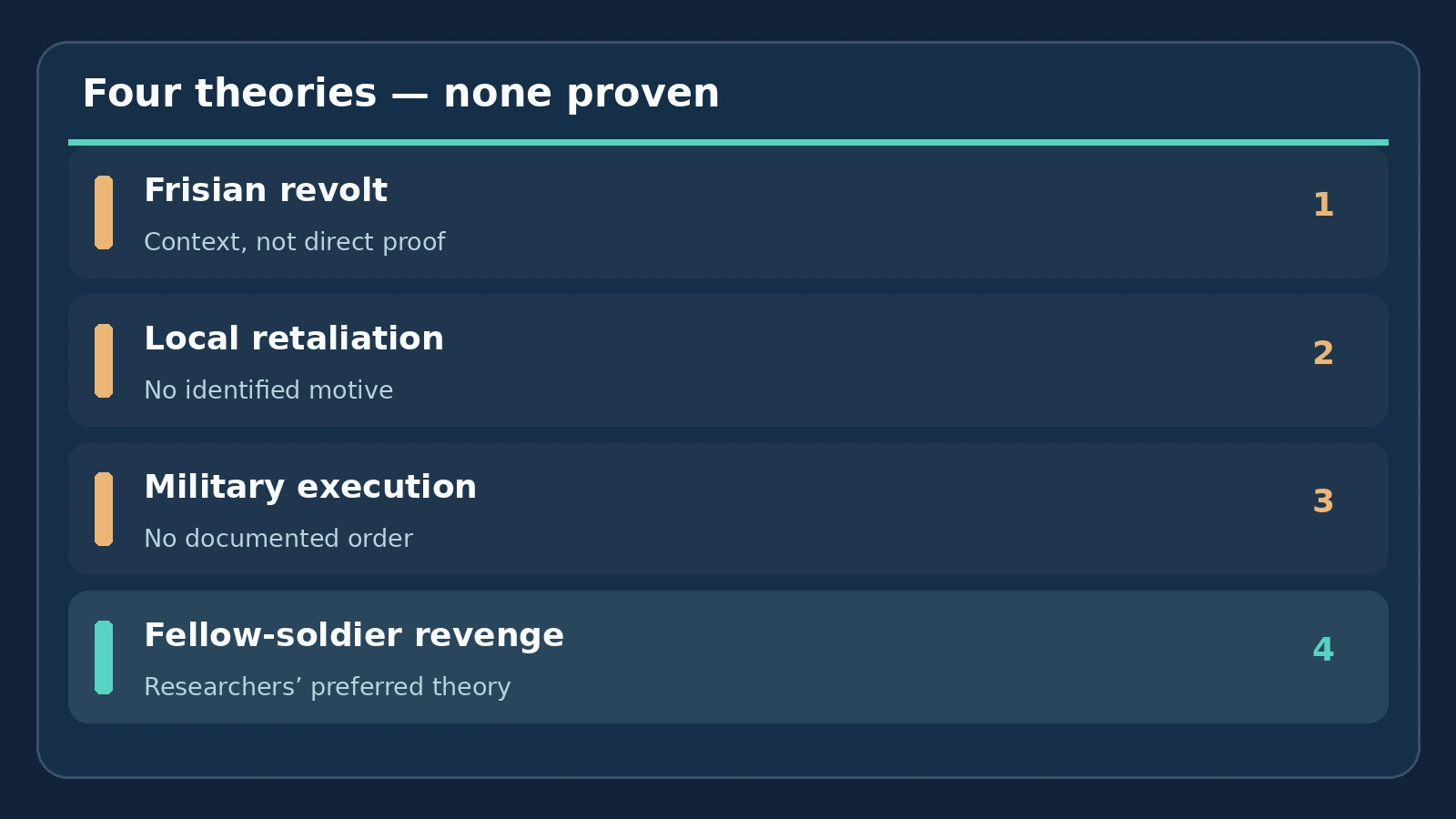
| Retaliation by fellow soldiers | Researchers see severe stabbing as personal violence | Identity of soldiers and precise motive |
The 2026 book examines six scenarios overall. The table summarises four broad explanations explicitly discussed in the university’s public account; it is not a claimed reproduction of all six numbered chapters or a mathematical probability ranking. Researchers consider an attack during the Frisian revolt, violence by local inhabitants, punishment connected to desertion, and retaliation by fellow soldiers. Their preference is for a revenge attack within the military community, but they warn that there is no final certainty.
To weigh these possibilities, start with what the skeleton and excavated objects establish, then test each narrative against the same observations. A hypothesis that can explain severe repeated stabbing is not automatically correct if it cannot also account for dating, the well deposit and the individual’s likely mobility. Conversely, lack of a recorded motive does not make all scenarios equally well supported. Interpretive discipline means being open about which comparisons rely on judgments.
How strong is each kind of evidence?
The strongest evidence concerns directly recorded objects and anatomical marks: a skeleton in a well, equipment, and signs of penetrating trauma. Strong but model-dependent evidence includes a dagger’s fit to the wounds and the southern-European childhood suggested by isotope data. Much weaker evidence concerns an exact date of the killing, a connection to a named revolt, a specific perpetrator or a particular motive. None of those propositions is established merely because one interpretation makes an engaging story.
This distinction protects readers from misleading headlines. A discovery can be both dramatic and honestly unresolved. The new research greatly narrows what makes sense about the person’s final experience, while leaving the social circumstances of the crime beyond direct observation. In other words, the forensic reconstruction is more advanced than the historical identification of the killers.
What can 3D reconstruction tell us — and what can it not?
Three-dimensional imaging and digital modelling preserve detailed representations of bone surfaces and allow researchers to examine a puncture without repeatedly handling the fragile original. Models can help compare a lesion’s geometry with a proposed blade and can be shared among specialists. Experimental reconstruction offers a way to ask whether an explanation is mechanically plausible instead of relying on a single visual impression.
There are limits: soft tissue is missing, trauma can be modified by later damage, and different forces or weapons may create overlapping patterns. Software can reconstruct the visible surfaces and simulate a proposed mechanism; it cannot automatically produce a film of what actually happened. The most responsible presentation of a 3D result uses conditional language such as ‘compatible with’ or ‘suggests’ rather than ‘proves exactly how’.
What isotope analysis tells us — and why it is not DNA
DNA analysis investigates genetic information. Isotope analysis measures the relative abundance of chemical variants that can reflect diet, local geology or water sources. Teeth are particularly helpful because enamel forms during childhood and is comparatively resistant to later change. A person can have Roman military equipment, a northern European death location and a childhood chemical signature consistent with southern Europe without there being any contradiction.
The two methods answer different questions. A family or genetic affinity would require genetic evidence; the authors’ public report discusses isotope evidence for childhood geography. It would therefore be inaccurate to label the result ‘DNA proves he was Italian’ or ‘a Roman citizen identified by genetics’. That claim goes well beyond what was reported. Distinguishing these approaches is particularly valuable in popular coverage where every scientific test is sometimes described vaguely as genetic.
Timeline of the case
| Date | Event | Why it matters |
|---|---|---|
| Early first century CE | Roman military presence around Velsen | Historical context of the well |
| AD 28 | Frisian uprising recorded by Tacitus | Possible context, not a proved murder date |
| 1977 | Skeleton and objects excavated from a well | Discovery of original evidence |
| 1980s | Local Frisian origin among early suggestions | An interpretation later challenged |
| 2026 | Book and Leiden announcement published | New forensic and isotope interpretation |
Why the investigation matters even without a culprit
Early Roman skeletons preserved well enough for detailed forensic work are scarce. Combining osteoarchaeology, artefact research, isotope chemistry and digital modelling lets archaeologists test old assumptions across independent lines of evidence. Instead of treating a classical historical narrative as a ready-made explanation, the team puts it next to information from an individual body and its burial environment. That change of method is a contribution in itself.
The study also restores individuality to an ancient archaeological find. Belongings suggest everyday use, an unusually large body reflects a distinct life history, and teeth preserve traces of a childhood far from the burial site. None of these details is a complete biography. Together, however, they convey how military frontiers connected very different places and people, often in circumstances shaped by hierarchy, violence and political change.
Where are the actual photographs and artefacts?
Leiden University’s original report contains authentic images of the skeleton, the recovered belt and dagger sheath, a facial reconstruction by Maja d’Hollosy and illustrations by Fred Marschall. Those images belong to their credited creators and are linked here at the source rather than copied without a clear re-use licence. This article’s large opening scene and its explanatory diagrams are original editorial illustrations, not excavation photos or reconstructions approved by the excavators.
For the original materials, open the Leiden University report and image gallery. For the full methods, context and different hypotheses, consult the scholarly book’s publication page, where the contents can be read online. The research is also discussed in an independent interview by Gizmodo. Each plays a different role: original reporting, research chapters and external interpretation.
Questions the evidence still cannot answer
- His personal name, precise military unit and the documented chain of orders around the death.
- Whether the blade found in the well produced every single injury, or whether more than one weapon was used.
- Which people carried out the attack, how many attackers there were, and whether they were local residents or fellow soldiers.
- Exactly how long elapsed between the assault, death and deposition of the remains.
- Whether AD 28 and the Frisian revolt explain this particular incident rather than serving as historical background.
- Whether any additional undiscovered evidence can decisively favour one proposed motive.
A simple evidence checklist for readers
When you encounter an archaeology headline claiming that a 2,000-year-old killing has been ‘solved’, ask five questions. Was the wound actually documented in bone, or only inferred from a drawing? Is the proposed weapon demonstrated or merely found nearby? Does isotope chemistry identify childhood geography or a modern nationality? Is a historical battle independently dated to the death? Finally, is the culprit named by direct evidence or favoured in the researchers’ judgement? These questions are useful for assessing other spectacular archaeological claims too.
The same evidence-first method can clarify other ancient mysteries. For example, readers interested in how exceptional preservation changes our knowledge can explore our report on the glass-like brain remains from Herculaneum; for a separate historical reconstruction, see the ancient shipwreck and trade investigation. Those are different topics, but the same distinction between observations and interpretations applies.
The conclusion: much clearer violence, still an unsolved murder
The Velsen case is not proof that a tax revolt killed a named Roman soldier, and not proof that his comrades committed murder. It is a well-documented revision of a rare early Roman skeleton: serious penetrating trauma, a plausible military dagger, evidence for an upbringing away from the northern Netherlands and a range of competing scenarios. The investigators favour retaliation by fellow soldiers, while openly acknowledging that certainty is impossible on the available record.
That honest boundary is what makes this story worth reading. Archaeology did not magically turn the past into a perfectly filmed crime scene. It took a 1977 discovery and used new methods to extract much more from it, while leaving room for readers and future research to revisit the remaining unknowns.
Primary sources and further reading
- Leiden University, Solving an ancient cold case: Roman was brutally murdered (26 October 2026) — original researchers’ public statement and photo credits.
- Driessen and Van Driel-Murray (eds.), Victims of Violence from the Early Roman Fort Velsen 1 (2026), Sidestone Press, DOI 10.59641/j84776mv — original edited research volume and contents.
- Gizmodo, Archaeologists Thought This Roman Soldier Was Killed in a Tax Revolt (27 October 2026) — follow-up reporting and researchers’ comments.
- Phys.org / Leiden University (26 October 2026) — syndicated university release.
- Archaeology Magazine, Velsen military camp contextual note (2021) — broader fort context, not evidence in the murder case.
You may also like
 Science & Discoveries
First Fully Marine Amphibian? The 237-Million-Year-Old Gerrothorax Discovery
Two remarkably complete Chinese fossils suggest an armored early amphibian spent its life in the sea. Here is…
 History & Archaeology
Why Did 20 Homo naledi Individuals Show No Male Markers? The Tooth Protein Mystery
A 2026 Cell study tested 23 fossil teeth representing at least 20 Homo naledi individuals, finding no confident…
 History & Archaeology
Ice Age DNA Reveals How Europeans Were Connected 30,000 Years Ago
New 2026 genomic evidence reveals east-west links among Gravettian peoples in Ice Age Europe and human ancestry preserved…