
Ice Age DNA Reveals How Europeans Were Connected 30,000 Years Ago
New 2026 genomic evidence reveals east-west links among Gravettian peoples in Ice Age Europe and human ancestry preserved in cave sediment.
Contents
- The discovery in four findings
- Who were the Gravettian people?
- The woman from Isturitz: why one genome matters
- Did this prove a specific route across Europe?
- The four archaeological places that tell different parts of the story
- The surprising second discovery: human DNA in cave dirt
- How could human DNA survive without a skeleton?
- What was the Last Glacial Maximum—and why does it matter?
- A baby and a mother in southern Italy: what genetics can actually say
- An illustrated time line: do not confuse three different ages
- How do scientists detect eastern ancestry in a western sample?
- What is established, inferred and still unknown?
- What three common headlines get wrong
- 'DNA proves the whole continent was one population'
- 'A woman carried genes from an eastern nation'
- 'Scientists sequenced a prehistoric person's complete genome from dust'
- Why the 2026 research adds value beyond older studies
- Can archaeologists confirm the genetic story without relying on DNA alone?
- Key sources and real photographs
- Conclusion: Ice Age Europe was more connected than a two-group map suggests
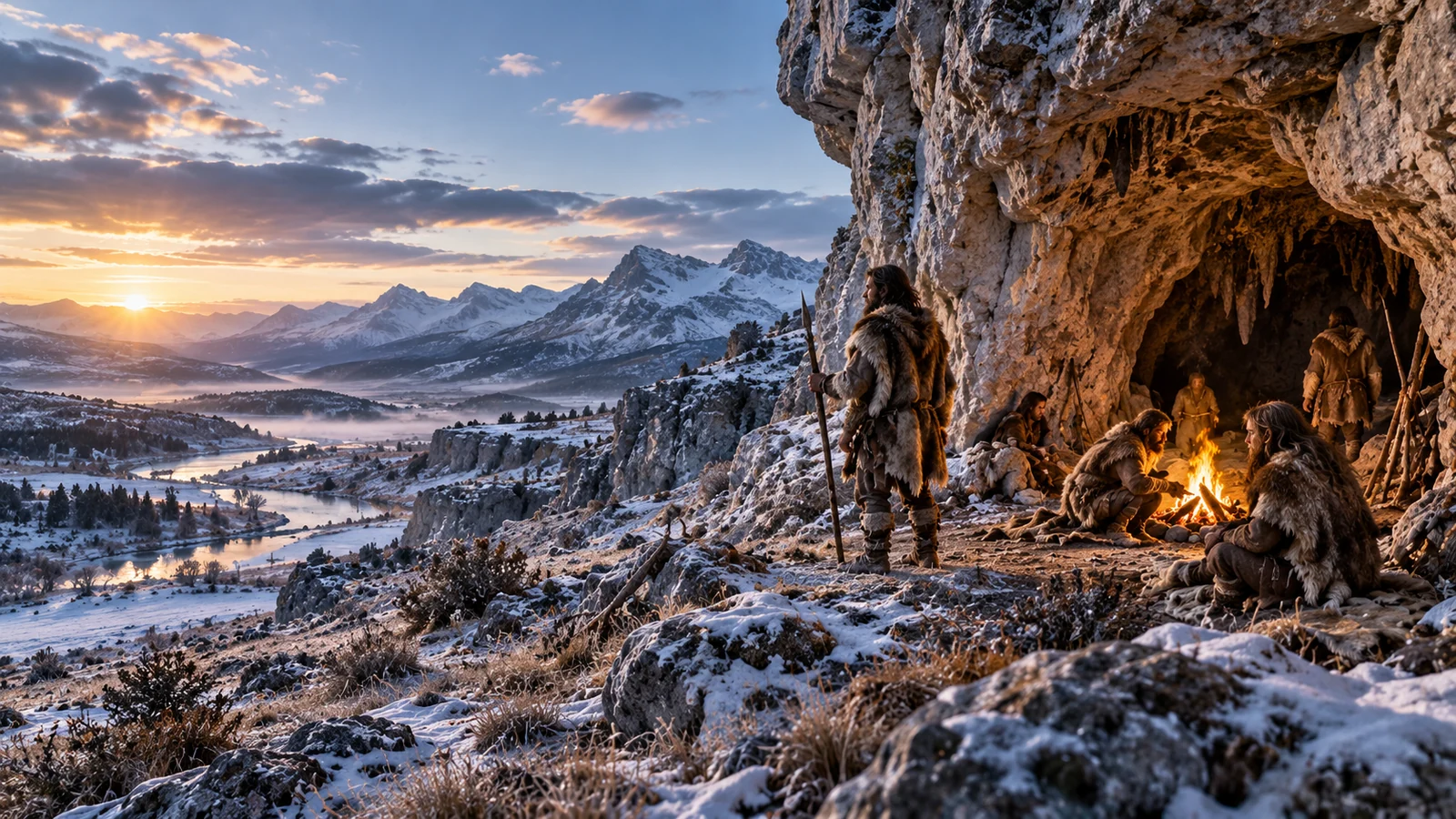
A woman who lived in what is now southwestern France roughly 30,000 years ago carried a genetic signature linking western Europe to populations farther east. A study published in Science Advances on 23 October 2026 also retrieved ancient human nuclear DNA from Spanish cave sediment about 22,000 years old, even though that sampled layer yielded no human bones or teeth. Together, the findings offer a more complicated picture of Ice Age Europe: some communities maintained regional ancestry across millennia while others exchanged genes over long distances.
The results do not mean that scientists have reconstructed one prehistoric road, identified an entire tribe, or shown that every European today descends from this woman. What they demonstrate is much narrower—and more interesting: the old contrast between culturally connected Gravettian communities and apparently separate genetic ancestry groups was too simple. The University of Vienna’s 23 October 2026 statement and the study record in Science Advances (DOI: 10.1126/sciadv.aeh6128) provide the core evidence.
The discovery in four findings
- Isturitz, France: A woman who lived about 30,000 years ago had primarily western Gravettian-related ancestry alongside an eastern-related contribution.
- Timing: Genetic modelling places the mixture roughly 32,500–31,500 years ago, before that woman’s lifetime. It is not a dated journey by the woman herself.
- El Mirón, Spain: A roughly 22,000-year-old archaeological layer yielded about 14,000 informative human genetic variants (single-nucleotide polymorphisms, or SNPs) from cave sediment rather than an identifiable skeleton.
- Ostuni, Italy: The genetic relationship of a fetus and a previously studied woman contributes evidence about family relationships; it cannot describe marriage customs across a whole continent.
These points change our understanding of population connections, not the date at which modern humans first reached Europe. Modern humans had entered the continent well before the Gravettian, at least about 45,000 years ago. The researchers’ technical abstract explicitly frames this study as an addition to an already limited sample of early European genomes.
Who were the Gravettian people?
Archaeologists use Gravettian for overlapping traditions of stone tools, ornament production, hunting strategies and other material practices found across broad parts of Europe roughly 34,000–25,000 years ago. It is a label for a prehistoric archaeological culture, not the name of a single nation, language, ethnicity or DNA-defined group. People associated with Gravettian artifacts could share techniques, interact with neighbours and still have varied ancestry.
The challenge emerged sharply in a major 2023 Nature study of ancient European hunter-gatherers. Its authors described distinguishable ancestry profiles among roughly contemporaneous Gravettian-associated individuals. Western samples clustered around an ancestry profile commonly called Fournol, while central, eastern and parts of southern Europe included a profile termed Věstonice. Those labels derive from archaeological specimens and comparative genetic analysis—not from the names or identities of ancient ethnic communities.
At first glance the archaeological story and the genetic story seemed to clash: similar artifacts appeared across an extensive area, but the available ancient genomes showed regional structure. The 2026 work does not erase that structure. It adds cases of genetic exchange within it, suggesting regional continuity and long-range connectivity could operate at the same time.
The woman from Isturitz: why one genome matters
Isturitz Cave lies in the French Basque region of southwestern France. The newly analysed remains belong to a woman whose lifetime falls around 30,000 years ago. Researchers report the oldest genome-wide dataset of an anatomically modern human yet available from southwestern Europe. That phrasing is specific: it does not claim this is Europe’s oldest human, its oldest DNA of any kind or its first female ancestor.
Most of her ancestry fit the western Gravettian-associated genetic profile. But statistical comparisons also detected a component related to groups from central and eastern Europe. The study argues that some earlier mixing or movement connected populations previously treated as more separated. A related signal from another individual previously studied at Ormesson, France, lends context to this interpretation.
The modelling dates the ancestry mixture to approximately 32,500–31,500 calibrated years before present. This is an estimate from genetic patterns under model assumptions, not a directly observed historical event. Because the woman lived later, the mixing could have occurred among earlier generations. She need not have traveled east herself; the signal could have moved through relatives or networks over multiple generations.
Did this prove a specific route across Europe?
No. The genetic evidence is consistent with population contact and mixture, but it does not specify a river route, number of journeys, caravan, trading path or exact geographic origin of every ancestor. Movement could have taken place in stages. Nor can a single ancient genome tell us the social motives—marriage, relocation, conflict, seasonal meeting or some combination. Isturitz has archaeological features consistent with being a meeting point, but that remains a contextual interpretation rather than proof of a particular gathering.
A photograph of the actual Isturitz cave entrance is available on Wikimedia Commons (photograph by Krijun, CC BY-SA 3.0). The original study announcement also includes a separately credited photograph by Severine Dabadie. These are real images of the site, unlike the illustrative reconstruction accompanying this article.
The four archaeological places that tell different parts of the story
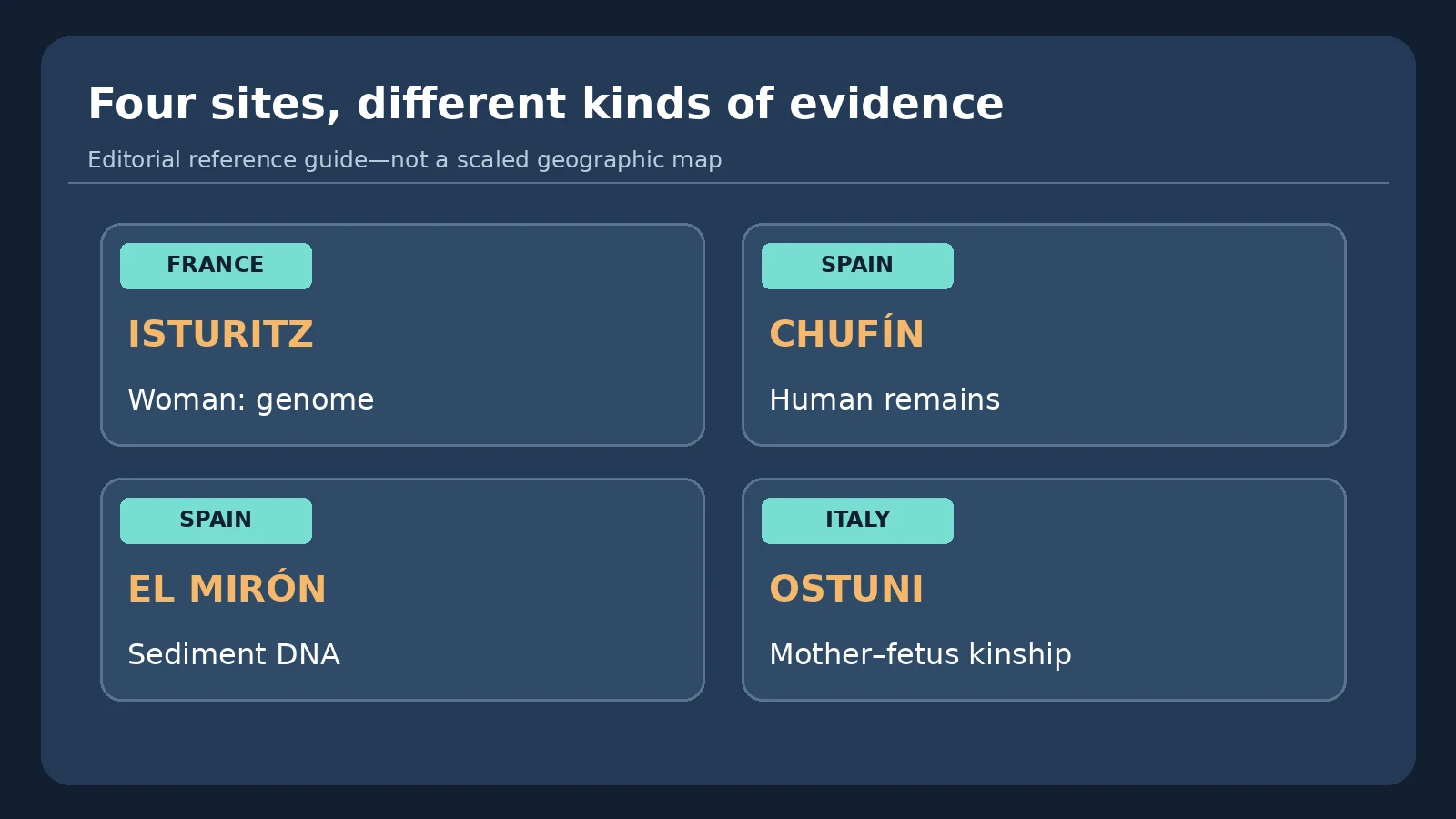
| Location | Country | Material studied | What it contributes | What it cannot establish alone |
|---|---|---|---|---|
| Isturitz | France | Ancient woman’s genome-wide DNA | Western ancestry with an eastern-related genetic contribution | Her personal travel route or exact language |
| Chufín | Spain | DNA from a Gravettian-associated individual | Additional evidence of regional ancestry in northern Iberia | Genetic make-up of every person in ancient Spain |
| El Mirón | Spain | Human DNA from a 22,000-year-old cave sediment layer | Persistence of western-related ancestry through cold conditions | A complete genome of one named person |
| Ostuni | Italy | DNA from a fetal skeleton considered alongside the mother’s data | Probable close maternal relationship and clues to parental relatedness | Generalized rules for all Gravettian families |
Why distinguish the materials? DNA from a particular bone or tooth can sometimes be associated with one sampled individual. Sediment DNA is different: a geological deposit can contain fragments shed at different times or by different people, as well as nonhuman DNA and contamination. Researchers have to use context, molecular authentication and comparative statistics to interpret the signal.
The surprising second discovery: human DNA in cave dirt
Human bones from the coldest stretches of the Upper Palaeolithic are scarce, which leaves big gaps in genetic maps. At El Mirón Cave in Cantabria, northern Spain, ancient sedimentary DNA offered another route into the past. The team investigated an approximately 22,000-year-old Solutrean-associated layer and recovered around 14,000 human SNPs—genetic positions useful for ancestry comparisons.
This does not mean the researchers unearthed 14,000 people or sequenced 14,000 complete genomes. An SNP is a position where DNA bases can differ among individuals. Thousands of such positions may be compared against reference samples to place otherwise fragmentary material in a broad ancestry context. Scientists used these signals to support the persistence of ancestry related to the Fournol group in southwestern Europe during the Last Glacial Maximum.
A separate 2025 Nature Communications paper had already shown the wider value of cave sediment research at El Mirón. The 2026 contribution is more specific: a layer and analysis that connect human nuclear variation to a particular cold-period phase. These papers should be treated as complementary, not as independent proof that one uninterrupted biological population occupied one cave without interruption.
How could human DNA survive without a skeleton?
Human beings shed cells and biological traces. Fragments can become associated with soil particles or mineral material inside sheltered environments. Over long periods, many molecules degrade; researchers may nevertheless recover sufficiently short fragments from carefully controlled samples. Ancient DNA analysis uses clean sampling, sequencing, characteristic molecular damage patterns, contamination checks and comparison to reference data. The scientific task is not simply to look at dirt and read the DNA of whoever once sat there.
This is a major reason sediment DNA is useful: it extends archaeology’s reach beyond the rare lucky survival of bones. But it also demands caution. A layer may contain multiple contributors, molecules can shift through deposits, and later contamination must be evaluated. The new finding provides a population-level genetic signal in archaeological context, not a reconstructed biography.
What was the Last Glacial Maximum—and why does it matter?
The Last Glacial Maximum, abbreviated LGM, refers approximately to 26,500–19,000 years ago, when global ice sheets reached particularly extensive conditions during the last ice age. Local climates varied; not every area of Europe was entirely ice-covered. Researchers have long investigated whether some humans survived in relatively more habitable southern regions while northern areas became difficult to occupy.
Southwestern Europe, especially the Franco-Cantabrian and Iberian region, is often discussed as a refugium—a region that supported human populations through the harshest conditions and contributed to later population histories. Recovering an ancestry signature from about 22,000 years ago supports survival of a genetic lineage in that wider region through part of the maximum. It does not prove that exactly the same individuals, settlement or customs endured unchanged, nor that this was the only refuge.
The 2023 large-scale palaeogenomic study had also argued for western ancestry surviving the cold period in southwestern Europe. The new sediment evidence helps fill gaps in the physical record during a period for which skeletal samples are few. That is incremental science, not the reversal of every previous conclusion.
A baby and a mother in southern Italy: what genetics can actually say
At Ostuni in southern Italy, the researchers analysed an ancient fetal skeleton designated Ostuni1b and considered it alongside the previously studied woman Ostuni1. The genomic evidence is consistent with the fetus being her son. Analysis also suggests the father belonged to a similar broad genetic population and that the parents were not closely related.
This offers an intimate, individual-scale glimpse of population history. However, translating one family into a sweeping claim such as ‘Stone Age Europeans had formal anti-incest laws’ would go beyond the data. The findings help test relatedness in this particular case and can inform larger discussions when more families are sampled. They cannot determine a prehistoric community’s universal social rules or preferences.
An illustrated time line: do not confuse three different ages
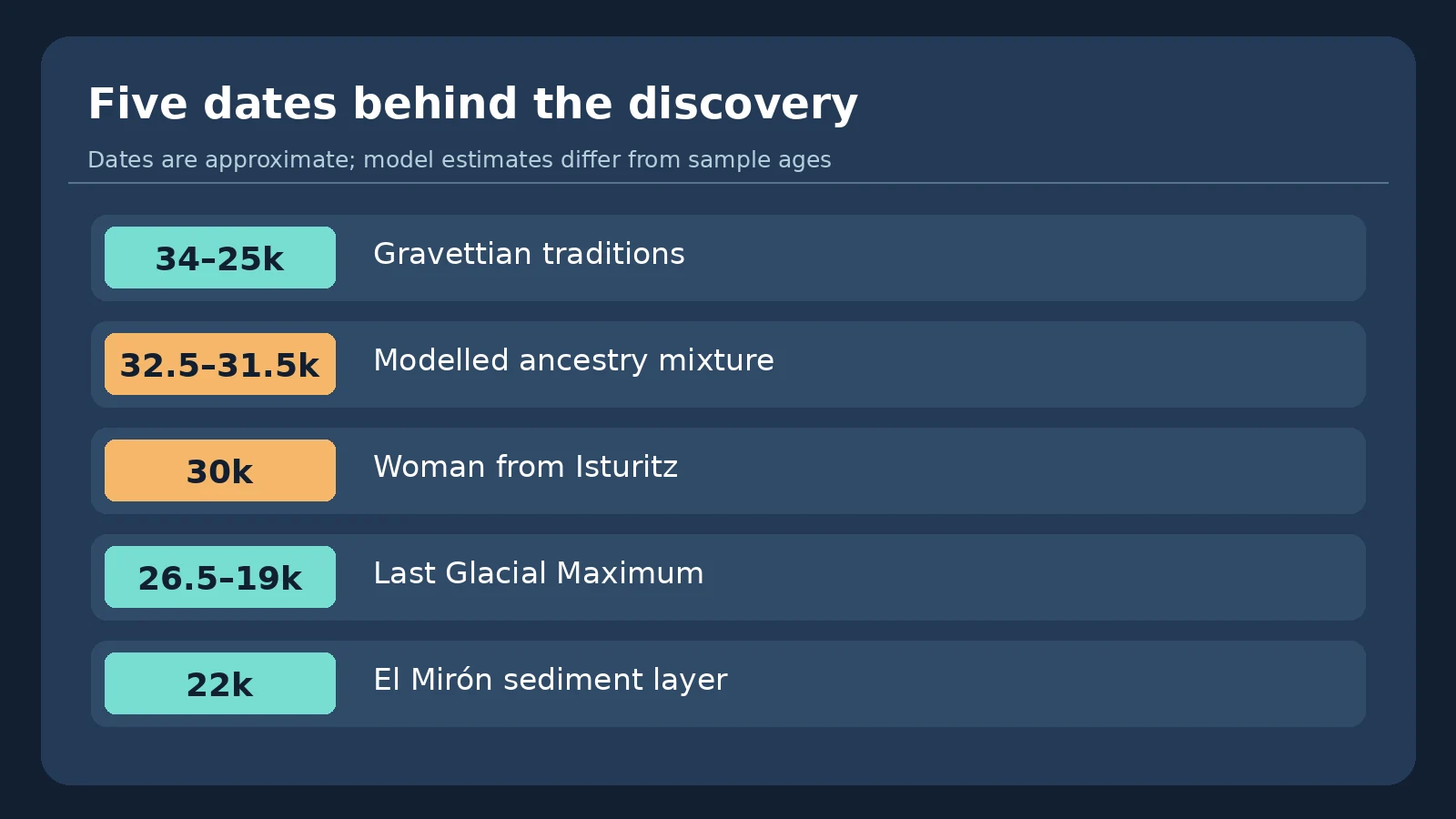
| Approximate date | Event | How to interpret it |
|---|---|---|
| 34,000–25,000 years ago | Archaeological Gravettian traditions across parts of Europe | Broad cultural date range, not one human lifespan |
| 32,500–31,500 years ago | Modelled east–west ancestry mixture | Estimated period inferred from DNA |
| Around 30,000 years ago | Lifetime of the Isturitz woman | Approximate calendar age of a sampled person |
| 26,500–19,000 years ago | Last Glacial Maximum | Broad climatic interval, not a one-day event |
| Around 22,000 years ago | El Mirón sediment layer | Archaeological layer and DNA sampled from it |
A subtle but important detail is that radiocarbon years and calibrated calendar years are not identical. Calibration adjusts measurements against changing past atmospheric radiocarbon concentrations. Readers comparing a raw laboratory date and a popular headline may find different numbers referring to the same find. Prefer the authors’ calibrated chronology when comparing events.
How do scientists detect eastern ancestry in a western sample?
Ancient DNA often survives as short, damaged fragments. Instead of using a consumer genealogy-style ethnicity percentage, palaeogeneticists compare shared patterns across many genetic positions and test alternative models of relatedness. Where possible, they also estimate the number of generations since populations mixed from patterns in the genome. These calculations have confidence ranges and assumptions.
An intuitive illustration: imagine a group whose DNA shares patterns mostly with a western reference cluster, but also has a statistically supported set of patterns closer to an eastern-related cluster. The most useful question is not ‘What nationality was she?’—modern nationalities did not exist. It is which model of ancient relationships best explains the observed allele sharing, and whether other sampled individuals show consistent evidence.
That is why genetic ancestry, archaeological culture and modern identity must be kept separate. A Gravettian stone-tool tradition is not the genetic equivalent of a passport. A genetic cluster is a statistical summary, not an ancient tribe introducing itself by name. Modern Europeans are shaped by many subsequent migrations and population changes across tens of thousands of years.
What is established, inferred and still unknown?
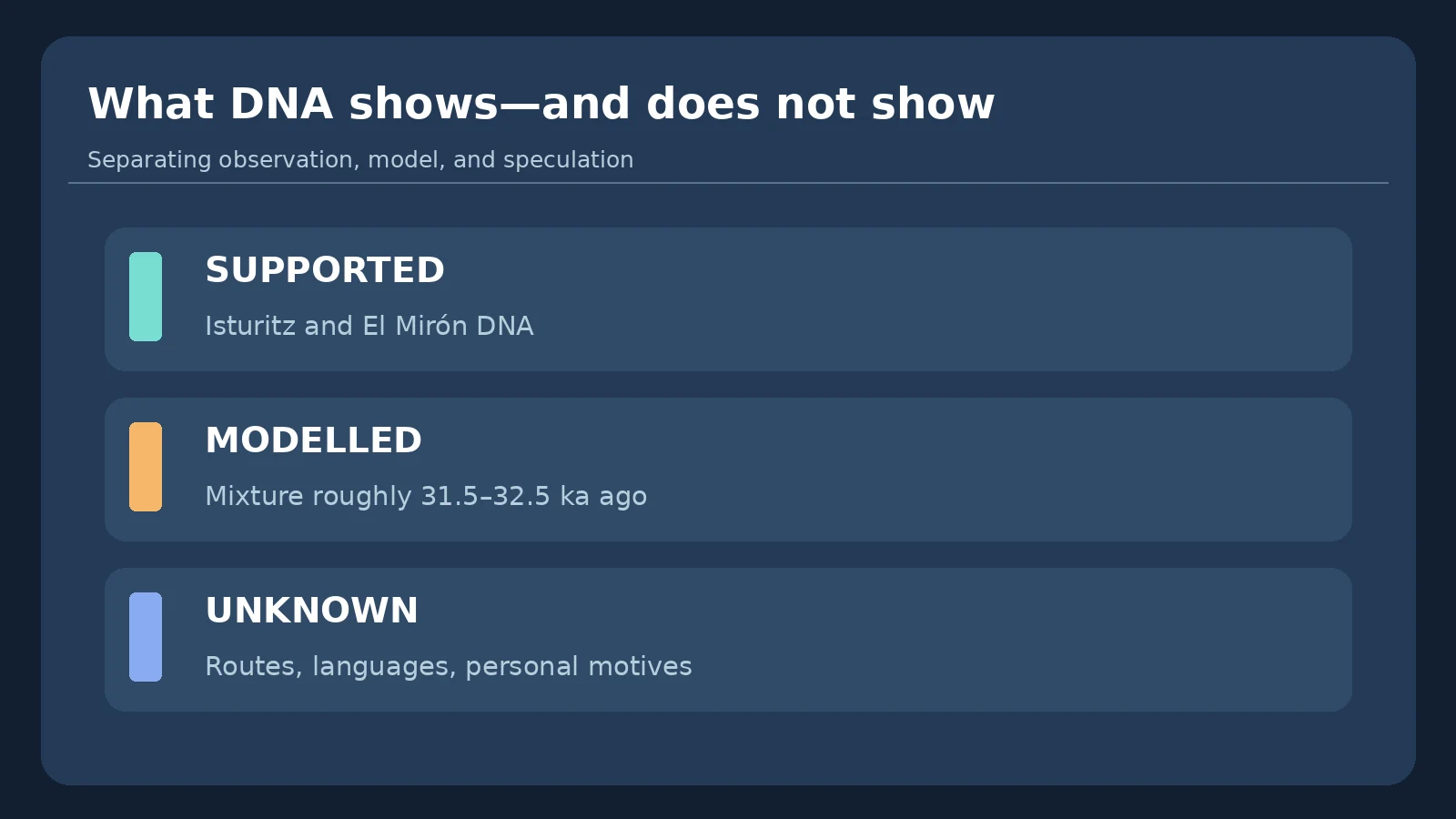
| Statement | Evidence level | Responsible wording |
|---|---|---|
| The Isturitz sample includes ancestry linked to eastern-related populations | Supported by ancient genomic analysis | New genetic evidence for connections |
| The mixture happened around 32,500–31,500 years ago | Model estimate | Approximate date, subject to model assumptions |
| A particular woman walked from eastern Europe to France | Not established | Her ancestry reflects earlier contact; her itinerary is unknown |
| El Mirón sediment yields human nuclear DNA | Direct laboratory result | Human SNP information recovered from a 22,000-year-old layer |
| Western-related ancestry endured in southwestern Europe through the LGM | Supported population-history interpretation | Evidence of regional ancestry continuity |
| One Ostuni family proves all prehistoric marriage norms | Not established | Specific relatedness result, not continental social policy |
The evidence is strongest where it ties a sample to an authenticated archaeological context and reproducible genomic signal. It becomes progressively more tentative when moving from ancestry patterns to individual movement, motives, social customs or modern political identity.
What three common headlines get wrong
‘DNA proves the whole continent was one population’
Incorrect. Archaeological resemblance is not proof of complete genetic sameness, and the new study itself shows regional structure alongside connections. The stronger takeaway is neither total separation nor total uniformity.
‘A woman carried genes from an eastern nation’
Misleading. Nations and today’s borders did not exist. The comparison concerns DNA related to ancient reference populations, not a present-day country’s ancestral ownership.
‘Scientists sequenced a prehistoric person’s complete genome from dust’
Overstated for El Mirón. The team obtained informative human SNP signals from cave sediment. That is significant, but should not be recast as one complete, individual-specific genome recovered from soil.
Why the 2026 research adds value beyond older studies
The 2023 Nature work drew a substantial map of western and central European hunter-gatherer population history and established important regional differences. The 2026 study adds rare sample locations, an eastern-related contribution in a western woman’s genome, and a more direct view of ancestry in a skeletal-scarce time slice using sediment. At the same time, earlier El Mirón research had already demonstrated that environmental DNA could capture ancient population history. Putting the work together is more accurate than treating a new paper as if everything was unknown before its publication.
There are also unresolved questions. Exactly which eastern-related communities contributed ancestry? Was exchange rapid or spread across many small contacts? How often did prehistoric groups meet, and did those contacts follow seasonal paths? Which parts of southern Europe acted as refuges under different climatic phases? The new genomic data are useful precisely because they generate questions that additional dated individuals and securely sampled deposits might answer.
Can archaeologists confirm the genetic story without relying on DNA alone?
They can build a stronger account by comparing independently dated layers, tool production methods, raw-material provenance, ornament traditions, burial practices, mobility indicators from isotopes and environmental reconstructions. But shared technology does not automatically imply intermarriage: know-how can spread without people relocating. Likewise, genetic mixture need not leave an obvious change in local tools.
A particularly useful research design would compare securely dated individuals from several sites before and after the estimated genetic exchange, alongside stratified sediments from geographic gaps. This could test whether eastern-related ancestry appeared suddenly, gradually or in multiple pulses. The present study strengthens a plausible network model; it is not the endpoint of prehistoric migration research.
Key sources and real photographs
- University of Vienna, 23 October 2026 — original institutional summary and credited photograph of Isturitz.
- Gelabert and colleagues, Science Advances (2026) — primary paper, DOI 10.1126/sciadv.aeh6128; also see the technical abstract.
- Posth and colleagues, Nature (2023) — previous large-scale genomic framework for European hunter-gatherers.
- Nature Communications (2025), El Mirón sediment DNA — preceding environmental DNA research from this cave.
- Actual Isturitz entrance, photograph by Krijun — Wikimedia Commons, CC BY-SA 3.0. This is linked as a real photo, not misrepresented as a research-generated image.
Conclusion: Ice Age Europe was more connected than a two-group map suggests
The strongest message of the October 2026 study is not that researchers discovered an unknown ‘first European’ or rewrote an entire continent’s ancestry. They found that an approximately 30,000-year-old woman’s genome contains evidence of earlier east–west contact; that DNA preserved in 22,000-year-old Spanish cave sediment can document regional continuity even without human bones; and that genomic family relationships can illuminate individual histories while demanding cautious interpretation.
Together, these findings replace a false choice—isolated groups or a uniform continent—with a richer picture of people who maintained local roots while remaining linked across vast prehistoric landscapes. More samples will tell us how those connections worked.
You may also like
 History & Archaeology
Who Killed the Roman Soldier in the Well? Inside a 2,000-Year-Old Cold Case
A Roman-era skeleton from Velsen has been re-examined with modern forensic science. Explore the dagger, injuries, tooth isotopes…
 Science & Discoveries
First Fully Marine Amphibian? The 237-Million-Year-Old Gerrothorax Discovery
Two remarkably complete Chinese fossils suggest an armored early amphibian spent its life in the sea. Here is…
 History & Archaeology
Why Did 20 Homo naledi Individuals Show No Male Markers? The Tooth Protein Mystery
A 2026 Cell study tested 23 fossil teeth representing at least 20 Homo naledi individuals, finding no confident…