
Why Did 20 Homo naledi Individuals Show No Male Markers? The Tooth Protein Mystery
A 2026 Cell study tested 23 fossil teeth representing at least 20 Homo naledi individuals, finding no confident male AMELY markers. Here is what that really means.
Contents
- The study at a glance: teeth are not people
- What is Homo naledi, and why was its discovery unusual?
- Two real fossil photographs: what do they actually show?
- Why analyze teeth rather than ancient DNA?
- How AMELX and AMELY help estimate biological sex
- The actual result: no convincing male marker in the sample
- Three leading explanations for the unexpected result
- A simple calculation shows the surprise—and the trap
- What did the protein similarity reveal about diversity?
- Does this prove Homo naledi deliberately buried the dead?
- Dating the fossils: why “300,000 years old” is shorthand
- Six claims that the research does not establish
- What could resolve the mystery next?
- Why the discovery matters even without a final answer
- Original research, evidence and image credits
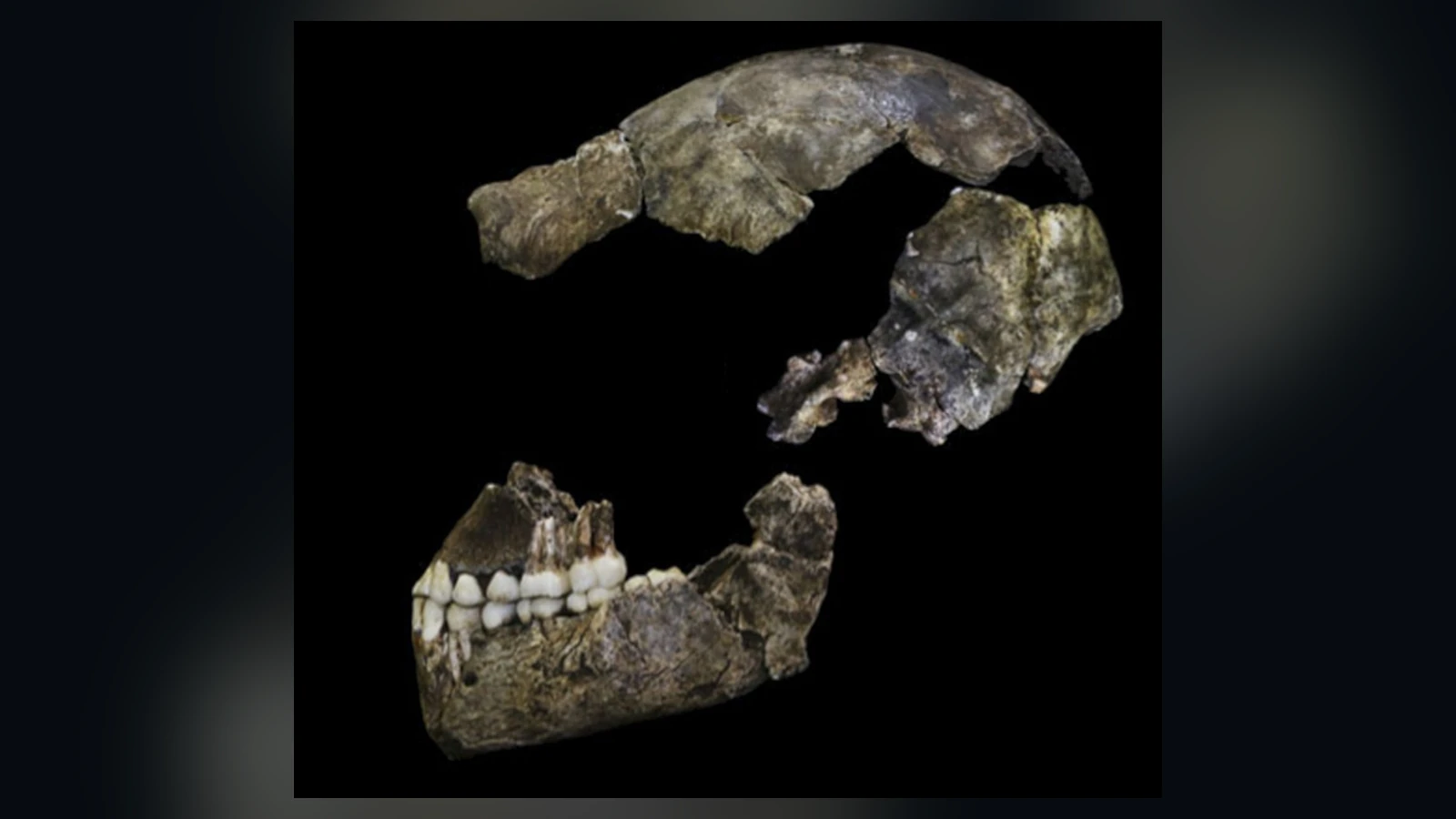
Were all the Homo naledi individuals sampled from South Africa female? A paper published online on 24 June 2026 and in the 9 July issue of Cell produced an unexpected result: researchers could not confidently identify a single male among at least 20 individuals represented by 23 fossil tooth specimens from the Rising Star cave system. That is what the evidence says. It does not establish that everyone who entered the caves was female—or that the species lacked males. Read the full research paper and the European Research Council summary.
The story sounds like an archaeological puzzle: fossils from multiple underground chambers, yet remarkably similar biochemical signals in their teeth. Accuracy matters more than sensation. Failure to find a protein marker normally associated with males is not proof that no males existed. This guide separates the specimens from the people they represent, explains the laboratory method and compares the leading explanations against the actual evidence.
The study at a glance: teeth are not people
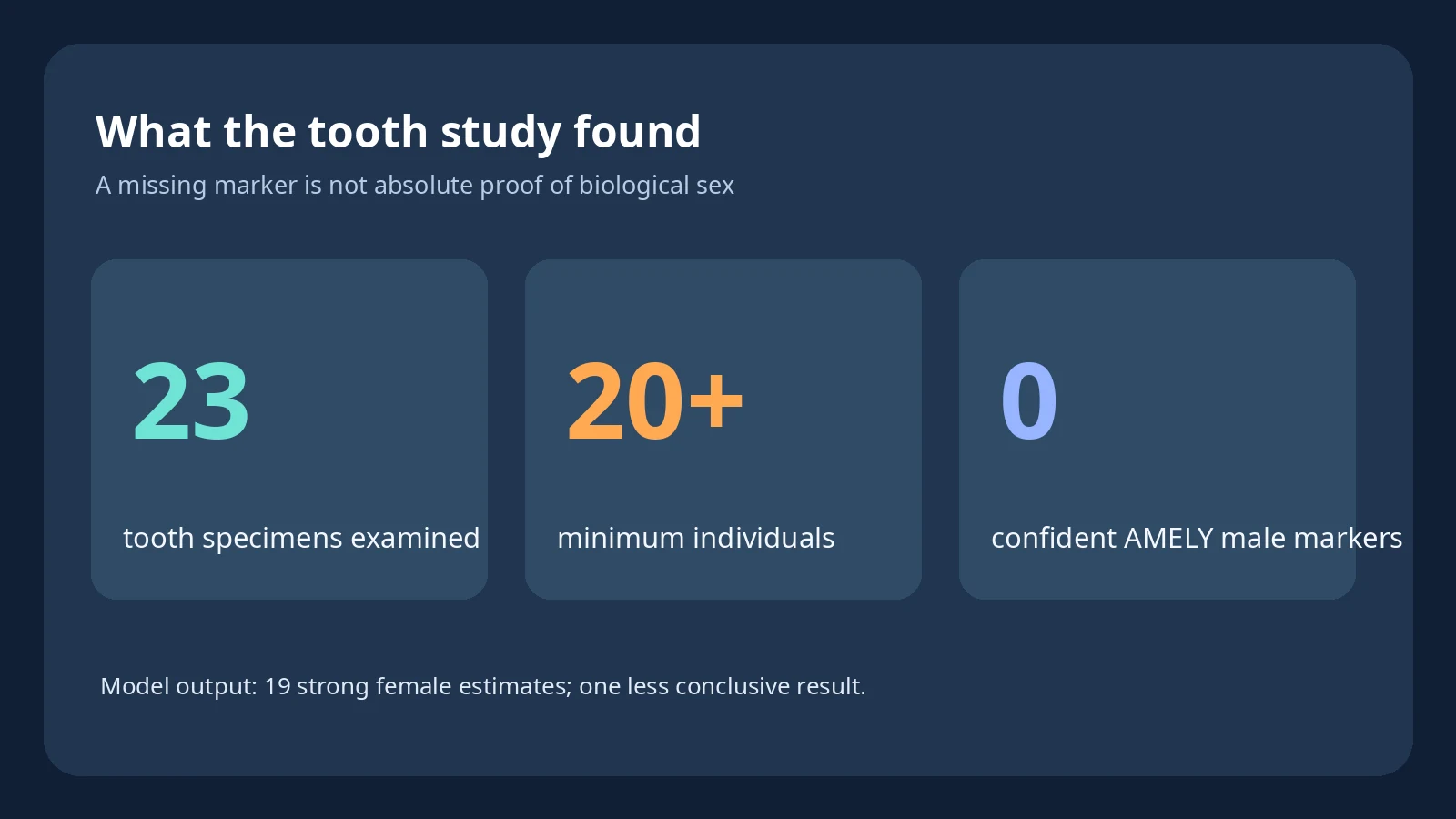
| Measure | Reported result | How to interpret it |
|---|---|---|
| Dental enamel specimens | 23 | Number of analyzed samples, not people |
| Minimum individuals | 20 | Estimated from overlapping teeth and provenances |
| Confidently detected male markers | 0 | No unambiguous AMELY signal |
| Stronger female model estimates | 19 | Above 95% under the paper’s model assumptions |
| Remaining individual | 1 | Less certain female-leaning model result |
| Estimated age | ~335,000–236,000 years | Dating interval for certain remains, not every tooth |
These figures come from the original study. The probabilities come from a model applied to protein measurements; they are not complete chromosome tests. Zero denotes confident detections of a male-associated protein signature, not a population-wide census of males over the entire lifetime of the species.
What is Homo naledi, and why was its discovery unusual?
Homo naledi was described in 2015 following discoveries in the Rising Star cave system in South Africa’s Cradle of Humankind, near Johannesburg. Its anatomy mixes traits associated with older hominins—such as a relatively small brain and aspects of the shoulders and trunk—with more Homo-like feet, hands and facial features. Dating published in eLife in 2017 placed fossils from the Dinaledi Chamber at approximately 335,000–236,000 years ago.
A small brain alone cannot establish an extinct species’ intelligence, and chronological overlap with other ancient humans does not make Homo naledi a direct ancestor of living people. Human evolution is a branching history rather than a straight ladder. The Australian Museum overview provides accessible background on the fossils, discoveries and dating.
Two real fossil photographs: what do they actually show?
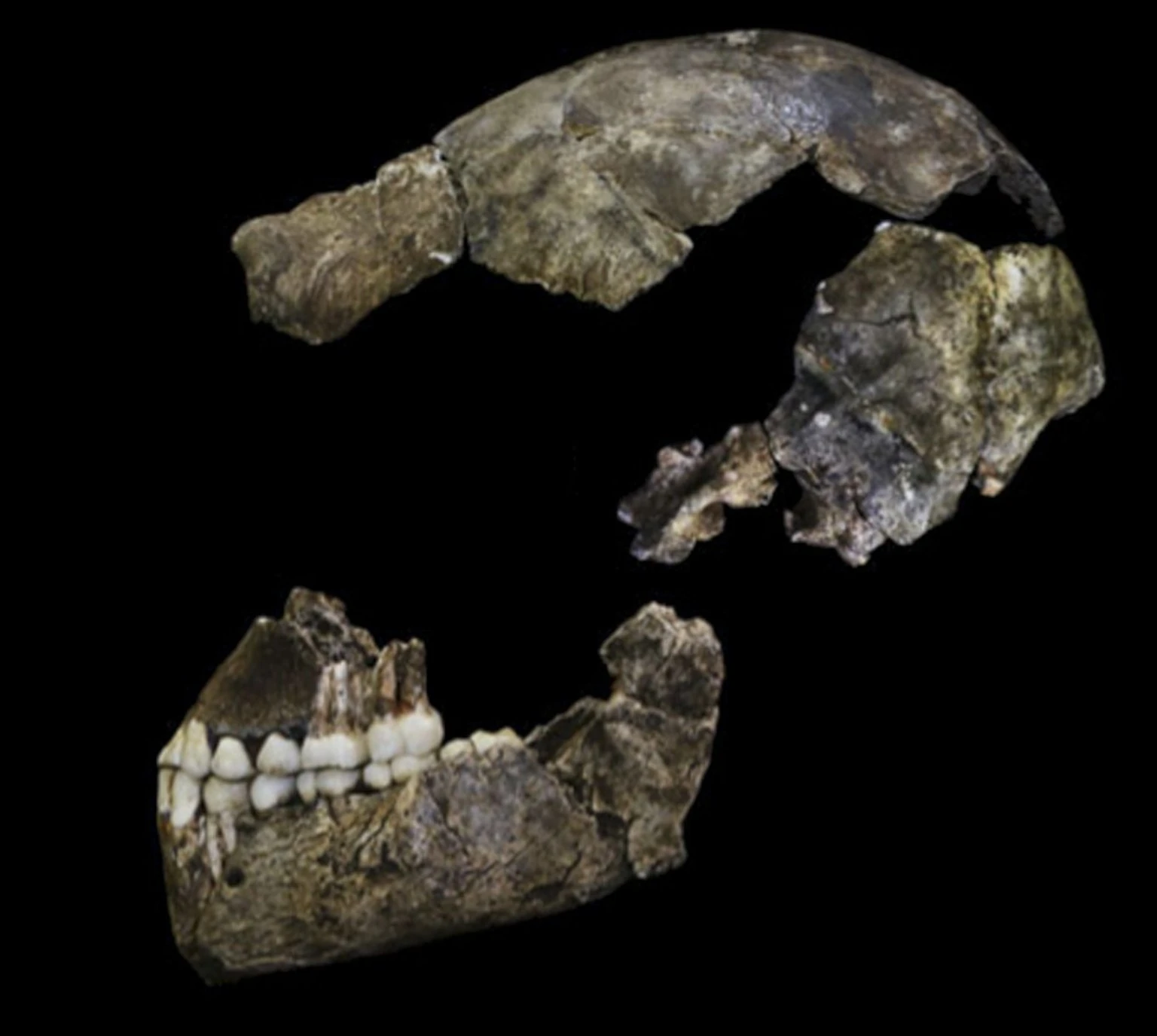
The first image shows the reconstructed holotype skull DH1 (Dinaledi Hominin 1). This is an authentic fossil photograph, not an AI reconstruction. Credit: Berger et al. (2015), Wikimedia Commons original, CC BY 4.0; re-encoded as WebP for this article. It is a 2015 collection photograph, not proof that these precise pieces were sampled in the 2026 proteomics study.
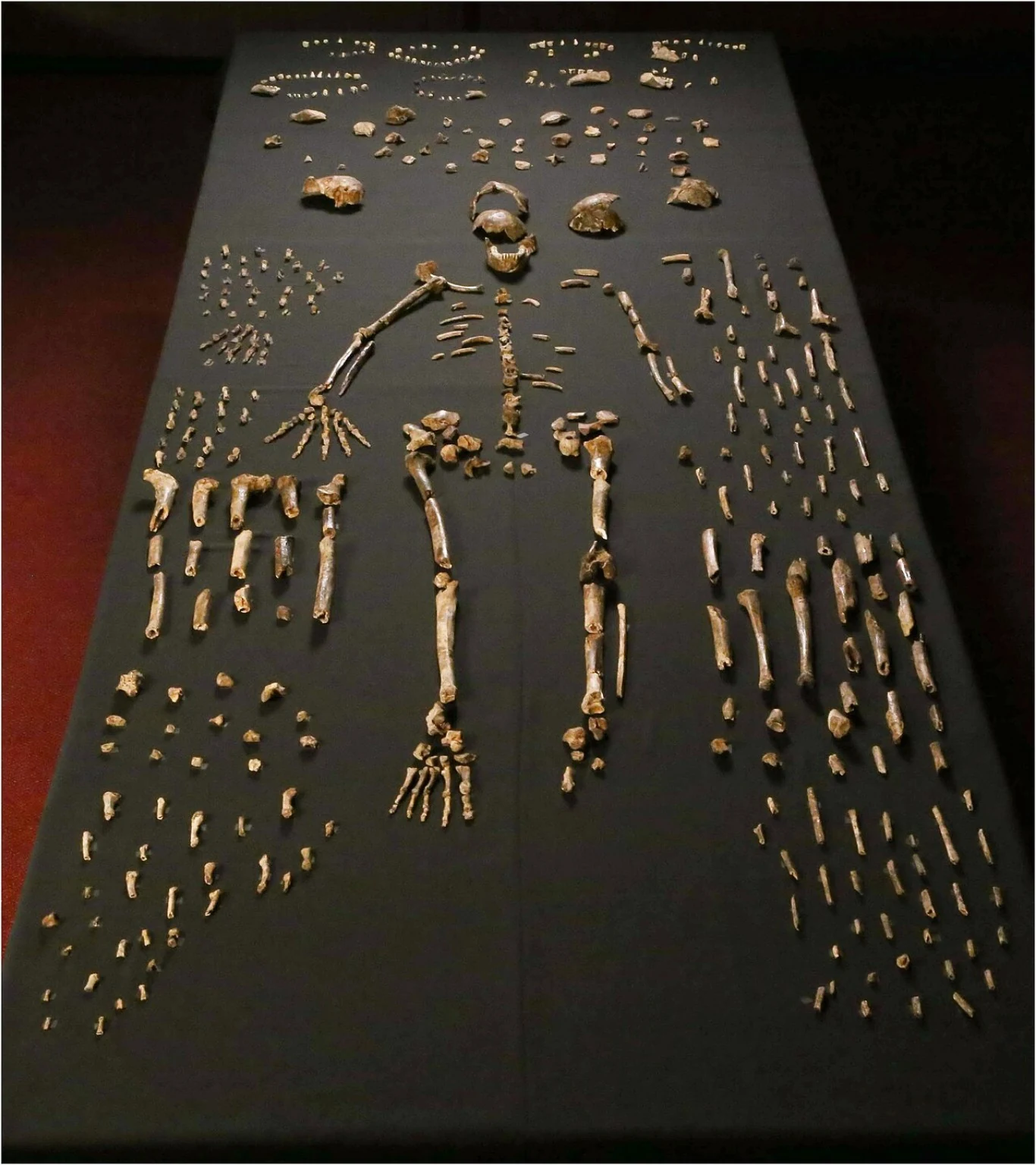
The second photograph documents an arrangement of hundreds of Dinaledi skeletal elements. Bones arranged near the centre resemble a skeleton, but this display is a composite from multiple individuals, not one recovered intact body. Credit: Lee Roger Berger research team, Wikimedia Commons, CC BY 4.0; converted to WebP without a substantive edit. The distinction matters: 20 inferred individuals does not mean 20 complete skeletons were discovered.
Why analyze teeth rather than ancient DNA?
Ancient DNA degrades through heat, moisture and microbial processes, particularly across hundreds of thousands of years. Mineral-rich tooth enamel can protect traces of some proteins for much longer, making palaeoproteomics useful where DNA may not survive. The researchers did not sequence complete chromosomes or reconstruct the full genomes of the 20 individuals. They examined preserved enamel protein fragments.
How AMELX and AMELY help estimate biological sex
Amelogenin contributes to tooth-enamel formation. In living humans, an X-linked gene typically yields AMELX, while a Y-linked counterpart yields AMELY. Detection of a diagnostic AMELY peptide is therefore strong evidence of a Y-associated signature. AMELX alone, however, is not decisive evidence of femaleness unless the method was sensitive enough to have detected AMELY had it been present.
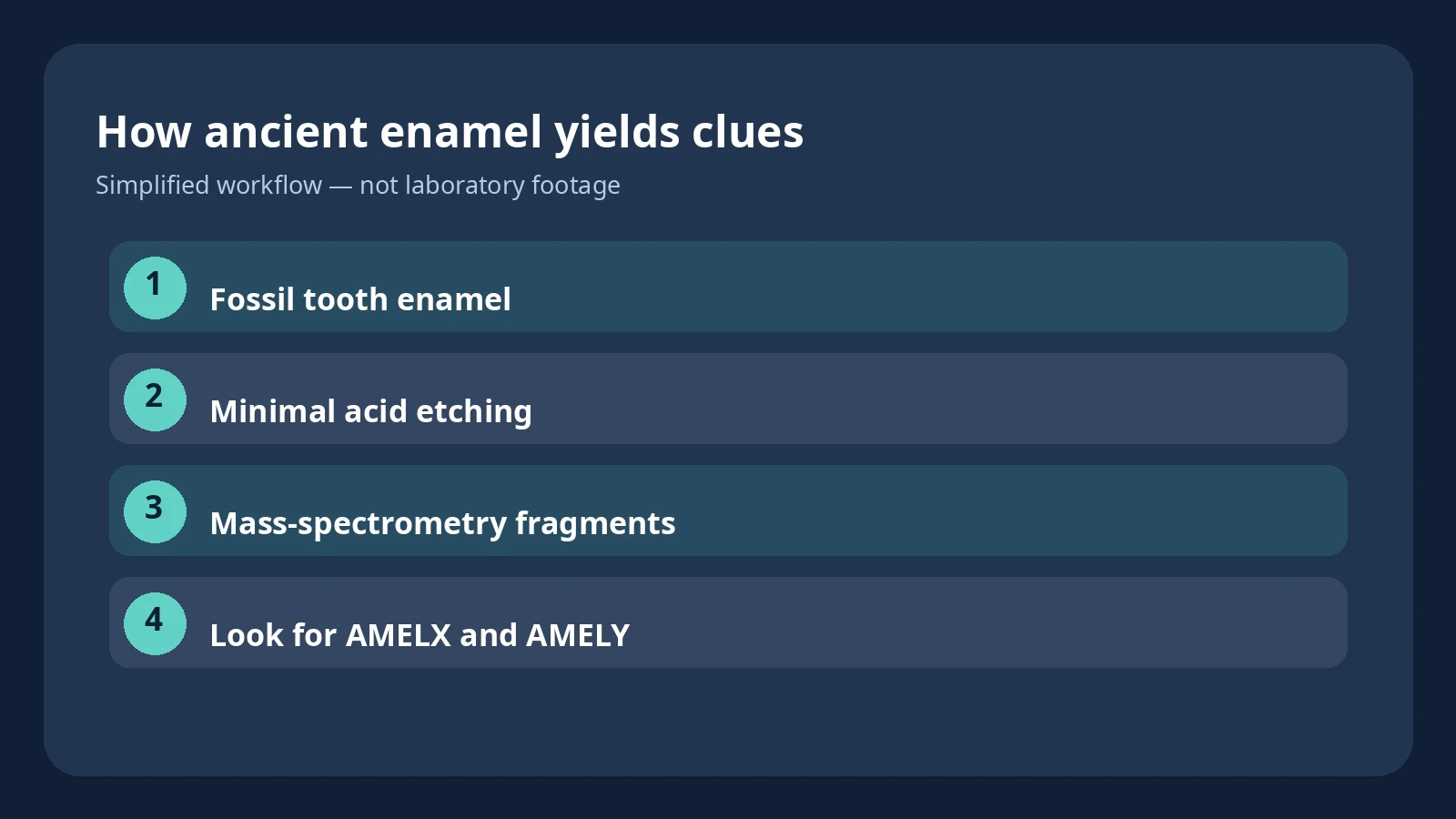
The team applied minimally destructive acid etching to enamel surfaces, identified peptide fragments through mass spectrometry and compared candidate protein signatures with controls. Sensitivity checks make a simple laboratory detection failure less likely; they do not rule out every biological possibility involving ancient gene sequences or expression in an extinct species. The methods section documents the sampling and technical validation.
The actual result: no convincing male marker in the sample
The 23 specimens came from the Dinaledi and Lesedi chambers, Hill Antechamber and U.W. 110, representing at least 20 individuals. Enamel proteins were recovered, yet diagnostic AMELY signatures were not found at a level permitting confident assignment of a male. Under the authors’ conditional statistical model, 19 individuals had estimated female probabilities above 95%; the twentieth was less conclusive. This is not equivalent to directly observing 20 XX chromosome sets.
News headlines understandably highlighted an apparently female group. The paper’s more careful wording is that no males were confidently identified. This is not a semantic quibble: the claim sets the burden of proof. Researchers analyzed available archaeological material from specific underground locations, not a random survey of every individual who lived in the region.
Three leading explanations for the unexpected result
| Hypothesis | What it could explain | What remains unproven |
|---|---|---|
| Genuinely female-biased assemblage | Missing AMELY and limited skeletal variation | How remains accumulated in the cave |
| Archaeological or social selection | Disproportionate females in sampled chambers | Independent evidence for sex-specific deposition |
| Different AMELY sequence in extinct species | Failure of markers designed around living relatives | The species’ full DNA sequence is unknown |
| Low-diversity population | Similarity across recovered protein regions | Close kinship from a small protein sample |
Some researchers see the repeated absence of a male-associated signature as potentially compatible with patterned mortuary behavior or a female-biased social group. Others emphasize the cave’s geological history, the incompleteness of the fossil record and assumptions about extinct enamel proteins. No single scenario has yet explained every observation independently. A story about a strictly all-female society would outrun the data.
A simple calculation shows the surprise—and the trap
Illustration only: suppose 20 people are sampled independently from a population with an exact 50:50 sex ratio and perfect sex identification. The probability of 20 females is (0.5)^20—about 0.000095%, or one in 1,048,576. That is not the study’s real p-value. Fossils were not randomly sampled, the underlying sex ratio is unknown, and the biological/protein-test assumptions may be violated.
If a hypothetical selected group were 80% female, the same independent-binomial illustration gives 0.8^20 ≈ 1.15%; at 90% female it becomes 0.9^20 ≈ 12.16%. These are teaching examples, not inferred sex ratios for Rising Star. They demonstrate why a visually astonishing result cannot be interpreted without the sampling process.
What did the protein similarity reveal about diversity?
The recovered partial protein sequences showed no detected variation across the sample. Simulations using present-day human genomic data suggested that such uniformity would be unusual in a large, diverse population. Lower diversity, long-term isolation or inbreeding are possible explanations. But this is not evidence that the fossils were genetically identical clones: most of their genomes were not examined.
Two sequence details stood out: a distinctive AMELX amino-acid substitution and an ancestral state in COL17A1, also observed in samples from Paranthropus robustus. Sharing one ancestral protein state does not establish direct interbreeding or close ancestry. Reliable evolutionary placement requires far more informative sites and independent evidence.
Does this prove Homo naledi deliberately buried the dead?
Deliberate burial is among the most debated interpretations of the Rising Star finds. A research team led by Lee Berger published a revised study in 2025 arguing that fossil positions and sediments are compatible with intentional mortuary handling. Other scholars challenge aspects of the sedimentary and archaeological interpretation. The tooth-protein result may sharpen the question, but it does not independently establish burial rituals, a sex-sorted cemetery or a specific social institution. See the eLife paper and review history.
Even a genuinely female-dominated assemblage would leave separate questions: Were bodies placed intentionally? Did deposits form over a long interval? Did different chambers serve different purposes? Did cave sediment movement affect the final pattern? Sex estimation, deposition mechanism and cultural interpretation require different lines of evidence.
Dating the fossils: why “300,000 years old” is shorthand
Dating of Dinaledi material points broadly to 335,000–236,000 years ago, using several techniques on cave sediments, flowstones and selected teeth, each with uncertainty. The age of every fossil pictured here has not been measured, nor should all specimens from four locations be assumed to have accumulated at the same moment. The time span matters when considering whether remains reflect one group or repeated deposits over generations.
Six claims that the research does not establish
| Headline claim | Scientific status |
|---|---|
| “No Homo naledi male ever existed” | Unsupported: the tested sample is not the whole species |
| “The species lacked Y chromosomes” | Not demonstrated: full genomes were not recovered |
| “Twenty complete skeletons were found” | Incorrect: a minimum number inferred from scattered remains |
| “All twenty are indisputably female” | Overstated: model assumptions and a less-certain individual |
| “Ritual burial is proven” | No: deposition is a separate archaeological debate |
| “The individuals were genetic clones” | No: uniformity concerns limited protein segments |
What could resolve the mystery next?
Next steps include expanding the sample, improving sensitivity for diagnostic AMELY peptides and, where fossil preservation permits, testing additional proteins in dentine or bone. Carefully documented finds from new cave contexts could reveal whether the sampled group is systematically biased. Recovering more extensive protein sequences would also test the apparent lack of variation across the limited markers available today.
Ancient DNA, if preservation ever makes it recoverable here, could provide wider evidence about ancestry, chromosomes and relatedness. That remains a possibility rather than an achieved result. Testing must minimize damage to rare fossils. The authors deposited their proteomics measurements in ProteomeXchange as PXD054549, facilitating independent reanalysis.
Why the discovery matters even without a final answer
The broader breakthrough is methodological. Fossil teeth are not merely shapes used to estimate diet or anatomy: enamel can preserve partial molecular records that researchers can recover with limited destruction. That permits new questions about ancient assemblages long after their discovery. The study reopens interpretations of fossils known for over a decade without pretending to erase the uncertainties in their evolutionary or social history.
The defensible headline is simple: tooth proteins from at least 20 Homo naledi individuals yielded no confidently identified male marker. That statement is both remarkable and testable. It is more useful than declaring a mysterious women-only civilization, because it leaves room for the essential follow-up work.
Original research, evidence and image credits
Primary references: Madupe et al., Cell (2026), full text; European Research Council (25 June 2026); University of York (24 June 2026); Dirks et al., eLife (2017), fossil dating; Berger et al., eLife (2025), burial argument and peer review; dataset PXD054549.
Photo attribution: Skull: Berger et al. (2015), Commons page; skeletal display: Lee Roger Berger research team, Commons page; both CC BY 4.0. The lead image was resized/re-encoded for layout. The two additional infographics are original Horus Valley interpretations of the reported numbers and methods, not laboratory photographs. Nothing in the photographs claims the pictured bones were each tested in 2026.
You may also like
 History & Archaeology
Who Killed the Roman Soldier in the Well? Inside a 2,000-Year-Old Cold Case
A Roman-era skeleton from Velsen has been re-examined with modern forensic science. Explore the dagger, injuries, tooth isotopes…
 History & Archaeology
Ice Age DNA Reveals How Europeans Were Connected 30,000 Years Ago
New 2026 genomic evidence reveals east-west links among Gravettian peoples in Ice Age Europe and human ancestry preserved…
 History & Archaeology
Doggerland: The Lost World Beneath the North Sea — What Archaeologists Have Discovered
Doggerland once connected Britain to continental Europe. Explore its Stone Age inhabitants, lost rivers, 2026 ancient-DNA findings and…