
Why Are Butterflies So Hard to Catch? Their Wing Optical Illusion Explained
A 2026 Nature study explains how butterfly wing patterns and flight alter motion cues and can misdirect attempts to catch them.
Contents
- The discovery in one minute: misleading motion, not invisibility
- Why high-contrast stripes matter only when the wings move
- How the 2026 researchers tested the hypothesis
- 1. A high-speed record of real butterfly take-offs
- 2. Surveying butterflies across Europe
- 3. Humans trying to catch virtual butterflies
- 4. Letting artificial wing patterns evolve on computers
- A practical illustration: why an error of milliseconds matters
- Butterfly stripes, zebra stripes and warning colors: three different stories
- Why swallowtails are especially interesting
- How birds see motion—and what the model can and cannot represent
- What the study proves—and what it leaves open
- Why the finding matters beyond butterflies
- Can you see this illusion yourself? A small, honest demonstration
- The take-home finding
- Original sources, picture credits and research transparency

A butterfly can make a bird miss without disappearing. Its wings may produce an optical illusion that misrepresents the insect’s speed or flight direction at the instant a predator commits to an attack. That is the central finding of a research paper published in Nature on 30 September 2026 by scientists associated with the universities of Exeter and Essex. The result is more specific—and more interesting—than the claim that every butterfly uses camouflage. Contrasting bands, moving wing edges and flapping dynamics can combine to produce false motion signals even while the butterfly’s body follows a different path.
The team investigated real take-offs with high-speed cameras, analyzed hundreds of European butterfly forms, evolved thousands of wing patterns digitally and asked volunteers to catch virtual butterflies on a touchscreen. The evidence supports a powerful visual mechanism, but it does not mean that researchers followed thousands of hunting birds or established the survival rate of every butterfly in the wild. Understanding that distinction is essential to understanding the discovery. This guide reconstructs the experiments, gives a worked illustration of the timing problem and explains what scientists still need to test. The original peer-reviewed paper is available free at Nature.
The discovery in one minute: misleading motion, not invisibility
A camouflaged animal benefits when it is still and blends with its background. A flying butterfly has the opposite problem: its changing position makes it easy to notice. The 2026 findings suggest that some butterflies gain an advantage after a predator has already noticed them. The conspicuous markings can interfere with the predator’s calculation of the target’s position a fraction of a second later. If the strike goes behind the butterfly or toward an expendable wing margin, the attack may fail despite a perfectly visible target.
Researchers call the phenomenon motion confusion or motion dazzle. It is a problem for motion-processing circuits rather than a supernatural trick or a change in the butterfly’s actual route. High-contrast markings create local apparent movement as the forewings and hindwings flex, fold and rotate. Individual pieces of the image can signal motion in a direction that disagrees with the butterfly’s real travel. The model detects competing estimates and, in certain conditions, places too much weight on the wrong one.
| The moving animal | What is physically happening | What the observer may estimate |
|---|---|---|
| Butterfly body | Moves along its real trajectory | The correct global direction and speed, if the signal is clear |
| Contrasting wing band | Changes angle and visible area during a flap | Local movement that can conflict with body movement |
| Hindwing tail or sharp edge | Sweeps laterally as wings deform | A false sideways target or a misleading point of aim |
| An almost plain wing | Offers fewer internal contrast landmarks | Often less of this particular pattern-driven confusion; other defences may still work |
Why high-contrast stripes matter only when the wings move
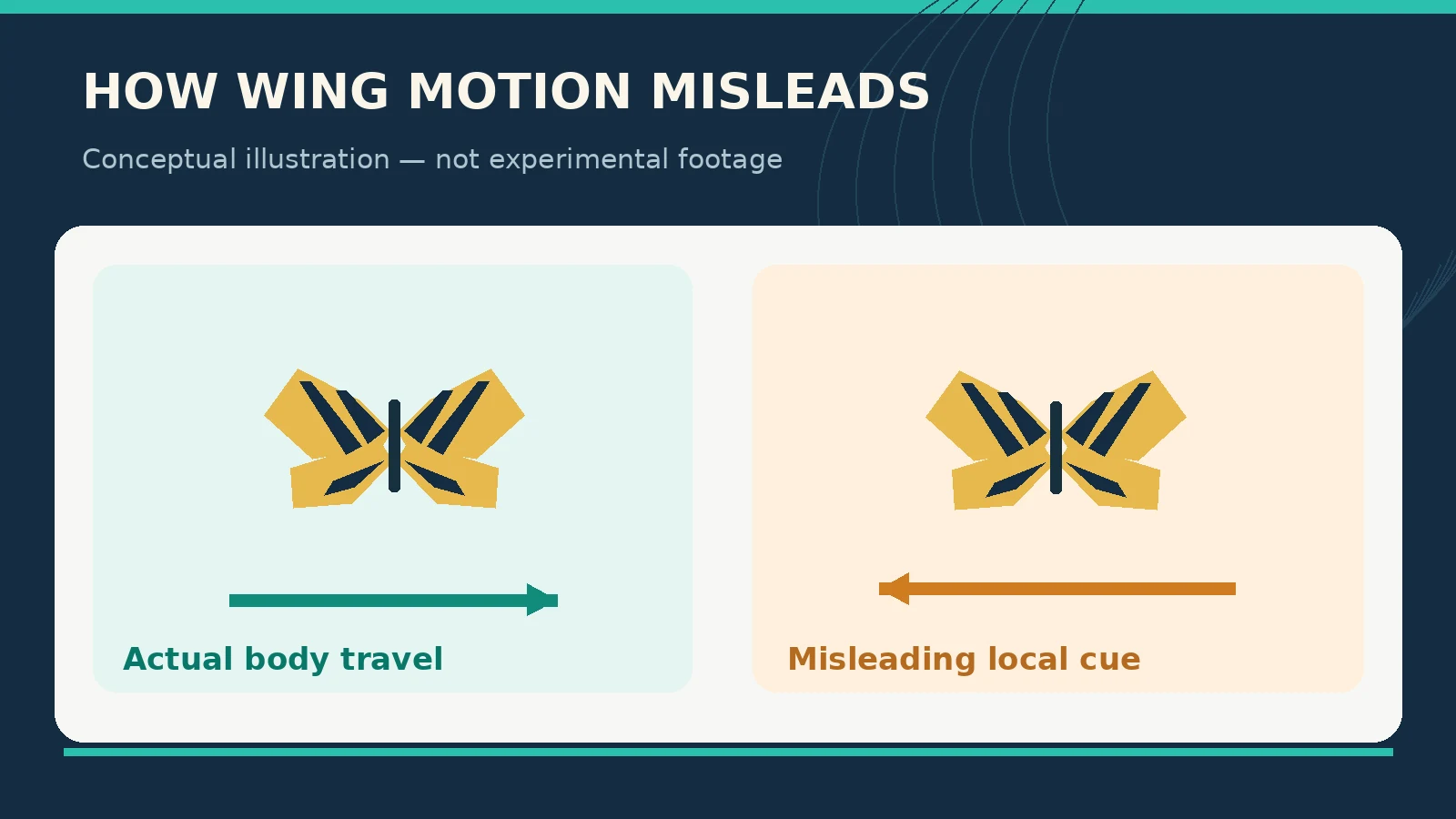
Imagine watching a black-and-yellow line painted on a window. With the window still, the line tells you about shape, not flight. Now put the same diagonal line on a flexible, folding surface and move the entire surface upward while it twists. The line’s projected movement can point down or sideways even though the center of the object keeps rising. A motion detector analyzing small patches of the visual field may initially register these local directions separately. The mismatch is especially relevant because a predator must estimate where the prey will be when the beak reaches it, not merely where it was in the previous frame.
The team likened the effect to the barber-pole illusion: a rotating cylinder with diagonal stripes seems to carry stripes upward even though the physical motion is around an axis. The butterfly is not a miniature striped cylinder, and the analogy is not a mathematical equivalence. It helps describe why a patterned flexible wing can generate a strong apparent movement along the stripe orientation that is not the body’s actual motion. In one memorable observation, the researchers’ bird-vision model assigned prominent downward motion signals to a butterfly flying upward. That was an output of a visual-processing model, not evidence that an actual bird consciously saw the world upside down. University of Exeter explanation.
How the 2026 researchers tested the hypothesis
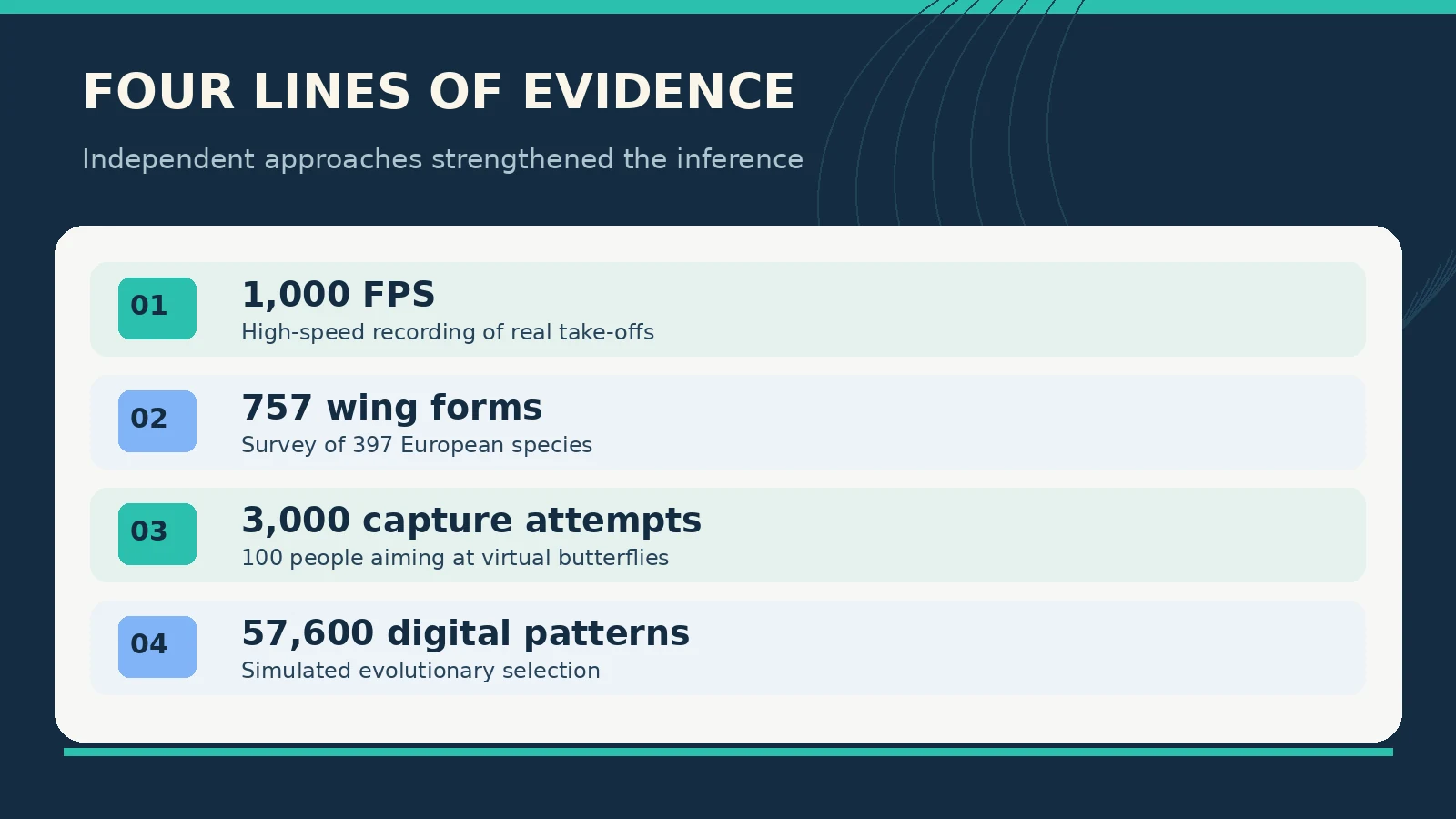
Rather than depending on a single eye-catching video, the study combined four forms of evidence. Each addresses a different weak point. Real films establish that signals can arise from biological wing motion; comparative analyses show whether those signals correlate with natural forms; laboratory behavior tests whether a simulated observer aims differently; and computer evolution checks whether selection for motion confusion independently produces patterns resembling real wings. No single component alone proves a specific evolutionary history, which is why the convergent approach matters.
1. A high-speed record of real butterfly take-offs
The researchers filmed real butterflies beginning flight at 1,000 frames per second. They then segmented the insects and compared the natural patterned wings with artificial versions whose wing markings had been replaced by relatively plain gray, black or white treatments. The aim was to keep important elements of movement while altering the visual pattern. A model inspired by animal motion detectors compared signals that supported forward motion with signals pointing backward or sideways. This is stronger than comparing a still photograph of two species: the wing positions change over milliseconds, precisely when the relevant illusion may emerge.
The analysis of a set of seven wing morphotypes included 18 flight sequences, with 2,391 analyzed frames per pattern treatment in the published comparison. Natural markings produced greater directional confusion than the digitally simplified treatments. This tells us that pattern contributes above and beyond movement alone in the tested footage; it does not reveal a universal percentage reduction in predation. The paper reports the model and comparisons in Figure 1 of the original Nature article.
2. Surveying butterflies across Europe
The researchers modeled 757 wing forms across 397 European species. Crucially, they examined shapes and pattern distributions rather than declaring every multicolored butterfly equally protected. Contrasting vertical bands, a single conspicuous band, asymmetrical distributions and tails on hindwings could increase the motion-confusion measures. Swallowtails were especially notable in the modeled dataset, while results among brush-footed butterflies varied widely. That variation matters: the study identifies one plausible defensive function in a diverse set of insects, not a single rule that can be applied just by looking at wing brightness.
Two different scores matter here. Forward confusion reflects a stronger mismatch between forward and backward motion estimates, which may cause an attack to fall behind the insect. Sideways confusion compares forward with lateral signals, suggesting potential misses toward the side. Wings that are nearly white can also generate strong raw forward-motion energy because they contrast with the background; that is not identical to maximizing the researchers’ ratio-based confusion score. Keeping these measurements separate prevents readers from interpreting every bright wing as evidence of exactly the same defense.
3. Humans trying to catch virtual butterflies
To ask whether model predictions affected targeting rather than just computer outputs, the team recruited 100 participants and collected approximately 3,000 attempts to touch a moving virtual butterfly. Volunteers saw animated targets on a high-refresh-rate touchscreen. Five butterfly forms were selected to span the modeled confusion range. The participants were not told to act like birds in a natural habitat; they supplied a controlled human behavioral test of whether certain patterns could bias the location of an attempted capture.
As predicted, patterns producing higher forward confusion led to landing points shifted and stretched toward positions behind the moving virtual butterfly. The study estimated that the difference in the center of the targeting distributions between the highest- and lowest-confusion forms was roughly 38% of mean butterfly body length. That is a displacement of aiming distributions within the experimental display, not a measured fall in wild-bird capture success by 38%. The distinction is important for science reporting: the experiment demonstrates consistent misdirection in controlled conditions, without replacing field studies of predators.
4. Letting artificial wing patterns evolve on computers
Finally, the investigators used genetic algorithms to generate and test 57,600 digital wing designs. Selection favored particular modeled motion signals over repeated computational generations, and some of the resulting patterns resembled natural high-contrast bands and stripe arrangements. This is an intriguing convergence: one can obtain butterfly-like graphics by selecting for motion confusion even without instructing the algorithm to imitate a butterfly. It does not prove that real butterflies consciously evolved to fool birds or that this force was more important than courtship, thermoregulation, warning coloration or camouflage throughout their history.
| Evidence stream | What it directly tested | Main limitation |
|---|---|---|
| High-speed filming | Motion-detector signals from patterned versus simplified wings | Model perception, not live bird strikes |
| European wing comparison | Which anatomical features align with greater modeled confusion | Associations do not isolate every evolutionary cause |
| Human capture game | Whether some patterns shift where observers aim | People and touchscreen tasks are not wild birds |
| Digital evolution | Whether confusion-based selection generates similar forms | The digital fitness function is predefined |
A practical illustration: why an error of milliseconds matters
Consider a simplified example, not a measurement of a bird hunt. In one virtual-capture setup, the researchers animated butterflies at about 40 centimeters per second. At that speed, a butterfly travels 2 centimeters in 50 milliseconds: 40 cm/s multiplied by 0.05 s = 2 cm. A predator that estimates the future position using slightly misleading motion cues may aim at a spot that the insect has already passed. The calculation helps explain why a small visual error during the last stage of an attack could matter, but the study did not establish that every natural butterfly moves at that speed or every bird has the same response delay.
There is a second reason for caution. A wing tail is not the same as a torso. A hit at a slender hindwing projection may be much less damaging than a strike at the body. Observations of missing swallowtail wing tails and beak-shaped wing damage are consistent with misdirected attacks, but an observed notch does not uniquely reveal what the attacker saw. The value of the 2026 work is that it supplies a mechanism that makes such observations plausible rather than offering photographs alone as proof.
Butterfly stripes, zebra stripes and warning colors: three different stories
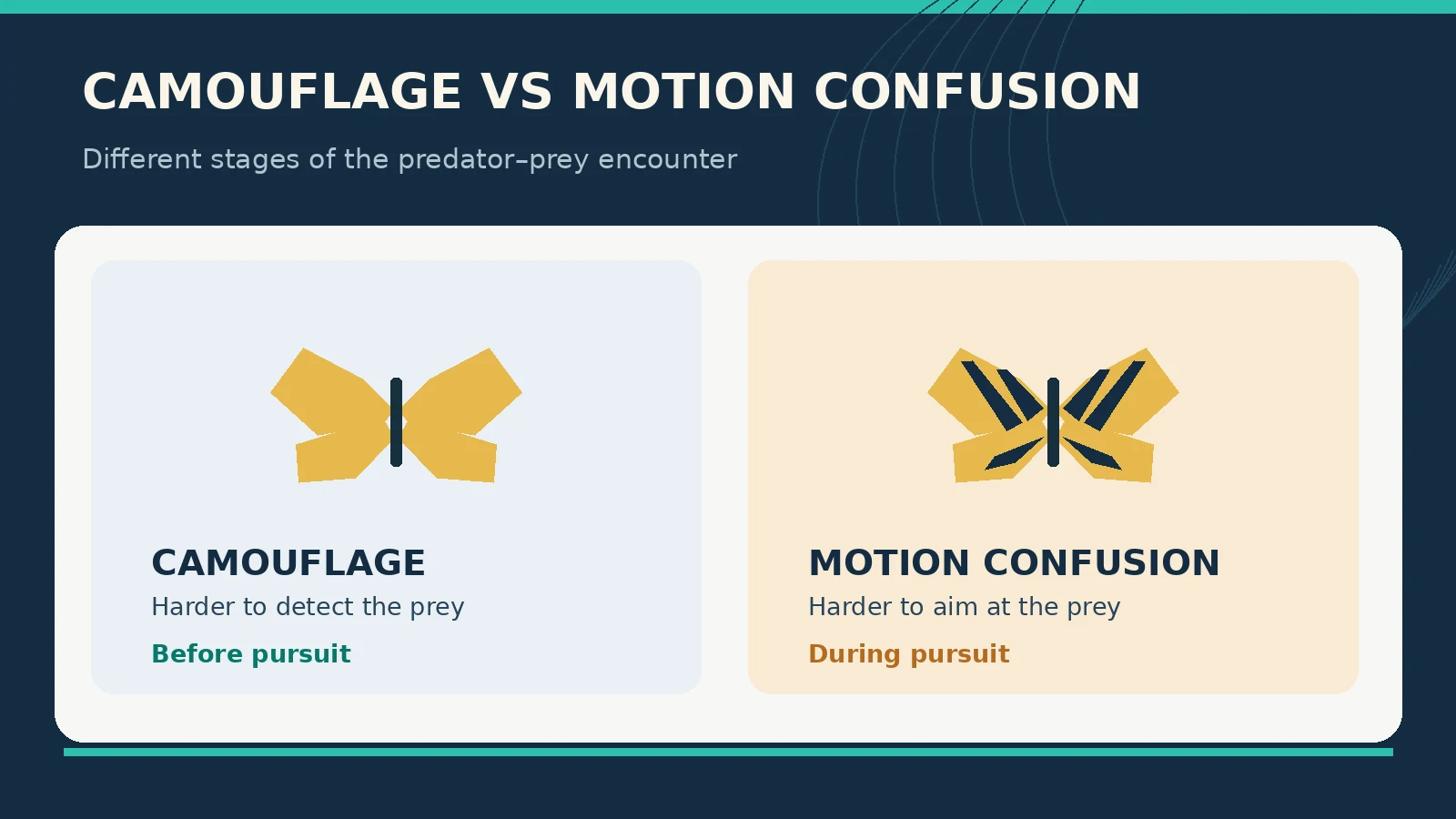
Naturalists have debated motion dazzle since long before this study. Zebras’ bold stripes, snakes’ contrast and patterns on lizards have inspired the idea that moving markings confuse predators. Research on rigid models has often produced mixed results. Butterfly wings offer a particularly useful comparison because their patterns are carried on surfaces that deform while the insect moves, creating local signals that a painted, rigid block does not. The new result should not be simplistically converted into a conclusion that zebra stripes have the same effect in the field.
Warning coloration signals that an animal may be unpleasant or harmful to eat; camouflage lowers detection; mimicry makes an animal resemble another species or an object; motion confusion attempts to disrupt the estimate of position or speed. A butterfly can use more than one strategy. A vivid wing does not automatically mean camouflage has failed, nor does a plain one mean it has no defenses. Moreover, different predators have different eyes, motion processing, lighting conditions and pursuit tactics, so an advantage against one visual system may not transfer perfectly to every other predator.
| Strategy | Primary job | Requires the predator to see the target? | Example qualification |
|---|---|---|---|
| Camouflage | Delay initial detection | Usually no | Movement can defeat concealment |
| Warning coloration | Signal danger or unpalatability | Yes | Effective only with predator learning or appropriate responses |
| Mimicry | Alter recognition or classification | Often yes | Can coexist with other mechanisms |
| Motion confusion | Distort motion/aiming calculations | Yes | Especially relevant once a pursuit begins |
Why swallowtails are especially interesting
Many swallowtail butterflies have striking yellow-and-black bands and thin tails projecting from the hindwings. The study found high modeled forward and sideways confusion among the examined swallowtails. A tail can enlarge the rapidly moving outline and create a tempting, expendable point of aim, potentially allowing a predator to damage a small wing projection instead of the body. This explains why the group is so visually compelling for the research question, but it is not a claim that every swallowtail survives attacks or that all the tails evolved for this purpose alone.
For a real photographic example, see Andreas Schoellhorn’s 2022 photograph of two Papilio machaon butterflies flying in Switzerland, licensed CC BY-SA 4.0. It is an authentic observation of the species’ prominent contrasting wings and tails, not a photograph from the 2026 experimental setup. The featured image in this Horus Valley article is an editorial illustration, and the following diagrams are explanatory reconstructions rather than the journal’s original data panels.
How birds see motion—and what the model can and cannot represent
A bird’s visual system is not just a high-resolution camera. Specialized neurons respond to changes in brightness and contrast across neighboring parts of the visual field and across time. A visual-computation framework can estimate motion by comparing which direction produces the stronger local response. The 2026 researchers used biologically inspired elementary motion detectors and visual filtering based on avian vision, rather than simply tracking the butterfly’s body with a generic phone camera. Their outputs quantify directional signals generated by the moving wing surfaces.
However, the model is a deliberately simplified representation of visual processing. A real bird can combine motion with depth, looming, body shape, learned experience and many other cues. A dragonfly or other insect predator may process motion differently from a bird; a cluttered woodland background differs from a plain screen. It would therefore be wrong to say that the computer model allows the researchers to know exactly what a bird sees consciously. It offers a testable explanation of visual information likely available during an attack.
What the study proves—and what it leaves open
Directly supported: modeled motion signals differed between patterned and digitally unpatterned real flight sequences; natural wing forms varied in their predicted confusion potential; human aiming shifted in the predicted direction for selected virtual butterflies; and digital selection for confusion generated some natural-looking wing motifs. Multiple independent methods converged on the idea that flexible wing markings can distort motion estimates.
Suggested but not established: the exact increase in survival probability in nature, the frequency of failed strikes by specific bird species, the full evolutionary history of each butterfly’s markings, and whether the same mechanism dominates all wing colors, backgrounds, viewing angles or weather conditions. A field experiment that compares predator strikes across otherwise similar moving butterflies while varying markings would narrow some of these gaps, although controlling movement, learning and predator behavior is difficult.
Not justified by the evidence: claims that butterflies are invisible to birds, that all birds always miss, that the research measured thousands of real bird attacks, or that it proves zebra camouflage works identically. Exciting science becomes more useful, not less interesting, when the limits are made explicit.
Why the finding matters beyond butterflies
The study is relevant to a broader question in perception: when a surface moves and deforms, how should a visual system decide whether its local edges represent the object’s true velocity? Engineers working on robotic tracking, cameras or autonomous navigation sometimes face an analogous challenge. A system that blindly averages local motion vectors may misinterpret patterned flexible objects. That analogy does not mean the scientists delivered a finished robot vision algorithm or a ready-made commercial anti-drone device; potential applications need their own tests.
It also suggests fruitful questions about fishes’ flicking tails, lizards’ body markings and even contrasting patches on bird wings. Researchers could now measure whether those designs generate motion confusion across multiple species of predator, rather than assuming that conspicuous movement has a universal consequence. A particularly strong future design would combine high-speed footage, species-specific visual models and direct behavioral tests in the same predator, then report real capture outcomes.
Can you see this illusion yourself? A small, honest demonstration
A simple exercise can illustrate the principle without pretending to reproduce the study. Draw a thick diagonal black stripe on a piece of paper and move the paper horizontally while rotating it slightly. Ask a friend to follow the stripe, then to track a small dot placed at the center. The apparent movement of the stripe can disagree with the dot’s displacement, especially when the stripe spans only a small viewing window. Try replacing the stripe with a uniform shape and observe how the available local direction cues change. Do not handle or chase wild butterflies; a diagram or short animation is enough.
This household exercise is a visual analogy, not an experimental validation of the biological findings. The published study controlled stimuli with high-speed filming, calibrated video playback, modeled observer vision and specified trial conditions. Its peer-reviewed results should be distinguished from what a casual demonstration may make a person think they see.
The take-home finding
A butterfly does not need to vanish to escape. Its moving wing stripes, changing outline and actual flight dynamics can make the wrong direction stand out at exactly the wrong time for a pursuer. What was once a century-old possibility now has evidence from video, comparative morphology, computer evolution and a carefully controlled aiming task. The most accurate headline is not “Scientists prove butterflies hypnotize birds” but “Certain butterfly wing patterns can create motion cues that misdirect attacks.” That is a remarkable result on its own.
Original sources, picture credits and research transparency
Primary research: Hancock et al., Nature, 30 September 2026, DOI 10.1038/s41586-026-11062-w, an open-access paper under CC BY 4.0. Research institution explanation: University of Exeter and University of Essex. Study summary: Nature Portfolio, 1 October 2026. Credited real photograph of Papilio machaon: Andreas Schoellhorn / Wikimedia Commons / CC BY-SA 4.0. The photograph is linked for independent viewing, not included in the supplied ZIP because its binary could not be retrieved and verified. This article’s featured illustration and internal diagrams are original editorial assets; they do not purport to show actual Nature experimental screenshots. Verified 27 October 2026.
You may also like
 Science & Discoveries
First Fully Marine Amphibian? The 237-Million-Year-Old Gerrothorax Discovery
Two remarkably complete Chinese fossils suggest an armored early amphibian spent its life in the sea. Here is…
 Science & Nature
Four-Winged Norellraptor: Did Dinosaur Flight Evolve More Than Once?
A new feathered dinosaur from China suggests flight-related anatomy evolved along more than one route, but the fossil…
 Science & Curiosities
Do Jumping Spiders Dream? Two Sleep Stages and a REM-Like Discovery
A 2026 PNAS study finds two regulated sleep stages in a jumping spider, including REM-like behaviour—without proving that…