
Four-Winged Norellraptor: Did Dinosaur Flight Evolve More Than Once?
A new feathered dinosaur from China suggests flight-related anatomy evolved along more than one route, but the fossil does not prove how it flew.
Contents
- What exactly did scientists discover?
- Why does a small dinosaur matter to the origin of flight?
- What the fossil actually preserves—and what illustrations invent
- The 57 out of 194 result: a reproducible calculation
- Similar hardware, different order of assembly
- Two rival explanations, and where the new study shifts the balance
- A comparison that prevents a common misunderstanding
- Did Norellraptor fly, glide or just jump?
- Were four wings an evolutionary dead end?
- What bone microscopy reveals about the animal's age
- Where the fossil was found, and why its provenance matters
- Which close relatives help interpret Norellraptor?
- How the branching family tree changes the story
- An accessible thought experiment: the same solution, different histories
- What the headlines often leave out
- Three checks readers can use when evaluating fossil headlines
- What should researchers test next?
- The evidence in one comparison
- Original research, figure access and reuse rights
- Conclusion: flight may have been an evolutionary experiment, not a single invention
A 57-centimetre fossil from north-eastern China is forcing palaeontologists to revisit a deceptively simple question: did flight begin once among the ancestors of birds, or did closely related dinosaurs construct their own flying equipment independently? The new species, Norellraptor barsboldi, is a small feathered predator belonging to Microraptorinae. Its virtually complete skeleton preserves traces of plumage, intricate wrist and forelimb anatomy, and microscopic evidence of how its bones grew. A peer-reviewed paper published in Nature Communications on 29 September 2026 argues that the body plan associated with flight emerged through different evolutionary sequences in microraptorines and early birds. Read the primary paper.
The headline is exciting, but there is a distinction worth protecting. The researchers did not film a dinosaur flying or prove that this individual could sustain powered flight. They reconstructed evolutionary relationships from skeletal traits and compared the order in which flight-related changes appeared. Their results provide evidence for independently assembled aerial adaptations—not a definitive account of every take-off, wingbeat or landing in the Early Cretaceous. This guide examines the specimen itself, the 57-of-194 calculation, the competing hypotheses, and what additional fossils would need to show.
What exactly did scientists discover?
The holotype, museum number 130108-MHGU-F4281, is preserved in the Museum of Hebei GEO University, Shijiazhuang. The specimen comes from the Jiufotang Formation near Lamadong Town, Jianchang County, western Liaoning, China. The formation belongs to the Early Cretaceous. This identifies the animal’s geological setting; the paper does not establish a precise individual birthday measured to the nearest million years. The unusually complete skeleton is approximately 57 cm long. Some shoulder-girdle and limb elements shifted after burial, but the main vertebral series and extensive portions of the body remain identifiable.
The researchers named a new genus and species rather than merely assigning the bones to the better-known Microraptor. The genus honours the late American palaeontologist Mark Norell, and the species epithet honours the late Mongolian palaeontologist Rinchen Barsbold. Both made influential contributions to understanding dinosaurs and their relationship with birds. The fossil was discovered by a local farmer and donated to the museum in 2023; its description as a new taxon was published in 2026. A 2026 announcement is therefore not the same thing as a fossil having been freshly excavated that year.
| At-a-glance fact | Verified detail | Important qualification |
|---|---|---|
| Scientific name | Norellraptor barsboldi | A newly described microraptorine, not a modern bird |
| Announcement | 29 September 2026 | Date of scientific publication |
| Specimen | 130108-MHGU-F4281 | Holotype housed at Hebei GEO University |
| Preserved skeleton | About 57 cm long | Length of the skeleton, not a wingspan |
| Locality | Western Liaoning, China | Jiufotang Formation, Early Cretaceous |
| Age at death | At least approximately 3 years | An osteohistological inference, not a birth certificate |
| Feather preservation | Traces around limbs and tail | Incomplete feather outlines; actual wing shape remains uncertain |
Why does a small dinosaur matter to the origin of flight?
Birds are living dinosaurs. Their lineage emerged within theropod dinosaurs, yet a feathered limb is not automatically proof of a single simple path from walking to powered flight. Several close relatives of birds developed combinations of flight feathers, reinforced shoulders, flexible wrist joints and unusual hindlimb plumage. Those mosaics create a puzzle: are the similarities inherited from an ancestor already equipped for aerial movement, or did separate branches arrive at comparable engineering solutions?
Microraptorines are especially informative because they are close relatives of birds without being their direct ancestors in the study’s preferred evolutionary tree. Some members are popularly described as four-winged dinosaurs: long feathers associated with the forelimbs and hindlimbs suggest multiple aerodynamic surfaces. The phrase does not mean four sets of bird-style arms, nor does it establish that all members flapped four limbs exactly like paired wings. A prehistoric animal may have combined gliding, controlled descent and flapping in ways no living animal replicates precisely.
What the fossil actually preserves—and what illustrations invent
The paper documents plumage near the right upper arm, behind the pelvis, near the tail, and beside parts of the lower hindlimb and foot. Feathers at the tail tip show distinctive central shafts, and some forelimb feathers may have been asymmetrical, a feature often associated with aerodynamic performance. However, the preserved feather outlines are incomplete and locally degraded. The authors explicitly caution that their original lengths and detailed shapes are difficult to determine. It would therefore be wrong to claim the fossil records an uninterrupted, perfectly preserved silhouette of four complete wings.
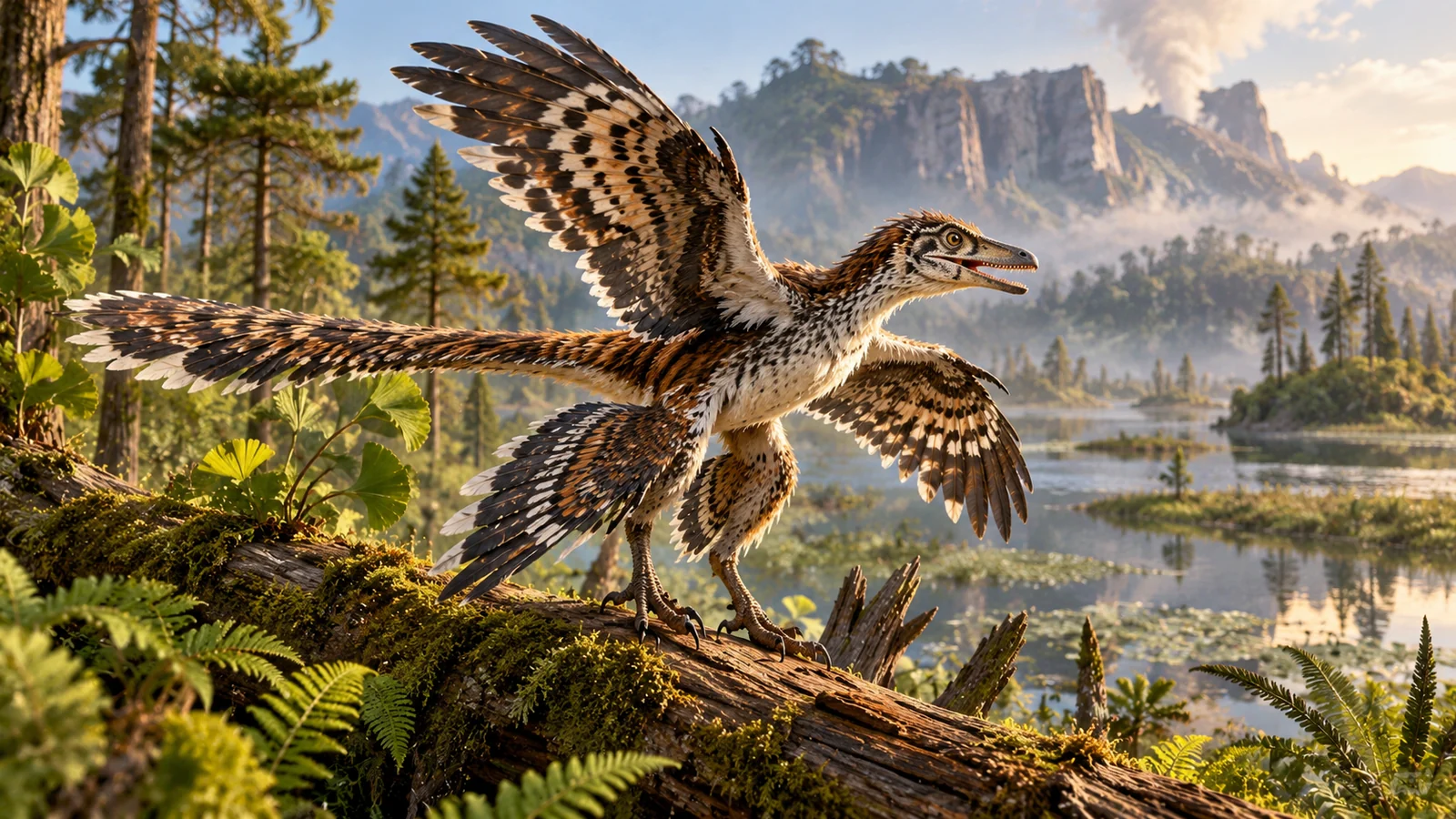
Reconstruction artists have to choose a feather distribution, body coloration, arm position and landscape. A vivid reconstruction can communicate a plausible animal in motion, but it is neither a direct photograph nor a measurement of its actual plumage pattern. The feature image in this guide is an original speculative paleoart illustration. For images of the authentic fossil, visit Figure 1 in the research article and Figure 2, showing hands and feet. These figures are linked, not copied into this advertising-supported article, because the publisher’s published licence restricts commercial reuse and derivative work.
The 57 out of 194 result: a reproducible calculation
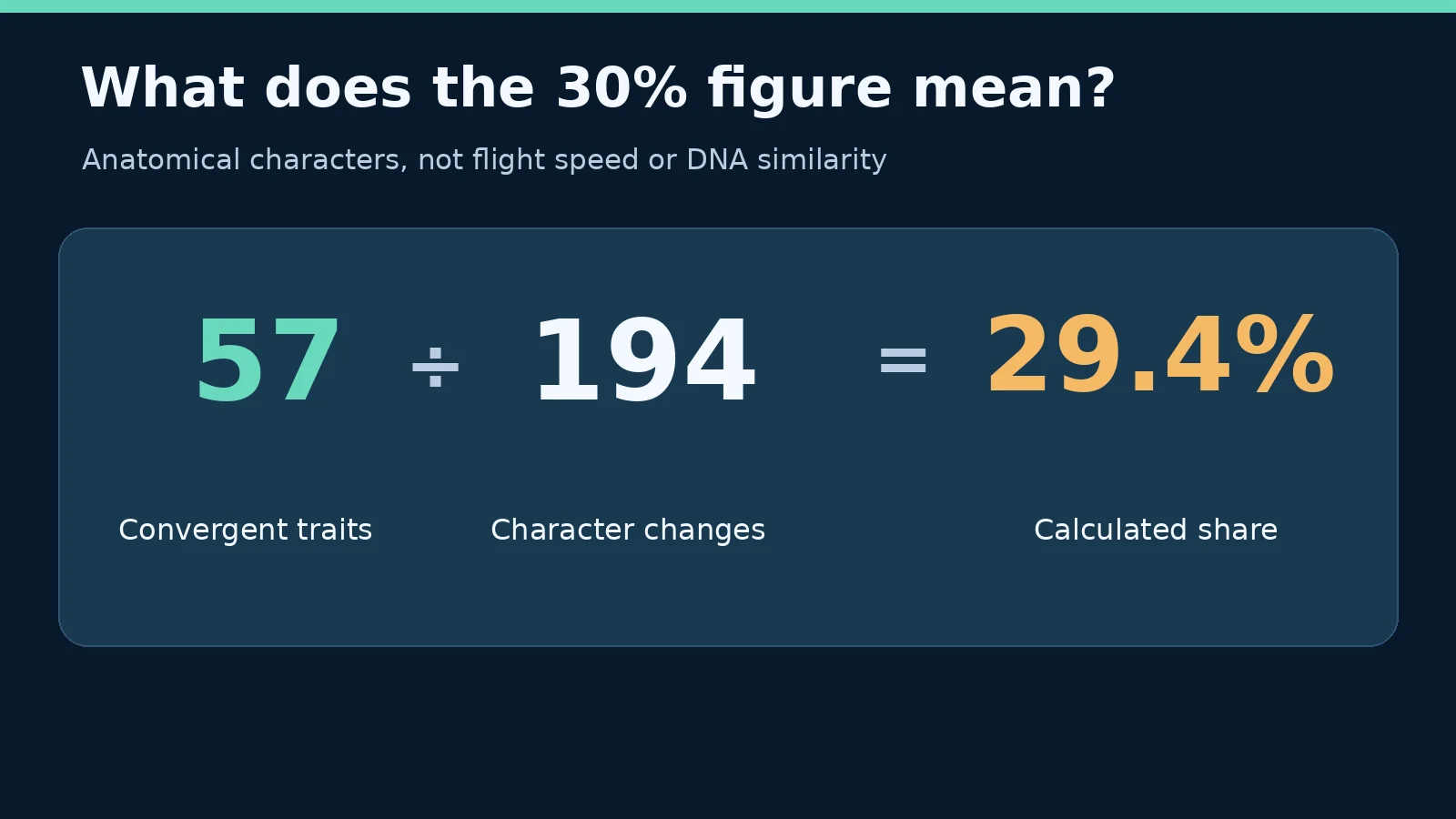
The team reconstructed 194 evolutionary character changes across microraptorine branches. They identified 57 of those changes as independently acquired in the bird lineage. Dividing 57 by 194 gives 0.2938, or 29.38%, reasonably described as ‘about 30%’. These are counts of inferred anatomical character-state changes in an evolutionary analysis, not the percentage of dinosaurs that could fly, not a genetic similarity score and certainly not the proportion of their DNA shared with birds.
A character can represent such things as the relative proportions of arm bones, a wrist configuration, the shape of the sternum, or features in the pelvis and ribs. The researchers coded these anatomical observations across fossil species, computed evolutionary relationships, and inferred where those characters probably changed. Different tree assumptions and missing fossil data may alter reconstructions. The value 57/194 is informative in the context of this specific dataset and analysis, not a universal law of wing evolution.
| Calculation | Arithmetic | What it means |
|---|---|---|
| Changes inferred in microraptorines | 194 | Modelled anatomical transformations |
| Also inferred independently in birds | 57 | Convergently acquired characters |
| Fraction | 57 ÷ 194 | 0.2938 |
| Rounded percentage | 0.2938 × 100 | 29.4%, approximately 30% |
| Not measured here | Bird DNA or flight speed | Cannot be calculated from this character count |
Similar hardware, different order of assembly
This is the strongest conceptual result. Imagine two teams building lightweight aircraft. Both eventually install strong wing supports, a steering surface and a reinforced fuselage. A photograph of the finished machines might make the construction histories look identical. Yet one team could reinforce the frame before altering its control surfaces, while the other does the reverse. Shared end products do not require the same sequence of development.
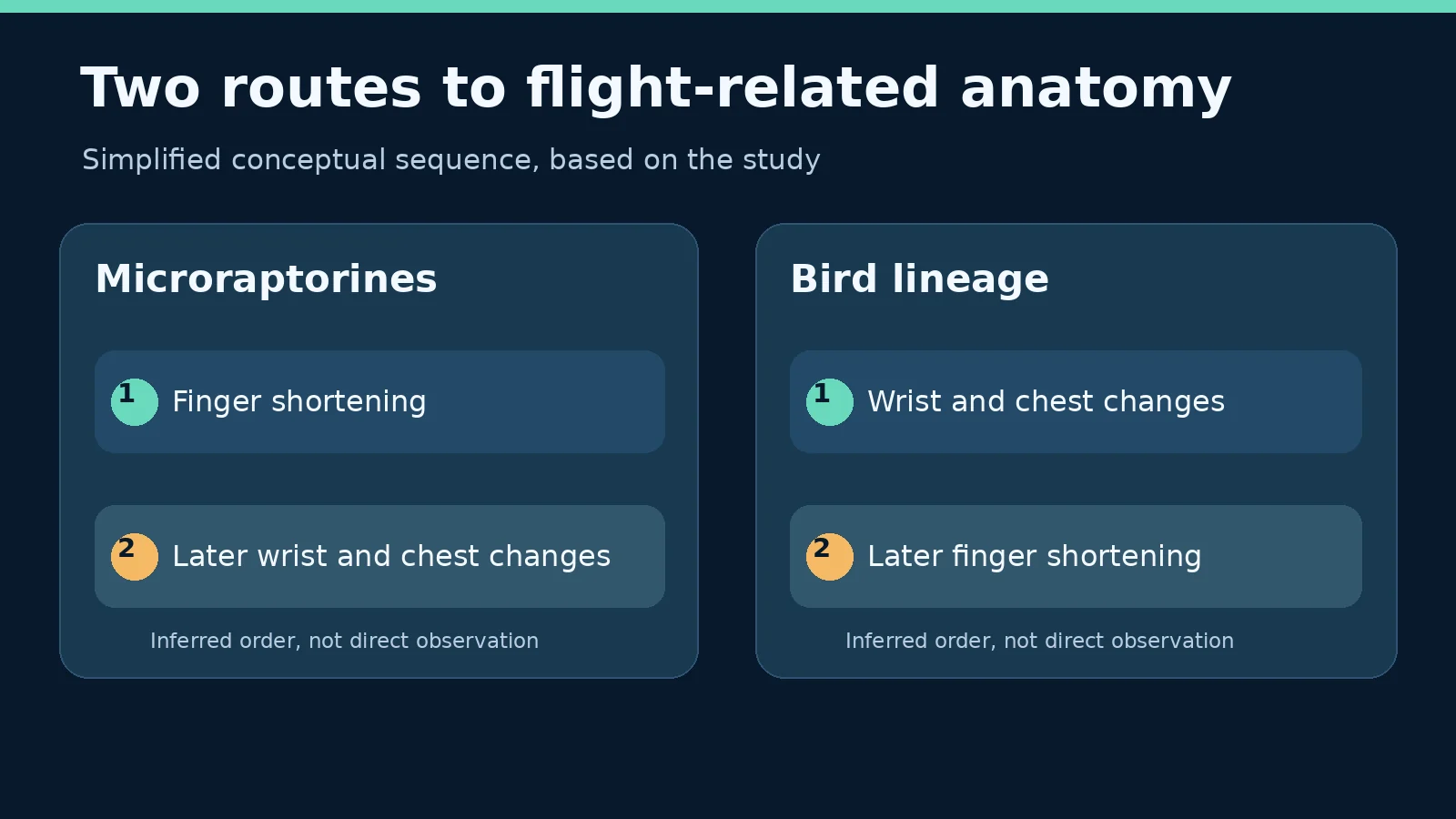
For microraptorines, the reconstructed early changes include shortening certain finger segments and modifying the hand’s original grasping architecture. Later within the group came changes involving fusion of wrist/hand elements and other forelimb and chest features. In the bird lineage, the order of comparable sets of changes differs in the team’s reconstruction. This is evidence against a single developmental timetable producing the same aerial anatomy in both branches. It is not evidence that the two groups had absolutely no common ancestor: they obviously share deep ancestry as paravian dinosaurs.
Two rival explanations, and where the new study shifts the balance
Hypothesis A: inherited proto-flight equipment. Perhaps a common paravian ancestor already had an incipient set of aerial features. Birds and microraptorines inherited parts of it, elaborated them differently, and other branches lost some traits. Under this model, scattered wing-like features can be fragments of a shared ancestral toolkit. This hypothesis is more subtle than saying the ancestor was necessarily a strong modern-style flier.
Hypothesis B: convergent assembly. The common ancestor had relevant feathers and developmental capacities, but the specific set of wing-related anatomical changes arose in more than one descendant branch under different selection pressures. In that case, a microraptorine can resemble a bird mechanically without being on the direct line that led to living birds. The study favours this second interpretation for the origins and assembly of the flight apparatus, while acknowledging that wider phylogenetic disputes and new material could refine the picture.
A comparison that prevents a common misunderstanding
| Question | Birds / Avialae | Microraptorines | Safe conclusion |
|---|---|---|---|
| Are they dinosaurs? | Yes, birds are living theropods | Yes, extinct theropod dinosaurs | Both belong to Dinosauria |
| Were feathers present? | Yes | Yes, in several fossils | Feathers alone do not prove powered flight |
| Did they have flight-related anatomy? | Yes, diverse through time | Yes, in multiple taxa | Similarity may have evolved convergently |
| Same exact evolutionary sequence? | One reconstructed sequence | A different reconstructed sequence | Central claim of the 2026 study |
| Can this fossil prove active flapping? | Not applicable as a single proof | No direct behavioural record | Flight mode remains a separate question |
| Direct ancestors of modern birds? | Members of the bird lineage | Not in the favoured tree | ‘Bird-like’ is not ‘direct ancestor’ |
Did Norellraptor fly, glide or just jump?
A skeleton can constrain possible movements but does not replay them. Functional questions require estimates of mass, wing area, feather stiffness, joint range, muscle power and aerodynamic drag. For Norellraptor, the incomplete plumage means scientists cannot derive a reliable wing surface simply by measuring a complete fossil outline. Some microraptorines may have combined short bursts of flapping with gliding, controlled descent, leaping or manoeuvring through trees, but those possibilities should not be promoted as observed behaviour of this species.
The distinction between gliding and powered flight also matters. A glider converts height into forward distance while losing altitude. A powered flier can supply mechanical work to the air through wingbeats, sometimes maintaining or gaining height. Controlled descent lies somewhere along a behavioural continuum, and an animal might use different strategies for escape, travel or catching prey. Future biomechanical reconstructions need explicit uncertainty ranges instead of a yes/no verdict from the shape of one feather.
Were four wings an evolutionary dead end?
Calling the microraptorine design an ‘evolutionary failure’ simply because modern birds did not keep long hindlimb feathers would be misleading. A body plan can be effective in a particular environment for millions of years without leading directly to modern species. Long feathers on hindlimbs may contribute to lift, drag, braking, steering, stability or display depending on their orientation and flexibility. Different species may have used them differently.
Evolution does not operate toward a preselected modern bird. If two dinosaur lineages faced similar aerodynamic challenges, natural selection could favour similar surfaces while the underlying anatomy followed different trajectories. The 2026 findings illuminate one branch of an evolutionary experiment, not a competition in which surviving birds retrospectively prove that every alternative was defective.
What bone microscopy reveals about the animal’s age
The researchers took a small cross-sectional sample from the left radius, one of the forearm bones. Under polarized, transmitted and fluorescent light, growth lines and patterns of bone deposition become visible. Two distinct lines of arrested growth plus evidence that older inner tissue had been resorbed support the interpretation that the animal was at least three years old when it died. These are not tree rings with a perfectly preserved complete lifetime record; remodelling can erase earlier intervals, hence the cautious lower bound.
The paper also discusses whether the forelimb grew according to a pattern different from modern birds. Particular bone tissues and interruptions in growth may be relevant to when a limb became functionally mature. That hypothesis remains preliminary: one individual’s forearm cross-section cannot provide full growth curves for an entire species, and comparison across fossil taxa introduces uncertainty about age, bone choice and preservation conditions.
Where the fossil was found, and why its provenance matters
The Jiufotang Formation belongs to the fossil-rich Early Cretaceous rocks of north-eastern China. Exceptional preservation in parts of the Jehol ecosystem allows feathers and other delicate traces to survive alongside bones. That is why sites in Liaoning have transformed accounts of dinosaur plumage and early bird evolution. Geological context matters as much as visual beauty: an isolated skeleton without a trustworthy horizon could be assigned an incorrect age or biological setting.
The paper reports that a local farmer found the fossil near Lamadong and donated it to Hebei GEO University in 2023. The researchers checked integrity and original locality, including whether the apparently complete skeleton was a genuine association rather than a fabricated composite. The detailed methods are important because specimens traded outside controlled excavations sometimes raise questions about provenance. The study describes museum access and identifies the holotype accession number for future scientific scrutiny.
Which close relatives help interpret Norellraptor?
Microraptor is the familiar comparison: it is one of the most studied feathered dinosaurs with substantial feathers associated with forelimbs and hindlimbs. Changyuraptor offers another example of unusually long tail feathers, while Wulong documents an immature microraptorine with distinctive plumage. Archaeopteryx belongs to the early bird-related evolutionary story but should not be pictured as the direct ancestor of Norellraptor. An evolutionary tree depicts branching relatedness and inferred character histories, not a single queue of species becoming more ‘advanced’.
The 2026 analysis places Norellraptor near Zhongjianosaurus among relatively late-diverging microraptorines. Researchers compared skull openings, arm bones, fusion patterns in the foot, and other features to justify its new name and position. The fossil’s unusual skull openings are taxonomically useful even though the popular flight headline concentrates on feathers. In science, a discovery’s identity and its proposed functional implications rest on overlapping but non-identical lines of evidence.
How the branching family tree changes the story
A common error is to draw an arrow from Microraptor to Archaeopteryx to pigeons, implying the first species literally transformed into the second. The fossil record provides sampling points on a branching history. Sister or nearby clades can share a predecessor without either one being a direct ancestor of the other. Both can later evolve parallel solutions, retain different primitive traits or lose structures that had been useful in a prior environment.
The study explores alternative placements in its phylogenetic calculations, including cases that constrain microraptorines to the bird lineage. Those constrained trees required 23 additional evolutionary steps compared with the preferred unconstrained trees. Such a difference strengthens the preferred interpretation under the selected characters and optimization approach; it is not the same as a mathematical probability of 100% or evidence that every competing tree is impossible.
An accessible thought experiment: the same solution, different histories
Consider the aerodynamic role of a relatively strong forelimb. A stiff, feathered surface resists deformation and can help control forces in the air. One lineage may first alter finger proportions and then reinforce the shoulder. Another may begin with chest and shoulder changes, then modify the hand. Both eventually arrive at a broadly wing-like configuration. This fictional engineering sequence is offered only as an analogy, but the principle resembles how researchers interpret character order in the evolutionary tree.
Why does order matter? If the exact same complex architecture and the same sequence arose in closely related groups, common inheritance or a shared developmental constraint could become more attractive explanations. Repeatedly different ordering instead makes it reasonable to ask whether environmental pressures promoted related but independent solutions. Researchers need multiple fossils, carefully coded characters and growth data before deciding which account best explains the total evidence.
What the headlines often leave out
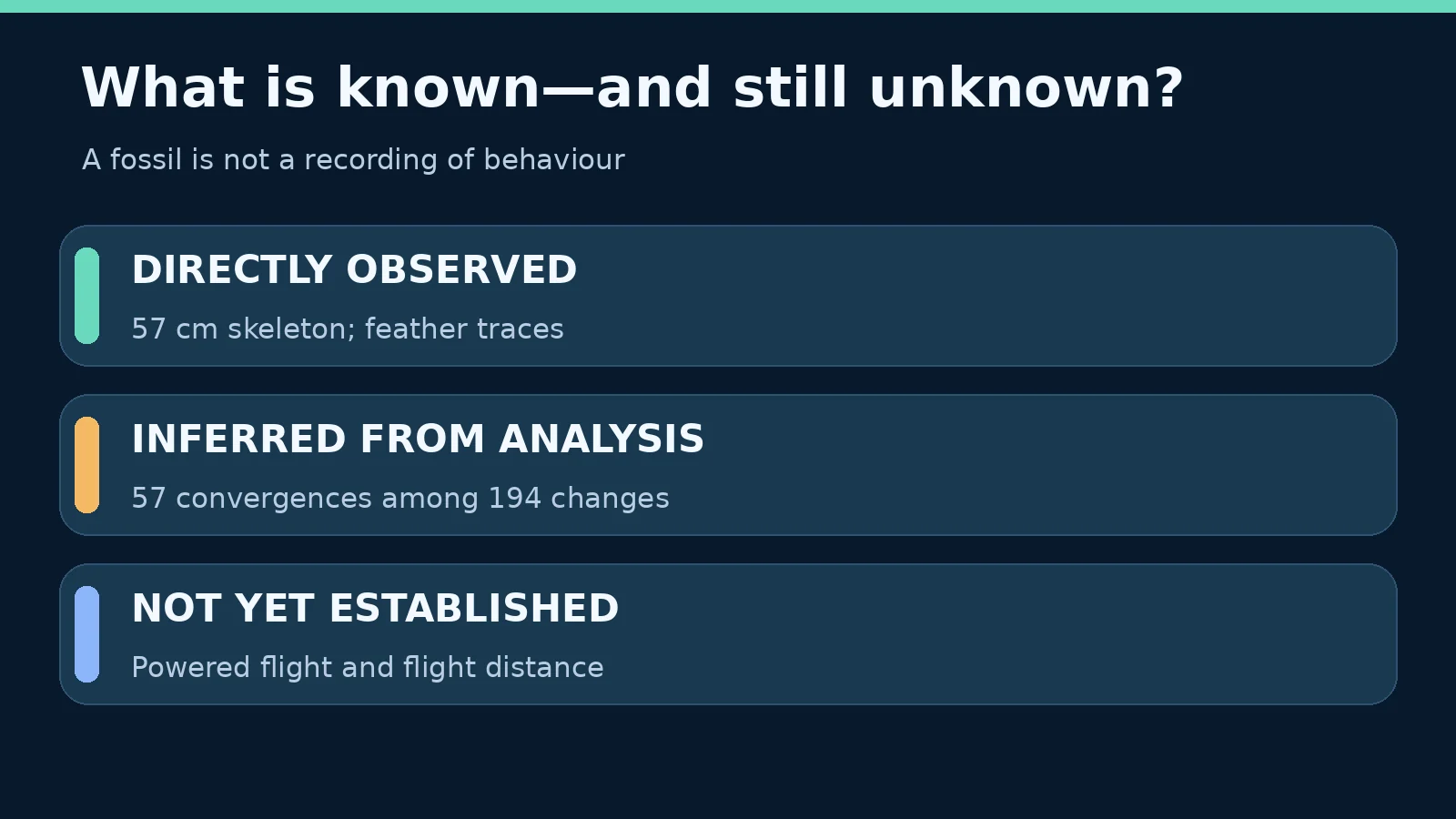
The strongest media stories mention the new taxon and a possible second origin of flight, but several caveats deserve equal prominence. The specimen does not directly reveal its own maximum flight distance; the preserved feathers are incomplete; the animal’s mass and muscular performance were not measured in life; and the statistical 30% refers to anatomical character changes rather than ‘30% bird DNA’. Nor does the discovery show that all feathered dinosaurs were able to fly.
Another pitfall is interpreting ‘flight evolved more than once’ to mean that modern birds originated from two unrelated groups. All living birds belong to an evolutionary lineage. The question is whether other close dinosaur groups separately evolved comparable capacities for aerial locomotion. The fossil strengthens evidence for that possibility without overturning the well-established dinosaur ancestry of birds.
Three checks readers can use when evaluating fossil headlines
First, ask what was directly preserved. The skull, limbs and traces of feathers are observed material; estimates of wing area or colour may come from models. Second, ask which result relies on a tree. The 57 convergences are inferred after coding anatomical characteristics and comparing alternative relationships. Third, look for behavioural evidence. A joint capable of a movement does not tell us how often that movement occurred in a real animal. Keeping these evidence categories separate makes the story more interesting, not less.
A fourth practical check is the date. Some coverage says scientists ‘discovered’ the dinosaur in September 2026, but the paper reports museum donation in 2023. The scientific discovery was formal classification and analysis. The distinction helps readers understand that new science often comes from re-examining fossils already stored in collections rather than dramatic new expeditions every week.
What should researchers test next?
More complete plumage from closely related species could improve estimates of aerodynamic area and feather orientation. Joint-range studies may place bounds on limb stroke and body posture; three-dimensional musculoskeletal models could test whether plausible muscles could sustain repeated flaps. Histological samples from comparable forelimb and hindlimb elements across ages would help test whether microraptorines had a distinctive schedule of limb development. These tests could support, modify or weaken the 2026 interpretation.
Better sampling of under-represented paravian groups is equally important. Evolutionary trees are hypotheses constructed from available character data; discovering previously unknown combinations of anatomy may shift the inferred order of changes. A careful future study would report which conclusions remain stable under alternative species selections, trait codings and phylogenetic constraints. That is how a provocative fossil develops into a stronger evolutionary account.
The evidence in one comparison
| Statement | Assessment | Why |
|---|---|---|
| The fossil is about 57 cm long | Direct observation | Described complete skeleton |
| It preserves some feather traces | Direct observation | Multiple plumage impressions, but incomplete |
| It died at least about three years old | Supported inference | Growth marks and bone resorption |
| About 29.4% of studied changes recurred in birds | Study-based calculation | 57 out of 194 coded transformations |
| Aerial adaptations followed different inferred sequences | Central model result | Comparison of reconstructed evolutionary character order |
| Norellraptor could sustain modern bird-like powered flight | Not established | No direct behavioural record or complete aerodynamic measurements |
| This proves birds do not descend from dinosaurs | False | Birds remain theropod dinosaurs |
Original research, figure access and reuse rights
The primary source is Wang, X. et al. (2026), ‘Independent assembly of the flight apparatus in a non-avian dinosaur clade’, Nature Communications 17, article 10074, DOI 10.1038/s41467-026-77804-6. Nature Portfolio’s editorial summary provides a useful public overview. See the original whole-fossil image, limb close-ups, bone cross-section and evolutionary diagram.
The research is publicly readable but its images are covered by a Creative Commons Attribution–NonCommercial–NoDerivatives 4.0 licence unless separately credited otherwise. Since this website carries advertising, the original figures are linked rather than republished. The featured paleoart and the three infographic diagrams in this article were made for Horus Valley and are explicitly illustrative, not photographs or adapted reproductions of the restricted figures. Read the publisher’s permissions statement at the end of the research article.
Conclusion: flight may have been an evolutionary experiment, not a single invention
Norellraptor barsboldi enriches a fossil record in which feathered dinosaurs occupied many ecological and anatomical possibilities. The striking discovery is not merely another beautiful specimen with wing-like feathers. It is that the reconstructed order of anatomical change differs between the microraptorine and avialan branches, despite similarities in their final flight-related equipment. That makes convergent evolution an increasingly compelling explanation for some forms of dinosaur aerial adaptation, while leaving room for future fossils to refine the detailed history.
The most defensible headline is therefore also the most intriguing: flight-related dinosaur anatomy may have been assembled independently through more than one evolutionary route. Understanding exactly what this individual could do in the air remains a challenge for palaeontology, comparative anatomy and biomechanics—not a fact already captured in stone.
You may also like
 Science & Discoveries
First Fully Marine Amphibian? The 237-Million-Year-Old Gerrothorax Discovery
Two remarkably complete Chinese fossils suggest an armored early amphibian spent its life in the sea. Here is…
 Science & Nature
Why Are Butterflies So Hard to Catch? Their Wing Optical Illusion Explained
A 2026 Nature study explains how butterfly wing patterns and flight alter motion cues and can misdirect attempts…
 Science & Curiosities
Do Jumping Spiders Dream? Two Sleep Stages and a REM-Like Discovery
A 2026 PNAS study finds two regulated sleep stages in a jumping spider, including REM-like behaviour—without proving that…