
How Long Will Food Last in a Fridge or Freezer Without Power?
A fridge usually keeps food cold for 4 hours without power; a full freezer for about 48 hours. Learn which foods to keep or discard, with US and UK advice.
Contents
- Fridge and freezer without power: the quick time chart
- The US and UK temperature rules are not exactly the same
- What food should you throw out after a long fridge power cut?
- What if the freezer thaws during a power outage?
- Power went out for 6, 8, 12 or 24 hours: what should you do?
- Example: a 7-hour cut with chicken and milk in the fridge
- Example: a full freezer was off for 30 hours
- Example: the power went off overnight and then came back
- What to do immediately when the electricity fails
- A no-panic checklist once the power returns
- What about babies, older people and refrigerated medicines?
- Common mistakes that make an outage riskier
- Frequently asked questions
- Is milk safe after the fridge has been off for five hours?
- Can eggs stay in a switched-off fridge overnight?
- Can I refreeze chicken that has partly defrosted?
- Does a four-hour outage mean I have two extra hours to eat the food?
- Can I keep food outdoors in cold winter weather?
- What if the freezer is still cold after 48 hours?
- The safest rule to remember
- Official sources and editorial review
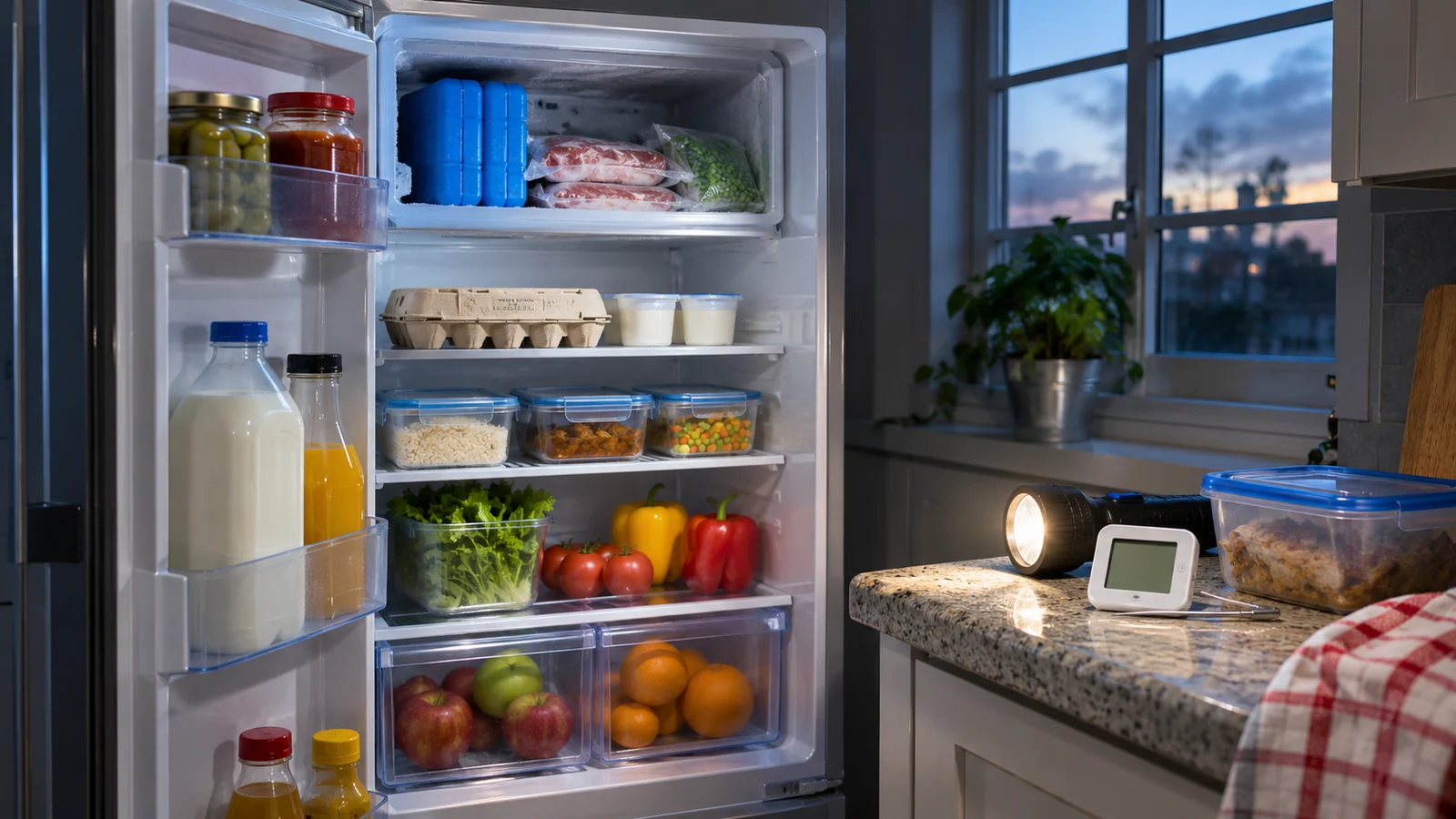
A refrigerator usually keeps food safely chilled for up to 4 hours without electricity if its door stays closed. A full freezer can hold a safe temperature for roughly 48 hours; a half-full freezer, around 24 hours. These are estimates, not guarantees. What matters after an outage is the food’s actual temperature, how long it was too warm, and whether it needs refrigeration in the first place. The CDC’s emergency food-safety guidance explains the basic limits.
Quick decision: If your fridge has been off for more than four hours and you cannot prove its perishable food stayed cold enough, discard meat, fish, milk, eggs, cooked rice, prepared salads and leftovers. Do not test food by tasting it. UK-specific temperature rules are explained below because they differ from the US threshold.
Fridge and freezer without power: the quick time chart
| Appliance or condition | Typical safe cold-holding time with door closed | What to do next |
|---|---|---|
| Refrigerator | Up to about 4 hours | After this, assess temperature history; discard unsafe perishables |
| Full, closed freezer | Around 48 hours | Check individual packages, ice crystals and food temperature |
| Half-full, closed freezer | Around 24 hours | Check sooner; food warms faster |
| Small freezer compartment inside a fridge | May be shorter than a stand-alone freezer | Do not assume it will last the full 24–48 hours |
| Any appliance opened repeatedly | Potentially much less than the figures above | Use a thermometer rather than the clock alone |
These times begin when effective cooling stops. They do not mean that every refrigerated food becomes unsafe the moment a four-hour outage ends, nor that frozen food is automatically safe until hour 48. Opening doors, high room temperatures and a warm appliance before the outage change the outcome. USDA guidance specifically cautions that a refrigerator’s small freezer compartment may not hold temperature as long as a separate freezer.
The US and UK temperature rules are not exactly the same
| Location | Normal fridge target | Critical outage rule |
|---|---|---|
| United States | At or below 40°F (4°C) | Discard perishable refrigerated foods after a 4-hour outage without reliable cold storage. Foods above 40°F for more than 2 hours should be discarded. |
| England, Wales and Northern Ireland | Normally 5°C or lower | UK Food Standards Agency guidance permits chilled foods to be held below 8°C during a power cut. If the fridge reaches 8°C or above, eat items needing refrigeration within 4 hours or discard them. |
| Scotland | Normally 5°C or lower | Food Standards Scotland also uses a below-8°C power-cut threshold and advises using chilled food within 4 hours once 8°C is reached. |
A 4-hour power cut is different from 4 hours above the UK’s 8°C threshold, or 2 hours above the US’s 40°F (4°C) threshold. Those are separate clocks. In the US, when temperature history is unknown after a long outage, the conservative official direction is to discard refrigerated perishables rather than guess. In the UK, follow the Food Standards Agency’s specific power-cut advice and Food Standards Scotland.
Important distinction: the UK’s 8°C emergency allowance is not the everyday recommended setting for a fridge. It does not override a product’s use-by date, manufacturer’s storage instructions or evidence that the food was already unsafe before the outage.
What food should you throw out after a long fridge power cut?
The following examples use the US FoodSafety.gov refrigerated-food chart: the “discard” column applies when that food has been at 40°F (4°C) or above for more than two hours. During an outage exceeding four hours with unknown temperatures, the CDC recommends discarding perishable refrigerated foods. UK readers should also apply the separate 8°C guidance above.
| Food in the fridge | Usual decision after unsafe warming | Why or qualification |
|---|---|---|
| Raw or cooked chicken, meat and fish | Discard | Includes deli meat, sausages, seafood and meat-containing meals |
| Milk, yoghurt, cream, soft cheese | Discard | Includes opened plant-based milk requiring refrigeration |
| Fresh eggs, cooked eggs, egg salad | Discard | Do not rely on a normal smell |
| Cooked rice, pasta, potatoes, stews, leftovers | Discard | High-risk prepared foods need verified temperature control |
| Cut fruit, sliced vegetables, prewashed bagged greens | Discard | Cut/prepared produce has different handling needs from whole produce |
| Hard cheese (such as cheddar or Parmesan) | Often keep | Specific hard cheeses appear in the US keep list; follow product label |
| Butter, margarine; intact whole fruit and vegetables | Usually keep | Not treated like high-risk chilled meat or milk in the US chart |
| Bread, plain cakes, peanut butter, mustard and pickles | Usually keep | Provided packaging and food condition are sound |
| Shredded cheese, opened pasta sauce, creamy dressings | Discard | Not equivalent to a sealed block of hard cheese |
Some condiments have special exceptions. For example, the US chart says to discard opened mayonnaise, tartar sauce and horseradish if held above 50°F (10°C) for more than eight hours; it generally allows ketchup and mustard to be kept. Avoid inventing one expiry time for every sauce.
What if the freezer thaws during a power outage?
A thawed freezer is not automatically a total loss. According to FoodSafety.gov, many frozen foods can be refrozen or cooked when they still contain ice crystals or are measured at 40°F (4°C) or below. Food quality may deteriorate after refreezing. If meat, seafood or prepared meals have been above 40°F for more than two hours, discard them.
| Freezer food after power returns | If still icy or at/below 40°F (4°C) | If above 40°F (4°C) for over 2 hours |
|---|---|---|
| Raw meat, chicken, fish | May refreeze or cook | Discard |
| Frozen prepared meal, pizza or casserole | May refreeze or cook | Discard |
| Frozen milk | May refreeze, but texture may change | Discard |
| Frozen fruit and plain bread | Usually may refreeze | Often may refreeze; check type and contamination |
| Ice cream or frozen yoghurt that has softened/thawed | Discard if thawed; ice crystals are not a general rescue rule here | Discard |
| Plain frozen vegetables | May refreeze, quality may suffer | Official chart gives a 6-hour above-40°F discard point for these items |
The 48-hour and 24-hour freezer figures apply best to a well-filled compartment that stays closed. If you are unsure whether a particular food stayed cold, do not rely on the state of other packages or on the condition of ice cream alone. Check the specific food and use a food thermometer when available.
Power went out for 6, 8, 12 or 24 hours: what should you do?
| Time without power | Refrigerator decision | Freezer decision |
|---|---|---|
| 2 hours | Usually still within closed-fridge estimate; check if already warm | Keep closed |
| 4 hours | Refrigerated perishables need immediate assessment; US guidance says discard after this point without adequate cooling | Still generally within estimated freezer window |
| 6–8 hours | Do not assume meat, milk and leftovers are safe; check documented temperatures and country rules | Usually check only when electricity returns or emergency cold transfer is necessary |
| 12 hours or overnight | With unknown temperatures, discard perishable fridge food; do not trust smell | Many well-filled freezers may still be cold; inspect packages |
| 24 hours | Use alternative reliable cold storage for any food still safe | A half-full freezer may be near its limit |
| 48 hours | Fridge estimate no longer applicable without independent cooling | A full freezer may be near its limit; inspect actual food temperature |
Example: a 7-hour cut with chicken and milk in the fridge
If there is no thermometer log or ice-filled cooler showing they stayed safely chilled, discard the chicken and milk under the conservative US rule. In the UK, a documented fridge temperature history remaining below 8°C may change the assessment, but the storage label and individual food still matter.
Example: a full freezer was off for 30 hours
The 48-hour estimate suggests the food may still be cold, especially if the door never opened. Inspect a representative range of packages. Meat with ice crystals or measured at or below 40°F (4°C) may be refrozen under US guidance; fully thawed warm meat must be discarded. Do not assume every shelf warmed evenly.
Example: the power went off overnight and then came back
You cannot reverse unsafe warming by switching the fridge back on. A display reading 3°C once the appliance has cooled again does not prove that the food never spent hours above a critical limit. If no reliable history is available, follow the conservative discard rule for high-risk foods.
What to do immediately when the electricity fails
- Note the start time. Record when power failed and whether there were earlier interruptions that left the appliance warm.
- Keep both doors shut. Choose food in advance rather than repeatedly browsing inside the fridge.
- Check the thermometer without unnecessary opening. If your appliance has a display or a logging thermometer, preserve the readings. A display showing its target setting is not necessarily the actual food temperature.
- Prepare an iced cooler if a long outage is likely. Keep the contents at or below 40°F (4°C) for the conservative US benchmark; replenish ice as it melts.
- Move perishables only if you can maintain safe cold storage. A warm car, uncooled bag or sunny doorstep does not preserve food.
- Keep a shelf-stable meal and water available. This reduces pressure to eat questionable leftovers.
If you use dry ice, observe the manufacturer’s handling instructions and ensure adequate ventilation. Never use a charcoal grill, barbecue or camping stove inside a home to heat food: the risk of carbon monoxide poisoning is serious. See the UK official power-cut guide for safe cooking considerations.
A no-panic checklist once the power returns
- Check and record appliance temperatures before the fridge has had time to cool down again, if possible.
- Identify the duration of the outage and any previous periods of warm storage. Do not reset the safety clock merely because the power briefly returned.
- Review refrigerated meat, fish, eggs, dairy, cut produce and leftovers first. Discard items that crossed the relevant limits.
- Inspect frozen products individually for ice crystals and, where possible, measure the food temperature.
- Keep shelf-stable food separately; do not throw away every jar or loaf simply because it was stored in the refrigerator.
- Clean leaked juices and discard any food contaminated by floodwater or sewage regardless of appliance temperature.
- Record losses for any relevant insurance claim, but do not retain unsafe food merely for a photograph or receipt.
Keep a note of what you discarded and why. If food has a use-by date, has been opened unusually long or was mishandled before the outage, electricity returning does not restore its safety.
What about babies, older people and refrigerated medicines?
Pregnant people, young children, older adults and people with weakened immune systems can be more vulnerable to severe foodborne illness. Avoid relying on uncertain high-risk leftovers in these households. UK guidance gives extra caution for these groups and notes that ready-to-feed infant formula may be useful if safe boiling water is unavailable.
Opened, refrigerated infant formula is not comparable to an unopened shelf-stable carton. Use manufacturer instructions and official infant-feeding advice. If a medicine needs refrigeration, contact a pharmacist or manufacturer: a food-safety timescale cannot establish whether a medicine remains effective.
Common mistakes that make an outage riskier
- Smelling or tasting the food: dangerous bacteria may be present without an obvious smell or taste.
- Assuming cold-feeling food is definitely safe: touch cannot tell you how long it was above a safe temperature.
- Trusting the freezer “coin in ice” trick as proof: it may suggest that ice melted, but it cannot establish the exact food temperatures or hours spent unsafe.
- Using the fridge setting as a temperature measurement: the set point and real temperature can differ.
- Putting all refrigerated foods in one category: a hard block of cheese and cooked chicken require different decisions.
- Cooking food that spent too long warm: cooking cannot reliably undo every hazard created by unsafe storage.
Frequently asked questions
Is milk safe after the fridge has been off for five hours?
Under conservative US advice, discard refrigerated milk after a power outage exceeding four hours unless you have reliable evidence of safe cold storage. UK advice uses the documented below-8°C emergency threshold, the four-hour limit once 8°C is reached, and product label instructions.
Can eggs stay in a switched-off fridge overnight?
Do not assume so. The US official chart treats refrigerated shell eggs and cooked egg dishes as perishable: discard them if they spent more than two hours above 40°F (4°C). An overnight outage with unknown temperatures is not evidence they remained safe.
Can I refreeze chicken that has partly defrosted?
Usually yes under US guidance if it still contains ice crystals or measures no more than 40°F (4°C), provided it was otherwise handled safely. Discard chicken that remained above 40°F for more than two hours. Refreezing may reduce eating quality.
Does a four-hour outage mean I have two extra hours to eat the food?
No automatic extra two hours applies. The four-hour closed-fridge estimate and the US limit of more than two hours above 40°F measure different things. If the actual temperature history is unknown, follow the official conservative rule rather than adding the figures together.
Can I keep food outdoors in cold winter weather?
UK guidance permits chilled food outside under suitable cold conditions, protected from animals, contamination and direct sunlight, in sealed containers. Ensure temperatures remain safely low. For the US threshold, a monitored cooler with ice is generally more dependable than an uncontrolled outdoor location.
What if the freezer is still cold after 48 hours?
Check the actual food. The 48-hour estimate is not an automatic deadline or a guarantee. Frozen foods with ice crystals, or measured at 40°F (4°C) or below, may often be refrozen under US guidance; use the specific frozen-food chart for exceptions such as ice cream.
The safest rule to remember
Keep the doors closed, use a thermometer when possible and assess perishables separately from shelf-stable food. For an unmonitored US refrigerator, the practical cutoff is about four hours without power. For the UK, follow the FSA’s more specific temperature-based emergency rule. For a freezer, 24–48 hours is a starting estimate—not a substitute for checking ice crystals and food temperatures.
For a broader household plan, see our UK 72-hour emergency kit checklist, including non-perishable food, water and power-cut preparation. That article covers preparedness; this guide focuses on whether existing chilled and frozen foods are still safe to eat.
Official sources and editorial review
- CDC — Keep Food Safe After a Disaster or Emergency (USA).
- FoodSafety.gov — Refrigerated and Frozen Food Safety Charts (USA).
- FDA — Power Outages: Key Tips for Consumers About Food Safety (USA).
- Food Standards Agency — Food Safety in a Power Cut (England, Wales and Northern Ireland).
- Food Standards Scotland — Power Cuts (Scotland).
- USDA — How to Keep Food Safe During a Power Failure (USA).
Sources reviewed: 8 November 2026. This article summarises general home-food-safety guidance; appliance conditions, local official alerts, contamination and individual package instructions can require more cautious decisions. The featured image is a conceptual kitchen illustration, not evidence of a measured refrigerator temperature or a recommendation to leave its door open.
You may also like
 Health & Safety
T&T Black Soybean Recall: Affected Codes and What to Do
Check the T&T black soybean recall in Canada: affected 300 g packs, UPC, codes and the official instructions…
 Health & Safety
Bomberry Recall: Affected Products, Dates and Refunds
Check the Bomberry 150g recall, affected flavours and best-before dates. Follow retailer-return or manufacturer email refund instructions in…
 Health & Safety
What Are Peptides? Approved Medicines vs Online Products
Understand peptides, approved medicines and unapproved online products. Check Australian registration, safety warnings and questions to ask your…