
UK 72-Hour Emergency Kit: The Official Be Ready Checklist and a Practical Household Plan
A practical UK 72-hour emergency kit guide with water calculations, food, power-cut preparation, and family checklists.
Contents
- Why the UK launched Be Ready in October 2026
- The official 72-hour emergency kit checklist
- How much water does a family need for 72 hours?
- A worked example: two adults, two children and a dog
- How to store emergency water
- Food for three days: choose meals that work without electricity
- What to do before and during a power cut
- Before an outage
- During an outage
- Your paper emergency plan: one page can be more useful than another app
- Families with babies and young children
- Older people, disability and medical equipment
- Priority Services Register: free additional support
- Preparing pets without overlooking their needs
- Emergency kit versus grab bag: they are not the same thing
- A low-cost, four-week preparation plan
- The mistakes that make an emergency kit less useful
- What changes across the UK?
- Printable 72-hour household checklist
- A practical 72-hour plan for different types of disruption
- The first 15 minutes of an unexpected outage
- Planning for a flat, shared house or limited storage
- Make a three-day no-cook menu before shopping
- What about food in the fridge and freezer?
- Communications: plan for the internet not working
- Emergency alerts and trusted updates
- Floods, storms and extreme temperatures: why the kit needs a plan
- Medication, refrigeration and equipment: questions to settle now
- Test your plan with a 20-minute household exercise
- Maintenance: a six-month kit audit
- Final takeaway
- Official sources and further reading
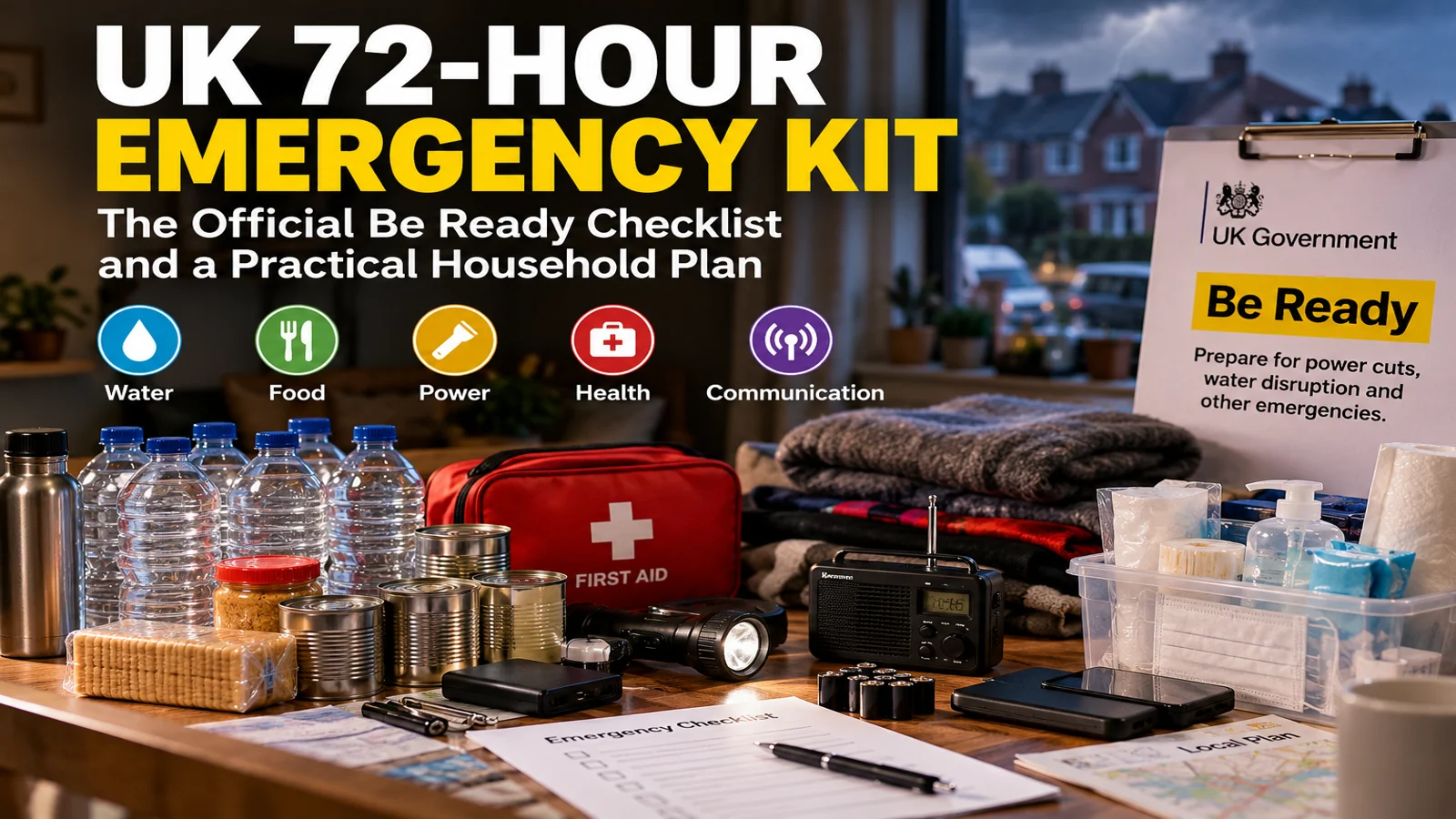
The UK government's Be Ready campaign encourages households to prepare for three days of disruption to essential services. That does not mean a particular emergency is imminent. It means making a realistic plan for events such as severe weather, a power cut, water supply disruption or temporary loss of phone and internet access. The starting point is simple: check what you already have, identify gaps and add essentials gradually rather than panic-buying.
At a glance: Set aside drinking water at 3 litres per person per day, or 9 litres per person for 72 hours, with extra water for cooking, washing, medical needs and pets. Keep three days of ready-to-eat food, a torch, a battery-powered or wind-up FM radio, a charged power bank, basic first aid, essential medicines, hygiene supplies, paper contacts and a small amount of cash suited to your circumstances. The government advises reviewing supplies every six months.
Why the UK launched Be Ready in October 2026
On 22 October 2026, the Cabinet Office announced the first stage of a three-year public preparedness campaign. Its focus is resilience during interruptions to everyday services, including electricity, water, mobile networks and the internet. The advice builds on government preparedness guidance first published in 2024. It is practical advice, not evidence that the government expects a specific attack or disaster on a particular date.
For the official guidance, see Be Ready for emergencies and the Cabinet Office announcement.
The official 72-hour emergency kit checklist
| Category | What to prepare | Why it matters |
|---|---|---|
| Water | At least 3 litres per person per day for drinking | Tap water may be unavailable or unsafe during some incidents |
| Food | Three days of familiar, shelf-stable, ready-to-eat food | Cooking and refrigeration may not be available |
| Light | Torch, spare batteries | A safer alternative to candles |
| Information | Battery-powered or wind-up FM radio | Updates may continue when internet and mobile services fail |
| Power | Charged power bank and suitable cables | Helps keep a phone available for essential communication |
| Warmth | Blankets, sleeping bags and layers | Heating may stop during a power cut |
| Hygiene | Wet wipes, hand sanitiser, toilet supplies | Water interruptions make routine hygiene harder |
| Medical | First-aid supplies, prescriptions, device instructions | Treatment and equipment may be harder to access |
| Money | Some cash in notes and coins, plus cards | Card terminals and cash machines may be affected |
| Records | Printed phone numbers, IDs and relevant insurance information | Digital documents may be inaccessible |
| Dependants | Baby supplies, pet food and pet water | Household needs differ |
This is a household planning checklist, not a claim that every family must buy an expensive pre-packed survival kit.
How much water does a family need for 72 hours?
The government's current baseline is 3 litres of drinking water per person per day. Multiply household size by three days and then by three litres:
Drinking water (litres) = number of people × 3 × 3.
| Household size | Three-day drinking-water baseline |
|---|---|
| 1 person | 9 litres |
| 2 people | 18 litres |
| 3 people | 27 litres |
| 4 people | 36 litres |
| 5 people | 45 litres |
| 6 people | 54 litres |
These figures are drinking-water baselines, not complete water budgets. Add separate water for cooking, washing, pets, baby formula and medical devices where applicable. Needs can increase in hot weather or with illness. If you have limited storage, begin with what is feasible and build up over time. Follow any water-company or public-health advice about whether tap water is safe to drink.
A worked example: two adults, two children and a dog
Four people need a 36-litre baseline for drinking over three days. The dog's water is additional, as are any cooking and hygiene needs. The exact extra amount depends on the dog's size and health, the foods prepared and the household's medical requirements. Rather than guessing a universal number, write those extra needs on your checklist and review them with relevant guidance.
How to store emergency water
Keep commercially bottled water in accordance with the label, away from excess heat and direct sunlight. Rotate it by its marked date. Do not assume a household filter makes floodwater or chemically contaminated water safe; follow official local notices. If a boil-water notice is issued, remember that boiling may be impossible without power, and boiling does not remove every type of chemical contamination.
Food for three days: choose meals that work without electricity
Build around foods your household already eats. Useful options include ready-to-eat tinned fish or beans, tinned fruit and vegetables, crackers, nut butter where safe for your household, dried fruit and other shelf-stable foods. Keep a manual tin opener if needed. Check allergy requirements and special diets. Avoid planning meals that rely entirely on a fridge, freezer, hob, kettle or microwave.
A simple three-day approach is to choose three familiar breakfasts, lunches and dinners per person, then confirm that each can be eaten safely without refrigeration or cooking. Add snacks for children and any foods required for specific medical diets. Check labels for storage instructions after opening; an opened product may no longer be shelf-stable.
Food-safety rule: If a power cut affects refrigerated or frozen food, follow current Food Standards Agency advice rather than judging safety by smell or appearance. Never use outdoor barbecues, charcoal burners or camping stoves indoors: carbon monoxide can kill.
What to do before and during a power cut
Before an outage
Charge your power bank, keep charging cables together and know where your torch is. Write down important phone numbers and local radio frequencies. Check your smoke alarms monthly. Know how to safely isolate water, gas and electricity if emergency instructions require it, but do not interfere with electrical or gas equipment unless you know the correct procedure.
If you depend on an electrically powered medical device, contact your healthcare team and energy provider before an outage to agree a safe contingency plan. A consumer power bank should never be assumed capable of operating medical equipment without confirmation of compatibility and runtime.
During an outage
Use a torch rather than candles. Keep fridge and freezer doors closed as much as possible, follow official food-safety guidance, and preserve phone battery for essential calls and updates. In England, Scotland and Wales, 105 is the power-cut reporting number; in Northern Ireland, the Be Ready guidance lists 03457 643643. Call 999 if someone is in immediate danger.
If you suspect a gas leak, follow the relevant gas emergency service's instructions and do not operate switches or flames near the suspected leak.
Your paper emergency plan: one page can be more useful than another app
A power or network outage can make cloud-only notes inaccessible. Print or handwrite a sheet containing:
- Household members' names, emergency contacts and an agreed meeting place.
- Any relevant medication names, doses and allergies; protect sensitive information appropriately.
- Electricity, water and gas supplier contact details, plus insurance policy information.
- School or childcare contacts and arrangements for collection.
- Neighbours or relatives who may need a check-in, with their consent.
- Local radio frequencies and instructions for important medical equipment.
Agree how you will reconnect if phones stop working. Choose a nearby meeting point and a second contact outside the immediate area. Discuss the plan with children using calm, age-appropriate language.
Families with babies and young children
Consider ready-to-feed formula where appropriate: the government specifically notes that boiling water to prepare powdered formula may not be possible. Store nappies, wipes, any feeding equipment and the supplies needed for the child's age. Keep school and nursery contact details current. If a baby needs specialised feeding or medication, seek individual advice from the child's healthcare professional.
Older people, disability and medical equipment
A general kit is not a substitute for a tailored continuity plan. Consider medicine access, refrigerated medicines, mobility aids, hearing-aid batteries and powered medical devices. Request repeat prescriptions in good time: the official checklist advises allowing up to five working days. Never stop or change prescription treatment simply to build a reserve.
Priority Services Register: free additional support
In England, Scotland and Wales, eligible households can register for extra support from electricity, gas and water providers through the Priority Services Register. Eligibility can include households with children under five, certain health needs and other vulnerabilities. Registration does not guarantee uninterrupted supply, immediate restoration or a specific backup power service. Northern Ireland uses Customer Care Registers. See the PSR information site and your utility provider for details.
Preparing pets without overlooking their needs
Include three days of usual pet food, drinking water, bowls, medication where prescribed, waste bags or litter, and a lead or carrier if evacuation becomes necessary. Keep veterinary and microchip details accessible. Water and food requirements vary significantly by animal, so plan for your own pet rather than using the human drinking-water formula.
Emergency kit versus grab bag: they are not the same thing
A home kit supports you while sheltering at home during a service interruption. A grab bag holds portable essentials for an evacuation ordered by emergency responders. It might include documents, medication, chargers, water, suitable clothing and supplies for dependants. Do not delay escape from a fire to retrieve a bag or belongings. Always follow emergency-service instructions.
A low-cost, four-week preparation plan
Week 1 — free checks: Write emergency contacts, choose a meeting place, check existing food and batteries, learn where utilities can be isolated and explore PSR eligibility.
Week 2 — drinking water: Calculate your baseline and buy or allocate bottled water within your budget and storage capacity.
Week 3 — food and hygiene: Add a few extra familiar, long-life foods during routine shopping. Check a manual tin opener, wipes and basic first aid.
Week 4 — communication and power: Check your torch and spare batteries, charge a power bank, find a working FM radio and print the household plan.
You do not need to buy everything at once. Buying only items you can use and rotate reduces waste. Avoid paying inflated prices for a branded 'survival kit' when you already own many of its components.
The mistakes that make an emergency kit less useful
- Counting drinking water as the total water supply. Cooking, hygiene, pets and medical needs can require more.
- Buying food that requires electricity. Choose a realistic no-cook menu.
- Depending entirely on mobile internet. Keep a radio and printed contact details.
- Forgetting accessibility and prescriptions. Personal needs matter more than a generic shopping list.
- Using candles or outdoor cooking appliances indoors. Fire and carbon-monoxide risks can make an outage far more dangerous.
- Failing to rotate supplies. Set a six-month review reminder.
- Confusing preparation with panic buying. The official approach is gradual and proportionate.
What changes across the UK?
The Be Ready campaign offers broad household guidance, but flood warnings, local emergency services and some utility arrangements differ across England, Scotland, Wales and Northern Ireland. The Priority Services Register route described above applies to England, Scotland and Wales, while Northern Ireland has Customer Care Registers. Check the appropriate national and local official services for warnings and specific response instructions.
Printable 72-hour household checklist
- [ ] Calculate drinking water: 9 litres per person for three days, plus additional needs.
- [ ] Check three days of ready-to-eat food and a manual tin opener.
- [ ] Put torch, batteries, radio, cables and charged power bank together.
- [ ] Prepare blankets, warm clothing and hygiene supplies.
- [ ] Check first-aid items and essential medication arrangements.
- [ ] Print emergency contacts, meeting point and medical instructions.
- [ ] Set aside an appropriate small amount of cash.
- [ ] Include baby, disability-related and pet supplies as relevant.
- [ ] Check eligibility for the Priority Services Register or Customer Care Registers.
- [ ] Agree how to check on neighbours or relatives who may need help.
- [ ] Review the kit every six months.
A practical 72-hour plan for different types of disruption
A useful kit starts with the problem you are preparing for, not a shopping basket. The same supplies can help in several situations, but the first actions differ. A power cut calls for conserving battery life and keeping refrigerated food safe. A water interruption calls for protecting stored drinking water and following your supplier's notices. A flood warning may require leaving early, while a short mobile-network outage may only require alternative ways to receive updates.
| Disruption | First sensible checks | What not to assume |
|---|---|---|
| Electricity unavailable | Check whether neighbours are affected; contact the network operator; conserve phone charge | That a household power bank can run heating or medical equipment |
| Tap water unavailable | Check your water supplier's incident updates; use stored drinking water | That all tap-water problems can be solved by boiling |
| Mobile or internet outage | Try available official radio broadcasts and agreed household contact arrangements | That emergency alerts or online maps will always be accessible |
| Severe weather or flood risk | Follow Met Office, Environment Agency and local emergency instructions | That staying at home is always safer than evacuation |
| Temporary supply-chain disruption | Use the ordinary shelf-stable food you already rotate | That bulk buying is necessary or helpful |
Decision rule: If authorities tell you to evacuate, shelter in place, avoid tap water or take another protective action, that instruction takes precedence over a generic checklist. This guide is for preparedness, not a replacement for live emergency information.
The first 15 minutes of an unexpected outage
First, check for immediate danger, such as fire, flooding, a person dependent on powered medical equipment or an unsafe indoor temperature. Call emergency services when needed. Next, identify the affected service using a safe, reliable method: a nearby neighbour, the relevant provider's incident page if accessible, or a radio. Then tell household members where the torch and printed plan are kept. Finally, avoid unnecessary phone use while you establish how long the disruption may last. There is no need to make every decision at once.
Planning for a flat, shared house or limited storage
Not every household has a garage or spare cupboard. A flat may have no outdoor space, while a shared home may have several people buying duplicate supplies. The goal is a clearly labelled, reachable supply rather than a perfect-looking kit. Store heavy water containers low down, away from heat and without blocking corridors or exits. Do not overload shelves or place water where leaks could damage electrical sockets.
For a shared house, agree which supplies are communal and which are personal. Shared torches, a radio and a tin opener are straightforward; medication, allergy-safe food and personal hygiene items generally need individual planning. Record who is responsible for replacing communal items and how everyone can access them. If a housemate is away when an incident happens, the remaining residents should still know where supplies are stored.
A smaller initial reserve is better than abandoning preparation because the full target feels impossible. Work towards the drinking-water baseline over several shopping trips, then account separately for cooking, washing and other needs. Keep exits and accessibility routes clear at all times.
Make a three-day no-cook menu before shopping
The most efficient way to avoid waste is to build a menu around familiar food. This illustrative example is not an official nutritional plan; adjust portions, allergies, dietary requirements and energy needs for your household.
| Day | Breakfast | Lunch | Dinner |
|---|---|---|---|
| 1 | Shelf-stable cereal or oat bars and fruit | Crackers with tinned beans or fish | Ready-to-eat pulses and tinned vegetables |
| 2 | Nut-free or suitable snack bars and fruit | Tinned soup only if safely edible without heating, otherwise a no-cook alternative | Bread or crispbread with shelf-stable toppings |
| 3 | Familiar breakfast bars and dried fruit | Tinned pulses and crackers | Remaining unopened ready-to-eat items |
Read the label: some canned products are ready to eat cold, while others require cooking. Do not plan to consume food raw when its instructions require thorough heating. If a household member has diabetes, swallowing difficulties, food allergies or another condition affecting food choices, adapt the plan with professional advice. If you have pets, store their food separately so it cannot be confused with household supplies.
What about food in the fridge and freezer?
Avoid repeatedly opening the doors during a power cut. Exact safe storage times depend on the appliance, temperature, how full it is and how often it is opened. Do not treat a universal number of hours as proof that food is safe. Consult the Food Standards Agency's current guidance, and discard food when official advice indicates it is unsafe. A smell test cannot reliably detect harmful bacteria.
Communications: plan for the internet not working
A charged phone is valuable, but it is not a complete communication plan. Write down essential numbers, keep the phone in a low-power mode when appropriate and avoid using it for unnecessary streaming. A radio provides another channel for public information, although coverage and broadcasts vary by location. Learn in advance which stations are useful locally and test your radio rather than leaving it unopened in its packaging.
Consider an agreed message such as 'I'm safe; I'm at home; I'll check in at 6 pm' to reduce repeated calls when networks are congested. For children, choose one or two trusted adults they can contact and explain where they should wait if a school or transport disruption separates the family. Do not assume that a landline will operate during a power cut: some modern digital voice services depend on powered equipment. Ask your provider about any backup arrangements relevant to your needs.
Emergency alerts and trusted updates
The UK's Emergency Alerts system can send warnings to compatible mobile devices in affected areas, but a phone that is switched off, has no usable signal or is incompatible may not receive one. It is a supplement, not the only information source. Use official government, weather, local authority and utility updates when available. Be wary of viral screenshots claiming an emergency has been declared without a verifiable source.
Official reference: UK Emergency Alerts.
Floods, storms and extreme temperatures: why the kit needs a plan
A three-day home kit does not make an unsafe building safe. If flooding threatens your property, consult the relevant national flood-warning service and follow emergency instructions. Do not drive or walk through floodwater; its depth, current and hidden hazards may be difficult to judge. Keep a grab bag accessible only if doing so does not obstruct an exit.
During cold weather, layers, blankets and access to a safe warm location matter if heating fails. Never use a gas oven, charcoal grill or outdoor heater to warm an indoor room. During hot weather, drinking-water needs and health risks may increase, particularly for babies, older adults and people with some medical conditions. Seek local health advice if indoor temperatures become unsafe.
Useful official starting points include Met Office weather warnings, flood warnings in England and the appropriate devolved national services.
Medication, refrigeration and equipment: questions to settle now
For prescriptions, keep a current medication list and the contact details of your pharmacy and clinical team. Do not change doses, stockpile restricted medicines or attempt to create an emergency supply without professional advice. Ask a pharmacist what to do if a medicine normally requires refrigeration; different medicines have different stability rules, and an improvised ice pack can damage some products by freezing them.
For electrically powered equipment, document the model, power requirements and an agreed backup or relocation plan. A generic battery pack may lack the required output or capacity. If the equipment is life-sustaining, discuss the contingency plan with the responsible clinician and relevant provider well before an emergency. If power fails and the person is at immediate risk, seek urgent help rather than troubleshooting indefinitely.
Test your plan with a 20-minute household exercise
You do not need to switch off electricity or create a dangerous simulation. On a normal day, ask everyone to find the torch, radio, paper contact list and drinking-water storage. Time how long it takes. Then pretend the phone has no internet: can you still find the network operator's number, a meeting point and the instructions for essential equipment? Check whether children know whom to approach and whether someone with limited mobility can reach the supplies.
Write down three improvements, assign each to a household member and check them next month. A practical exercise exposes missing batteries and inaccessible storage far more effectively than buying another gadget. Keep the exercise calm; it should build confidence rather than frighten children.
Maintenance: a six-month kit audit
Choose two dates each year that are easy to remember. Check the use-by or best-before information on food, batteries and water as applicable; rotate consumables into normal household use before replacing them. Test the torch and radio, recharge the power bank according to its instructions, verify phone numbers and review medical needs. Check that clothing and baby supplies still fit. Replace any damaged or leaking containers and make sure the kit remains accessible after furniture or household changes.
| Check | What to record | Action if missing |
|---|---|---|
| Water | Litres available versus calculated baseline | Add safe drinking water gradually |
| Food | Three realistic days of meals | Replace expired or unsuitable items |
| Power and light | Torch works; batteries and bank usable | Recharge or replace safely |
| Contacts | Numbers and meeting points current | Print a revised page |
| Medical and accessibility | Individual plan still appropriate | Speak with the relevant professional |
| Dependants and pets | Food, supplies and carrier fit needs | Update quantities and equipment |
A dated checklist on the inside of a cupboard is often enough. Keep the plan proportionate: the purpose is to make a disruption easier to manage, not to turn preparedness into an expensive hobby.
Final takeaway
The most useful 72-hour emergency kit is not the biggest or most expensive one. It is the kit your household can actually access and use when the lights go out, water stops flowing or networks fail. Start with drinking water, ready-to-eat food, light, communication, medicines and a paper plan. Then adjust for the people and animals in your home. The UK's Be Ready advice is designed to make this achievable gradually—not to cause alarm.
Official sources and further reading
- UK Cabinet Office, 22 October 2026: https://www.gov.uk/government/news/households-encouraged-to-take-small-simple-steps-to-stay-prepared-in-an-emergency
- UK Government Be Ready checklist: https://beready.campaign.gov.uk/be-ready-for-emergencies/
- Priority Services Register: https://www.thepsr.co.uk/
- UK food safety guidance: https://www.food.gov.uk/
You may also like
 How To
UK 72-Hour Emergency Kit: Be Ready Checklist, Water Calculator and Family Plan
UK Be Ready 72-hour emergency kit explained: official checklist, water quantities by household size, power-cut plan and affordable…
 How To
iCloud Backup Stuck or Taking Too Long? Diagnose Slow Uploads Without Losing Data
iCloud backup stuck for hours? Estimate upload time, check Next Backup Size, fix failed backups, and protect photos…
 How To
Microsoft Account Locked? How to Recover Access Without Losing Data
Locked out of your Microsoft account? Identify the correct recovery route, handle verification problems, and protect Outlook, Windows…