
UK 72-Hour Emergency Kit: Be Ready Checklist, Water Calculator and Family Plan
UK Be Ready 72-hour emergency kit explained: official checklist, water quantities by household size, power-cut plan and affordable preparation steps.
Contents
- Why the UK launched Be Ready in October 2026
- The official UK 72-hour emergency kit checklist
- 72-hour water calculator: how many litres does your family need?
- Food planning: 3 days without a fridge or cooker
- Power cut plan: what to do before and during an outage
- If mobile networks, Wi-Fi or card payments fail
- Medical devices, older relatives, disability and the Priority Services Register
- Babies, children and pets: the items generic checklists miss
- Build a 72-hour kit on a budget without panic buying
- Home kit versus grab bag: they solve different problems
- Emergency alerts and where to get reliable updates
- A practical 15-minute household readiness test
- Printable 72-hour household checklist
- What this guide adds beyond the news headlines
- Bottom line
- Official sources
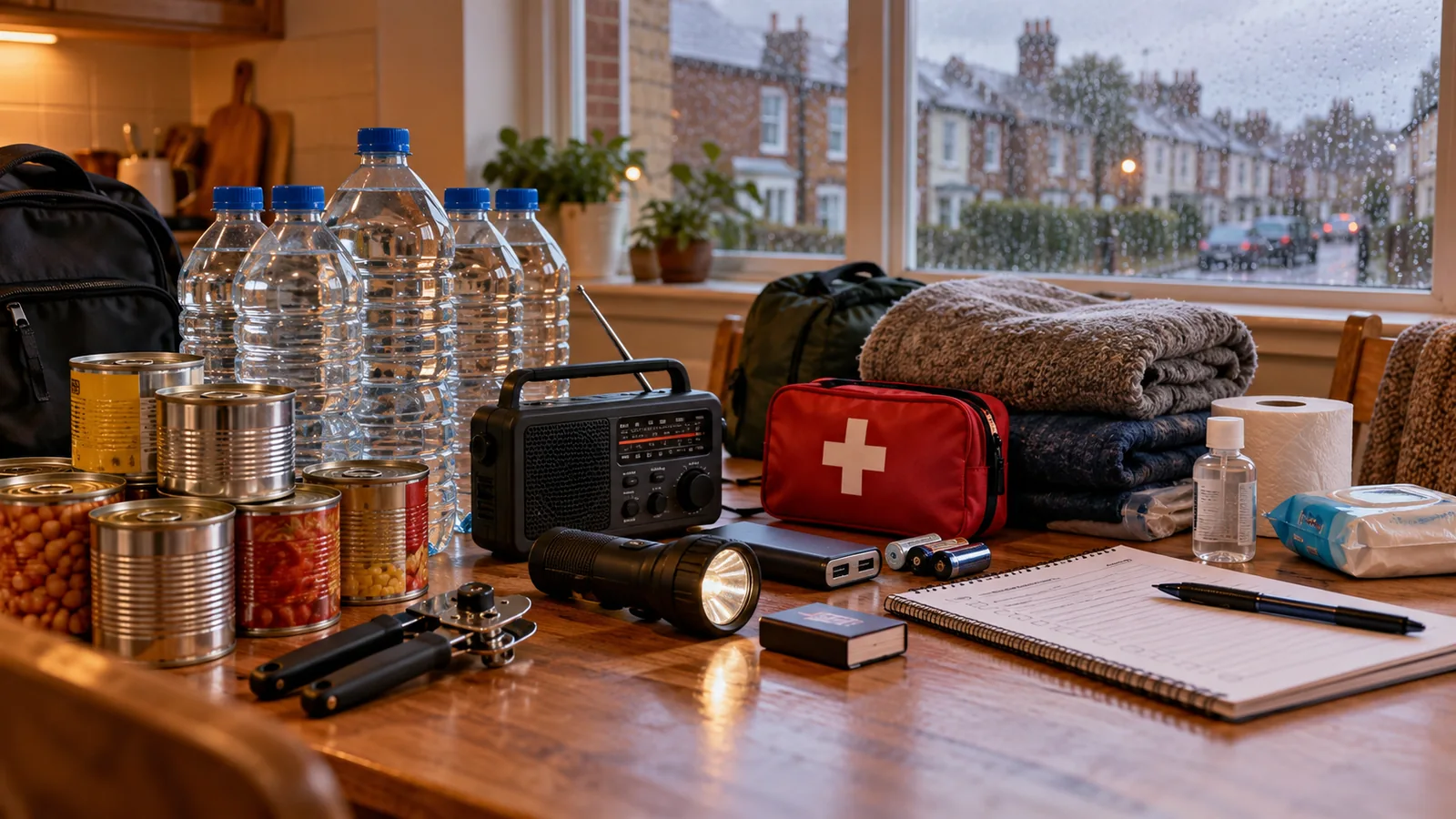
Quick answer: The UK government’s Be Ready campaign, launched on 22 October 2026, asks households to prepare for three days of disruption. Start with bottled drinking water (3 litres per person per day), non-perishable food, light, a radio, phone charging, essential medicines, paper contacts and a plan for vulnerable household members. You do not need to buy everything at once. The official checklist is at Be Ready.
The practical challenge is not finding a shopping list: it is adapting that list to your household, storage space, budget and the type of emergency. This guide provides worked water calculations, a decision table for power, water and communications outages, a low-cost build sequence and a printable checklist you can copy. It distinguishes official advice from our planning examples.
Why the UK launched Be Ready in October 2026
In a statement to Parliament on 22 October 2026, the Cabinet Office said the three-year Be Ready campaign would encourage practical household resilience after storms, wildfires and other disruptions. Government research cited in that statement found 13% felt prepared for a major disruption and 84% wanted more government information. These are government-reported research findings, not Google search volumes. Read the parliamentary statement.
The campaign is not an announcement that a specific attack or nationwide blackout is imminent. It is general preparation for plausible interruptions to electricity, water, phones, internet, transport or payment systems. A three-day kit is a planning baseline, not a guarantee that every incident will end within 72 hours.
The official UK 72-hour emergency kit checklist
| Category | What to keep | Why it matters |
|---|---|---|
| Water | 3 litres per person per day for drinking | Water mains or shops may be unavailable |
| Food | Three days of shelf-stable ready-to-eat foods and manual opener | Cooking and refrigeration may fail |
| Light and warmth | Torch, batteries, blankets, warm clothing | Avoid candles and manage cold rooms |
| Communication | Battery/wind-up FM radio; charged power bank | Mobile and broadband may fail |
| Health | First-aid items, prescribed medicines, equipment instructions | Maintain essential care |
| Hygiene | Hand sanitiser, wet wipes, bathroom essentials | Water supply may stop |
| Money and papers | Some cash, cards, printed contacts and document copies | Electronic payments and internet access may fail |
| Dependants | Baby formula, nappies, pet food and pet water as relevant | Different households have different needs |
This table condenses the government checklist. The government does not prescribe a universal cash amount or a universal food shopping bill. Tailor quantities to dietary needs, mobility, pets, medical devices and available space.
72-hour water calculator: how many litres does your family need?
Official drinking-water baseline: 3 litres × number of people × 3 days = 9 litres per person for a 72-hour period. This calculation covers drinking only. Cooking, washing, hygiene, baby formula, pets and some medical needs require additional water. If a household member has special fluid requirements, follow individual clinical guidance rather than assuming this baseline is sufficient.
| People | Calculation | Drinking water |
|---|---|---|
| 1 | 1 × 3 × 3 | 9 litres |
| 2 | 2 × 3 × 3 | 18 litres |
| 3 | 3 × 3 × 3 | 27 litres |
| 4 | 4 × 3 × 3 | 36 litres |
| 5 | 5 × 3 × 3 | 45 litres |
| 6 | 6 × 3 × 3 | 54 litres |
For example, a four-person household needs 36 litres for drinking, not 36 litres for every possible household task. If the family has six 2-litre bottles, that is 12 litres: it covers one third of the drinking-water target. They would need another 24 litres to reach the 72-hour baseline. These are transparent arithmetic examples, not estimates of how much water a particular household will actually consume.
For a wider resilience margin, the earlier UK Prepare guidance notes that around 10 litres per person per day can provide more comfort when basic cooking and hygiene are included, while actual needs vary. The current Be Ready checklist specifies 3 litres for drinking and explicitly says more is needed for other tasks. Compare the older Prepare guidance.
Food planning: 3 days without a fridge or cooker
Choose foods your household already eats, ideally with long shelf lives and no need for refrigeration, heating or added water. Suitable examples may include canned beans, fish, vegetables and fruit; crackers; nut butter where allergies permit; and dried fruit. Include a manual tin opener for cans without ring pulls. Check dietary restrictions, texture needs, allergies and infant feeding before buying.
Build a simple meal plan before shopping: breakfast, lunch, dinner and snacks for each person for three days. Do not assume that a food item is usable if its preparation requires boiling water, a microwave or an electric hob. Keep drinking water separate from any extra water required for food preparation.
| Situation | Useful adjustment | Avoid assuming |
|---|---|---|
| No electricity | Ready-to-eat shelf-stable meals | Fridge/freezer stays safe indefinitely |
| No running water | Foods needing no washing or rehydration | You can boil water without fuel |
| Infant feeding | Ready-to-feed formula if appropriate | Powdered formula is easy to prepare safely without power |
| Food allergy | Clearly labelled familiar alternatives | Emergency kits are one-size-fits-all |
| Pet at home | Three days of food plus separate water | Human water allowance includes pets |
Power cut plan: what to do before and during an outage
Before an outage, charge power banks, identify battery-powered lights, write down local radio frequencies and know where to find blankets. Store supplies where you can reach them safely in the dark. The official Be Ready power-cut guidance recommends keeping outage reporting numbers on paper: 105 for England, Scotland and Wales, and 03457 643643 in Northern Ireland.
During an outage, use torches rather than candles where possible, preserve phone battery by reducing unnecessary use, and listen to reliable local updates. Never use a portable barbecue, camping stove or fuel-powered generator indoors or in an enclosed space: carbon monoxide can be fatal. Do not use a vehicle engine in a closed garage to charge devices.
If mobile networks, Wi-Fi or card payments fail
An emergency contact list should not exist only on your phone. Print or write names, numbers, addresses, the local meeting point, medical contacts, utility suppliers and insurance details. Agree in advance where family members will meet if they cannot call or message one another. Keep a modest amount of cash based on the essentials your household may need; there is no official universal amount.
A battery or wind-up FM radio offers another route to public updates if broadband or mobile networks stop working. Test the radio, label its batteries and record useful frequencies. Keep a charged power bank with the kit and verify that its cable fits your phone or compatible device.
Medical devices, older relatives, disability and the Priority Services Register
Households relying on electrically powered medical devices should have an individual continuity plan. Ask the device provider or clinical team what happens when power fails, whether backup batteries are suitable and when urgent support is needed. A generic power bank is not necessarily safe or sufficient for medical equipment.
Eligible households should consider the free Priority Services Register or their supplier’s corresponding scheme. It helps utility providers identify customers needing extra assistance during interruptions; it does not promise uninterrupted power or priority restoration for every home. Northern Ireland uses Customer Care Registers. Keep supplier details current and do not rely on registration as your only contingency.
Keep medication lists and doses on paper. Order repeat prescriptions in good time; the Be Ready checklist suggests requesting them up to five working days before needed. Do not stockpile prescription drugs outside medical advice or change doses in anticipation of an outage.
Babies, children and pets: the items generic checklists miss
Infants may need ready-to-feed formula, nappies, wipes, appropriate bottles and feeding supplies. Ready-to-feed formula is especially practical when safe boiling and sterilising cannot be guaranteed. Parents should follow NHS and manufacturer instructions for feeding and storage. Children may also benefit from familiar snacks, a small comfort item and an agreed family communication plan.
For pets, keep food, water, medicines, a lead or carrier, identification and the contact details of a vet. Water for pets is extra: do not subtract it from the drinking-water amount calculated for people. Consider how you would transport animals if officials advise evacuation.
Build a 72-hour kit on a budget without panic buying
The government explicitly says supplies can be gathered gradually. A practical first pass is to inventory what you already own, then fill the gaps in order of importance. This avoids buying expensive duplicate kits or food that nobody will eat.
- First: record contacts, medication details and a household meeting point; these actions can cost nothing.
- Second: set aside bottled drinking water, rotating it before its best-before date.
- Third: build three days of familiar shelf-stable meals and check you have a manual opener.
- Fourth: add or test a torch, radio, batteries and charging options.
- Fifth: cover first aid, hygiene, warmth and any needs specific to babies, disability or pets.
A household does not need a specialist survival subscription or a pre-packed tactical bag. Check existing supplies and prioritise actual vulnerabilities. Do not publish an invented “minimum kit price”: costs vary by retailer, family size, dietary needs and what the household already has.
Home kit versus grab bag: they solve different problems
| Situation | Home supplies | Grab bag |
|---|---|---|
| Shelter at home during outage | Main three-day water and food reserve | Optional small essentials |
| Evacuate after official instruction | Leave bulky supplies if unsafe to carry | Documents, medication, phone, essentials |
| Fire in the home | Do not delay escape to collect supplies | Leave immediately; follow fire-safety guidance |
| Flood warning | Move supplies safely if time permits | Keep essentials ready; obey local instructions |
A home kit is intended for staying safe when services are interrupted. A grab bag helps if you are told to leave. If a fire breaks out, escaping safely matters more than collecting a bag. For flooding or other hazards, follow the relevant emergency services and local authority instructions rather than assuming you should always shelter in place.
Emergency alerts and where to get reliable updates
The UK Emergency Alerts system can warn compatible phones in areas affected by danger to life. Government guidance says location services do not have to be enabled to receive such alerts. Check official alerts and warnings, Met Office weather warnings and any local flood-warning service relevant to your address. During an incident, prioritise current official instructions over generic preparedness articles.
A practical 15-minute household readiness test
Try this low-risk exercise on a normal day, without switching off medical equipment or creating a real hazard: locate your torch without using your phone light; find the paper contact list; confirm the radio works; count your drinking-water bottles; check that your power bank and cable connect; and ask each household member where to meet if phones fail. Record missing items and address them gradually.
This is a suggested household exercise, not a claimed scientific experiment or an official government test. Its purpose is to reveal practical gaps before an emergency.
Printable 72-hour household checklist
- Bottled drinking water: 9 litres per person for three days, plus extra for cooking, hygiene, babies and pets.
- Three days of ready-to-eat food per person and a manual tin opener.
- Torch and batteries; blankets and warm clothing.
- Battery or wind-up FM radio and written frequencies.
- Charged power bank, correct charging cables and any device-specific backups.
- First aid, hygiene supplies, prescribed medication and printed medicine details.
- Cash, cards, printed IDs and key documents stored securely.
- Paper emergency contacts, meeting point, outage-reporting number and insurance information.
- Baby supplies, pet supplies and accessibility or medical equipment plans where relevant.
- Review dates and test equipment periodically.
What this guide adds beyond the news headlines
Coverage of the campaign naturally focuses on the announcement and suggested shopping items. This guide turns the government’s recommendations into household arithmetic, a scenario-based plan, a staged low-cost checklist and explicit safeguards for medical-device users. The water figures are labelled as official baseline versus calculated examples; neither represents a promise that a fixed amount will fit every household.
Bottom line
The UK’s Be Ready campaign is a call for measured, affordable preparation—not panic buying. For most households, the highest-value first steps are a three-day drinking-water baseline, shelf-stable food, reliable light and information, written contacts and an individual plan for people with additional needs. Review your kit periodically and follow official instructions if an emergency actually occurs.
Official sources
You may also like
 How To
UK 72-Hour Emergency Kit: The Official Be Ready Checklist and a Practical Household Plan
A practical UK 72-hour emergency kit guide with water calculations, food, power-cut preparation, and family checklists.
 How To
iCloud Backup Stuck or Taking Too Long? Diagnose Slow Uploads Without Losing Data
iCloud backup stuck for hours? Estimate upload time, check Next Backup Size, fix failed backups, and protect photos…
 How To
Microsoft Account Locked? How to Recover Access Without Losing Data
Locked out of your Microsoft account? Identify the correct recovery route, handle verification problems, and protect Outlook, Windows…