
What Are Peptides? Approved Medicines vs Online Products
Understand peptides, approved medicines and unapproved online products. Check Australian registration, safety warnings and questions to ask your pharmacist.
Contents
- What peptides do—and what the name cannot prove
- Approved medicine and unapproved product are different categories
- Why Australian health authorities are warning people now
- A real example of why the label is not enough
- How to check a peptide medicine in Australia
- 1. Identify the actual product
- 2. Search the official register independently
- 3. Clarify a missing or mismatched result
- 4. Ask about the proposed use and follow-up
- Claims that need more than a screenshot or certificate
- If you already used an unapproved product
- Questions to take to your appointment
- Sources and review date

Peptides are short chains of amino acids. Some are used in established medicines, including insulin, while many products promoted online for recovery, muscle growth or anti-ageing have not been approved for those purposes. The word peptide tells you something about a substance’s chemistry; it does not tell you whether a particular product works, contains what its label claims or is suitable for you.
For people in Australia, the practical starting point is to establish the exact product, its status on the Australian Register of Therapeutic Goods (ARTG), and who is responsible for prescribing and supplying it. A professional-looking website or a prescription alone does not establish that the product has TGA approval.
This guide explains those checks using Australian regulatory guidance reviewed on 29 October 2026. It does not provide injection instructions, doses or a treatment plan. Do not change an established prescribed treatment because of a general warning about a different product.
What peptides do—and what the name cannot prove
The TGA’s peptide overview explains that these amino-acid chains participate in processes such as signalling, metabolism and tissue repair. Manufactured peptide medicines can act on biological pathways, but a plausible mechanism is only the beginning of evaluating a treatment.
Three different questions often get collapsed into one: does a molecule have an effect in a laboratory, does a properly manufactured medicine have acceptable benefits and risks for a specific use, and is the particular item offered to you authentic? Evidence addressing the first question does not automatically answer the other two.
For example, a seller may describe a biological pathway and show an impressive diagram. Before that becomes useful treatment information, you still need to know what was tested, whether the participants were humans, what outcomes were measured and whether the tested formulation matches the product being sold. Those are questions to take to a qualified health professional, rather than gaps to fill with testimonials.
Peptide skin care is another reason to identify the product and its claims precisely. The TGA overview explains that some products limited to cosmetic purposes may be regulated as cosmetics instead of therapeutic goods. An injectable product, a prescription medicine and a cosmetic cream should not be treated as interchangeable simply because all three use the word peptide.
Approved medicine and unapproved product are different categories
The TGA’s regulatory guidance gives insulin, semaglutide, oxytocin, desmopressin and octreotide as examples of peptide-based medicines with approved products. Approval concerns specific products and therapeutic purposes; it is not an endorsement of every vial bearing the same ingredient name.
Unapproved therapeutic goods generally have not been assessed by the TGA for quality, safety and effectiveness. Limited medical access pathways exist in particular circumstances, so “unapproved” and “always illegal in every circumstance” are not interchangeable. Equally, access under an exemption is not the same as the regulator approving a product for general supply.
Many peptide medicines require a prescription. A prescription is a clinical and supply document; ARTG inclusion is a regulatory status. Ask about both, particularly if a clinic presents a product as an experimental or compounded treatment.
The useful question is: “What is this exact product’s regulatory status, and what evidence supports this proposed use for me?” That is more informative than asking whether peptides, as an entire group, are good or bad.
Why Australian health authorities are warning people now
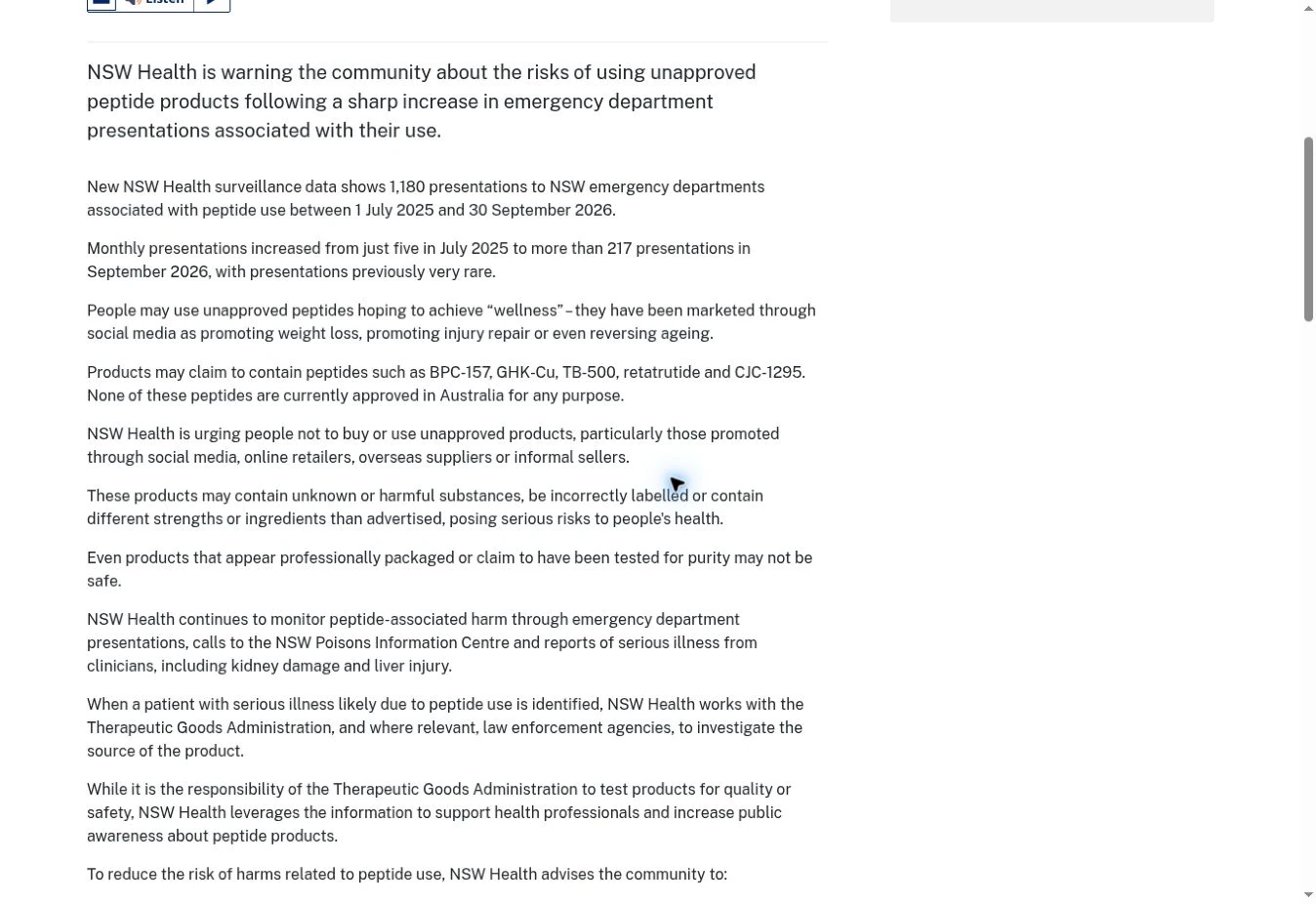
On 19 October 2026, NSW Health reported 1,180 emergency department presentations associated with peptide use between 1 July 2025 and 30 September 2026. The release describes a rise from five monthly presentations in July 2025 to more than 217 in September 2026.
These are recorded presentations, not a count proving that 1,180 different people had a reaction caused by a verified ingredient. The figures also do not supply a denominator for calculating an individual user’s risk. They show why the authorities are investigating and warning the public.
Victoria issued a separate anaphylaxis advisory on 27 October 2026. It reported 13 notifications associated with unapproved peptides since July 2025. That is a different surveillance system and location; adding the Victorian and NSW totals together would create a misleading single figure.
The NSW warning names BPC-157, GHK-Cu, TB-500, retatrutide and CJC-1295 among substances products may claim to contain, and states that none is currently approved in Australia for any purpose. That status should be checked again if you are reading this after the review date.
A real example of why the label is not enough
In a 14 September 2026 safety advisory, the TGA described testing a product sold as retatrutide after a serious adverse event. Its laboratory found semaglutide and no retatrutide in the sample.
That finding illustrates an identity problem, separate from whether a genuine medicine is effective. Reading a study of one ingredient cannot establish the contents of a different, unverified vial. It also does not mean the tested sample represents every product sold under that name.
The advisory says retatrutide was still undergoing human clinical trials and should not be used outside a clinical trial setting. Do not treat online stock availability as evidence of approval or confuse trial participation with buying a product independently.
How to check a peptide medicine in Australia
The official ARTG search accepts a product name, ID or sponsor. Its entries can include formulation, sponsor and manufacturer information, with Product Information and Consumer Medicine Information where available. The following is a practical verification workflow, not a guarantee of authenticity.
1. Identify the actual product
Write down the brand, active ingredient, strength, dosage form and supplier shown on the packaging. Ask the prescriber or pharmacist for the exact product name and ARTG number, if applicable. An abbreviation or a sales nickname may be insufficient to identify a medicine.
For example, “a recovery peptide” is not a product identity. If a seller will not specify what it supplies, that missing information is a reason to pause, rather than a reason to choose the closest-sounding medicine in a database.
2. Search the official register independently
Open the TGA page yourself and search using the supplied details. Compare the result with the actual item; do not rely on a screenshot sent by the seller. A record for another strength or formulation does not settle the status of the product in front of you.
A copied registration number can point to a genuine entry while being printed on an unrelated item. Register checking helps establish regulatory information, but it cannot chemically authenticate a package or replace an accountable pharmacy supply chain.
3. Clarify a missing or mismatched result
If you cannot find a matching entry, ask the pharmacist or prescriber to explain the status and any claimed access pathway. Do not conclude from one unsuccessful search that every legal question is settled. Conversely, do not accept “the clinic is registered” as an answer about a different product’s approval.
Keep the product details and the explanation together. This makes a follow-up conversation much more useful than asking another professional to identify a substance from a vague marketing description.
4. Ask about the proposed use and follow-up
Ask what human evidence supports the intended benefit, what alternatives exist, what monitoring is needed and whom to contact if something goes wrong. A clear answer should concern your proposed treatment, rather than borrowing credibility from an unrelated approved peptide medicine.
These checks are intended to improve a conversation with a qualified professional. They do not turn self-directed purchasing into a supervised clinical treatment.
Claims that need more than a screenshot or certificate
A laboratory purity certificate addresses only what was tested under its stated conditions. It does not, by itself, establish clinical benefit, appropriate use or that the sample matches the item delivered to you. NSW Health also warns that professional packaging and purity claims do not establish safety.
Likewise, “research use only” is not a consumer safety standard. The TGA says such wording does not remove therapeutic-goods obligations. If a product is promoted with personal treatment benefits while the label says it is not intended for people, ask how those statements can be reconciled before taking any further step.
For a broader method of checking supporting documents, see our guide to spotting fake QR codes and checking the actual destination. A code linking to a polished certificate page still needs independent verification.
If you already used an unapproved product
Tell your treating health professional what you used, when, how it was labelled and where it came from. Bring the packaging or photographs if available. NSW Health advises people using an unprescribed peptide product to seek professional advice before the next dose.
In Australia, call 000 for difficulty breathing, collapse or other signs of anaphylaxis. Victoria’s advisory warns that severe reactions can occur even after earlier doses without a reaction. Do not delay urgent care to investigate a seller or because you are worried about explaining how you obtained the product.
For unexpected symptoms that are not an immediate emergency, seek medical advice promptly. Reporting an adverse event to the TGA can help surveillance, but an online report is not a substitute for care. Outside Australia, use your local emergency service and medicines regulator.
Questions to take to your appointment
- What exact product and formulation are being proposed?
- Is it included in the ARTG, and for what purpose?
- If it is unapproved, what access pathway applies, and why is it being considered?
- What evidence in humans supports the proposed benefit?
- What approved alternatives, monitoring and follow-up are available?
You do not need to become a pharmacologist to ask these questions. Their purpose is to connect a health claim to a named product, a responsible professional and evidence that applies to your situation.
Sources and review date
Reviewed 29 October 2026. This is a consumer explainer grounded in Australian public guidance, not an individual medical assessment. The cover is a conceptual representation of a chain, not a molecular measurement or a photograph of a treatment. The embedded NSW image is an actual public-page screenshot.
You may also like
 Health & Safety
Bomberry Recall: Affected Products, Dates and Refunds
Check the Bomberry 150g recall, affected flavours and best-before dates. Follow retailer-return or manufacturer email refund instructions in…
 Health & Safety
Miyoko’s Butter Recall 2026: Affected Lot Codes, Best-By Dates and Refunds
Check the Miyoko’s butter recall by product, UPC, lot code and best-by date. Compare salted and unsalted notices…
 Health & Safety
Kayem Foods Recall 2026: Check Hot Dogs, Bacon, UPC Codes and What to Do
Kayem Foods recalled 1.58 million pounds of ready-to-eat meats. Check the USDA UPC list, establishment numbers, affected products…