
Kayem Foods Recall 2026: Check Hot Dogs, Bacon, UPC Codes and What to Do
Kayem Foods recalled 1.58 million pounds of ready-to-eat meats. Check the USDA UPC list, establishment numbers, affected products and what to do next.
Contents
- Kayem Foods recall 2026: the facts at a glance
- How to check whether your hot dogs, bacon or sausage are recalled
- What each package code tells you
- Which brands and meat types should shoppers check?
- Why were the products recalled?
- What does a Class I recall mean?
- What to do if you already bought or ate an affected product
- If it is still in your fridge or freezer
- If you already ate it
- Where were the recalled products sold?
- How to get the full UPC and product-label list
- Three mistakes to avoid when checking a recall
- Official sources and updates
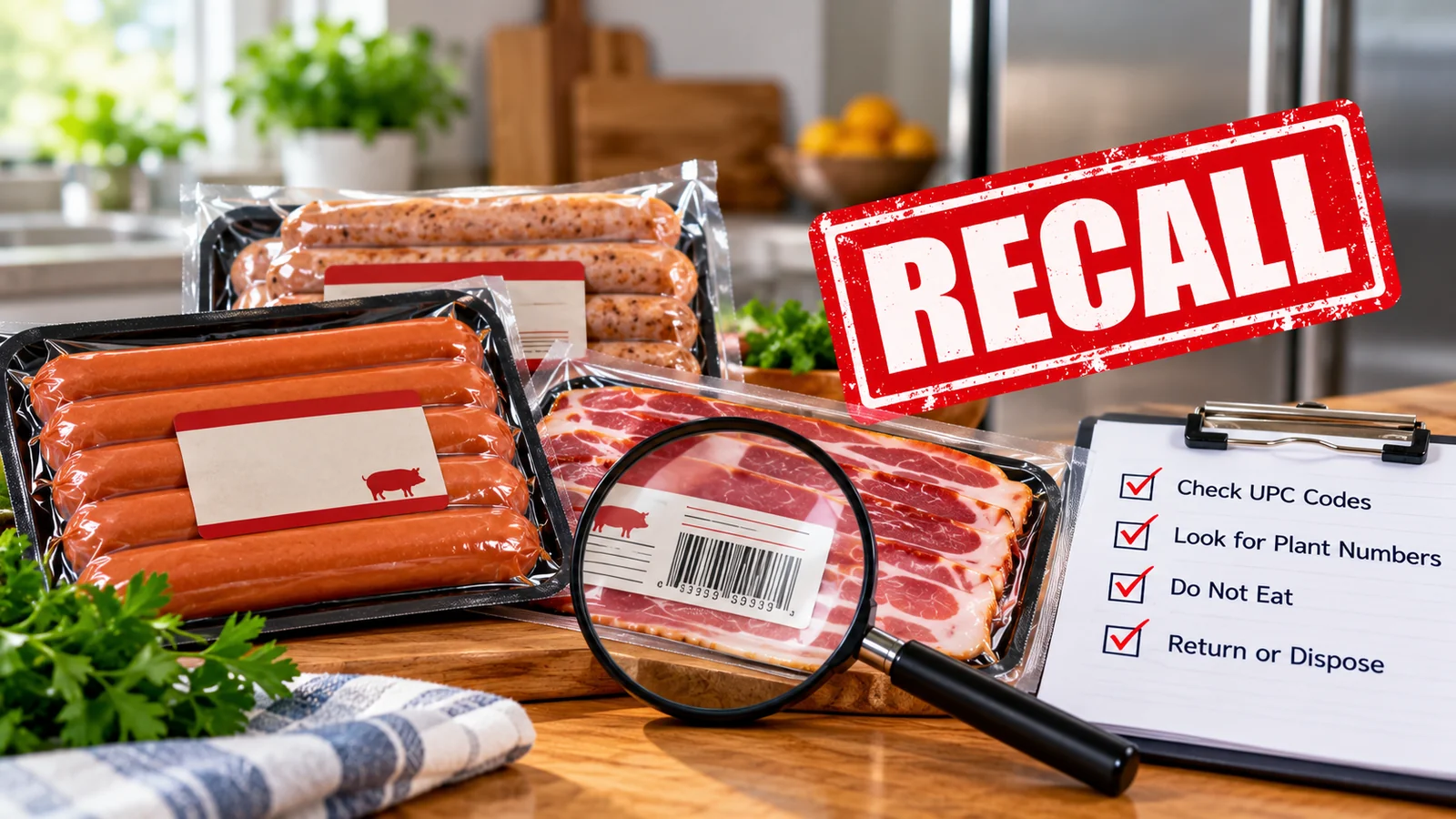
Updated October 20, 2026. The U.S. Department of Agriculture announced a Class I recall of approximately 1,584,361 pounds of Kayem Foods ready-to-eat meat and poultry products on October 17, 2026, because of possible unsafe storage temperatures. The recall includes certain hot dogs, sausages, bacon, ham and other cooked meats. Do not eat a recalled product, even if it looks or smells normal. Check its exact brand, description, UPC and lot details against the official product list, then return it or throw it away. Read the USDA FSIS recall notice (026-2026).
Kayem Foods recall 2026: the facts at a glance
| Item | Confirmed information |
|---|---|
| Recall announcement | October 17, 2026 (USDA FSIS) |
| Recall reference | 026-2026; Class I (high health risk) |
| Quantity | Approximately 1,584,361 pounds |
| Product type | Ready-to-eat meat and poultry products |
| Approximate production dates | March 31–October 7, 2026 |
| Establishment marks | EST. M/P 7839; EST. P 20935A; EST. M 9520 |
| Distribution | U.S. retail and foodservice locations nationwide; also Hong Kong |
| Confirmed illnesses at announcement | None reported to FSIS as of October 17 |
The dates above are not a substitute for matching your package. The USDA notice links to product labels and a product/UPC list, which should be treated as the authoritative, potentially updated reference. The company also has its own recall information page.
How to check whether your hot dogs, bacon or sausage are recalled
- Set the package aside. Do not taste it while checking. Keep it away from ready-to-eat foods to avoid cross-contamination.
- Find the brand and complete product name. “Kayem” is not the only brand involved; do not assume every product sold by a brand is affected.
- Look for the USDA inspection mark. The notice lists EST. M/P 7839, EST. P 20935A and EST. M 9520. These are useful screening identifiers, not a complete match on their own.
- Read the UPC, lot code, size and any date information. Compare all available identifiers with the USDA product list and label images.
- Confirm against the latest official notice. If you cannot resolve an uncertain match, contact the manufacturer or retailer and avoid eating the product in the meantime.
- If the product is affected, do not consume it. Return it to the store or dispose of it following local waste rules. Wash hands and clean any surfaces contaminated by leaking packaging.
What each package code tells you
| Code or label | How to use it | Important limitation |
|---|---|---|
| Establishment number | Screen for the USDA-inspected plant identifiers listed in the recall | A matching establishment number alone does not establish that every item from the plant is recalled |
| UPC / barcode number | Compare the precise retail product identifier against the linked official list | Similar packaging can have a different UPC |
| Lot / batch code | Check whether a particular production or distribution batch is listed | Codes may appear in different locations by package |
| Product name and weight | Distinguish variants, flavors and pack sizes | Generic category labels such as “hot dogs” are not enough |
| Sell-by / use-by date | Cross-check when a specific affected product entry provides dates | Do not infer safety from a future date |
Example, not an actual recalled UPC: Suppose a shopper finds a package of chicken sausage with an establishment number shown in the USDA notice. That is a reason to investigate, not proof that this particular flavor and package size is on the recall list. The shopper must still compare its full name, UPC and any listed lot or date. Conversely, a product sold under a different brand can be affected if it appears in the official list.
Which brands and meat types should shoppers check?
The recall spans multiple brand labels and a broad assortment of cooked meat and poultry products. News coverage identifies examples including Kayem, Al Fresco, Deutschmacher, Essem, Jordan’s, McKenzie and Triple M. For the complete and current list, use the USDA product-label and UPC attachments rather than relying on a shortened article list. Open the official recall and its attachments.
- Hot dogs, franks and other cooked sausages.
- Chicken sausages and breakfast sausages.
- Bacon and various ham products.
- Selected turkey and other ready-to-eat deli or prepared meats.
These categories describe types mentioned in reporting, not an assertion that every product of that type or brand is recalled. A precise match to the official product identifiers is essential.
Why were the products recalled?
According to FSIS, Kayem received a retail-customer complaint on October 1 about products arriving at warm temperatures. The company investigated and found that a warehouse cooler had experienced temperature deviations while storing various ready-to-eat meat and poultry products. This is a possible temperature-abuse recall, not an announcement that a specific pathogen was confirmed in every package. USDA FSIS statement.
Ready-to-eat products can be consumed without another cooking step. Inadequate temperature control can allow microorganisms to grow, so the agency recommends that recalled products not be eaten. Reheating, freezing or checking for an unusual odor is not a reliable way to reverse the recall or certify that a product is safe.
What does a Class I recall mean?
USDA FSIS designated this a Class I recall, health risk high. That classification means there is a reasonable probability that using the product will cause serious adverse health consequences or death. It is a risk classification; it does not mean every package contains dangerous bacteria or that illness has already occurred. The October 17 notice reported no confirmed illnesses linked to these products at that time. Check subsequent official updates before repeating that status as current.
What to do if you already bought or ate an affected product
If it is still in your fridge or freezer
- Do not eat or serve the recalled item.
- Photograph the package identifiers if you need them for a return or a manufacturer inquiry.
- Return the item to the place of purchase or discard it.
- If packaging leaked, clean affected refrigerator shelves and utensils using appropriate food-safe cleaning guidance.
If you already ate it
Do not panic or assume illness is inevitable. Monitor for symptoms such as vomiting, diarrhea, abdominal cramps or fever. Seek medical advice promptly if symptoms are severe or persistent, if you cannot keep fluids down, or if you are pregnant, older, immunocompromised or caring for a young child. Bloody diarrhea, signs of dehydration, confusion or other serious symptoms warrant urgent assessment. Tell the clinician the product name, when it was eaten and that it may be part of USDA recall 026-2026. FSIS specifically advises anyone concerned about illness to contact a healthcare provider.
There is no evidence in the announcement that eating an affected product necessarily causes illness. Do not take antibiotics or other medication solely because of the recall without a clinician’s advice.
Where were the recalled products sold?
FSIS reports shipments to retail and foodservice locations nationwide in the United States and to Hong Kong. This is a distribution statement, not a verified list of every individual store. Do not assume that a retailer sold a specific recalled SKU unless the product or store notice confirms it. For people outside these markets, an imported product should still be checked against the same identifiers if there is a plausible match.
How to get the full UPC and product-label list
- Open the official FSIS recall bulletin.
- Find the links labeled Recall 026-2026 product labels and the list of products and UPC code numbers.
- Use your browser’s find function or search the downloaded document for the exact product name or UPC.
- Compare the package size, lot/date information and establishment mark with the official entry.
- If information is missing or confusing, contact Kayem Foods or the seller before consuming the product.
Kayem lists consumer support at 800-426-6100 and info@kayem.com on its recall announcement, with published phone hours Monday–Friday, 7:30 a.m.–4 p.m. Eastern. Contact details and recall documents may change; confirm them on the official page.
Three mistakes to avoid when checking a recall
- Assuming a brand name alone is decisive: the recall covers particular products, not necessarily all products sold under the same brand.
- Using only a production date: dates provide context but are not a replacement for the product/UPC list and any lot details.
- Believing cooking or freezing cancels the recall: USDA says not to consume the recalled items; follow that instruction rather than experimenting with food-safety workarounds.
Official sources and updates
- USDA FSIS: Kayem Foods recall 026-2026 (October 17, 2026) — primary recall notice, establishment identifiers and links to affected product lists.
- Kayem Foods: voluntary recall announcement (October 16, 2026) — manufacturer explanation and customer-service contact.
Bottom line: The safest way to decide whether a package is involved is to compare its complete product identity against the current USDA list. Do not eat an affected item. This article summarizes information available October 20, 2026 and is not a substitute for updates to the government notice.
You may also like
 Health & Safety
Bomberry Recall: Affected Products, Dates and Refunds
Check the Bomberry 150g recall, affected flavours and best-before dates. Follow retailer-return or manufacturer email refund instructions in…
 Health & Safety
What Are Peptides? Approved Medicines vs Online Products
Understand peptides, approved medicines and unapproved online products. Check Australian registration, safety warnings and questions to ask your…
 Health & Safety
Miyoko’s Butter Recall 2026: Affected Lot Codes, Best-By Dates and Refunds
Check the Miyoko’s butter recall by product, UPC, lot code and best-by date. Compare salted and unsalted notices…