
Grey Aliens: Where Did the Big-Eyed Greys Story Begin?
A documented investigation into the origin of Grey alien imagery, the Hill encounter and the difference between historical records and extraterrestrial evidence.
Contents
- What do people mean by “Grey aliens”?
- The 1961 Hill encounter: what happened first?
- A timeline: how the modern Grey took shape
- The archive test: what survives from the Hill case?
- Where does the classic big-eyed face come from?
- Does the Betty Hill star map prove the visitors came from Zeta Reticuli?
- Why “missing time” and hypnotic memories need special care
- A practical evidence checklist for viral “Grey alien” photographs
- What do official UFO investigations actually say?
- Greys, Anunnaki and reptilians: three different kinds of claim
- What would genuine evidence of a new intelligent species look like?
- Frequently asked questions
- Are Grey aliens scientifically proven?
- Did Betty and Barney Hill draw the first Grey?
- Does the university archive prove the abduction happened?
- Were the Greys in Roswell?
- Primary sources and further reading
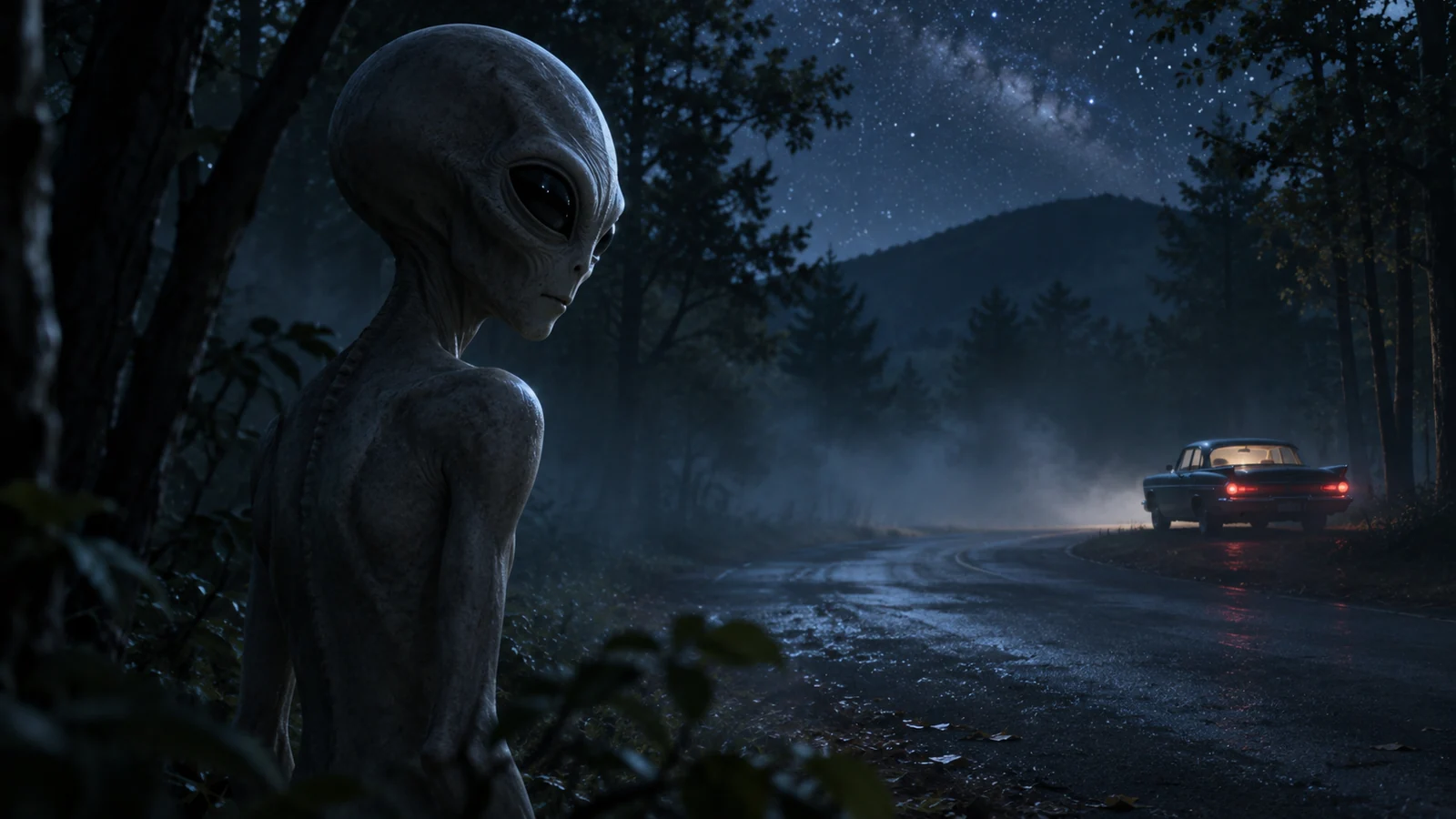
Quick answer: The Greys are the familiar alleged extraterrestrials with large heads, dark almond-shaped eyes, small noses and slim grey bodies. They are a recognizable character type in modern UFO testimony and popular culture, not a scientifically confirmed species. The 1961 Betty and Barney Hill case helped establish the modern abduction narrative, but the details most associated with it emerged through later accounts and hypnosis sessions. Neither an archival drawing nor a government UFO file verifies that the beings exist.
The more interesting question is not simply “Are Greys real?” It is how a particular face became the default image of an alien. Answering it takes us from a late-night road journey in New Hampshire to psychiatric interviews, preserved letters and artwork, popular television, and research into the limits of memory.
What do people mean by “Grey aliens”?
“Greys” or “Grays” is an informal label used in UFO communities for purported beings portrayed as short, smooth-skinned, large-headed and dark-eyed. Some accounts describe tiny mouths, narrow torsos and three or four fingers. There is no standardized biological description: witnesses, illustrators, books and films have varied the features, color and height. Treating every image as a photograph of one species confuses a recurring cultural motif with a specimen that science has examined.
A resemblance is not an identification. A toy, a book cover, a witness reconstruction, an archival artwork, and an alleged encounter video have different origins and evidentiary value. We will keep those categories separate throughout this article.
The 1961 Hill encounter: what happened first?
On the night of September 19–20, 1961, Betty and Barney Hill, a married couple from Portsmouth, New Hampshire, were returning through the White Mountains after a trip. They reported seeing an unusual light that seemed to follow their car; Barney said he inspected a strange object through binoculars. They later associated the journey with an unexplained gap in time. These are their reported experiences, not independently verified extraterrestrial actions. The Library of Congress teaching analysis and University of New Hampshire archive overview provide source-based historical context.

Geographic context, not encounter evidence: this scenic photograph illustrates the White Mountains / Franconia Notch area associated with the story. It is not a contemporaneous image of the 1961 drive. See the Library of Congress collection record and Carol M. Highsmith rights notice.
It matters that the initial account did not emerge as the polished story routinely retold online. Betty later described disturbing dreams, and the couple received psychological treatment. In 1964 psychiatrist Benjamin Simon used hypnosis in therapy; more elaborate memories of apparent captivity, examinations and beings were discussed. The dates mark a crucial change in the nature of the testimony. Many viral retellings collapse 1961, 1964 and the later publicity into a single evening.
The Hills also had lives beyond UFO culture. They were civil-rights advocates and an interracial couple living at a time of major social tension. That history deserves attention without making speculative psychological explanations for what either person experienced. The Portsmouth Historical Society 2026 exhibition centers their community work as well as the famous claim.
A timeline: how the modern Grey took shape
| September 1961 | Hills report a strange aerial encounter on the drive | An account and sighting claim; not proof of visitors |
|---|---|---|
| 1964 | Psychiatric hypnosis sessions and recalled abduction narrative | A later record of experiences; recall is not independent verification |
| 1965–1966 | Press coverage and John G. Fuller’s 1966 book The Interrupted Journey | Mass circulation of the story |
| 1967 | Artist David G. Baker makes an alien image commissioned from descriptions | Archival illustration, not a photograph |
| 1975–1977 | The UFO Incident and Close Encounters of the Third Kind reach broad audiences | Visual vocabulary enters entertainment |
| 1980s onward | Abduction literature and memorable Grey-themed cover images circulate | A recognizable standard image develops |
Two particularly useful checks are the UNH archival description of the 1967 David G. Baker painting and PBS Monstrum history of Grey imagery. The archived painting is dated to 1967, several years after the alleged incident. Confusing that date with a contemporary portrait of a visitor is an avoidable error.
The archive test: what survives from the Hill case?
The University of New Hampshire holds the Betty and Barney Hill Papers (MC 197): notebooks, correspondence, press material, photographs, star charts, the dress that Betty associated with the incident, and commissioned sculptural or painted depictions. The official access and licensing page explains the holdings and directs requests for image reuse to the university. Rice University also catalogs the Kathleen Marden papers concerning the case.
An archived object proves that an item existed and was preserved. It does not automatically confirm the explanation later attached to it. A photograph of a drawing proves that someone made the drawing. A preserved dress proves an item of clothing exists and can be studied; marks on fabric by themselves cannot establish who or what caused them. A report that authorities received a claim is different from a report validating the claim.
Where does the classic big-eyed face come from?
The Hill accounts are a central influence, but a precise “first Grey ever drawn” claim is hard to substantiate. Descriptions differed in the early material and the iconic all-black almond eyes became more standardized over years of repeated visual media. PBS traces a line through the 1975 television film The UFO Incident and Spielberg’s 1977 Close Encounters of the Third Kind. A TV series or poster can popularize a face without serving as evidence for the being depicted.
Science fiction and UFO accounts influenced one another. The Paley Center records the broadcast of The Outer Limits episode The Bellero Shield on February 10, 1964, a date cited in debates about overlapping imagery. That overlap is worth considering, but it does not prove that a specific witness consciously copied a specific episode. A careful explanation distinguishes a documented broadcast date from a disputed causal hypothesis. Source: Paley Center episode catalog.
A famous later step was Communion, Whitley Strieber’s 1987 book, whose large-eyed cover helped spread a now-instantly recognizable alien face. That cover is published artwork, not a documentary image. We link to archival or rights-holder sources rather than inserting book art copied from a commercial site.
Does the Betty Hill star map prove the visitors came from Zeta Reticuli?
Betty’s remembered star chart is part of the documented story. Later enthusiasts proposed that its pattern might correspond to real stars, including Zeta Reticuli. But matching a few points in a drawing to stars depends on choices of orientation, perspective, distance, which stars to include and how to interpret the lines. A claimed match does not independently establish that the original drawing was a navigation map, still less that a vessel visited Earth.
The UNH collection entry for Betty Hill’s Star Chart preserves the paper-trail of the claim and later work by Marjorie Fish. Read its existence as a historical source about what people believed and modeled—not as a proven astronomical itinerary.
Why “missing time” and hypnotic memories need special care
Remembering a frightening event feels compelling, but the vividness of a memory and the sincerity of the narrator are not tests of its historical accuracy. The American Medical Association’s 1985 Council on Scientific Affairs review concluded that memory reports obtained under hypnosis can include confabulations and pseudomemories and can be less reliable than ordinary recall. The important distinction is between a real subjective experience and independent verification of its proposed cause. See the JAMA review indexed by PubMed and peer-reviewed history of hypnotically related false memories.
Sleep disturbance, sleep paralysis, anxiety, dreams, storytelling and suggestion are researched as possible contributors to some encounter narratives. None of those explanations should be declared the diagnosis of Betty, Barney or an individual stranger without sufficient evidence. Conversely, the absence of an explanation for one person’s memory does not establish a visitor from another planet.
A practical evidence checklist for viral “Grey alien” photographs
- Identify the earliest source: who first uploaded the image, and on what date? A repost is not an origin.
- Separate artwork from documentary media: sketches, film stills, masks and digital composites may look like photography.
- Look for an object trail: original negative, accession number, provenance, camera metadata or a named archive.
- Compare the claim with the actual document: a declassified UFO file may record a report without confirming its content.
- Seek independent corroboration: multiple copies of one source are not multiple witnesses.
- Allow uncertainty: “unidentified” means the available evidence did not identify the object, not “extraterrestrial.”
What do official UFO investigations actually say?
UAP is a broad administrative term for unidentified anomalous phenomena. The U.S. Department of Defense said in its March 8, 2024 summary of AARO’s historical review that it had found no verifiable evidence that investigated sightings represented extraterrestrial activity or that U.S. authorities held extraterrestrial technology. That is an official assessment with a defined investigative scope; it is not a philosophical demonstration that life cannot exist anywhere else. Read the DoD report summary and the AARO resource hub.
The Hill story therefore should not be promoted as a proven recovery of Grey extraterrestrials. Nor should an unresolved sky observation be treated as worthless: observations can inspire legitimate investigation, provided we preserve what was recorded, when it was recorded and what remains unverified.
Greys, Anunnaki and reptilians: three different kinds of claim
The modern Greys narrative grows from 20th-century encounter accounts and entertainment. The Anunnaki are documented divine figures in ancient Mesopotamian texts, later reframed by speculative writers as aliens. Reptilian-humanoid stories blend modern conspiracy narratives with much older symbolism. Similarity in online videos is not evidence that the terms identify one race, event or civilization. For primary-text context see our Anunnaki, Nibiru and alien-myth investigation; for a different evidence method see the proposed search for technosignatures in lunar dust.
What would genuine evidence of a new intelligent species look like?
A scientifically robust case would need an authentic object or reproducible signal, documented collection conditions, secure custody, independent analysis and findings published so other researchers could attempt to reproduce them. A drawing of a face and testimony under hypnosis can be important cultural or psychological evidence, but neither meets those standards for confirming an extraterrestrial species.
Bottom line: The Greys are unquestionably real as a hugely influential image in modern folklore and entertainment. Their existence as biological visitors to Earth remains unverified. The Hill case is worth reading precisely because its archives show the stages by which a strange report became a cultural icon.
Frequently asked questions
Are Grey aliens scientifically proven?
No. There is no publicly verified physical or biological evidence confirming Grey aliens as a species or as visitors to Earth. This does not answer every question about life elsewhere in the universe.
Did Betty and Barney Hill draw the first Grey?
Their case strongly influenced the modern Grey image, but a unique first drawing cannot be established from the sources reviewed. Some widely circulated images were commissioned years after the reported 1961 encounter.
Does the university archive prove the abduction happened?
No. The archive preserves contemporaneous and later records of the reported experience. Custody and authenticity of papers should not be confused with validation of the extraordinary interpretation.
Were the Greys in Roswell?
Accounts connecting Grey bodies to the 1947 Roswell incident are claims. They do not turn the existence of the Greys into a verified historical fact.
Primary sources and further reading
- University of New Hampshire — Hill papers: holdings, access and image licensing
- UNH archival object guide, including 1967 alien painting and 1964 star chart
- Library of Congress — scientific-literacy case study
- Portsmouth Historical Society — Betty and Barney exhibition (2026)
- Rice University — Kathleen Marden papers finding aid
- JAMA/PubMed — hypnosis and memory reliability
- U.S. Department of Defense — AARO historical review summary
- PBS — why the Greys became iconic
You may also like
 History & Civilizations
Buto Discovery: How Radar and Excavation Revealed a Buried Saite Building
At ancient Buto in Egypt, satellite radar, electrical surveys and excavation reveal a buried Saite-era mudbrick structure. See…
 History & Civilizations
Ubaid Lizard Figurines: What the Reptilian Heads Really Show
Examine real Ubaid figurines with British Museum and Penn Museum records, original photos, a nursing mother’s missing head,…
 History & Civilizations
How Do Archaeologists Date Ancient Artifacts? Radiocarbon, Layers, Pottery and the Limits of Scientific Dating
How do archaeologists date ancient artifacts? Compare carbon-14, stratigraphy, tree rings and pottery dating with practical examples and…