
Could Moon Dust Hold Traces of Alien Technology? What Scientists Propose—and Haven’t Found
A lunar technosignature proposal explained: what scientists could search for, why unusual grains are not proof of aliens, and how contamination and null results matter.
Contents
- What is actually new about the Moon-dust proposal?
- What would a microscopic technosignature be?
- Why search the Moon instead of Earth?
- The journey is a chain of conditions, not one assumption
- Why does one cubic meter appear in the discussion?
- What would make a candidate worth taking seriously?
- Can AI find alien particles?
- What would finding nothing tell us?
- How this differs from UFO reports and biological discoveries
- A quick guide to reading the next headline
- Sources and research status

Scientists have proposed searching Moon dust for microscopic traces of alien technology. They have not found any. The idea is to investigate whether tiny manufactured particles from other civilizations could survive space travel and become preserved among ordinary lunar grains. Its appeal is that a physical trace might remain long after a civilization stopped transmitting.
The work is a research proposal with a quantitative model, not an announcement of extraterrestrial material. As checked on October 26, 2026, the public research record identifies a preprint, first submitted to arXiv on June 23 and last revised on August 18. The SETI Institute publicized it on September 8. No confirmed journal acceptance was established in this review.
What is actually new about the Moon-dust proposal?
Lewis J. Pinault, Brian C. Lacki, Ian A. Crawford and Andrew P. V. Siemion examine a particular possibility: very small engineered particles reaching the lunar surface. Their framework joins transport, survival, deposition and detection questions. The SETI announcement describes a proposed investigation, not a completed search yielding a discovery.
The distinction is important because a scientific proposal can be valuable without establishing that its hypothetical target exists. A detector design does not prove the presence of what it is designed to detect. Likewise, a route by which a grain might arrive is not evidence that an alien civilization produced one.
| What the sources support | What they do not establish |
|---|---|
| A model for searching lunar regolith for microscopic engineered material | That extraterrestrial engineered material has been recovered |
| A preprint and institutional announcements | A confirmed final journal publication in the sources checked |
| Testable questions about transport and detection | A measured probability that aliens exist |
| Potential future sample analysis | A guaranteed discovery date or a confirmed mission dedicated to this search |
What would a microscopic technosignature be?
A technosignature is a possible indicator of technology. In this case, the proposed target is a material particle, rather than a radio transmission or a distant atmospheric gas. “Microscopic” is a statement about scale. It does not mean the particle must be a functioning robot, a miniature computer or an intentional message.
Three different claims must remain separate: a grain is unusual, a grain was manufactured, and a manufactured grain originated beyond Earth. The first can motivate investigation. It does not automatically establish either of the others.
For example, an angular or repeating feature might initially look interesting. The next question would be whether mineral growth, fracture, melting, an instrument artifact or terrestrial contamination could explain it. Calling it artificial before those checks would turn a screening observation into a conclusion it cannot support.
Why search the Moon instead of Earth?
The proposal treats lunar material as a long-duration collection surface. The Moon does not have Earth’s combination of rainfall, oceans and biological activity constantly altering exposed material. That makes it an appealing place to investigate ancient records. The UCL research announcement explains the motivation for examining preserved particles in lunar soil.
But “archive” must not be read as “untouched.” Impacts, radiation and surface mixing complicate preservation. Research indexed by NASA’s Technical Reports Server discusses weathering processes capable of altering regolith. A useful archive can contain damaged, redistributed or ambiguous evidence.
This creates a selection problem. Material that once reached the Moon may no longer retain a feature that identifies its origin. Conversely, a striking surviving feature might owe its appearance to lunar processing. A serious investigation needs to address both possibilities.
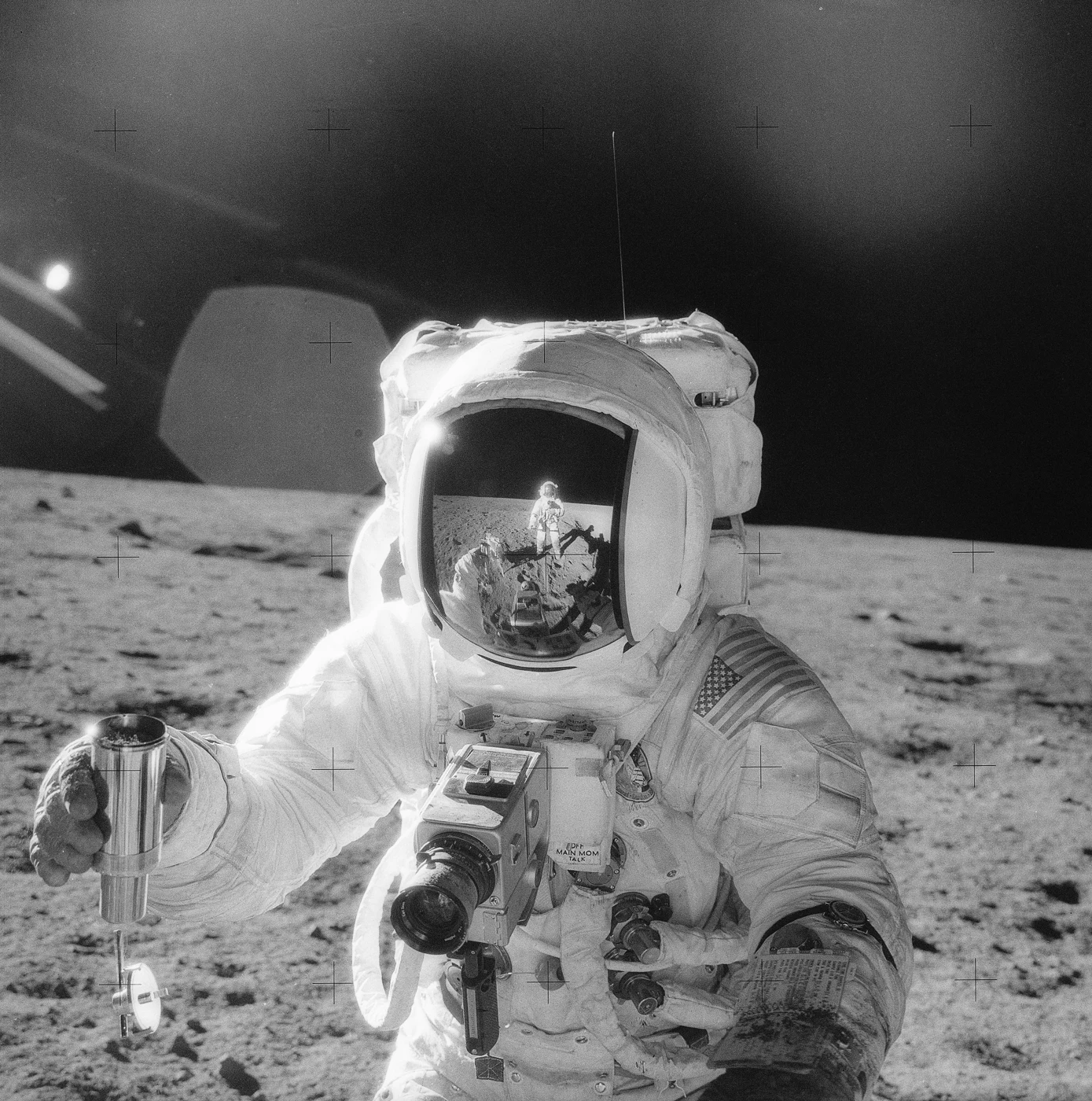
This real NASA Apollo 12 photograph shows lunar-soil collection in 1969. It illustrates actual sample work, not the recovery of alien material. Historic mission photographs should never be presented as images of the hypothetical particles discussed here.
The journey is a chain of conditions, not one assumption
To connect an imagined civilization with a grain in a laboratory, several things must happen. Material must be produced and released, survive transport, reach the relevant region, arrive without losing every diagnostic property, persist through lunar processing, enter the collected sample and be recognized during analysis.
This chain explains why a search result depends on more than the number of civilizations. A universe containing technological life would not necessarily supply the particular durable particles that a particular lunar experiment can detect.
| Stage | Question a search must address |
|---|---|
| Production | Would a civilization make this kind of material? |
| Release | Would any of it escape into space? |
| Transport | Could it survive and reach the Solar System? |
| Arrival and preservation | Would recognizable features survive deposition and later processing? |
| Sampling | Would the selected location and volume include it? |
| Identification | Could the instruments distinguish it from natural grains and contamination? |
Why does one cubic meter appear in the discussion?
The authors use a reference volume of lunar regolith to explore what a search might constrain. A cubic meter is a volume, equivalent to 1,000 liters. It is not the assertion that a container of that size must contain an alien object. Nor does an easily described sample volume imply an easy laboratory workload.
What matters is the effective material actually examined at the required sensitivity. A bulk sample can be large while the portion inspected at high resolution is small. A credible report would need to distinguish collected material, prepared material, screened material and fully characterized candidate grains.
There is also no reason to assume every location represents the whole Moon equally. Sampling context affects what a result means. Any comparison between two studies should ask whether they examined similar material with comparable preparation, instruments and identification criteria.
What would make a candidate worth taking seriously?
The following checklist is an editorial aid to assessing a future claim, not an assertion that a candidate has passed these tests. The key is to require several lines of evidence instead of one arresting photograph.
- Documented origin: Where was the sample collected, and how was it stored and transferred?
- Reproducible observation: Can the feature be observed again, preferably with a different instrument or method?
- Natural explanations: Have relevant minerals, impact products and preparation artifacts been investigated?
- Contamination controls: Could collection equipment, spacecraft, laboratory tools or handling introduce a similar particle?
- Evidence of manufacture: What specific measurement supports engineering rather than visual resemblance?
- Evidence of non-Earth origin: How is that conclusion distinguished from ordinary human-made debris?
- Independent scrutiny: Can other qualified researchers examine the evidence and challenge the interpretation?
A candidate may be scientifically interesting even if it ultimately proves natural. The important standard is that the explanation improves as more measurements arrive. A label such as “anomaly” should remain a description of an unresolved observation, not a substitute for a demonstrated origin.
Can AI find alien particles?
Machine-assisted analysis can help organize a large search by ranking images or flagging features for further inspection. In this setting, an AI output would be a screening result. It would not establish that a civilization made the object.
Consider a hypothetical classifier that marks rare-looking grains. To understand its output, researchers would need to know what examples it learned from, what natural materials were missing from training, how often ordinary grains are flagged and whether the same feature remains when imaging conditions change.
That is why the useful question is not “Did the AI call it alien?” It is “What measurement made it interesting, and what independent analysis followed?” A dramatic confidence score cannot replace material identification or a contamination history.
What would finding nothing tell us?
A null result could constrain a specified model if the experiment’s sampling and detection performance were well characterized. It would not settle the existence of extraterrestrial intelligence. The conclusion must remain attached to the kind of material and delivery history the experiment can test.
Imagine a detector sensitive to durable particles with a recognizable feature. Failure to detect those particles would say less about civilizations that never produced them, material destroyed before arrival, or traces outside the sampled locations. This is a logical limitation of the search design, not a claim that any of those alternatives actually occurred.
Similarly, a positive screening result would require follow-up. Finding one unexplained grain does not let an experiment skip from uncertainty to confirmation. Positive and negative results both need carefully stated boundaries.
How this differs from UFO reports and biological discoveries
This proposal concerns microscopic material and laboratory analysis. It is not evidence about an unexplained object in the sky, an alleged visitation or a recovered spacecraft. Those are different observations with different evidential requirements.
It is also distinct from finding organic molecules. “Organic” describes a category of carbon chemistry and is not interchangeable with “biological,” while “engineered” concerns manufacture. An article that moves between these words without explaining the transition risks claiming more than its evidence shows.
For a different question about biology and space, see whether tardigrades can survive in space. Studying Earth organisms under space conditions is distinct from establishing that life originated elsewhere.
A quick guide to reading the next headline
| If a headline says… | Ask… |
|---|---|
| Scientists will search for alien technology | Is this a proposal, funded experiment or completed analysis? |
| A strange grain was discovered | What was measured, and which ordinary explanations remain? |
| AI identified a candidate | What independent laboratory tests followed? |
| No alien material was found | What sample and material classes could the search actually exclude? |
| The paper is peer reviewed | Is there a journal publication record, rather than only an arXiv DOI? |
The worthwhile development is the attempt to turn an unusual idea into a test with stated assumptions. Its scientific value depends on how clearly those assumptions, controls and limitations are reported. The Moon could offer a place to look; the available sources do not show that the sought-for technology has been found.
Sources and research status
- Original preprint and version history — use this to identify the authors, revisions and stated research status.
- SETI Institute announcement, September 8, 2026 — explains the proposed search and explicitly reports no discovery of extraterrestrial technology.
- UCL announcement, August 17, 2026 — institutional context for the research.
- NASA-indexed lunar weathering research — context for why preservation should not be confused with an untouched surface.
- NASA Apollo 12 soil-collection photograph — historical image and attribution.
Reviewed October 26, 2026. The evidence-checking tables above are Horus Valley’s explanatory synthesis. They are not experimental results, official discovery criteria or a claim that this proposal has found a candidate. No journal acceptance or confirmed extraterrestrial artifact was established from the records checked.
You may also like
 History & Archaeology
Who Killed the Roman Soldier in the Well? Inside a 2,000-Year-Old Cold Case
A Roman-era skeleton from Velsen has been re-examined with modern forensic science. Explore the dagger, injuries, tooth isotopes…
 Science & Discoveries
First Fully Marine Amphibian? The 237-Million-Year-Old Gerrothorax Discovery
Two remarkably complete Chinese fossils suggest an armored early amphibian spent its life in the sea. Here is…
 History & Archaeology
Ice Age DNA Reveals How Europeans Were Connected 30,000 Years Ago
New 2026 genomic evidence reveals east-west links among Gravettian peoples in Ice Age Europe and human ancestry preserved…