
Can Tardigrades Really Survive in Space? What Experiments Actually Show
Yes, some tardigrades survived real exposure to space. The FOTON-M3 experiments reveal exactly when they survived, how UV changed the outcome, and what the evidence cannot prove.
Contents
- What is a tardigrade?
- What actually happened in the FOTON-M3 mission?
- Vacuum, radiation and ultraviolet light are different hazards
- Did the animals reproduce afterward?
- Why does drying matter so much?
- Can a tardigrade live permanently on the Moon or Mars?
- What does “survive” mean in a scientific paper?
- A common misconception: all tardigrades are indestructible
- How to read the evidence responsibly
- Why the result matters beyond curiosity
- Primary sources and further reading
- The original 2007 TARDIS experiment: the conditions that mattered
- The surprising 68% figure—and why it can mislead
- A comparison of three very different space experiments
- What a tun actually does—and does not do
- Why ultraviolet radiation is the critical caveat
- Can tardigrades survive the temperature of space?
- What happened to eggs and future generations?
- Could tardigrades spread life between planets?
- The lunar tardigrade story: a claim, not a survival result
- A practical checklist for judging viral tardigrade claims
- What researchers can learn from these animals
- Bottom line: the evidence supports survival, not invincibility
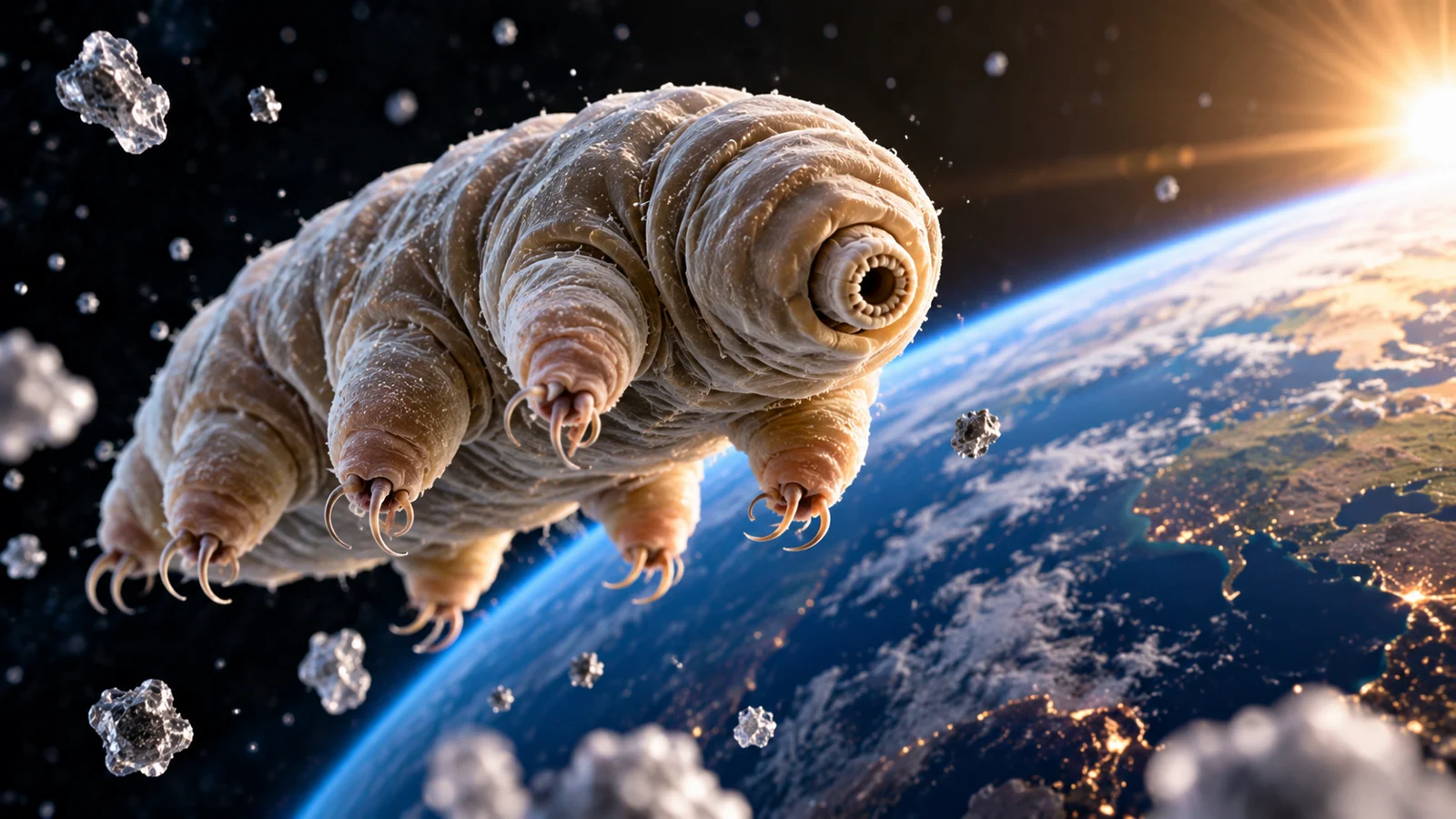
Yes—some tardigrades have survived exposure to the space environment and later resumed activity. But the popular claim that “water bears can survive anything” is misleading. The answer depends on whether the animal is dried out, how much ultraviolet radiation it receives, how long it is exposed, and what counts as survival. Real space experiments are more interesting than the myth.
What is a tardigrade?
Tardigrades are tiny, eight-legged animals found in environments including mosses, soils and freshwater habitats. Many species can survive drying by entering a highly reduced metabolic state. This state is often called a tun, when the animal contracts its body and loses much of its water. Not all tardigrades or life stages respond identically, and not every stress is survivable.
What actually happened in the FOTON-M3 mission?
In 2007, experiments aboard the FOTON-M3 mission exposed tardigrades to aspects of low-Earth-orbit space conditions. The European Space Agency described the TARDIS experiment and reported that water bears survived direct space exposure. A separate LIFE–TARSE investigation studied desiccated and active animals during the mission, comparing outcomes with controls on Earth.
The crucial scientific point is that different experiments used different species, hydration states and exposure conditions. A survival percentage from one group must not be treated as a universal percentage for every tardigrade in space.
Vacuum, radiation and ultraviolet light are different hazards
| Exposure | What the experiments indicate | Important limitation |
|---|---|---|
| Space vacuum | Some dried tardigrades can survive limited exposure | Not proof of indefinite survival |
| Cosmic radiation | Some specimens tolerated mission conditions | Dose and duration matter |
| Solar ultraviolet radiation | Strong exposure can sharply reduce survival | Shielding and wavelength matter |
| Microgravity during flight | Certain measured outcomes resembled ground controls | Not equivalent to unshielded open-space exposure |
| Rehydration afterward | Some animals resumed activity or reproduced | Recovery is not guaranteed for every specimen |
Did the animals reproduce afterward?
The 2009 peer-reviewed LIFE–TARSE paper reports observations including molting, egg laying and hatching in the spaceflight experiments. That is a stronger finding than simply seeing movement after rehydration. However, it does not imply every exposed animal survived or that all future generations would be unaffected under any space condition.
Why does drying matter so much?
When hydrated, an animal has active cellular processes that are vulnerable to extreme stress. In desiccation-tolerant species, entering anhydrobiosis changes how biological systems respond to water loss and some environmental extremes. It is tempting to call this “suspended animation,” but that phrase can obscure important molecular damage and recovery processes. Researchers test survival, DNA integrity, antioxidant responses and reproductive outcomes rather than relying on a single dramatic observation.
Can a tardigrade live permanently on the Moon or Mars?
Surviving a limited experiment is not the same as maintaining a population. Permanent habitation would require access to water and nutrients, suitable conditions for active metabolism, reproduction and protection from harmful exposure. Neither the FOTON-M3 findings nor the ESA summary demonstrates that tardigrades can form self-sustaining colonies on the Moon, Mars or in open space.
What does “survive” mean in a scientific paper?
A study might count an animal as surviving if it regains movement after rehydration. Other studies examine longer-term survival, reproduction, offspring, DNA damage or physiological responses. These endpoints answer different questions. Always check the exact species, exposure, control group and measurement used before comparing percentages across studies.
A common misconception: all tardigrades are indestructible
No organism is literally indestructible. Tardigrades are unusually resilient under certain conditions, particularly when desiccated, but intense solar UV, unsuitable exposure duration and other stresses can kill them. ESA’s report and the primary papers support a remarkable limited survival capability, not immunity to every form of radiation or heat.
How to read the evidence responsibly
The European Space Agency’s 2008 article is a useful accessible summary, while the 2009 peer-reviewed LIFE–TARSE paper provides methods and measured outcomes. A second research publication examined desiccated animals during the mission and compared them with Earth controls. Reading the sources together helps separate vacuum survival, spaceflight exposure and unshielded UV exposure.
Why the result matters beyond curiosity
Tardigrade experiments help researchers investigate biological stress responses and the limits of life. They are relevant to astrobiology and to the study of protective mechanisms in organisms, but they do not establish that complex life can freely travel between planets. The valuable scientific question is not “Are water bears immortal?” but which conditions, species and mechanisms allow temporary survival—and where the limits begin.
Primary sources and further reading
The original 2007 TARDIS experiment: the conditions that mattered
The TARDIS experiment was carried by ESA's Biopan-6 platform on the FOTON-M3 spacecraft in September 2007. Its design is central to interpreting the famous result. The researchers did not simply put a collection of animals outside a spacecraft and ask whether they were alive when they returned. They prepared dried animals, separated experimental groups by their exposure to ultraviolet light, included laboratory controls, and checked recovery after the samples returned to Earth. This distinction turns an extraordinary-sounding headline into a testable result.
Two species were studied in the original exposure work: Richtersius coronifer and Milnesium tardigradum. The samples spent roughly ten days in low Earth orbit at an altitude reported as 258–281 kilometers. Every exposed flight sample experienced space vacuum and the ionizing radiation present during the mission, but not every sample received the same sunlight. Some were shielded from solar ultraviolet light; others received selected ultraviolet wavelengths. The experiment therefore allowed a comparison of vacuum alone with vacuum plus a particularly destructive additional stress. Read the original Current Biology paper.
In both species, vacuum-only survival was high and generally comparable with laboratory controls. This is the strongest evidence behind the familiar statement that water bears can survive exposure to space. But when sunlight was added, survival declined sharply. Under the broadest ultraviolet exposure tested, only three Milnesium tardigradum specimens survived, while none of the Richtersius coronifer specimens in that exposure group revived. A narrow result like this should not be inflated into a claim that all tardigrades withstand unfiltered solar radiation.
The surprising 68% figure—and why it can mislead
The original paper reports that 68% of one Milnesium tardigradum group exposed to vacuum and UV-A/UV-B initially revived within 30 minutes. This is an attention-grabbing number, but the authors also reported substantial subsequent mortality. An animal moving soon after rehydration is not necessarily an animal that will remain alive, regain normal function, and reproduce over the following days. Short-term recovery and long-term survival are different endpoints.
Another scientific review summarizes a roughly 12% survival outcome for specimens exposed to vacuum, cosmic radiation and a specified ultraviolet treatment. These percentages need not conflict: they refer to different endpoints and reporting contexts. The proper interpretation is to read the species, wavelength range, observation time, and denominator beside every number. A percentage detached from those conditions is not a reliable fact about tardigrades as a group. Review of radiation tolerance.
A comparison of three very different space experiments
The FOTON-M3 mission included more than one tardigrade investigation. TARDIS tested desiccated animals exposed to the external space environment, including controlled ultraviolet treatments. LIFE–TARSE studied Macrobiotus richtersi in dried and hydrated states aboard the mission, with an emphasis on biological responses to spaceflight. These are related experiments, not interchangeable demonstrations of the same exposure. NASA has also supported studies of tardigrades aboard the International Space Station to investigate how biological systems respond to spaceflight and stress. An organism living inside a spacecraft is not receiving the same ultraviolet and vacuum exposure as one mounted outside it.
A useful reading test is to ask whether a study investigated survival in a protected spacecraft cabin, an exposed platform in low Earth orbit, or a ground laboratory chamber simulating selected hazards. All three can advance science, but they answer different questions. Calling them all 'surviving space' erases the most important differences in the evidence.
What a tun actually does—and does not do
A tardigrade in an active, hydrated state feeds, moves, grows and reproduces. During severe drying, certain species can contract into a tun-like state and dramatically reduce their metabolic activity. This process is called anhydrobiosis. It does not create an invisible force field around the animal. Instead, it changes the physical and biochemical conditions inside its cells and helps protect vulnerable structures while water is scarce.
Scientists have investigated protective proteins, cellular vitrification, antioxidant responses and DNA repair in different tardigrade species. Some species possess distinctive intrinsically disordered proteins associated with desiccation tolerance; others use partly different strategies. It would be inaccurate to claim that every species relies on one universal molecule or that all protective mechanisms have been fully established. The ability to endure dryness is also not a guarantee against heat, pressure, ultraviolet light, or radiation in every combination.
Recovery requires more than simply surviving a dry interval. The animal must be rehydrated under tolerable conditions and restore cellular functions. Damage may remain even if movement returns. This is why well-designed experiments monitor several outcomes rather than using one observation as proof of complete biological recovery.
Why ultraviolet radiation is the critical caveat
Earth's atmosphere absorbs much of the Sun's most damaging ultraviolet radiation. An exposed sample in orbit lacks that atmospheric shielding. Solar UV can damage nucleic acids and proteins and interfere with the processes needed for recovery. The TARDIS investigators intentionally compared wavelength ranges, including UV-A and UV-B and a wider ultraviolet spectrum. The sharp survival differences show that 'space' is not one single environmental variable.
Cosmic ionizing radiation presents another challenge, but it should not be conflated with ultraviolet radiation. Ionizing radiation can penetrate materials and damage cells through different mechanisms. The amount received depends on orbital conditions, shielding, exposure time and the type of radiation. A successful ten-day test at low Earth orbit does not establish safety during a yearslong interplanetary journey. Neither does it establish survival during direct exposure on a planet with a different atmosphere and surface chemistry.
Can tardigrades survive the temperature of space?
Statements such as 'space is minus 270 degrees Celsius' oversimplify the thermal environment. In a vacuum, an object's temperature depends on radiation absorbed from the Sun and nearby surfaces, radiation emitted, its material properties and its thermal history. A sample in sunlight and a sample in shadow can experience very different thermal conditions. Space itself does not cool an object in the same way cold air does on Earth, because there is no surrounding air to transfer heat by convection.
Some tardigrades survive striking temperature challenges in carefully defined laboratory tests, especially in dormant states. But tolerance varies with species, hydration, duration and heating or cooling rate. Laboratory temperature records cannot simply be combined with separate radiation and vacuum records to claim that an animal survives every extreme simultaneously. The FOTON-M3 study is valuable precisely because it tested a defined combination of actual orbital conditions.
What happened to eggs and future generations?
The researchers did more than observe adults. The original study included eggs, and follow-up research examined reproductive outcomes. A 2016 paper reported no reduced performance in the descendant generations it studied from surviving Milnesium tardigradum individuals. That is encouraging evidence about those survivors and their offspring, but it is not proof that radiation never produces heritable effects or that every species and dose has the same outcome. The study concerned a selected group that survived the original exposure. Read the 2016 follow-up.
This introduces a subtle issue called survivor selection. When a harsh exposure kills many individuals, the animals available for later reproduction studies are, by definition, the ones that survived. Their outcomes can tell us what surviving lineages did under the tested conditions; they cannot reveal the reproductive future of animals that died. A responsible article should not turn a positive offspring result into a universal guarantee of harmless exposure.
Could tardigrades spread life between planets?
The idea that organisms might travel between worlds is often discussed under the broader heading of panspermia. A small animal surviving an orbital experiment does not demonstrate that it could survive launch from a planetary surface, ejection by impact, a long journey through deep space, atmospheric entry, impact at the destination, and establishment in a suitable habitat. Each step is a separate physical and biological hurdle. TARDIS tested only a limited part of that hypothetical chain.
A population also needs more than the ability of one dormant individual to survive. It must encounter liquid water, suitable nutrients and conditions permitting metabolism and reproduction. A dehydrated tardigrade may persist through a hostile interval without being capable of living actively in that environment. Consequently, claims that tardigrades can colonize the Moon or Mars are not established by the spaceflight studies discussed here.
The lunar tardigrade story: a claim, not a survival result
Tardigrades became part of public discussion about the Moon after reports that dehydrated specimens were carried aboard the Beresheet lunar lander, which crashed in 2019. Their presence aboard a spacecraft is not evidence that they survived the crash, remain viable on the surface or can reproduce there. Without recovered specimens or a verified biological test, survival is unknown. The distinction matters: 'sent to the Moon' is a transport claim, whereas 'survived on the Moon' requires direct evidence.
The same principle applies to any future report about life on another world. Researchers would need a clear sample history, appropriate controls and an independently verifiable demonstration of viability. A dramatic photograph, press release or hypothetical calculation is not a substitute for that evidence.
A practical checklist for judging viral tardigrade claims
Before sharing a claim that water bears are 'indestructible,' check five details. First, identify the species; tardigrades are a diverse group, not one uniform organism. Second, ask whether the animals were hydrated or desiccated. Third, distinguish protected spaceflight from direct exposure to vacuum and sunlight. Fourth, look for the length of exposure and the exact radiation or temperature conditions. Fifth, find out whether survival meant immediate movement, survival after days, or successful reproduction. If an article omits all five, its headline may be more confident than the underlying experiment.
A sixth check is whether a number comes from a primary paper or a secondary summary. The original 2008 report is especially useful because it presents the treatment groups and recovery measurements. ESA provides accessible context, while later reviews discuss how results vary by species and experimental design. Reading across these sources reveals why the scientifically accurate answer is both remarkable and conditional.
What researchers can learn from these animals
Studying tardigrades may improve understanding of how cells withstand water loss, oxidative stress and certain forms of radiation. Those questions are relevant to basic biology and may eventually inform approaches to preserving biological materials. But moving from an animal's natural adaptations to a safe human medical treatment is a long research process. No one should interpret tardigrade resilience as evidence that humans could tolerate space exposure without life-support systems or radiation protection.
For astrobiology, the lesson is equally nuanced. The experiments demonstrate that certain multicellular animals can endure short periods of conditions once assumed uniformly lethal. They also reveal sharp limits, especially with solar ultraviolet exposure. Good science advances by mapping both the successes and the failures. The important discovery is not that the rules of biology have been suspended, but that some organisms operate much closer to those rules' boundaries than expected.
Bottom line: the evidence supports survival, not invincibility
Yes, particular tardigrade species have survived direct exposure to space vacuum in low Earth orbit, and a smaller number recovered after combined exposure to vacuum and solar ultraviolet radiation. That conclusion is backed by a real controlled experiment. However, survival depended on species, dormant state, ultraviolet wavelength, dose and the way recovery was measured. The data do not show indefinite survival in space, effortless survival on the Moon, or immunity to every radiation hazard.
The most useful takeaway is a question: 'Under exactly which conditions did these animals recover?' Asking that question preserves the wonder of the discovery without turning it into a myth.
You may also like
 HEALTH
Can Scientists Kill Harmful Gut Bacteria Without Harming Good Bacteria?
A 2026 study found argyrin B could target C. difficile in mice while preserving much of the gut…
 HEALTH
Does Fish Oil Improve Memory? What a Two-Year DHA Trial Actually Found
A two-year DHA trial raised omega-3 levels near the brain without improving memory. What the results mean for…
 History
What Did Denisovans Look Like? New Fossils Reveal Our Mysterious Human Relatives
New 2026 fossils from Bianfu Cave reveal Denisovan bones, teeth, tools and diet. Here is what science knows—and…