
Can Scientists Kill Harmful Gut Bacteria Without Harming Good Bacteria?
A 2026 study found argyrin B could target C. difficile in mice while preserving much of the gut microbiome. Here is what the evidence proves—and what remains unknown.
Contents
- What did scientists discover in October 2026?
- Why is C. difficile such a difficult infection?
- Why can infection return after treatment?
- How can an antimicrobial kill one bacterium but spare its neighbors?
- A practical analogy: pruning rather than clearing the forest
- What does “preserving the microbiome” actually mean?
- How does argyrin B compare with treatments already used?
- Could bacteriophages be even more precise?
- Why not simply use phages for every infection?
- What about CRISPR-based precision antibiotics?
- What would a convincing human trial of argyrin B need to show?
- Five questions to ask when you see a “good bacteria spared” headline
- 1. Was the treatment tested in humans?
- 2. Which harmful bacterium was targeted?
- 3. How were “good bacteria” measured?
- 4. Did researchers measure actual recovery?
- 5. Is the drug available or still experimental?
- What patients should do now
- Why the discovery matters beyond C. difficile
- The bottom line
- Original studies and authoritative references
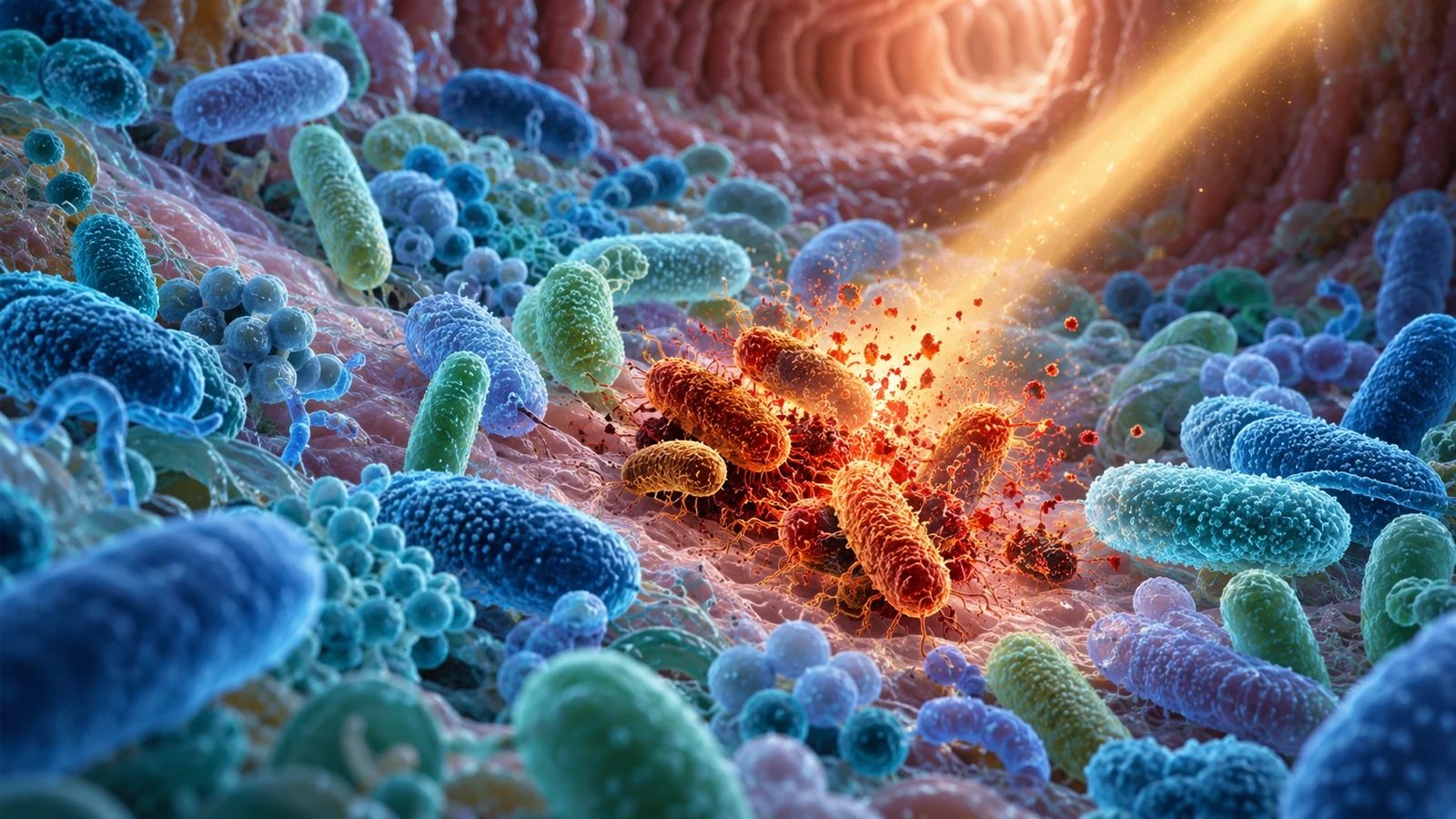
Short answer: Yes—in laboratory experiments and infected mice, scientists have shown that some highly selective antimicrobials can suppress a harmful gut bacterium while leaving much of the surrounding microbial community intact. A 2026 study identified argyrin B, a natural product originally found in soil-dwelling bacteria, as a promising candidate against Clostridioides difficile. However, argyrin B has not been established as a safe and effective treatment in humans. The achievement is precision in preclinical testing, not a cure ready for pharmacies.
The distinction matters because the gut microbiome is not a collection of uniformly “good” organisms waiting to be protected from uniformly “bad” ones. A bacterium may be harmless in one context and dangerous in another. The medical goal is to stop a specific infection while preserving the microbial functions that help protect the gut from future infections.
What did scientists discover in October 2026?
Researchers from the Helmholtz Institute for Pharmaceutical Research Saarland (HIPS), Hannover Medical School and collaborators reported that argyrin B showed strong activity against C. difficile in laboratory experiments and in a mouse model of infection. Their paper, published in npj Antimicrobials and Resistance, was titled “Argyrin B exhibits potent therapeutic efficacy in a Clostridioides difficile-infection mouse model while preserving microbiota functionality.” The results were announced by the German Center for Infection Research in October 2026.
Argyrin B reduced the pathogen burden in infected mice while having relatively limited effects on beneficial microorganisms and the broader functions of the gut community examined in the study. After oral administration, relatively little compound was detected in the bloodstream, suggesting that much of the exposure remained in the intestine. This is attractive for a drug intended to treat a disease concentrated in the colon, although low absorption alone does not prove safety.
The compound belongs to a family of natural substances made by myxobacteria, microorganisms found in soil. Scientists had already investigated argyrins for activity against other bacterial pathogens. The new work shows that a vulnerable molecular target is also present in C. difficile, providing a plausible mechanism for selective activity.
| Question | What the evidence supports | What it does not establish |
|---|---|---|
| Can argyrin B act against C. difficile? | Yes, in laboratory testing and infected mice | That it works in human patients |
| Does it spare the microbiome? | Many tested commensals and measured functions were relatively preserved | That every beneficial strain is unaffected |
| Does oral dosing reach the colon? | Mouse results suggest low systemic exposure | That human dosing and safety are settled |
| Will it prevent recurrence? | A biologically plausible future benefit | Clinical proof of fewer relapses |
| Is it an approved therapy? | No; it is a research candidate | A replacement for prescribed treatment |
Why is C. difficile such a difficult infection?
Clostridioides difficile, often shortened to C. diff, is a spore-forming bacterium capable of producing toxins that damage the intestinal lining. It can cause watery diarrhea, abdominal pain and inflammation of the colon. Severe disease can lead to dehydration and life-threatening complications. Its spores can survive difficult environmental conditions, making infection control especially important.
The problem often starts after antibiotics disrupt the usual microbial ecosystem. Resident microbes normally compete for nutrients and occupy ecological niches that make it harder for opportunistic pathogens to expand. When broad-spectrum antibiotics remove many of those competitors, C. difficile may multiply and produce toxins. Not everyone carrying the bacterium develops symptoms, and a positive test must be interpreted alongside clinical findings.
Why can infection return after treatment?
Treatment may reduce actively growing C. difficile without immediately restoring the diverse microbial community that ordinarily suppresses it. Persistent spores, repeated antibiotic exposure and individual susceptibility can contribute to recurrence. This is why scientists are interested not only in killing the pathogen but also in preserving or restoring the surrounding ecosystem.
How can an antimicrobial kill one bacterium but spare its neighbors?
Antimicrobials differ in which cellular structures or processes they target. A broad-spectrum antibiotic may affect many species because its target is widely shared. A narrow-spectrum compound may interact strongly with a target that is absent, structurally different or less accessible in other bacteria. Selectivity also depends on the drug concentration, how the substance enters cells, and the conditions in the intestine.
In the argyrin study, researchers connected antibacterial activity to a molecular target previously studied in another pathogen. Differences in how bacteria respond to that target help explain why C. difficile can be sensitive while many tested commensals are less affected. But a narrow spectrum is never synonymous with absolute specificity: susceptibility can vary among strains, and an organism not directly killed may still change in abundance as its ecological partners disappear.
A practical analogy: pruning rather than clearing the forest
Broad-spectrum treatment can resemble removing many plants to eliminate one invasive species. A targeted treatment is closer to removing the invasive plant while leaving most of the surrounding vegetation. The analogy has limits: gut microbes exchange nutrients, compete and respond to immune signals, so removing one organism can still change the rest of the ecosystem. Scientists must therefore measure community composition and function, not merely count the target bacterium.
What does “preserving the microbiome” actually mean?
A microbiome can be assessed through species abundance, overall diversity, gene content and metabolic activity. These are related but distinct measurements. A treatment might leave species diversity nearly unchanged while altering production of protective metabolites; conversely, it might shift some species yet preserve important functions. Claims about a “healthy microbiome” should identify which measurements were made and for how long.
The new argyrin B work emphasized preserving microbiota functionality, a meaningful step beyond demonstrating that a single cultured beneficial strain survives. Still, laboratory communities and mouse microbiomes cannot fully reproduce the variation among human patients, including different diets, medications, immune conditions and prior antibiotic exposure.
| Measure | What it can reveal | Important limitation |
|---|---|---|
| Bacterial counts | Whether the target organism declines | Does not describe all other microbes |
| Species composition | Which groups increase or decrease | Relative abundance can be misleading |
| Diversity indices | How varied the community remains | Higher diversity is not always healthier |
| Metabolic function | Whether key microbial activities persist | May vary with diet and sampling time |
| Recurrence after treatment | Whether infection returns | Requires appropriately designed follow-up |
| Clinical symptoms | Whether patients actually improve | Cannot be inferred from mouse bacterial counts |
How does argyrin B compare with treatments already used?
The best available treatment is not necessarily the newest molecule. Established treatment of symptomatic C. difficile infection follows clinical guidelines and depends on disease severity, availability, recurrence history and other patient factors. Fidaxomicin is a relatively narrow-spectrum antibiotic used for this infection and is favored in some guidelines because of its effect on recurrence compared with certain alternatives. Oral vancomycin remains an important treatment option in appropriate situations.
For selected patients with recurrent disease, clinicians may consider microbiota-based therapies intended to restore colonization resistance. These are different from targeted antibiotics: instead of directly eliminating a pathogen, they seek to rebuild a protective microbial ecosystem. Such products and procedures have specific indications and safety requirements and should not be attempted at home.
| Approach | Core idea | Evidence or status |
|---|---|---|
| Argyrin B | Selectively inhibit C. difficile while sparing many commensals | Preclinical laboratory and mouse research |
| Fidaxomicin | Treat C. difficile with relatively narrow antimicrobial activity | Established clinical treatment |
| Oral vancomycin | Treat C. difficile in the intestine | Established clinical treatment; microbiome effects differ |
| Microbiota-based therapies | Restore colonization resistance after recurrent infection | Clinical options for selected patients |
| Bacteriophages | Use viruses that infect selected bacterial strains | Promising but highly context-dependent |
| CRISPR antimicrobials | Target bacterial genes or resistance mechanisms | Primarily experimental; delivery is a challenge |
Could bacteriophages be even more precise?
Bacteriophages are viruses that infect bacteria. Some recognize particular bacterial strains through surface structures, potentially making them more selective than conventional antibiotics. In July 2026, researchers described a phage-derived enzyme, or endolysin, that reduced Streptococcus salivarius in experimental small-intestinal communities and mouse models while largely preserving other bacteria. That study illustrates the broader promise of precision microbiome editing, but it targeted a different organism and biological problem than the argyrin B research.
Another 2026 research program examined phages that reduce the harmful behavior of certain E. coli strains associated with inflammatory bowel disease. Rather than eliminating every bacterium, the approach altered a bacterial trait involved in attaching to the gut lining. These are distinct experimental strategies, and neither should be described as an approved general treatment for inflammatory bowel disease.
Why not simply use phages for every infection?
Phages often require careful matching to the patient’s bacterial strain. Bacteria can evolve resistance to them, and the human immune system may influence their persistence. Manufacturing, purity, dosing, delivery and clinical trial design also create challenges. A 2026 consensus guideline in Nature Medicine emphasized that personalized phage therapy requires rigorous identification, quality control and monitoring rather than improvised administration.
What about CRISPR-based precision antibiotics?
CRISPR systems can be engineered to recognize particular bacterial genetic sequences. In principle, this could eliminate a pathogen or disable a resistance gene while leaving unrelated bacteria alone. In practice, delivering the molecular machinery into the right bacterial cells is difficult. Bacterial evolution, unintended ecological effects and safety validation remain major barriers. These technologies are scientifically important but should not be confused with standard treatments available today.
What would a convincing human trial of argyrin B need to show?
First, researchers must establish how the compound behaves in humans, including its stability, distribution within the intestine, dose-response relationship and possible toxicity. A drug that remains mostly in the colon may still affect the intestinal lining or interact with other medicines. Researchers also need to understand whether the compound affects bacterial strains differently and whether resistance develops.
A subsequent controlled trial would need to compare argyrin B against an appropriate standard treatment, using outcomes that matter to patients: resolution of diarrhea, prevention of serious complications, recurrence rates and adverse events. Microbiome sequencing and metabolite measurements could help explain why one treatment performs differently, but they should supplement—not replace—clinical endpoints.
| Stage | Main question | Where argyrin B stands |
|---|---|---|
| Test-tube studies | Does it inhibit the target bacterium? | Promising results reported |
| Animal infection models | Can it reduce infection in a living system? | Promising mouse results reported |
| Human safety studies | What doses and adverse effects occur? | Not established in the cited report |
| Controlled efficacy trials | Does it improve patient outcomes? | Not established |
| Long-term follow-up | Does it prevent recurrence without harmful trade-offs? | Unanswered |
Five questions to ask when you see a “good bacteria spared” headline
1. Was the treatment tested in humans?
An experiment in a petri dish or a mouse is an important first step, but the gut microbiome differs across species and individuals. Human effectiveness and safety require human evidence.
2. Which harmful bacterium was targeted?
The new argyrin B study concerns C. difficile, not every cause of diarrhea or abdominal pain. A treatment selective for one species cannot automatically be generalized to Salmonella, Campylobacter or all antibiotic-resistant bacteria.
3. How were “good bacteria” measured?
Look for community-wide analysis and functional outcomes. Testing just two or three beneficial species is weaker evidence than analyzing a complex microbiome before and after treatment.
4. Did researchers measure actual recovery?
Lower pathogen counts are useful, but patients care about symptom relief, fewer relapses, hospitalizations and safety. A compound can appear selective yet fail to improve those outcomes.
5. Is the drug available or still experimental?
Scientific press releases often describe future potential. Check whether the paper reports clinical trials or preclinical experiments, and whether any relevant regulator has authorized the treatment for the intended use.
What patients should do now
Do not seek argyrin B from unregulated suppliers or attempt to treat suspected C. difficile with laboratory chemicals. If you develop persistent watery diarrhea—particularly after antibiotic use or during a healthcare stay—contact a clinician. Severe abdominal pain, fever, blood in stool, signs of dehydration or marked weakness warrant prompt medical assessment. Treatment decisions should be based on symptoms, testing and clinical evaluation.
Avoid stopping a prescribed antibiotic on your own. If you are concerned about gut side effects, discuss the indication, duration and possible alternatives with your prescriber. Probiotics are not universally recommended for preventing or treating C. difficile, and they may be inappropriate for some high-risk patients. There is no one-size-fits-all supplement that reliably rebuilds the microbiome after every antibiotic course.
Why the discovery matters beyond C. difficile
Precision antimicrobials could eventually allow clinicians to remove a dangerous organism without erasing ecological protections against future infections. That would be a meaningful shift from simply maximizing bacterial killing to balancing pathogen control with microbiome preservation. The strategy may also help scientists study what individual microbes actually do by selectively removing them and observing the consequences.
Yet ecological precision is a high bar. Gut organisms interact through nutrient exchange, competition and immune signaling. Eliminating one strain may open a niche for another organism, so the long-term consequences must be measured. The strongest future studies will combine pathogen suppression, functional microbiome measurements and real clinical benefits.
The bottom line
The answer to “Can scientists kill harmful gut bacteria without harming good bacteria?” is increasingly yes in carefully designed experiments—but not perfectly, and not yet with the new argyrin B candidate in routine human care. The October 2026 research provides encouraging evidence that C. difficile can be suppressed while much of the microbiome remains functional. The next challenge is demonstrating that this selectivity translates into safe, effective and durable treatment for people.
Original studies and authoritative references
Argyrin B original research (npj Antimicrobials and Resistance, 2026).
German Center for Infection Research: official research summary.
Review: Antibiotic-induced gut microbiome dysbiosis and mitigation.
Phage endolysin selective microbiome study (2026).
Consensus guideline for personalized bacteriophage therapy (Nature Medicine, 2026).
You may also like
 History
The Mystery Yak of Denisova Cave: How Ancient DNA Revealed a Lost Ice Age Species
Twenty ancient nuclear genomes uncovered Yak X, an extinct bovine distinct from modern yaks. Explore its connection to…
 HEALTH
Does Fish Oil Improve Memory? What a Two-Year DHA Trial Actually Found
A two-year DHA trial raised omega-3 levels near the brain without improving memory. What the results mean for…
 History
What Did Denisovans Look Like? New Fossils Reveal Our Mysterious Human Relatives
New 2026 fossils from Bianfu Cave reveal Denisovan bones, teeth, tools and diet. Here is what science knows—and…