
The Mystery Yak of Denisova Cave: How Ancient DNA Revealed a Lost Ice Age Species
Twenty ancient nuclear genomes uncovered Yak X, an extinct bovine distinct from modern yaks. Explore its connection to Denisova Cave, Ice Age evolution, and what the DNA cannot yet prove.
Contents
- Yak X at a glance: What is known and what remains uncertain?
- What exactly was yak X—and why is this not an ordinary fossil discovery?
- The discovery unfolded in two stages: 2025 versus 2026
- Why Denisova Cave matters so much
- How could scientists identify an animal from unrecognizable bone fragments?
- Step 1: Identify suitable material without confusing appearance and identity
- Step 2: Compare mitochondrial DNA with the nuclear genome
- Step 3: Reconstruct relationships and test potential interbreeding
- The key numbers—and the mistakes they can cause
- Did yak X look like a modern yak?
- The Ice Age landscape: Mammoths, steppe bison, and changing habitats
- Did Denisovans hunt yak X?
- Why even living at the same time is harder to establish than it sounds
- When did yak X become extinct? Was warming responsible?
- Population decline versus loss of genetic diversity: Why the distinction matters
- Why the study's limited evidence of interbreeding matters
- Is yak X officially a newly named species?
- What if other extinct animals left no usable DNA?
- What the discovery says about lost Ice Age biodiversity
- Could ancient DNA bring yak X back to life?
- How to tell a real yak X fossil from an artist's illustration
- Five discoveries that could change the yak X story next
- A practical checklist for reading extraordinary ancient-DNA headlines
- Conclusion: Small bones revealed a missing branch of life's family tree
- Primary studies and further reading
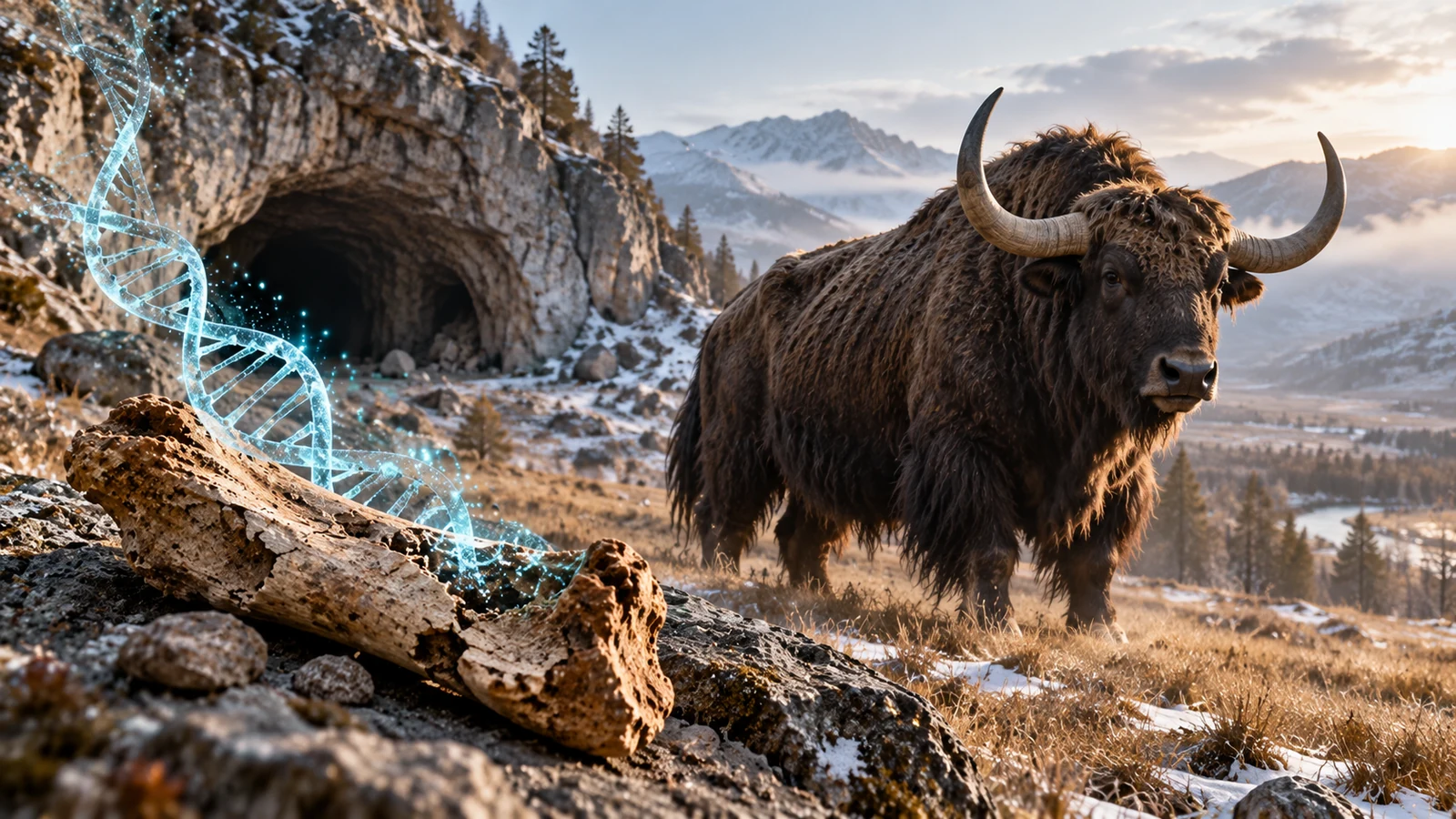
Featured image: conceptual artwork only. No documentary photograph or scientifically confirmed reconstruction of the extinct species exists.
Imagine opening a box of Ice Age bone fragments so small and damaged that even a trained anatomist cannot confidently say which species they belonged to. There is no complete skull, no recognizable pair of horns, and no preserved animal to photograph. Yet those apparently anonymous fragments have revealed a surprising chapter in the history of Eurasia: an ancient yak-like bovine, genetically distinct from living yaks, survived for a very long time before disappearing from the record.
Researchers strengthened the case for this animal in a paper published online in Current Biology on October 5, 2026. Their provisional name is yak X. By examining 20 ancient nuclear genomes recovered from Denisova Cave in Siberia and other sites across mid-latitude Asia, the team found evidence that yak X represented a distinct extinct species whose lineage began diverging from the ancestors of today’s yaks at least 400,000 years ago. See the original Current Biology study.
The discovery has prompted an alluring question: did this animal live alongside the mysterious Denisovans, a group of ancient humans known from the same cave? The cave connection is real; a documented encounter is not. Finding yak X bones at a location associated with Denisovans does not prove that Denisovans hunted the animals, ate them, or occupied the cave during the same precise period. The scientifically interesting story is already remarkable without inventing a prehistoric hunting scene.
This guide separates the findings from the open questions, explains how genetics can identify an animal that anatomy cannot, and explores what yak X tells us about Ice Age biodiversity, extinction, and the incomplete fossil record.
Yak X at a glance: What is known and what remains uncertain?
| Question | Evidence supports | Not established |
|---|---|---|
| What was yak X? | A distinct extinct bovine lineage closely related to modern yaks | A final formal taxonomic name or definitive identification with historical Baikal-yak fossils |
| How was it identified? | Twenty ancient nuclear genomes compared with living and extinct bovines | Its exact appearance, coat color, horn shape, or adult body size |
| What links it to Denisovans? | Some of its remains came from Denisova Cave, a major ancient-human archaeological site | A particular encounter, hunt, meal, or direct interaction with Denisovans |
| When did it live? | Reported specimens range broadly from roughly 250,000–200,000 years ago to around 27,000 years ago | The precise moment when the last individual died |
| Why did it disappear? | Genetic evidence of demographic decline and a possible population turnover | A proven single cause such as warming, human hunting, or disease |
The distinction running through this table is crucial: researchers can identify a lineage genetically without knowing every detail of the animal’s anatomy, ecology, or eventual disappearance. Unanswered questions do not cancel the achievement; they define the next research priorities.
What exactly was yak X—and why is this not an ordinary fossil discovery?
Modern yaks are large, thick-haired bovines associated with cold, high-elevation landscapes. Both domestic and wild yaks exist today. Yak X is not a newly discovered living breed, a rare zoo animal, or an individual caught on camera. It is a working label for an extinct evolutionary lineage reconstructed from ancient DNA. Its genome is related to that of modern yaks but diverges from the genetic diversity represented by living populations.
The first important clue came from mitochondrial DNA, a small genome generally inherited through the maternal line. A study published in Genome Biology and Evolution in 2025 recovered an unusual yak-like mitochondrial lineage from Pleistocene bovine remains in and around the Altai region. The researchers called that lineage yak X. Read the open-access 2025 paper.
That was a meaningful discovery, but mitochondrial DNA tells only one genealogical story. A maternal lineage can remain distinctive even when the rest of a population’s genome has a more complicated history. Ancient populations may also have exchanged genes with their relatives. The discovery of an unusual mitochondrial branch therefore does not, by itself, settle whether researchers are looking at a separate species or deep variation within a familiar one.
The 2026 nuclear-genome study addressed this problem with a much broader collection of genetic information. Across multiple parts of the genome, the researchers reconstructed relationships between yak X and other bovines, examined population history, and tested for evidence of gene flow. Their central conclusion was that yak X was a distinct species, with a lineage that had begun separating from modern yak ancestry at least 400,000 years earlier. That is a genetic conclusion—not a photograph, a complete skeleton, or an exact extinction date.
The discovery unfolded in two stages: 2025 versus 2026
Popular accounts can make the story sound as if a scientist picked up a small bone in October 2026 and immediately announced a new species. In reality, it is a cumulative scientific result. One study found an unfamiliar maternal lineage; the next tested its wider evolutionary independence.
| Research stage | Main evidence | Main question answered | Important limitation |
|---|---|---|---|
| 2025 study | Ancient bovine mitochondrial genomes | Was there an unrecognized yak-like maternal lineage in the Altai? | Mitochondrial DNA alone cannot resolve every species boundary or history of admixture |
| 2026 study | 20 nuclear genomes and evolutionary population analyses | Was yak X a distinct branch rather than simply a variant within known yaks? | The sampled bones remain largely uninformative about precise anatomy |
| Future research | More ancient genomes, diagnostic bones, detailed dates and environmental records | Could yak X match the so-called Baikal yak, and what caused its disappearance? | Those questions require evidence not yet resolved by current papers |
This distinction is one of the most useful lessons in reading scientific news. Identifying a surprising sequence is one step. Demonstrating that it belongs to a long-independent species is a much larger and more demanding one.
Why Denisova Cave matters so much
Denisova Cave lies in the Altai Mountains of southern Siberia. It became internationally famous because tiny human remains and ancient DNA revealed the Denisovans, an extinct group of human relatives whose genetics also left traces in some present-day populations. The cave and its sediments preserve a complicated history of people, animals, and environmental change over vast stretches of the Pleistocene.
But a cave is not a single room frozen at one moment. Sediment can accumulate over tens or hundreds of thousands of years. Bones may be introduced by predators, brought in by people, deposited after natural deaths, or moved after burial. Layers are investigated separately because two items recovered from the same named cave need not have belonged to the same population, century, or even climatic period.
Researchers have used archaeological stratigraphy, multiple dating methods, and ancient DNA from sediment to reconstruct this long sequence of occupation and ecological change. A related study in Nature Communications discusses the cave’s chronology and how human and animal records vary over time: research on Denisova Cave’s Pleistocene history.
The fact that some yak X specimens came from Denisova Cave therefore places the animal in an important regional Ice Age ecosystem. It does not independently establish a Denisovan hunting event. That more specific claim would require a much tighter connection between particular animals, dated layers, and traces of human activity.
For background on the ancient humans themselves, Horus Valley also has an article about what Denisovans may have looked like (Arabic). The present article focuses on the extinct bovine rather than reconstructing the hominin population.
How could scientists identify an animal from unrecognizable bone fragments?
Traditional zooarchaeology begins with shape. Teeth, skulls, joints, and distinctive limb bones can often distinguish a horse from a bison or a yak from another bovine. But many cave specimens are too small, worn, or shattered for those features to survive. Sometimes researchers cannot even determine which part of the skeleton a fragment came from.
Paleogenomics offers a second route. Researchers recover surviving DNA molecules from ancient remains, sequence the fragments in a laboratory, and compare them with genetic reference data from modern and extinct animals. A bone can be anatomically non-diagnostic yet still provide genetic material informative enough to reveal its evolutionary affinities.
Step 1: Identify suitable material without confusing appearance and identity
A fragment that cannot be assigned to species by eye is not scientifically worthless. Its shape may still narrow it to the bovine family, and in some contexts collagen protein fingerprinting can provide a further identification. Where DNA survives, sequencing can supply finer evolutionary resolution—but it depends heavily on preservation.
Ancient DNA is typically broken into tiny molecules. Heat, humidity, microbial activity, and chemical conditions can degrade it. Modern DNA contamination can also mislead a poorly controlled analysis. Specialized laboratories therefore use strict handling procedures, negative controls, replication where appropriate, and computational methods to recognize ancient molecular patterns and estimate confidence.
Not every bone yields sufficient sequence data. The twenty genomes in the 2026 paper represent genetic datasets researchers could analyze, not a complete census of every animal preserved in these caves.
Step 2: Compare mitochondrial DNA with the nuclear genome
Mitochondrial DNA is especially useful in old remains because cells originally contained many copies of it, giving researchers more potential material to recover. But it tracks a maternal lineage and can produce a tree that does not perfectly mirror the full ancestry of a population.
The nuclear genome contains information from ancestors across many chromosomes. Repeated comparisons over numerous genetic regions can provide stronger evidence about the depth of separation between lineages, the extent of historical mixing, and past demographic change. The 2026 paper was therefore important not merely because it added specimens, but because it expanded the kind of genetic evidence used to test yak X’s identity.
A practical analogy: mitochondrial DNA resembles one family’s maternal surname history, while the nuclear genome resembles a much broader collection of ancestry records. Neither metaphor is perfect, but it captures why researchers do not automatically equate an unusual maternal branch with a new species.
Step 3: Reconstruct relationships and test potential interbreeding
Species questions are not answered by counting a few unusual mutations. Researchers compare patterns across samples, check whether they remain consistent among locations and ages, and evaluate models in which the populations separated at different times or exchanged genes.
The 2026 team found negligible evidence of gene flow between yak X and the other bovines they investigated, including steppe bison and aurochs, despite geographic and temporal overlap. That supports evolutionary distinctiveness. It does not mathematically prove that no individual ever interbred with another population over hundreds of thousands of years. The careful statement is that the available genetic data do not provide substantial evidence of such exchange.
The key numbers—and the mistakes they can cause
The researchers assembled twenty ancient nuclear genomes from Denisova Cave and other mid-latitude Asian sites. In the reporting of the study, fourteen samples were described as coming from Denisova Cave and six from other locations. The oldest reported specimens have been described as roughly 250,000–200,000 years old, while the youngest known sample was around 27,000 years old. For context, see Reuters’ October 19, 2026 report and the primary papers.
Those figures are easily misread. Twenty genomes do not mean twenty separate species, nor do they reveal a herd size. A lineage divergence estimated at 400,000 years ago is not the date of its oldest sampled bone. And a youngest fossil dated to approximately 27,000 years ago does not establish that the last animal died then.
| Figure | Correct interpretation | Incorrect inference |
|---|---|---|
| 20 | Ancient nuclear genomes analyzed | Twenty newly discovered species or the entire historical population |
| 14 + 6 | Reported allocation of samples between Denisova Cave and other sites | Every animal died together in one cave |
| At least 400,000 years | Approximate minimum age of evolutionary divergence from living yak lineages | Direct date of the oldest Yak X bone |
| Roughly 250,000–200,000 years | Age range associated with some of the oldest reported specimens | The moment the species first appeared |
| Around 27,000 years | Age of the youngest currently reported specimen | An independently established final extinction date |
This is why responsible science writing should describe what was measured before turning an impressive number into a historical claim.
Did yak X look like a modern yak?
It may have shared general bovine features with modern yaks, but its precise appearance remains unknown. The bone fragments used for genetic identification do not establish coat color, horn length, shoulder height, adult weight, or a recognizable silhouette. Genes can inform evolutionary relationships without providing a complete anatomical portrait.
One possibility discussed by researchers is that the genetic lineage corresponds to a fossil form sometimes called the Baikal yak, associated in earlier literature with the name Bos mutus baikalensis. That would be an important connection between a genetically defined lineage and a morphology-based paleontological name. But it is still a hypothesis requiring more specimens that preserve both diagnostic anatomy and usable ancient DNA.
When an illustration shows a huge dark-haired yak standing before a Siberian cave, treat it as an artist’s interpretation unless a caption explicitly documents the fossil basis for the reconstruction. A photograph of a living yak is useful as a comparison to its relatives, not proof of what yak X looked like.
Image note: The featured picture in this article is conceptual artwork combining a yak-like animal, a cave, bone fragments, and a DNA motif. It is not a photograph of yak X and not a scientifically established reconstruction.
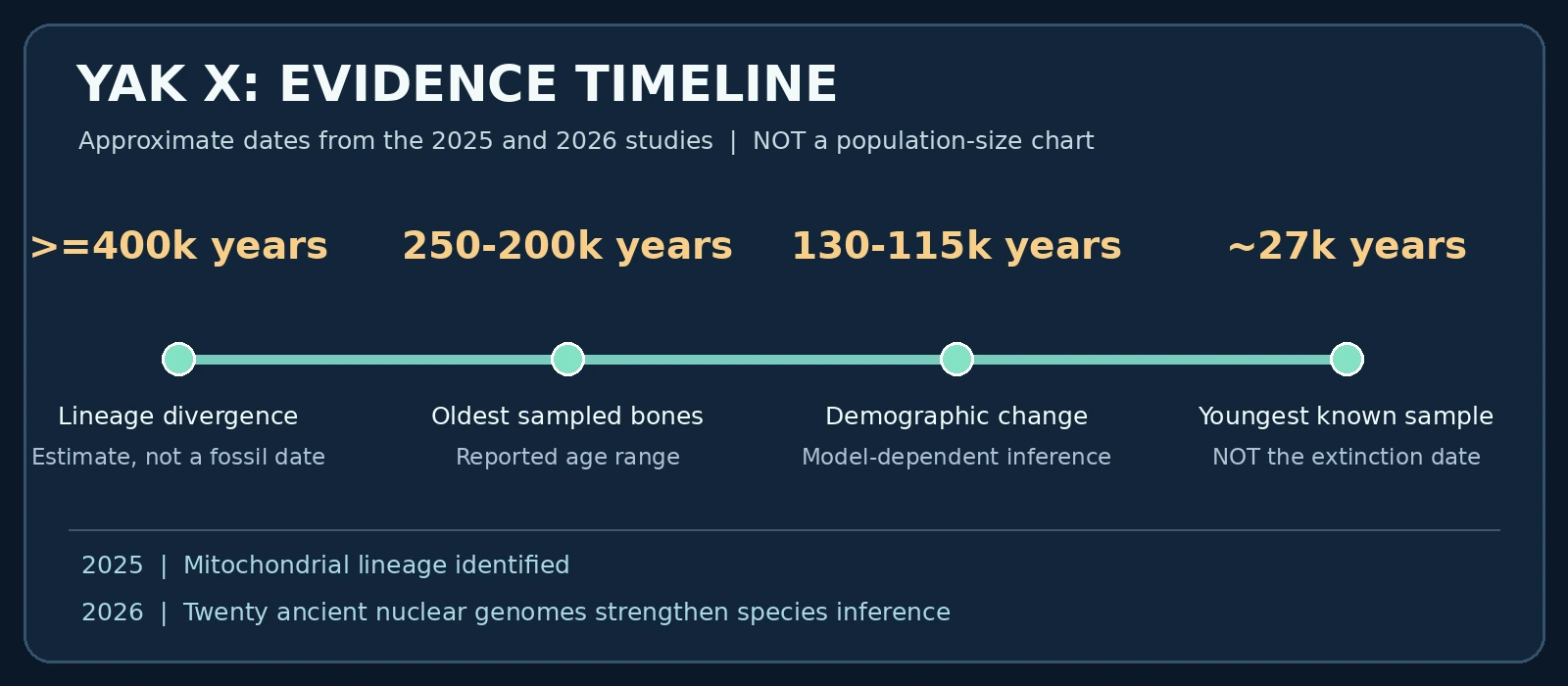
Evidence timeline: An original Horus Valley graphic summarizing the approximate dates discussed in the studies. It is not a population-size curve, and it does not claim to identify the exact date of extinction.
The Ice Age landscape: Mammoths, steppe bison, and changing habitats
Across the Pleistocene, large parts of northern Eurasia passed through repeated colder and warmer intervals. Open grassland and steppe habitats supported famous large mammals, including mammoths, woolly rhinoceroses, and steppe bison in some places and periods. Yak X was another bovine participant in this changing world, though it need not have shared every location or century with every other Ice Age animal.
The Altai–Sayan region contains mountains, valleys, plateaus, and ecological transitions that can create opportunities for distinct populations to survive and evolve. The ancient genomic findings make this landscape more interesting than a single list of familiar mammals: it was a place where bovine lineages could persist for long periods and diverge from the diversity represented by their modern relatives.
Changes in vegetation, snow cover, temperature, and access to suitable grazing areas may all have affected large herbivores. However, the yak X study does not supply a complete reconstruction of its diet at each site or a precise map of every migration. Bone isotope analysis, plant remains, dental wear, and more ecological context may help answer those questions in the future.
Did Denisovans hunt yak X?
It is the most dramatic question in the headline, but it is also the one most likely to encourage exaggeration. Denisova Cave contains evidence of ancient human relatives; it also contains yak X remains. Those facts alone do not demonstrate predation or consumption. Animal bones can arrive at cave sites through carnivore activity, natural mortality, transport by humans, later disturbance, or the accumulation of deposits over separate occupation episodes.
A persuasive case for ancient hunting or butchery would require connected evidence: cut marks made by tools on a securely identified bone, breakage consistent with marrow extraction, clear dating and stratigraphic association with human activity, or repeated patterns of processing at the site. Even apparent marks must be tested against natural scratching, trampling, and damage after burial.
The DNA study establishes the animal’s evolutionary identity and its presence in the regional record. It does not document a specific Denisovan meal or hunting strategy. There is no need to rule out prehistoric interaction altogether; it remains a possible research question. But possibility is not proof.
Why even living at the same time is harder to establish than it sounds
Cave layers span extraordinary lengths of time. Their ages are reconstructed with stratigraphy, radiometric dating where feasible, sediment dating, and other archaeological evidence. Some deposits can be mixed or moved. Consequently, researchers must compare the dates and context of a particular animal bone with the relevant evidence of human occupation before claiming contemporaneity.
Imagine a bovine bone from roughly 200,000 years ago and a stone tool from a layer that is tens of thousands of years younger. The shared site name does not turn them into one scene. A compelling story about an ancient hunter requires a demonstrated temporal and functional connection, not merely two discoveries pinned to the same cave on a map.
When did yak X become extinct? Was warming responsible?
The nuclear-genome paper reports evidence of demographic decline over the Mid-to-Late Pleistocene and a possible population turnover accompanied by lower genetic diversity around the Last Interglacial, roughly 130,000–115,000 years ago. That makes climate and habitat change relevant hypotheses. It does not prove that one warm interval directly caused extinction.
Yak X apparently survived long after that period, since the youngest reported evidence falls near 27,000 years ago. It may have persisted later still without leaving remains that have been recovered and genetically assigned. The available evidence does not specify its final year of existence, and it does not establish human hunting as the main cause of its disappearance.
Multiple pressures could have interacted: habitat fragmentation, shifts in suitable grazing zones, reduced population connectivity, genetic drift, and other ecological forces. Yet these are explanations to test, not findings to present as settled history. The research is valuable precisely because it identifies demographic patterns while leaving the causal story appropriately open.
Population decline versus loss of genetic diversity: Why the distinction matters
An animal population may shrink and subsequently recover, while severe or prolonged reductions can leave a lasting signature in its genes. When breeding populations become small or isolated, some variants can disappear through chance over generations. A particularly strong contraction is often described as a population bottleneck.
Inferring these processes from ancient genomes is complex. Samples are rarely evenly spaced in time or geography, genetic diversity does not translate directly into a headcount, and several evolutionary processes can produce overlapping signals. Researchers build models to estimate which histories are consistent with the data, rather than reading exact herd numbers from a strand of ancient DNA.
A reduction in diversity is not always a sign that extinction is imminent; likewise, species can disappear without leaving the same genetic fingerprint in the small number of bones available today. Twenty genomes distributed across an immense time span do not produce an annual census of every valley. They can, however, support a carefully qualified conclusion that a lineage experienced demographic changes at certain intervals.
Why the study’s limited evidence of interbreeding matters
The research found little evidence of gene flow between yak X and particular bovines that overlapped with it in time and geography, including steppe bison (Bison priscus) and aurochs (Bos primigenius). This strengthens the case for yak X as a long-distinct evolutionary branch.
The finding is striking beside ancient-human genetics, where Denisovans, Neanderthals, and ancestors of some modern human populations did exchange genes. But that contrast should not become the simplistic claim that ancient humans interbred while ancient animals never did. Other bovine lineages have their own complicated histories, and the study concerns particular tests, samples, and comparison groups.
The distinction between "negligible evidence detected" and "not a single mating event ever occurred" is fundamental. More genomes could reveal low-level signals or unsampled populations. Science often advances by narrowing what remains plausible rather than announcing absolute impossibility.
Is yak X officially a newly named species?
A newspaper may reasonably summarize the genetic conclusion as the discovery of a previously unrecognized extinct species. Formal zoological naming, however, involves rules and evidence distinct from attaching a convenient label to a DNA lineage. Fossils described under older names may also turn out to represent the same biological population.
The team argues that yak X constitutes a separate species on genome-wide evidence, but "yak X" is a provisional designation, not necessarily the final accepted scientific binomial. Testing a relationship to the fossil Baikal yak may require bones that combine recognizable anatomical characters with sequenced genomes.
That does not make the discovery less important. Scientists may have had anonymous bones in museum collections or excavation boxes for years without the tools needed to recognize them as a distinctive lineage. A new evolutionary branch can emerge from material that was already known physically but misunderstood biologically.
What if other extinct animals left no usable DNA?
The fossil record is uneven. Hot, wet, acidic, or otherwise destructive conditions can break down genetic material faster than cold settings. This helps explain why ancient genomes have transformed research in some northern regions while many equally interesting fossils elsewhere remain difficult to study molecularly.
Even without DNA, paleontologists can make progress through detailed anatomical comparisons, ancient proteins where they survive, tooth morphology, geological context, and associated environmental evidence. Ideally, one specimen eventually connects a genetic lineage with a diagnostic set of skeletal features. That would make it easier to recognize additional fossils that lack recoverable DNA.
Yak X is therefore not proof that researchers have now catalogued all Ice Age bovines. It illustrates how the animals we can name depend partly on the preservation of evidence and on the methods available to analyze it.
What the discovery says about lost Ice Age biodiversity
Public images of the Ice Age often center on mammoths, woolly rhinoceroses, and saber-toothed cats. The herbivores that sustained many ancient food webs receive less attention, even though their diversity was complicated. Ancient genomes show that labels such as "yak" or "bison" may conceal deeply divided lineages no longer visible among surviving animals.
Distinct herbivore lineages might have differed in cold tolerance, preferred vegetation, altitude, migration behavior, or seasonal habitat use. Yet those possibilities should not be mistaken for conclusions specifically established for yak X. Before claiming the species played a uniquely important ecological role, researchers would need better evidence of diet, anatomy, movement, and environmental interactions.
The larger lesson is about hidden biodiversity loss. A lineage can disappear without leaving a recognizable morphological signature in the available fossils. Ancient DNA can reveal that something was lost even when its precise appearance and ecological role remain mysterious.
Could ancient DNA bring yak X back to life?
Twenty ancient genomes do not mean scientists possess twenty living cells or intact chromosomes ready for cloning. Ancient genetic information is reconstructed from short, damaged fragments. Coverage varies between samples, and some genome positions may be uncertain or absent. Producing an organism would also require far more than a computer-readable sequence, including sophisticated understanding of development, reproduction, and the relationship between a genome and a living body.
Even if genome editing improves dramatically, producing a modern yak modified to express selected traits is not the same as restoring an extinct species in its complete historical form. The stated purpose of this research is to understand evolutionary diversity, divergence, and extinction—not to announce a de-extinction program.
How to tell a real yak X fossil from an artist’s illustration
Visuals can help an article, but the caption should disclose what they actually show. A photograph of a modern wild or domestic yak depicts a living relative, not yak X itself. A dramatic scene with a shaggy prehistoric bovine beside a cave is illustrative unless backed by anatomically diagnostic fossil evidence.
For this article, the featured image is labeled conceptual artwork rather than an authenticated reconstruction. The accompanying timeline is an original explanatory graphic using reported dates; it is not a graph of measured animal abundance, a map of confirmed Denisovan hunts, or a claim about the precise time of extinction.
Keeping these distinctions visible protects readers from a common online problem: images that feel realistic can make a speculative detail seem empirically established.
Five discoveries that could change the yak X story next
Researchers could move much further by recovering additional bones that are both genetically attributable to yak X and anatomically distinctive. Such specimens could clarify body form and test the proposed link with Baikal-yak fossils. More geographic sampling might reveal how widespread the lineage was. Better dates for late specimens could narrow—but not automatically resolve—the interval of disappearance.
A fourth priority is detailed environmental reconstruction, bringing together genetic data, cave stratigraphy, vegetation records, and local climate history. A fifth is direct evidence of animal processing: identifiable cut marks and archaeological associations might eventually allow researchers to assess whether ancient human groups used yak X as a food resource.
Each question requires its own evidence. The presence of an extinct animal in an ancient-human cave is a starting point for archaeology, not a substitute for that archaeology.
A practical checklist for reading extraordinary ancient-DNA headlines
Before sharing a headline declaring a "mystery animal" or "new extinct species," ask what was actually sequenced: mitochondrial DNA alone, or enough nuclear data to test broader relationships? Find out how many samples were used, where they came from, and the span of time they represent. Determine whether the species has a formal taxonomic name or a temporary research nickname.
Most importantly, distinguish the date of the oldest recovered specimen from the time a lineage originated, and the youngest recovered specimen from the true time of extinction. Claims about climate, hunting, behavior, and interbreeding need their own independent lines of evidence. These questions apply to many exciting discoveries in archaeology and evolutionary biology.
| Popular claim | What should you ask? | More accurate wording |
|---|---|---|
| "Scientists found a real picture of the animal" | Is it a diagnostic fossil, a photo of a modern yak, or digital art? | Its detailed appearance is unresolved; depictions are comparative or illustrative |
| "Denisovans hunted it" | Are there securely dated cut marks or related archaeological traces? | Interaction is possible but not demonstrated by this genetic study |
| "It died out 27,000 years ago" | Is that the last individual, or merely the youngest specimen found? | The youngest currently known sample is not an exact extinction date |
| "Warming wiped it out" | Does the paper establish a direct causal mechanism? | Demographic changes are reported; the final cause remains unsettled |
| "The species has an official scientific name" | Is a formal description and accepted binomial available? | Yak X remains a provisional label for a genetically distinct lineage |
For a broader discussion of how evidence of disappearing animals is interpreted, see Horus Valley’s guide to the five mass extinctions and their fossil record (Arabic). That article considers global crises; yak X illustrates how one species can disappear without its distinct identity being recognized for tens of thousands of years.
Conclusion: Small bones revealed a missing branch of life’s family tree
The achievement is not that scientists saw a strange prehistoric yak standing beside a Denisovan, but that they reconstructed an extinct bovine species from unremarkable-looking fragments. A mitochondrial clue reported in 2025 led to a much stronger, nuclear-genome-based conclusion in 2026. Twenty ancient genomes support the interpretation that yak X was separated from living yak lineages by a deep evolutionary history beginning at least 400,000 years ago.
Questions about its exact appearance, diet, relationships with ancient people, and final disappearance remain unanswered. Yet the discovery demonstrates something profound: biodiversity can vanish without leaving an obvious anatomical name in our fossil catalogues. Once researchers learn to read tiny, degraded genetic fragments, another hidden branch of ancient life can emerge into view.
Primary studies and further reading
- Oppenheimer et al., Current Biology, October 5, 2026: Ancient genomes reveal an extinct bovine species from mid-latitude Asia. Primary nuclear-genome study and evolutionary conclusions.
- Gilardet et al., Genome Biology and Evolution, 2025: Paleogenomics Reveals a Loss of Bovine Lineages in Mid-latitude Asia Over the Last 200,000 Years. Open-access study identifying the unusual mitochondrial lineage.
- Reuters, October 19, 2026: Famous Siberian cave yields remains of yak-like Ice Age mammal. Reporting and interviews on the archaeological samples.
- Nature Communications, 2025: Pleistocene chronology and history of hominins and fauna at Denisova Cave. Background on the multi-layered chronology of Denisova Cave.
- John Hawks, October 8, 2026: Denisova Cave’s mystery yak. A specialist discussion of classification and the unresolved morphology.
Editorial review: October 24, 2026. The article distinguishes published genomic findings from hypotheses about anatomy, human interactions, and extinction. The images are explanatory art and graphics, not documentary photographs of the extinct animal.
You may also like
 HEALTH
Can Scientists Kill Harmful Gut Bacteria Without Harming Good Bacteria?
A 2026 study found argyrin B could target C. difficile in mice while preserving much of the gut…
 HEALTH
Does Fish Oil Improve Memory? What a Two-Year DHA Trial Actually Found
A two-year DHA trial raised omega-3 levels near the brain without improving memory. What the results mean for…
 History
What Did Denisovans Look Like? New Fossils Reveal Our Mysterious Human Relatives
New 2026 fossils from Bianfu Cave reveal Denisovan bones, teeth, tools and diet. Here is what science knows—and…