
What Did Denisovans Look Like? New Fossils Reveal Our Mysterious Human Relatives
New 2026 fossils from Bianfu Cave reveal Denisovan bones, teeth, tools and diet. Here is what science knows—and cannot yet know—about their appearance.
Contents
- What exactly was discovered at Bianfu Cave?
- So what did Denisovans actually look like?
- Can the Harbin skull show us a Denisovan face?
- How did scientists identify Denisovans without DNA?
- The identification process in four stages
- What were Denisovans eating and making?
- Why the dates in headlines can be confusing
- Where did Denisovans live?
- Did Denisovans interbreed with modern humans?
- Denisovans, Neanderthals and modern humans: a careful comparison
- What the discovery does not prove
- How to evaluate a new ancient-human headline
- Why Bianfu matters for human evolution
- What scientists need to find next
- The bottom line
- Original research and authoritative reading
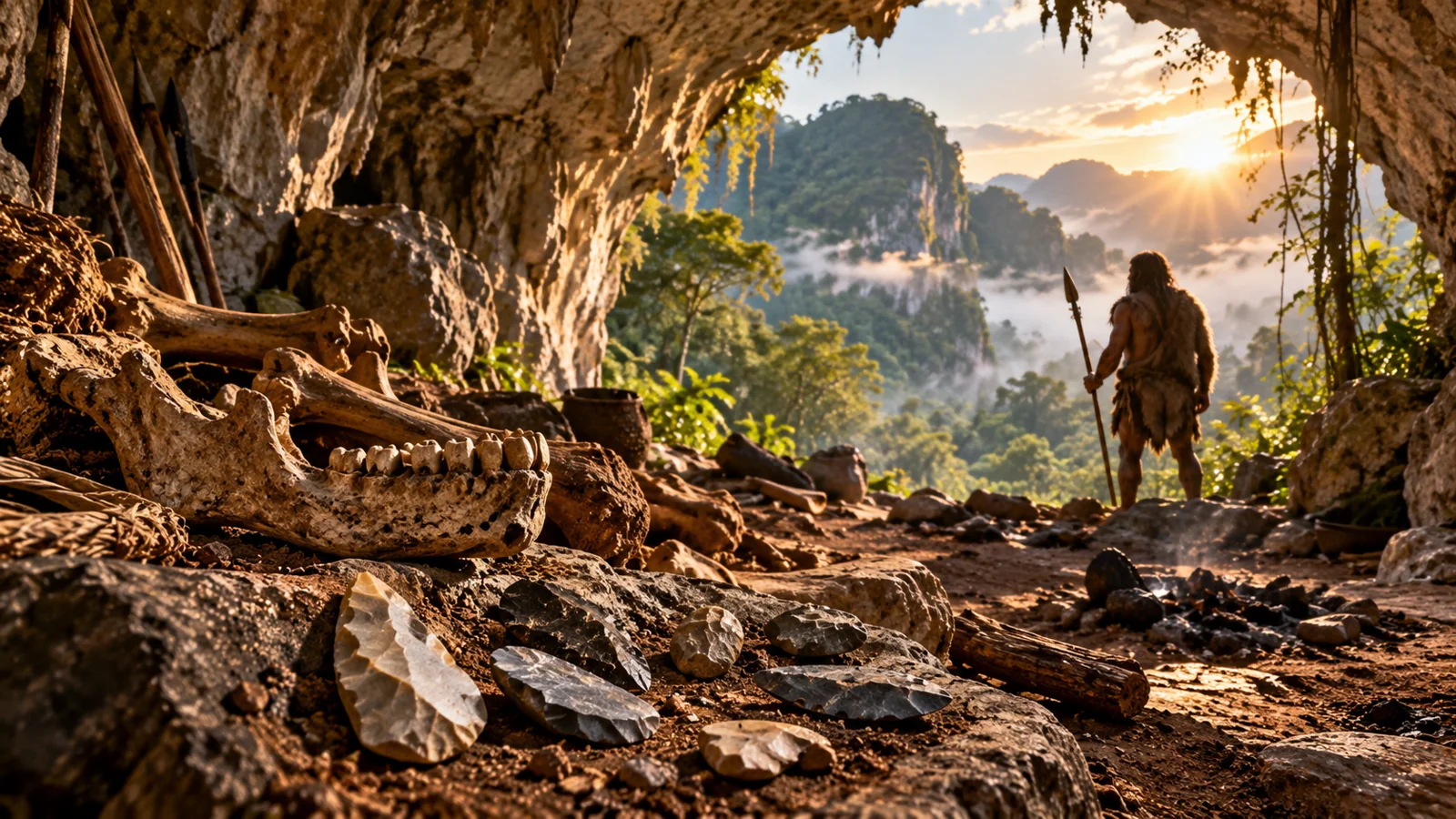
What did Denisovans look like? We have a clearer picture than we did a decade ago, but not a complete portrait. Two Nature studies published on 9 September 2026 identified Denisovan teeth, skull fragments and part of an arm bone from Bianfu Cave in southwestern China. They also connected those remains with a long archaeological record of tools, hunted animals and environmental change. The fossils can tell us about anatomy; they cannot establish every detail of face, skin, hair or clothing.
The new site matters because the earliest Denisovan discoveries were tiny fragments whose ancient DNA revealed an unexpected branch of human history. At Bianfu, scientists used preserved proteins to identify several specimens where ancient DNA could not be recovered. The finds are dated to approximately 167,000–134,000 years ago, while the broader cultural deposits span about 190,000–70,000 years ago. Those are different age ranges, and treating the full archaeological sequence as one continuously occupied Denisovan settlement would overstate the evidence.
What exactly was discovered at Bianfu Cave?
Bianfu Cave lies in Yunnan Province, near routes connecting the Tibetan Plateau, eastern Asia and Southeast Asia. Excavations produced four human-lineage teeth, fragments of skull bone and a proximal radius fragment, together with more than 1,300 stone artefacts and tens of thousands of mammal fossils. The molecular study specifically confirmed two teeth and three bone fragments as Denisovan; not every tooth recovered was individually confirmed in the same way. This distinction matters when news reports use the total number of human fossils as though each received identical laboratory testing.
The authors screened more than 60,000 fragmentary bones. They first narrowed down candidates by anatomy, then used collagen fingerprinting and deeper protein sequencing to distinguish human-lineage material from deer, bovids and other animals. The result is a rare combination of identified Denisovan fossils and archaeological context. See the original protein-identification paper and the companion archaeology paper.
| Evidence | What researchers observed | What it can establish |
|---|---|---|
| Two teeth and three bone fragments | Denisovan-associated protein signatures | Identity of tested specimens |
| Proximal radius fragment | Part of an arm bone | Limited evidence about arm anatomy |
| More than 1,300 stone artefacts | Worked local materials in multiple layers | Technology used by occupants of the site |
| Cut-marked animal bones | Traces of carcass processing | Evidence consistent with butchery and food use |
| Pollen and animal remains | Environmental clues | Likely forest and forest-steppe conditions |
So what did Denisovans actually look like?
The safest answer is that they were ancient humans with a combination of traits, not a single confidently reconstructed face. Teeth can preserve distinctive crown and root shapes. A skull fragment can constrain some aspects of cranial form, while a radius fragment reveals limited aspects of upper-limb anatomy. None of those isolated parts determines eye colour, hairstyle, facial expression or the exact proportions of an entire body.
The Bianfu radius was particularly valuable because securely identified Denisovan bones from below the skull are rare. Researchers reported a mixture of similarities: some aspects resemble Neanderthal anatomy, while the overall shape also shows affinities with modern humans. That is not proof that Denisovans were visually identical to either group. Anatomical traits vary among individuals and populations, and one fragment cannot settle body-wide appearance.
Can the Harbin skull show us a Denisovan face?
The nearly complete Harbin cranium from northeastern China has been linked to Denisovans through molecular research published in 2025. That is a major advance because a relatively complete skull supplies information that small teeth alone cannot. Yet a skull is not a photograph: soft tissue thickness, nose and ear shapes, skin pigmentation and hair remain partly inferential. Even a convincing museum reconstruction should be labelled as an artist’s interpretation rather than a verified likeness of every Denisovan population.
The name “Dragon Man” and the proposed species name Homo longi have their own taxonomic history. Whether all fossils grouped under particular species names should be considered Denisovan is still being debated. A genetic or protein-based lineage does not map automatically onto one universally accepted Latin species label.
How did scientists identify Denisovans without DNA?
Ancient DNA is a powerful identification tool, but it breaks down more quickly in warm and humid environments. The Bianfu team attempted to recover endogenous ancient DNA from selected remains and did not succeed. They instead examined ancient proteins, particularly collagen, which can survive in bone and tooth material after recoverable DNA has disappeared.
A practical analogy: DNA is the full recipe, while proteins are surviving products made from portions of that recipe. Scientists can compare amino-acid sequences in ancient protein fragments with those known from other humans and archaic relatives. Certain variants help assign a specimen to a lineage. However, protein evidence typically contains much less information than a complete genome and cannot independently tell us the whole ancestry of an individual.
The identification process in four stages
Stage 1 — Context: Record the precise sediment layer and relationship to surrounding finds. Stage 2 — Screening: Select fragments that may belong to hominins rather than animals. Stage 3 — Proteomics: Analyse surviving collagen and other protein fragments for informative amino-acid signatures. Stage 4 — Cross-check: Compare results with tooth and bone anatomy, dating and contamination controls. These stages strengthen an identification but do not eliminate every uncertainty about behaviour or appearance.
What were Denisovans eating and making?
The companion study described stone and simple bone tools and animal remains consistent with processing medium- and large-bodied mammals. Deer and bovids feature prominently. Some bones show cut marks and breakage patterns compatible with butchery and marrow extraction. The picture is of adaptable foragers using the resources available in a changing landscape, not of a population limited to one prey animal or one technology.
The cave deposits cover a broad span of time, and objects from different layers need not have been used by the same family, generation or even continuously resident population. Archaeologists compare layer-by-layer patterns rather than assume one uninterrupted 120,000-year occupation. The absence of identified remains of another human group in the examined layers also does not prove that no other human ever visited the surrounding region.
Why the dates in headlines can be confusing
| Claim | Approximate dates | What the range refers to |
|---|---|---|
| Molecularly identified Denisovan fossils | 167,000–134,000 years ago | Layers containing identified remains |
| Bianfu cultural deposits | 190,000–70,000 years ago | Broader sequence with artefacts and animal fossils |
| First Denisovan identification | 2010 | Modern scientific recognition through ancient DNA |
| Bianfu papers published | 9 September 2026 | Publication date, not discovery date |
The difference between 190,000 and 70,000 years is 120,000 years, but that arithmetic alone does not prove continuous Denisovan occupation throughout every year. A sequence can contain gaps, changes in sedimentation and repeated visits. Similarly, dating a sediment layer does not provide a birthday for an individual fossil. Chronological models combine several measurements and carry uncertainty intervals.
Where did Denisovans live?
Denisovans were first identified at Denisova Cave in Siberia. Subsequent evidence placed them in or near the Tibetan Plateau, the Taiwan Strait and other parts of Asia. The new Bianfu locality in Yunnan fills an important geographic gap between northern and southern evidence. It makes a broad Asian distribution easier to document, but a map of fossil sites is a map of discoveries—not a complete map of where the population once lived.
Preservation affects that map. Dry or cold caves can retain genetic material differently from tropical settings. Archaeologists also investigate places unevenly, and a fossil-rich cave may be easier to study than an open-air settlement. Therefore, the lack of Denisovan remains in a region is not necessarily proof that Denisovans were absent there.
Did Denisovans interbreed with modern humans?
Yes. Genomic studies have demonstrated that ancestors of some living people interbred with Denisovan populations. Denisovan-related ancestry is especially notable in parts of Oceania and Southeast Asia, although percentages vary among populations and across different methods. Certain inherited variants have been linked to adaptation at high altitude, but that does not mean every beneficial variant came from the same Denisovan group or that all Denisovan ancestry has known effects.
The Bianfu fossils do not provide a complete ancient genome, so researchers cannot yet assign these particular individuals to the exact Denisovan population that contributed DNA to any modern group. Geographic proximity to Southeast Asia makes the site relevant to migration hypotheses; it does not establish a direct genealogical connection to a named present-day community.
Denisovans, Neanderthals and modern humans: a careful comparison
| Question | Denisovans | Neanderthals | Homo sapiens |
|---|---|---|---|
| Identification | Ancient DNA and proteins plus a growing fossil record | Extensive fossils and ancient DNA | Extensive fossils and living genomes |
| Anatomy | Still incomplete; some cranial and limb traits known | Relatively well documented skeletons | Extensive global variation documented |
| Geography | Multiple parts of Asia documented | Europe and western/central Asia | Originated in Africa; now worldwide |
| Interbreeding | Evidence with ancestors of living humans | Evidence with ancestors of living humans | Interbred with both lineages |
| Reconstruction certainty | Limited, especially for soft tissues | Greater skeletal evidence; soft tissues inferred | Living anatomy directly observable |
What the discovery does not prove
It does not reveal an exact Denisovan face. Even the best skeletal evidence leaves uncertainty about skin, hair and soft tissue. It does not prove that every tool in every layer was made by a Denisovan. Associations depend on archaeological context. It does not establish a single Denisovan species name accepted by all researchers. The taxonomy remains active. It does not demonstrate that the Bianfu individuals were the direct ancestors of modern populations. That requires more lineage-specific genetic evidence.
Nor does it show that Denisovans were intellectually inferior or superior to other human groups. Stone tools and butchered animals are evidence of practical behaviour in a particular setting, not a standardized intelligence test. Different environments preserve different materials, so comparing apparent tool complexity across sites without accounting for preservation can be misleading.
How to evaluate a new ancient-human headline
Start by checking whether a fossil was identified by DNA, proteins, anatomy alone or association with tools. Next, separate the age of the fossil from the age range of the entire archaeological deposit. Ask whether a reconstruction includes preserved bones or speculative soft tissue. Finally, look for the original paper and see whether its authors use cautious language such as “suggests”, “consistent with” or “may”. Those words are often removed from dramatic summaries.
For example, “Denisovans used bone tools at Bianfu” is a defensible interpretation of the associated archaeological evidence. “Scientists photographed a Denisovan face from 150,000 years ago” is not. The first reports a research inference; the second mistakes reconstruction for direct observation.
Why Bianfu matters for human evolution
The significance is not just the number of fragments. The discovery connects molecular identification, a long archaeological sequence, animal remains, local climate indicators and geography. That allows scientists to investigate how an ancient human population may have adapted to changing forests and prey resources, and how Denisovans occupied a corridor that later became important for human movement across Asia.
The work also demonstrates the promise and limits of palaeoproteomics. Proteins can identify fossils in conditions where DNA recovery fails, opening new regions for investigation. But additional discoveries, especially securely dated skulls and limb bones from multiple places, are needed before a confident account of variation in Denisovan bodies and faces can be written.
What scientists need to find next
A larger sample of securely identified limb bones could help estimate body proportions. Additional skulls from different regions could test whether cranial traits varied substantially among Denisovan populations. Better preserved DNA from nearby or older sites could clarify which groups interbred with modern humans. Archaeological sequences with well-dated tools and food remains could reveal changes in technology and subsistence without assuming all finds represent one continuous population.
Researchers also need transparent methods for comparing ancient protein markers across specimens and laboratories. Confirming the same anatomical patterns in independent samples is stronger evidence than a single spectacular reconstruction. As the fossil sample expands, some currently plausible ideas will probably be revised—and that is normal scientific progress.
The bottom line
The September 2026 Bianfu discoveries make Denisovans less mysterious, but they do not give us a definitive full-body portrait. Five protein-confirmed specimens, including part of an arm bone, add precious anatomical evidence. The associated tools and animal remains reveal how occupants of this landscape lived and processed food. The responsible conclusion is exciting enough without embellishment: Denisovans were widespread, adaptable ancient humans, and the evidence for their bodies and behaviour is finally becoming richer.
Original research and authoritative reading
Nature Portfolio: Lives of Denisovans revealed in southwestern China.
You may also like
 Artificial Intelligence
Why Do We Deny AI Consciousness Even When It Behaves Like a Human? What a 2026 Study Reveals
A study of 1,092 UK participants found that people rate human agents as more conscious than AI even…
 History
The Mystery Yak of Denisova Cave: How Ancient DNA Revealed a Lost Ice Age Species
Twenty ancient nuclear genomes uncovered Yak X, an extinct bovine distinct from modern yaks. Explore its connection to…
 HEALTH
Can Scientists Kill Harmful Gut Bacteria Without Harming Good Bacteria?
A 2026 study found argyrin B could target C. difficile in mice while preserving much of the gut…