
Ubaid Lizard Figurines: What the Reptilian Heads Really Show
Examine real Ubaid figurines with British Museum and Penn Museum records, original photos, a nursing mother’s missing head, and the evidence behind reptilian myths.
Contents
- The two artifacts behind the famous photograph
- Artifact-by-artifact fact check
- What is the Ubaid culture—and is it the same as the Sumerians?
- Close look: the long-headed figure 122872
- Close look: the nursing figure 122873
- What makes the faces look reptilian?
- Were Ubaid people deliberately reshaping human skulls?
- Were they gods, ancestors, toys or burial gifts?
- Not every “Ubaid reptilian” image depicts the same discovery
- A newer find: the Ubaid-style figurine head from Kuwait
- Why the Anunnaki theory is a separate claim
- What changed when archaeologists revisited Woolley’s field notes in 2024?
- What do the photographs prove—and what would test a larger claim?
- How to fact-check any Ubaid figurine photo in five steps
- What we can—and cannot—conclude
- Common questions
- Are the Ubaid lizard figurines genuine?
- How old are the figures?
- Does the nursing statue have a lizard-headed mother?
- Do scholars know why the heads are long?
- Were they found in one secret underground temple?
- Primary sources and image credits
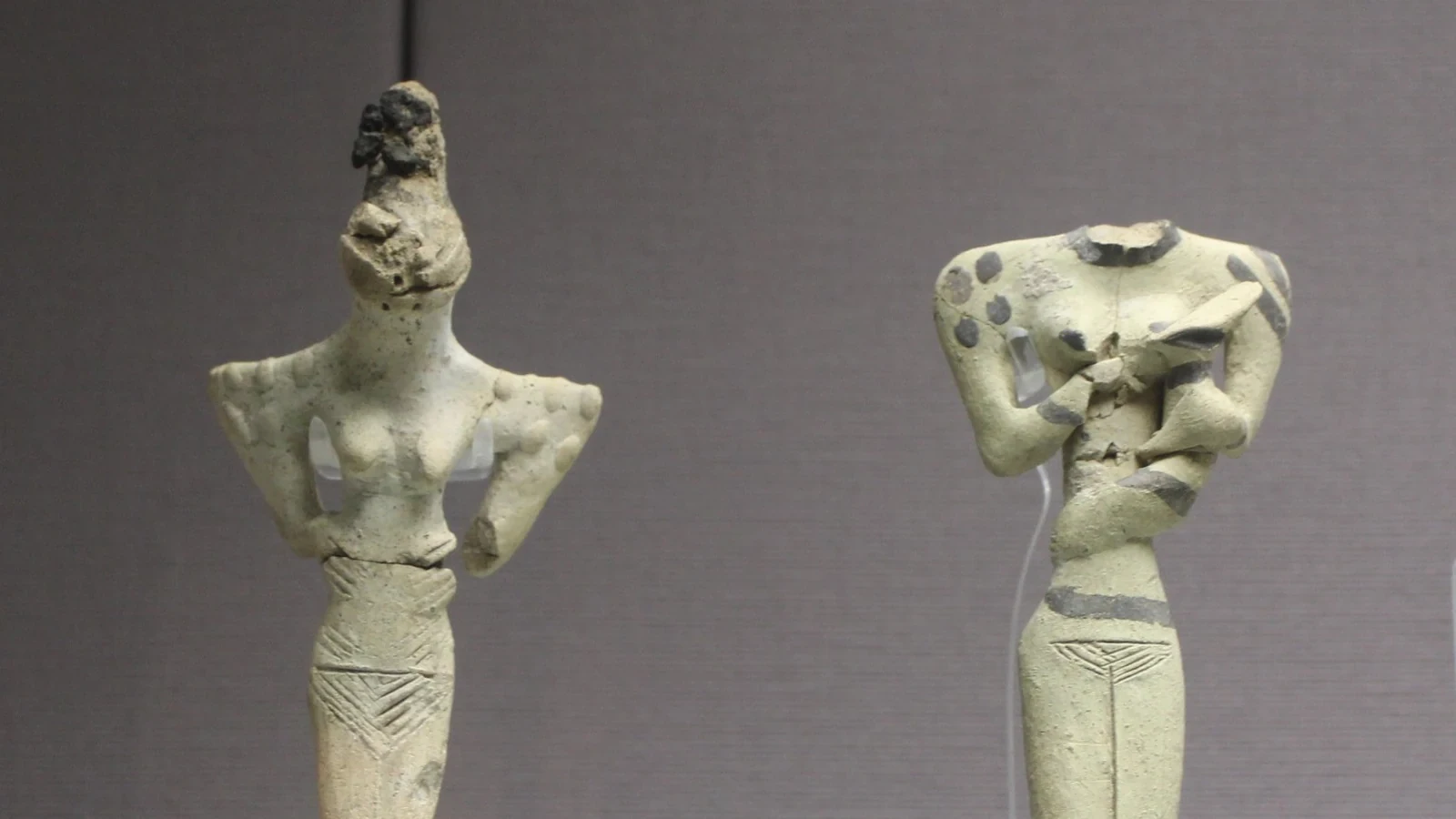
Quick answer: The so-called Ubaid “reptilian” figurines are real prehistoric clay artifacts from Mesopotamia, not verified portraits of a reptilian species or ancient astronauts. Their elongated heads, slanting eyes, angular shoulders and painted markings are documented in museum catalogues. What those features meant to their makers remains debated. The key is to look at each object and its excavation record rather than the dramatic nickname.
Two especially revealing examples photographed at the British Museum come from Ur in southern Iraq. The figure with a long head is catalogued as 122872. Beside it stands 122873, a figure nursing a child. The mother’s head is missing; it is the surviving infant that shows a stylized head. That small but decisive detail changes how the viral image should be described.
The two artifacts behind the famous photograph
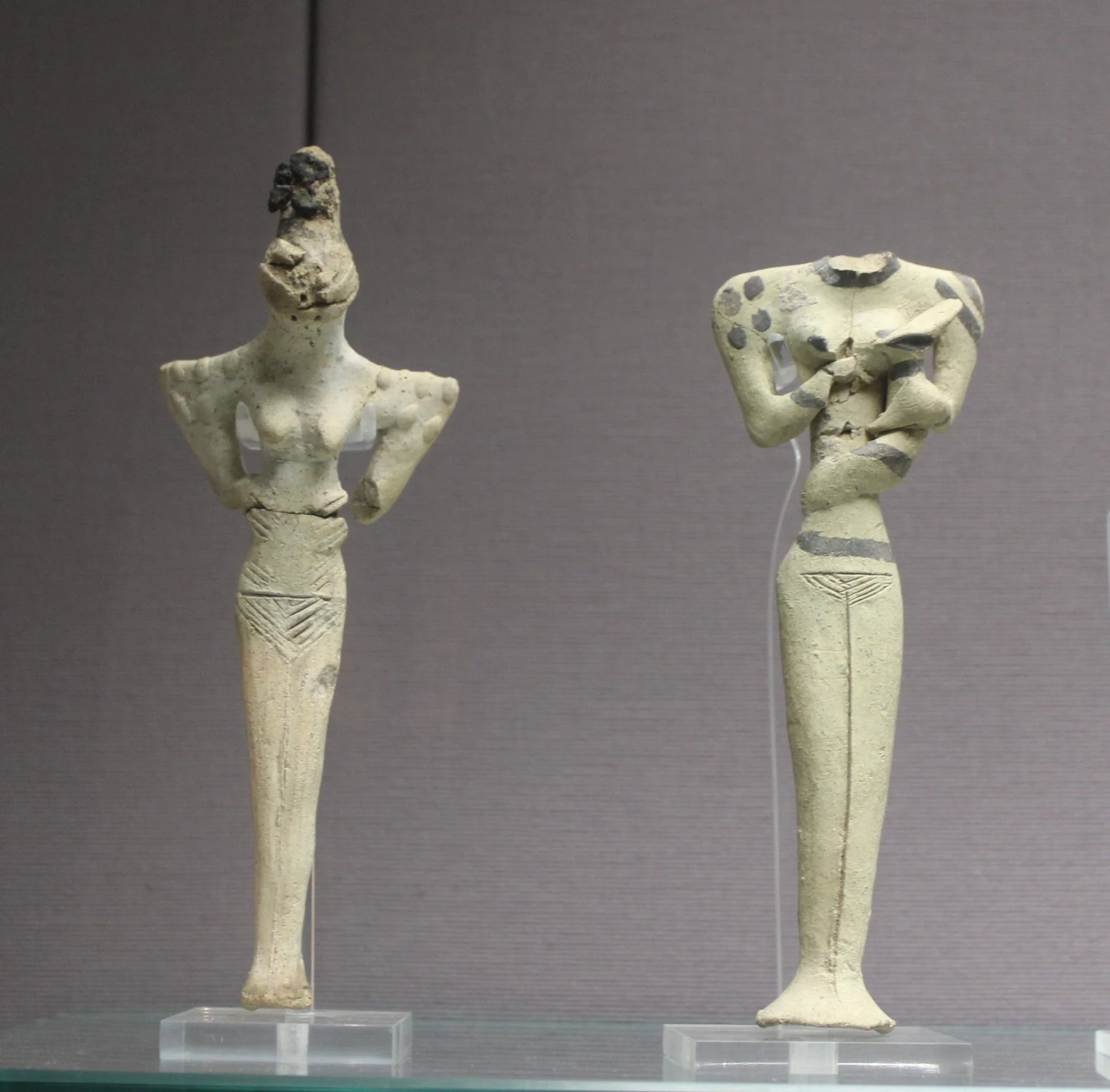
Photo: Zunkir. Museum objects from Ur photographed in the British Museum; resized/re-encoded as WebP. Source: Wikimedia Commons · CC BY-SA 4.0.
These are two distinct artifacts, not a pair of biological specimens. The photograph shows 122872 at left and 122873 at right. The museum objects are about the Ubaid tradition and are often dated in captions to roughly the fifth millennium BCE; broader cultural-date bands on catalogues should not be mistaken for a laboratory date measured directly on each object.
Artifact-by-artifact fact check
| 122872 | Ur, Iraq — Long head and headdress, bent arms, angled shoulders. Motherhood or an alien origin cannot be established from this figure |
|---|---|
| 122873 (U.15376) | Ur, Iraq — Headless adult nursing a child; surviving child head; painted bands and dots. Do not claim both adult and child have reptilian heads |
| 121002 | Southern Iraq; specific excavation spot unspecified in catalogue — Separate detached head with elongated features and black-painted eye slits. Not the head of the nursing mother in the supplied photo |
| 115357 | Eridu (Abu Shahrain), Iraq — Broken head and torso; long eyes and applied strips of clay. A different object from a different archaeological site |
| 31-16-734 | Ur, Iraq — Slanted eyes, bitumen hairstyle, hands at waist. A Penn Museum comparator, not part of the photographed British Museum pair |
The names and provenances above can be checked against the British Museum entry for 121002, the Eridu object 115357, the Penn Museum object 31-16-734 and the scholarly catalogues reproduced in Ur 1922–2022 (2024).
What is the Ubaid culture—and is it the same as the Sumerians?
“Ubaid” is an archaeological label for an interconnected set of material traditions across parts of the ancient Near East. It takes its name from Tell al-Ubaid in southern Iraq, not from a supposedly named reptile people. Museum and scholarly chronologies differ in their boundaries: the Metropolitan Museum of Art summarizes the Ubaid period as roughly 5500–4000 BCE, while different sites or subphases can be assigned wider or narrower dates. The figurines were produced long before the later cuneiform texts through which we know many Sumerian stories.
The Ubaid world included villages and increasingly substantial settlements, with farming, irrigation, fishing, distinctive pottery, social networks and early ceremonial architecture. Sites associated with Ubaid material include Ur, Eridu, Tell al-Ubaid and others across Mesopotamia and the Gulf. The Ubaid did not appear in the archaeological record as one uniform, genetically defined “race.” See the Metropolitan Museum’s historical overview and Augusta McMahon’s study of Tell al-Ubaid and Ur.
Close look: the long-headed figure 122872
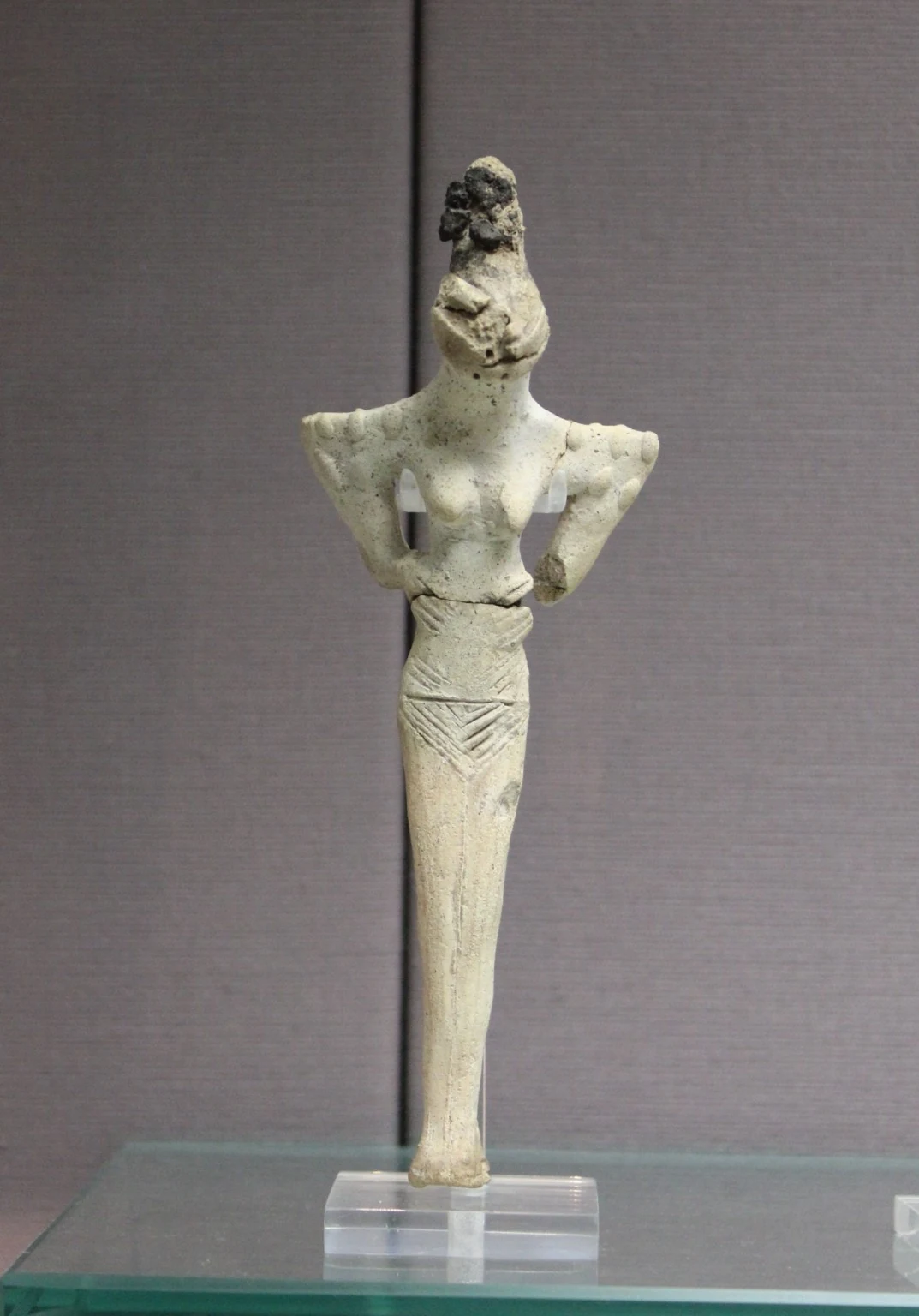
Photo: Zunkir. Museum objects from Ur photographed in the British Museum; resized/re-encoded as WebP. Source: Wikimedia Commons · CC BY-SA 4.0.
The left-hand figure combines a narrow, elongated face with an unusually high coiffure or head covering, a defined chest, shoulders angled outward and arms resting toward the waist. In the 2024 scholarly reappraisal by Ellen McAdam, this is excavated object U15380 / British Museum 122872, associated with Grave Q at Ur. The author records clay modelling, traces of paint and a bitumen headdress; that material is a clue to dress or styling, not biological anatomy.
It is easy to point at the eyes and see a snake, lizard or alien. Yet a visual resemblance does not establish what an artist intended, much less what species the artist saw. The body follows recognizable anthropomorphic conventions, with deliberately exaggerated proportions. An object that resembles a reptile to modern viewers can still be a highly stylized representation of a person, character or symbolic being.
Close look: the nursing figure 122873
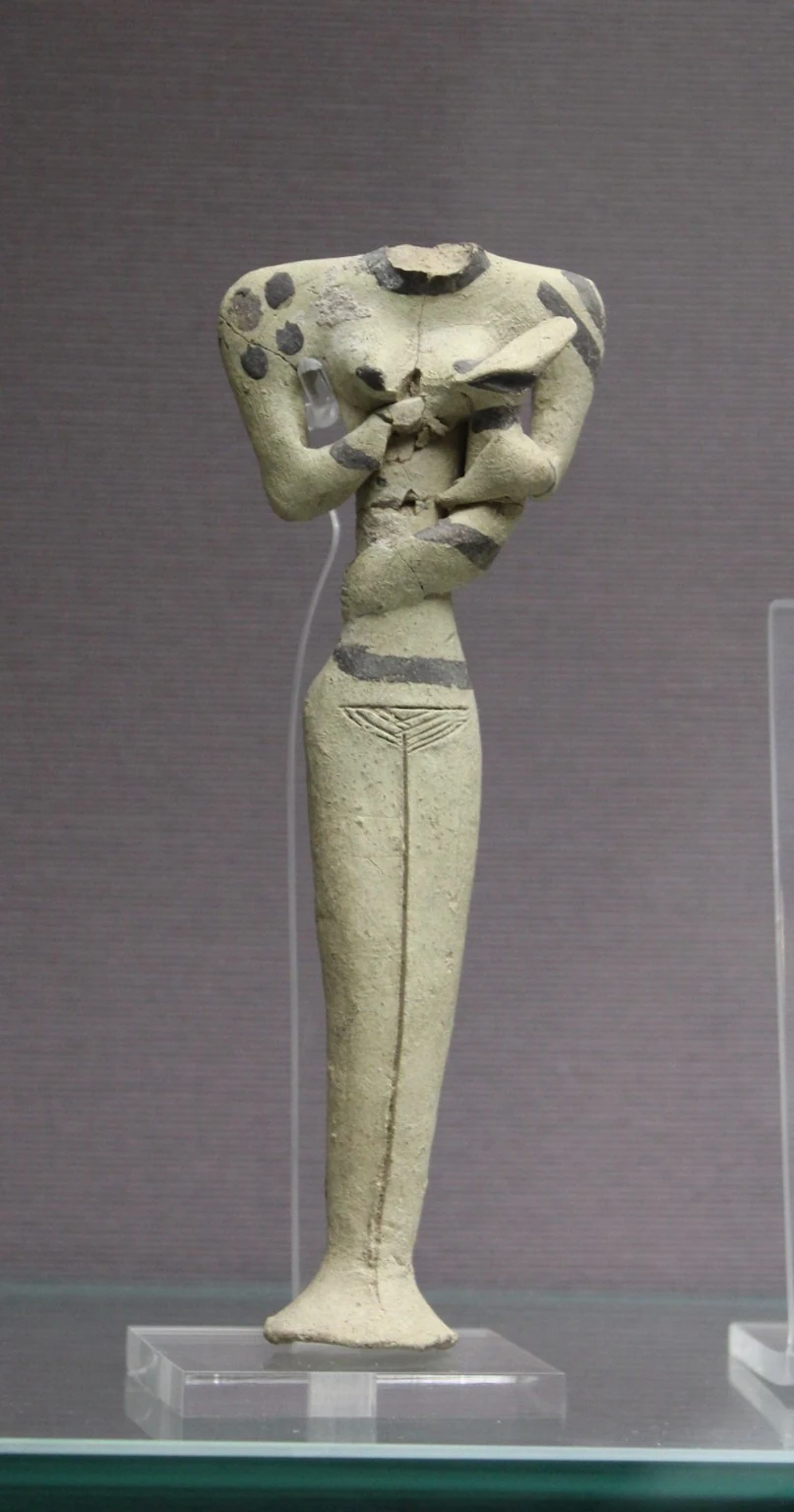
Photo: Zunkir. Museum objects from Ur photographed in the British Museum; resized/re-encoded as WebP. Source: Wikimedia Commons · CC BY-SA 4.0.
The other figure offers a crucial correction. The adult is portrayed with a child held to the chest, and the adult’s neck ends in a broken stump. The head of the adult cannot be used as evidence for any particular facial type: it is gone. The infant’s head is visibly elongated, while the body retains black dots and bands that museum specialists discuss as possible body decoration, ornaments or markings.
McAdam identifies this figure as U15376 / British Museum 122873, associated in the excavation reappraisal with Grave O at Ur. The report also explains why the original excavation context deserves caution: parts of the grave were difficult to excavate and the surviving bones were scant. A museum record or a popular description can simplify field context; a grave attribution should therefore be read alongside the excavation publication instead of automatically becoming “a perfectly intact sealed tomb.”
A nursing subject does not by itself establish a fertility cult. That interpretation is possible, but so are other social, protective, ancestor-related or representational roles. The exact use is not known; the motherhood scene tells us what is depicted, not how the object was used.
What makes the faces look reptilian?
- Elongated or pointed head: a modeled hairstyle, a deliberate facial convention or symbolic exaggeration could affect the silhouette.
- Slit- or coffee-bean-shaped eyes: an artistic convention found across several Ubaid examples, not measurable evidence of reptile physiology.
- Nostril holes and narrow mouths: simplified clay modelling can make human-like faces seem unfamiliar.
- Pellets, spots and painted stripes: possible jewelry, clothing, tattoos, scarification or symbolic marks; the meaning of each motif is disputed.
- Bitumen on the top of the head: a material explicitly documented in museum records and often interpreted as hair or a headdress.
The Yale eHRAF Ubaid summary notes the recurring “coffee bean” eyes. The British Museum catalogue even uses the descriptive expression “reptilian features” for a separate fragment. That expression records an appearance; it does not classify the figure as a literal animal-human hybrid.
Were Ubaid people deliberately reshaping human skulls?
Artificial cranial modification was practiced in a number of prehistoric societies, and published archaeology discusses evidence in Ubaid-related contexts. Kirsi O. Lorentz’s chapter, “Ubaid Headshaping: Negotiations of Identity through Physical Appearance?” in the University of Chicago volume Beyond the Ubaid (2010), considers head shaping and identity. It offers a plausible context for distinctive head representations, not proof that every long-headed figurine is a portrait of a reshaped human skull.
One should keep three claims separate: people may have altered head shape; potters may have represented that practice in art; the artifacts might instead encode another symbolic convention. The first does not automatically prove the other two. Aurelie Daems’s study of ophidian figurines also treats the category as an archaeological problem rather than a discovered non-human species.
Were they gods, ancestors, toys or burial gifts?
Archaeologists consider several possible functions: votive or ritual pieces, symbols of identity, figures linked to birth and family, ancestor representations, or objects used in everyday life. None is established for every specimen. Some examples were found in graves, while others come from occupation or disturbed contexts. Different deposition contexts weaken any claim that a single ritual explanation fits the whole group.
Material and manufacture also matter. Clay figures can break during making, use, burial or excavation; missing limbs and heads do not automatically mean deliberate mutilation. McAdam’s new analysis discusses variable styles and fabrication histories, and specifically warns that inaccurate modern replicas exist. If a spectacular image appears online with no museum number, it may not even show the authentic object.
Not every “Ubaid reptilian” image depicts the same discovery
A common viral mistake collapses Tell al-Ubaid, Ur and Eridu into one location, or treats every photographed female figure as the same specimen. These were distinct ancient sites, even though they shared material traditions. For example, the British Museum’s 115357 fragment was excavated at Eridu; 121002 is a small separate head recorded from southern Iraq; the photographed pair 122872 and 122873 are from Ur. An object number is the quickest way to resolve confusion.
A newer find: the Ubaid-style figurine head from Kuwait
The story did not end with the early digs in Iraq. In 2024, a Kuwaiti–Polish archaeological mission reported a small clay figurine head at Bahra 1 in northern Kuwait. Researchers described an elongated cranium, slanted eyes and flattened nose characteristic of the Ubaid figurine style. The university reported it as the first example of that type found in the Gulf region. It comes from a different site and context—not from the British Museum pair—and does not demonstrate extraterrestrial contact. See the University of Warsaw discovery announcement.
Why the Anunnaki theory is a separate claim
The popular online chain often runs: ancient figurines have lizard-like faces → they represent reptilian humanoids → those beings were the Anunnaki → the Anunnaki were extraterrestrials. Each arrow is an unproven inference. The figurines are prehistoric artifacts; “Anunnaki” refers to deities attested in later Mesopotamian written traditions. No preserved inscription identifies 122872 or 122873 as an Anunnaki, and museum catalogues do not classify the objects as evidence of spacecraft, genetic engineering or a biologically distinct reptile population.
For a source-based discussion of the actual Mesopotamian texts, read our separate investigation of the Anunnaki, Nibiru and ancient-astronaut claims. Connecting related mysteries can be interesting; presenting the connection as an excavation finding would be misleading.
What changed when archaeologists revisited Woolley’s field notes in 2024?
The modern reassessment is more than a new photograph of old objects. The 2024 volume Ur 1922–2022 includes Ellen McAdam’s detailed study of excavated figurines and Augusta McMahon’s reassessment of the Ubaid levels at Ur. These studies revisit objects, excavation labels, grave contexts and style changes. One reason simple viral timelines are unreliable is that early excavators used their own phase labels, and later scholars have revised how deposits and ceramic sequences correlate. The right question is not “Did someone find a reptile in 1919?” but “Which catalogued object, in which deposit, with which accompanying material, and how secure is that attribution?”
What do the photographs prove—and what would test a larger claim?
A photograph can prove that an unusual design exists and can display preserved details; it cannot verify the identity of the subject. A claim that the potters represented actual non-human visitors would need independent evidence: for example, unambiguous contemporary inscriptions, securely dated associated remains with diagnostic non-human anatomy, or other convergent archaeological data. None has been established for these pictured objects. In contrast, different hypotheses about social identity, art style and ritual use can be compared with distributions of figurines, pottery, graves, wear and manufacturing traces.
It is equally important not to turn the archaeological conclusion into unwarranted certainty. “The artifacts do not demonstrate aliens” does not mean scholars have decoded their full ancient meaning. Their function remains a legitimate historical question, even where the viral claim is unsupported.
How to fact-check any Ubaid figurine photo in five steps
- Identify the exact object rather than a circulating nickname: look for museum inventory numbers such as 122872 and 122873.
- Verify the actual findspot: Ur, Eridu, Tell al-Ubaid and sites farther away are not interchangeable.
- Compare the surviving parts with the caption. In 122873, it is the mother’s head that is absent.
- Separate a broad cultural date from the date of a particular excavation layer and the date the modern photograph was taken.
- Ask what independent evidence would support the claim. An odd shape alone is evidence of unusual design—not of extraterrestrial biology.
What we can—and cannot—conclude
| These are genuine Ubaid-period clay figures | Museum objects, photographs and excavation documents | Well supported |
|---|---|---|
| Certain faces were intentionally stylized | Repeated archaeological forms and manufacturing details | Well supported |
| The images prove a reptilian species existed | No anatomical, textual or archaeological corroboration | Not supported |
| Every figure was a fertility goddess | Some mother-and-child motifs, but purpose uncertain | Unresolved |
| Head shaping inspired all elongated faces | Head modification has been studied, but no one-to-one proof | Possible, not proven |
| The infant in 122873 has a stylized head | Direct observation of object and catalogue descriptions | Supported; the mother has no surviving head |
Common questions
Are the Ubaid lizard figurines genuine?
Yes. Examples are preserved in the British Museum and Penn Museum and published in excavation and academic records. Their authenticity does not verify supernatural or extraterrestrial explanations.
How old are the figures?
They are prehistoric artifacts associated with the Ubaid tradition, commonly assigned to the fifth millennium BCE in accounts of the Ur finds. Cultural period ranges differ by site and source; avoid assigning one exact year to every object.
Does the nursing statue have a lizard-headed mother?
No surviving head is attached to the mother in British Museum 122873. The surviving child has an unusually stylized head. Describing both heads as “reptilian” misrepresents the object.
Do scholars know why the heads are long?
Not conclusively. Artistic convention, symbolism, hairstyles or headdresses and social body-modification practices are discussed, but no universally proven meaning exists.
Were they found in one secret underground temple?
No. Objects of this type have been recorded from multiple Mesopotamian sites and contexts, including cemetery and settlement contexts. That is not evidence of a secret alien complex.
Primary sources and image credits
Core records: Metropolitan Museum of Art: Ubaid period; Ellen McAdam and Augusta McMahon, Ur 1922–2022 (2024); British Museum via Google Arts and Culture: nursing figure; Penn Museum 31-16-734; British Museum 115357.
Research: Aurelie Daems (2010), ophidian figurines; Beyond the Ubaid, University of Chicago, including Lorentz on head shaping; University of Warsaw announcement on Bahra 1.
Photography in this article, including the featured image: Zunkir, pair photograph, object 122872, and object 122873, via Wikimedia Commons; Creative Commons Attribution–ShareAlike 4.0. Images converted/resized to WebP, with a separate 16:9 crop of the pair photograph for the landscape cover; the museum artifacts themselves are not redrawn. The image license applies to the photographs and adaptations, not automatically to the entire article.
You may also like
 History & Civilizations
Buto Discovery: How Radar and Excavation Revealed a Buried Saite Building
At ancient Buto in Egypt, satellite radar, electrical surveys and excavation reveal a buried Saite-era mudbrick structure. See…
 History & Civilizations
Grey Aliens: Where Did the Big-Eyed Greys Story Begin?
A documented investigation into the origin of Grey alien imagery, the Hill encounter and the difference between historical…
 History & Civilizations
How Do Archaeologists Date Ancient Artifacts? Radiocarbon, Layers, Pottery and the Limits of Scientific Dating
How do archaeologists date ancient artifacts? Compare carbon-14, stratigraphy, tree rings and pottery dating with practical examples and…