
Who Were the Anunnaki? The Complete Story of Sumerian Gods, Nibiru and Alien Claims
The Anunnaki are attested in Mesopotamian texts—but do those tablets describe ancient gods or visitors from space? This detailed guide traces the myths, Nibiru claims and surviving evidence.
Contents
- Who were the Anunnaki—and why is their story so controversial?
- The Mesopotamian setting: Sumer, Akkad, Babylonia and Assyria
- What does Anunnaki actually mean?
- Seven, fifty or six hundred gods?
- Anu, Enlil, Enki, Inanna and other divine figures
- The creation of humans: labor, clay and divine purpose
- The great flood: Atrahasis, Ziusudra and Utnapishtim
- Inanna’s descent: seven Anuna judge the goddess
- The Anunnaki, Igigi and the underworld
- How the ancient-astronaut theory became popular
- Nibiru and the unrelated Planet Nine hypothesis
- Gold mining, DNA and alleged ancient technology
- Reliefs, winged figures and misleading images
- What the evidence supports—and what remains uncertain
- Primary texts and scholarly sources
The Anunnaki are attested in Mesopotamian texts—but do those tablets describe ancient gods or visitors from space? This detailed guide traces the myths, Nibiru claims and surviving evidence.
Who were the Anunnaki—and why is their story so controversial?
The Anunnaki enter the historical record through cuneiform writing in ancient Mesopotamia, not through evidence of visiting spacecraft. The name refers to groups of deities in Sumerian and Akkadian religious traditions. Modern entertainment has transformed them into alleged extraterrestrial visitors, often blending authentic mythological names with claims absent from the ancient sources.
To reconstruct the story, we must distinguish three things: what surviving tablets say, what historians and Assyriologists infer from them, and what modern speculative authors added thousands of years later. These are not interchangeable forms of evidence. There was no single, timeless Anunnaki doctrine shared by every Mesopotamian city.
Our sources span different languages, centuries, political systems and religious settings. Even the membership and number of the Anunnaki vary across texts, making any single definitive family tree or biography misleading.
The Mesopotamian setting: Sumer, Akkad, Babylonia and Assyria
The earliest urban traditions associated with the Sumerians developed in southern Mesopotamia, in cities such as Uruk, Ur, Eridu, Nippur and Lagash. Temple communities and scribal schools recorded hymns, administrative documents, ritual texts and mythological narratives on clay tablets. Akkadian-speaking cultures inherited and reshaped many of these traditions.
No ancient author left a comprehensive book titled The Story of the Anunnaki. Researchers instead compare scattered references in myths, royal inscriptions, god lists and ritual literature. Some tablets survive only in fragments, and a composition copied in a later century need not preserve every detail of an earlier version.
The existence of these ancient texts is archaeologically established. The separate claim that their divine characters were biological visitors from another planet would require independent evidence, which the tablets do not supply.
What does Anunnaki actually mean?
Sumerian forms include Anuna and Anunna; Akkadian versions include Anunnaki and Anunnaku. Scholarly discussions suggest a sense resembling “those of princely seed,” although the etymology is not absolutely settled. The popular assertion that the word literally means “those who came from heaven to Earth” is not an accepted academic translation.
In some Sumerian contexts the term denotes leading gods, or the gods associated with a particular city. In later settings it can refer especially to underworld deities. The meaning therefore depends on which text and period one is reading.
The ORACC Ancient Mesopotamian Gods and Goddesses project traces early attestations to post-Akkadian sources including Gudea inscriptions and Ur III material, with Akkadian forms continuing into much later periods.
Seven, fifty or six hundred gods?
There is no universally correct count. One source refers to fifty Anunna of Eridu; Inana’s Descent portrays seven Anuna as underworld judges; the Babylonian creation epic Enuma Elish describes a distribution of hundreds of Anunna between heaven and the netherworld.
These are literary and theological figures, not archaeological headcounts of a population. It is especially misleading to combine numbers from separate compositions and present the result as a census of alien beings.
No single known iconographic type securely depicts the Anunnaki collectively. Ancient reliefs can represent individual deities or protective beings without proving that every winged figure belongs to one supposed race.
Anu, Enlil, Enki, Inanna and other divine figures
An, called Anu in Akkadian, personified the heavens and represented supreme authority in many traditions. He is sometimes described as the father of the Anunna. Enlil was strongly associated with divine kingship and decisions about cosmic order, while Enki, or Ea, was connected with wisdom, fresh water and inventive solutions in myth.
Inanna, known as Ishtar in Akkadian traditions, figures prominently in stories of power, sexuality, conflict and descent to the underworld. Ereshkigal rules that underworld in a major narrative, while mother goddesses appear in various accounts of creation.
These relationships were not fixed across millennia. Cities promoted different patron deities and scribal traditions reorganized genealogies. The term Anunnaki therefore should not be treated as a permanent roster of the same named individuals.
The creation of humans: labor, clay and divine purpose
In the Akkadian Atrahasis epic, younger gods struggle under burdensome labor and rebel. Human beings are then created to take over tasks previously assigned to gods. The story expresses a religious explanation of work and humanity’s relationship to the divine world.
Other Mesopotamian compositions tell creation differently, sometimes invoking clay and a divine element. None of these passages describes DNA sequencing, a laboratory, or genetic engineering in the modern scientific sense. Such vocabulary belongs to recent reinterpretations.
The Igigi, another grouping of gods, feature in discussions of divine labor, but the relationship between Igigi and Anunnaki changes across texts. It is inaccurate to assume that every divine laborer in every story is an Anunnaki gold miner.
The great flood: Atrahasis, Ziusudra and Utnapishtim
Flood stories are among the most memorable elements of Mesopotamian literature. Atrahasis survives catastrophe after receiving a warning; related but distinct traditions concern the Sumerian Ziusudra and Utnapishtim in Tablet XI of the Epic of Gilgamesh.
The narratives differ in divine motivations, storytelling details and theological emphasis. Their similarities help historians study the movement and transformation of stories across the ancient Near East. They do not independently establish a planet-wide flood or extraterrestrial intervention.
Careful comparison asks which deity makes a decision in each version, who warns the human survivor, and what the tale communicates about divine authority, mortality and the precariousness of human life.
Inanna’s descent: seven Anuna judge the goddess
The Sumerian poem Inana’s Descent to the Netherworld recounts the goddess abandoning her heavenly and earthly stations to enter the realm of Ereshkigal. She passes through gates and loses the insignia of her status. Seven Anuna then pronounce judgment, and the narrative describes her death.
Enki later devises a means of rescue, leading to the complicated question of who must replace Inanna below. The story explores mortality, authority and the boundaries separating worlds rather than the mechanics of an underground alien base.
The Electronic Text Corpus of Sumerian Literature at Oxford provides the surviving text and an English translation, allowing readers to check the seven judges episode directly instead of relying on isolated social-media quotations.
The Anunnaki, Igigi and the underworld
In some later sources the Igigi are distinguished as heavenly gods while the Anunnaki are associated with the underworld. Elsewhere the categories overlap or the Anunnaki encompass leading gods more generally. The distinction is historically variable, not a universal cosmic chain of command.
The underworld itself belongs to Mesopotamian religious geography: a realm of death, divine judgment and ritual imagination. Reading every mythical location as a literal military installation or physical excavation site disregards the literary genre.
Contradictory internet charts often arise because they splice together texts separated by centuries as if they were chapters of a single modern novel.
How the ancient-astronaut theory became popular
Zecharia Sitchin popularized a radically different interpretation in his 1976 book The 12th Planet. In his account, the Anunnaki were extraterrestrials from Nibiru who traveled to Earth, sought gold and influenced human origins through advanced technology.
That narrative is a modern speculative construction, not a recognized translation of Sumerian or Akkadian sources. Mainstream Assyriology does not find cuneiform evidence for Anunnaki spacecraft, an extraterrestrial gold-mining colony or laboratory engineering of humans.
The theory is important as a modern cultural phenomenon: it illustrates how ancient religious names can be incorporated into science-fiction-like explanations. Its popularity, however, is not evidence of historical accuracy.
Nibiru and the unrelated Planet Nine hypothesis
The name Nibiru appears in ancient Babylonian astronomical and religious contexts, but it does not straightforwardly denote the fictional alien home world of popular videos. NASA has stated that there is no observational evidence for the supposed Nibiru planet claimed to be approaching Earth or threatening collision.
A different topic is the hypothetical Planet Nine: astronomers have proposed that an undiscovered distant planet might explain unusual orbital patterns in the outer solar system. It remains hypothetical and has not been directly observed. It is not scientifically connected to Anunnaki mythology or Sitchin’s claims.
The phrase “unknown planet” is not enough to link an astronomical research hypothesis to a modern mythological story. The standards of evidence are different.
Gold mining, DNA and alleged ancient technology
A recurring online claim says the Anunnaki needed gold to repair their planet’s atmosphere and engineered humans to mine it. No established cuneiform passage describes such an atmospheric repair program, genetic laboratory, DNA manipulation or extraterrestrial mining operation.
Myths that describe the creation of humans from clay and divine material use symbolic religious language. They cannot be converted into modern molecular biology simply by substituting scientific-sounding words for the original imagery.
A useful fact-checking method is to request the tablet designation, line numbers and a scholarly edition or translation. Then compare the passage with the claim. If the alleged detail is missing from the actual text, its presence in a popular retelling proves nothing about antiquity.
Reliefs, winged figures and misleading images
Online videos frequently show winged guardians, robed figures and objects resembling bags or cones as purported proof of Anunnaki equipment. Yet the meaning of ancient symbols must be investigated through their archaeological context, inscriptions and established iconographic conventions.
Some images are Assyrian rather than Sumerian; others come from unrelated cultures. ORACC notes that no distinct collective iconography of the Anunna is known, although individual deities certainly have recognizable symbols.
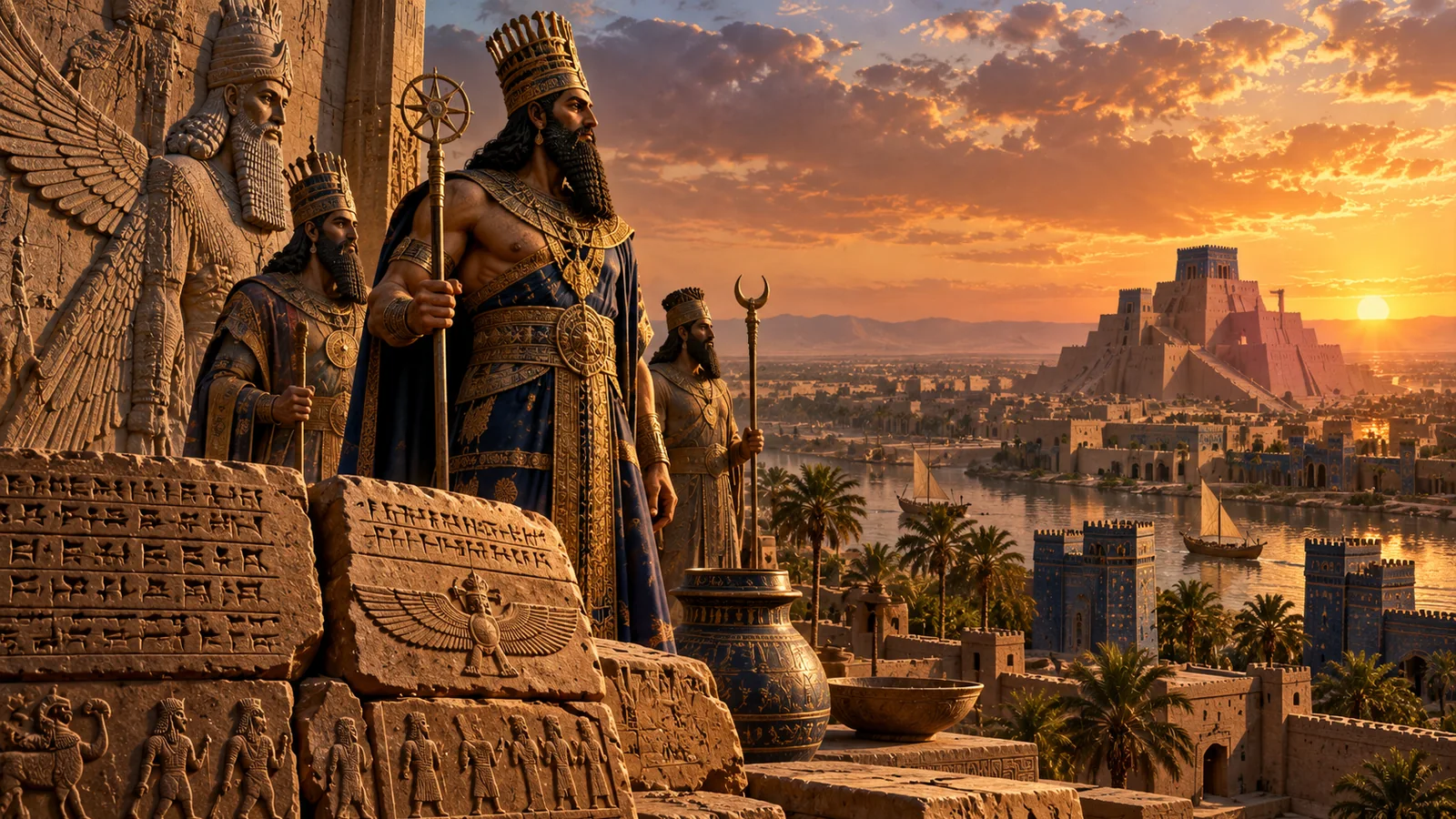
For responsible presentation, museum objects should be labeled with provenance and date where available. The featured artwork accompanying this article is an AI-generated historical illustration, not an authentic excavated artifact.
What the evidence supports—and what remains uncertain
The Anunnaki are real as figures in documented Mesopotamian religious traditions. The texts illuminate ancient ideas about kingship, labor, creation, death and divine judgment. They do not establish that an alien civilization founded humanity or visited Earth.
Important uncertainties remain: damaged tablets, shifting terminology, disputed interpretations and lost versions mean historians cannot reconstruct every local tradition perfectly. Recognizing uncertainty is different from inserting unsupported certainty into those gaps.
The fullest Anunnaki story is therefore two histories at once: an ancient history of Mesopotamian religious imagination and a modern history of how popular culture reinterpreted those sources through the lens of extraterrestrial speculation.
Primary texts and scholarly sources
You may also like
 History & Civilizations
 Nephilim: The Complete Story of Ancient Giants, Watchers, Enoch and the Flood
The Nephilim are often described online as giant humans, fallen angels, or extraterrestrial hybrids. The documentary starting point…
 History & Civilizations
 The Apkallu: Complete History of the Seven Sages, Enki, Oannes and the Flood
Ancient Mesopotamian traditions describe extraordinary sages who belonged to the world before the Flood and were associated with…