
The Apkallu: Complete History of the Seven Sages, Enki, Oannes and the Flood
Ancient Mesopotamian traditions describe extraordinary sages who belonged to the world before the Flood and were associated with divine wisdom, early kingship, and the god Enki. The Akkadian word apkallu, related to Sumerian abgal
Contents
- The Apkallu: Why the Seven Sages Still Fascinate Us
- What Does Apkallu Mean?
- The Historical Setting: More Than One Civilization
- Eridu, Enki, and the Apsu
- A Story About the Arrival of Knowledge
- Who Were the Seven Sages?
- Uanna and Oannes, the Sage From the Sea
- Was Oannes the Same as Adapa?
- The Sages and Kings Before the Flood
- Why the Flood Changes Everything
- The Scholars Who Came After
- Why Do Some Apkallu Wear Fish Skins?
- Bird Heads, Human Faces, and Wings
- The Bucket, Cone, and Sacred Tree
- Protective Figurines Buried Under Floors
- Are the Apkallu the Anunnaki?
- What About Enoch and the Watchers?
- Where Did the Alien Interpretation Come From?
- Evidence, Myth, and Modern Speculation
- Why the Apkallu Matter Today
- Conclusion
- Museum Collections and Further Reading
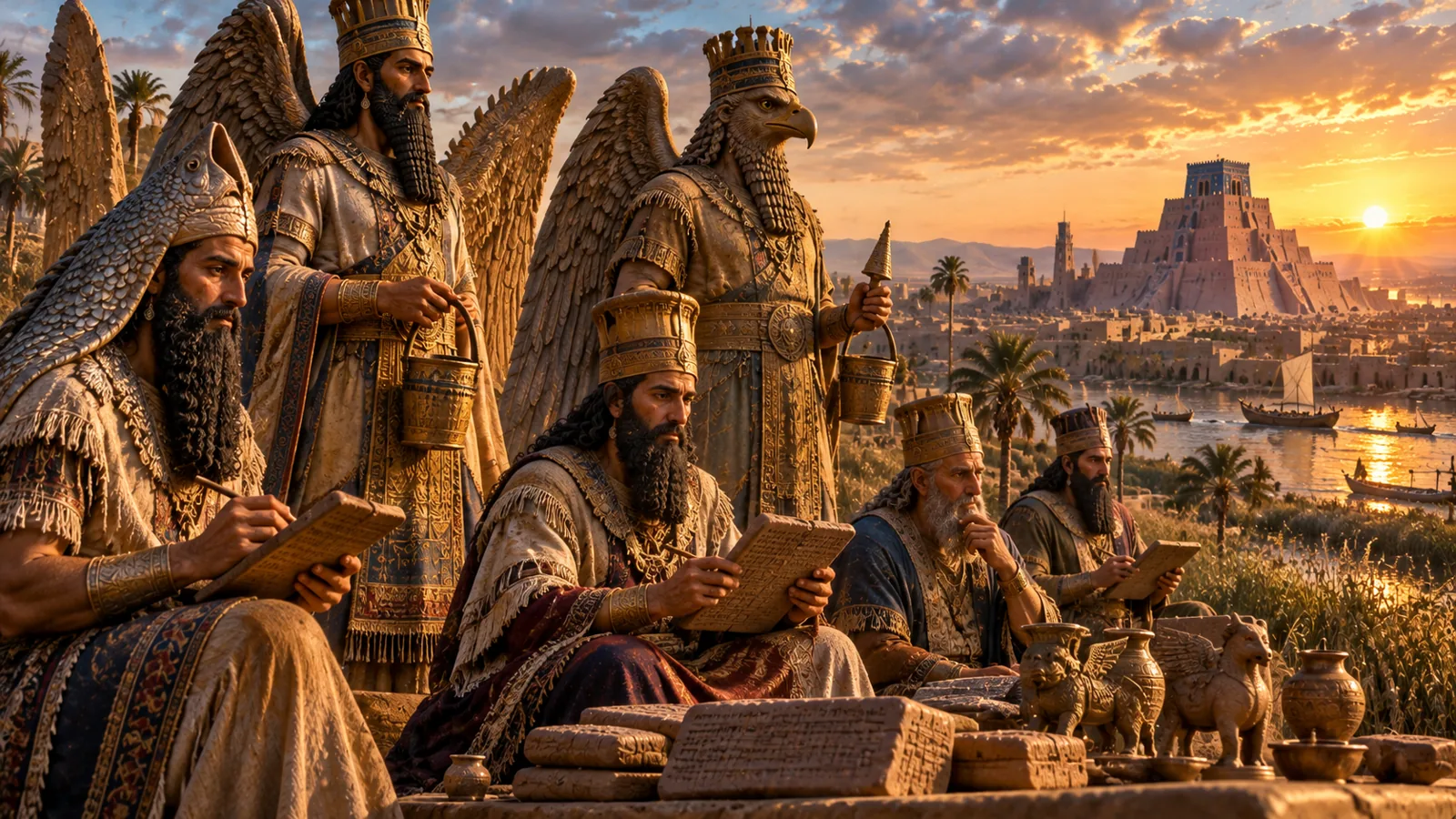
The Apkallu: Why the Seven Sages Still Fascinate Us
Ancient Mesopotamian traditions describe extraordinary sages who belonged to the world before the Flood and were associated with divine wisdom, early kingship, and the god Enki. The Akkadian word apkallu, related to Sumerian abgal, broadly denotes a sage. Their story is not established evidence of extraterrestrial visitors. It is a window into how communities in Sumer, Babylonia, and Assyria explained civilization, knowledge, ritual, and legitimate authority.
What Does Apkallu Mean?
Apkallu can mean a wise or exceptionally learned figure. In some sources it refers to the famous seven antediluvian sages; in others the word belongs to a wider world of ritual specialists and protective beings. Consequently, not every winged figure in an Assyrian relief should be identified as one particular named member of the seven. Definitions depend on the text, date, and context.
The Historical Setting: More Than One Civilization
The relevant evidence spans many centuries and several cultural traditions. Early southern Mesopotamian cities such as Eridu and Uruk shaped foundational stories, while later Akkadian, Babylonian, and Assyrian scribes transmitted and reinterpreted them. A surviving late tablet does not automatically establish the date when a story originated. Nor should all versions be flattened into a single unchanged Sumerian account.
Eridu, Enki, and the Apsu
Eridu held a special place in narratives of civilization’s beginnings and in the cult of Enki, called Ea in Akkadian tradition. Enki was connected with wisdom, craftsmanship, and the subterranean cosmic freshwater domain known as the Apsu. The sages’ association with water belongs to this religious cosmology. It is not a geographical report locating an extraterrestrial landing or a scientifically identified underwater settlement.
A Story About the Arrival of Knowledge
In versions of the tradition, humanity’s earliest communities receive instruction through sages connected with Ea. Later accounts credit the teachers with literacy, calculation, city building, temple foundations, agriculture, and correct ritual practice. This is an origin narrative: it explains why knowledge was considered sacred and authoritative. It is not contemporary documentation that one individual literally invented every discipline.
Who Were the Seven Sages?
Names appearing in later lists include Uanna, Uannedugga, Enmedugga, Enmegalamma, Enmebulugga, An-Enlilda, and Utuabzu. Transliteration, spellings, and arrangements differ across sources and scholarship. Some traditions link individual sages with legendary kings before the Flood. It would be misleading to claim that this exact list appears identically in every early Sumerian tablet.
Uanna and Oannes, the Sage From the Sea
The best-known sage is Uanna, often connected to Oannes in the account of the Babylonian priest Berossus, who wrote in Greek in the third century BCE. Oannes is described in later preserved reports as a remarkable sea-associated teacher with fishlike and human features. Berossus’s original history is lost; its contents survive through quotations and summaries by later writers. This transmission history matters when evaluating the details.
Was Oannes the Same as Adapa?
Scholars examine relationships between Uanna/Oannes and Adapa, the wise man of Eridu known from a different literary tradition involving divine wisdom and lost immortality. The parallels are important, but treating all names and episodes as interchangeable conceals real differences between texts. The responsible approach is to distinguish probable connections from a claim of complete identity.
The Sages and Kings Before the Flood
The Sumerian King List imagines an early age of kingship before a transformative Flood and attributes extraordinarily long reigns to some rulers. These numbers are part of a literary and ideological tradition, not independently verified lifespans. Later pairings of sages and kings communicate an ideal: kingship needed access to sacred wisdom, ritual expertise, and order.
Why the Flood Changes Everything
Flood narratives in Mesopotamia include versions in Atrahasis and the Epic of Gilgamesh. Within traditions about the sages, the Flood marks a boundary between a primordial world of extraordinary figures and later scholarly lineages. The texts do not all say precisely the same thing, and each has its own composition and transmission history. Similarity is not proof that every ancient flood story records one identical event.
The Scholars Who Came After
Later traditions associate learned human experts with the Akkadian term ummânū, referring to scholars and specialists. The relationship between supernatural antediluvian sages and subsequent human intellectual lineages helps explain the prestige of scribal learning in temples and courts. Actual Mesopotamian scholarship involved years of training, copying, interpretation, and practical expertise.
Why Do Some Apkallu Wear Fish Skins?
Assyrian objects show men wearing a fish-skin cloak, with the fish head above the human head and its tail hanging down the back. The Metropolitan Museum links this imagery to the sages associated with the Apsu and to ritual dress. A fish costume is iconographic and religious evidence, not proof that a biological fish-human hybrid walked among people.
Bird Heads, Human Faces, and Wings
Neo-Assyrian palaces also display protective figures with bird heads or human faces, often with wings. Museum descriptions sometimes identify them as apkallu or related protective spirits. The range of imagery is broader than the seven names in literary lists. A single visual motif should not be turned into a universal classification without examining its archaeological setting.
The Bucket, Cone, and Sacred Tree
Some guardians hold a bucket and a cone-shaped implement beside a stylized tree. The British Museum explains that Assyrian texts describe the cone as a purifier, likely associated with liquid from the bucket. The tree may carry associations with fertility, kingship, and protection, although interpretations vary. Calling these objects a battery, weapon, or high-tech instrument goes beyond the available evidence.
Protective Figurines Buried Under Floors
Small clay apkallu figurines have been excavated from deposits under Assyrian building floors. The Metropolitan Museum explains that such deposits were intended to protect interior spaces through ritual. The British Museum records bird-headed and fish-cloaked examples, including groups likely originally numbering seven. These finds are especially valuable because physical context confirms a specific ritual practice, rather than merely a literary description.
Are the Apkallu the Anunnaki?
No. Anunnaki is a term for a group of deities in Mesopotamian religious traditions; apkallu refers to sages associated with knowledge and, in some contexts, ritual protection. Their mythic worlds intersect through gods such as Enki, but the names are not interchangeable. Modern accounts that combine them into a single extraterrestrial species are not supported by the cuneiform evidence.
What About Enoch and the Watchers?
Researchers have compared Mesopotamian antediluvian sage traditions with later Jewish literature involving heavenly beings and transmitted knowledge. Such comparisons can illuminate cultural contact and the development of ideas in the ancient Near East. They do not establish that the figures are identical or that the stories document literal aliens. A shared narrative theme is not the same as shared historical proof.
Where Did the Alien Interpretation Come From?
Modern ancient-astronaut narratives reinterpret fish costumes, wings, symbolic trees, and ritual equipment as descriptions of extraterrestrial technology. But historical interpretation begins with the object’s date, provenance, language, and cultural function. Neither a protective clay figurine nor a carved bucket constitutes independent evidence for spacecraft, genetic engineering, or off-world teachers.
Evidence, Myth, and Modern Speculation
Three layers must be separated: surviving texts document what people wrote and believed; excavated objects establish artistic and ritual practices; contemporary theories propose additional explanations. A museum figurine is real. The existence of a supernatural being represented by that figurine is a different claim requiring separate evidence. Keeping these layers distinct makes the history more compelling, not less.
Why the Apkallu Matter Today
The sages reveal how Mesopotamians linked wisdom to the divine, legitimized kingship, and sought protection through images and ritual. Their transmission across languages and centuries also illustrates how myths change. Readers can appreciate their extraordinary cultural significance without treating speculative extraterrestrial claims as established history.
Conclusion
The apkallu are mythological sages of ancient Mesopotamia, prominently associated with Enki/Ea, Eridu, primordial knowledge, and the world before the Flood. Later traditions developed the story of Uanna/Oannes, while Assyrian art and ritual made protective figures tangible. Their historical importance is well supported; their interpretation as alien visitors is not.
Museum Collections and Further Reading
British Museum: fish-cloaked apkallu
British Museum: bird-headed figurine
British Museum: winged guardian and sacred tree
You may also like
 History & Civilizations
 Nephilim: The Complete Story of Ancient Giants, Watchers, Enoch and the Flood
The Nephilim are often described online as giant humans, fallen angels, or extraterrestrial hybrids. The documentary starting point…
 History & Civilizations
 Who Were the Anunnaki? The Complete Story of Sumerian Gods, Nibiru and Alien Claims
The Anunnaki are attested in Mesopotamian texts—but do those tablets describe ancient gods or visitors from space? This…