
Nephilim: The Complete Story of Ancient Giants, Watchers, Enoch and the Flood
The Nephilim are often described online as giant humans, fallen angels, or extraterrestrial hybrids. The documentary starting point is narrower: an obscure Hebrew word appearing only twice in the Hebrew Bible. Over many centuries, interpret
Contents
- Nephilim: How Four Ancient Verses Became a Global Mystery
- What Does Nephilim Mean?
- The First Passage: Genesis 6:1–4
- Who Were the Sons of God? Three Interpretive Traditions
- Why the Flood Matters
- 1 Enoch and the Book of the Watchers
- Mount Hermon and the Watchers’ Oath
- Forbidden Knowledge: Weapons, Adornment, and Divination
- Watchers and Giants Are Not the Same Beings
- Enoch as Messenger and the Judgment of the Watchers
- The Book of Giants and the Dead Sea Scrolls
- Gilgamesh and the Giants: Cultural Crossings
- The Second Biblical Passage: Numbers 13:33
- Anakim and Rephaim: Related Names, Different Contexts
- Was Goliath a Nephilim?
- Have Archaeologists Found Giant Skeletons?
- Nephilim Versus Anunnaki
- What About Alien-Hybrid Theories?
- Why Giant Traditions Persist
- How to Research the Nephilim Responsibly
- Conclusion: An Ancient Literary Mystery, Not Proven Superhuman Biology
- Sources and Further Reading
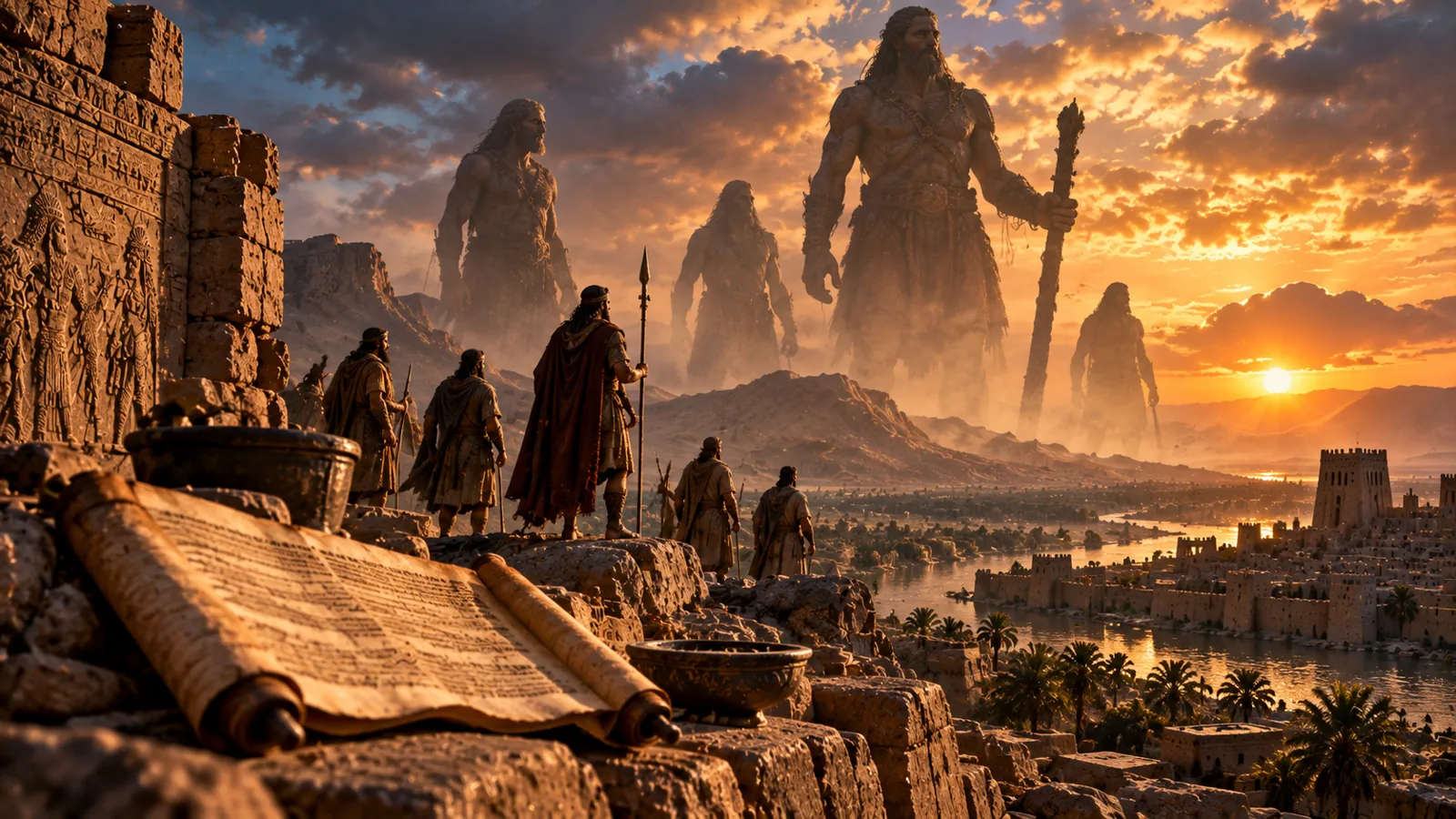
Nephilim: How Four Ancient Verses Became a Global Mystery
The Nephilim are often described online as giant humans, fallen angels, or extraterrestrial hybrids. The documentary starting point is narrower: an obscure Hebrew word appearing only twice in the Hebrew Bible. Over many centuries, interpreters expanded those passages into narratives about heavenly beings, violent giants, the Flood, and forbidden knowledge. This article separates the earliest passages from later Jewish literature, manuscript evidence, archaeology, and contemporary speculation. Those categories answer different questions and must not be conflated.
What Does Nephilim Mean?
Nephilim (Hebrew נְפִילִים) has a disputed etymology. Some scholars associate it with the Hebrew root for falling, but that does not demonstrate that the word literally means angels who fell from heaven. Ancient Greek translators commonly used gigantes, encouraging the familiar rendering giants. Yet the word alone supplies neither an exact physical height nor a biological classification. The broader biblical context invokes mighty figures and formidable reputations, which is not the same as an archaeological description.
The First Passage: Genesis 6:1–4
Genesis introduces the sons of God, the daughters of humanity, marriages, and the Nephilim immediately before the Flood narrative. It describes ancient mighty men of renown, but it does not list the Nephilim by name, specify their measurements, or recount a descent by 200 angels. Scholars also debate how precisely the Nephilim relate to the offspring mentioned in the same passage. Treating a later interpretation as though every detail appeared in Genesis misrepresents the source.
Who Were the Sons of God? Three Interpretive Traditions
A heavenly-being interpretation has important roots in ancient Jewish literature. Another reads the phrase in terms of powerful rulers or aristocratic elites abusing authority. A third, familiar in some Christian traditions, contrasts the descendants of Seth with the descendants of Cain. Each approach has its own history and textual difficulties. The dispute is not settled by a sensational image or a supposed newly translated tablet; the arguments concern language, literary setting, and reception history.
Why the Flood Matters
The placement of Genesis 6 before the Flood links the episode to a world characterized by mounting corruption and violence. Some ancient interpreters understood it as the transgression of a boundary between heavenly and human realms; others emphasized the oppression of the powerful. The text does not unambiguously declare that the Nephilim alone caused the Flood. That distinction matters because elaborate accounts of cosmic rebellion belong to later literary developments, even when inspired by this earlier passage.
1 Enoch and the Book of the Watchers
The Book of the Watchers, preserved within 1 Enoch, dramatically expands the story. Heavenly watchers descend, marry women, transmit dangerous arts, and produce destructive giants. The story is essential evidence for the history of Jewish religious imagination, but it is not an archaeological report or an unabridged version of Genesis. First Enoch is a composite collection that developed over time; its different sections have different literary histories and should not be assigned a single author or date.
Mount Hermon and the Watchers’ Oath
The Enochic narrative associates the watchers’ agreement with Mount Hermon and introduces names including Shemihazah and Asael or Azazel in discussions of transgression and punishment. Manuscripts and translations do not always preserve every detail identically. Mount Hermon is a meaningful literary and geographic reference within the tradition, not independently verified evidence of an extraterrestrial landing. Understanding the narrative requires attention to ancient symbolic geography.
Forbidden Knowledge: Weapons, Adornment, and Divination
The watchers are blamed for teaching humans techniques associated with warfare, ornamentation, and divination. This is a moral story about the danger of power without restraint, not an alternative archaeological history of metallurgy or astronomy. Human societies developed metalworking and other skills through traceable technological traditions. The text can be studied as a critique of corrupting knowledge without assuming that its supernatural explanation is historical fact.
Watchers and Giants Are Not the Same Beings
A crucial distinction is often lost in popular retellings: the watchers are the heavenly parents in the Enochic story, while the giants are their offspring. The giants consume resources and become violent, prompting appeals for judgment. Their extravagant portrayal belongs to an ancient apocalyptic literary world. Such descriptions cannot be converted into measurements of real human skeletons without independent evidence.
Enoch as Messenger and the Judgment of the Watchers
Enoch acts as an intermediary, carrying messages connected with the watchers’ fate. The narrative explores responsibility, punishment, cosmic order, and the consequences of transgression. This tradition helped shape later discussions of angels and evil in some Jewish and Christian writings, although communities did not adopt all details uniformly. The story matters historically because we can trace how ideas circulated and changed.
The Book of Giants and the Dead Sea Scrolls
Aramaic fragments of a distinct Book of Giants were discovered among the Qumran manuscripts. These fragments preserve dreams, warnings, and the impending judgment of giants, demonstrating that the story circulated in antiquity. Because the material is fragmentary, reconstructions of its narrative differ among scholars. The manuscripts authenticate the antiquity of a written tradition; they do not independently verify the supernatural events described in it.
Gilgamesh and the Giants: Cultural Crossings
Studies of the Book of Giants fragments identify names associated with Mesopotamian heroic tradition, including Gilgamesh. This is fascinating evidence of literary adaptation and cultural exchange. It does not mean the original Mesopotamian Epic of Gilgamesh was secretly an eyewitness account of the biblical Nephilim. A character name can travel across languages and acquire a new role without referring to a single historical individual.
The Second Biblical Passage: Numbers 13:33
The word Nephilim appears again in the scouts’ fearful report about the inhabitants of Canaan. The speakers connect the Anakim to the Nephilim and describe themselves as grasshoppers by comparison. This is a reported perception within a narrative of anxiety and disagreement, not a field survey documenting exact heights. Some interpreters see rhetorical exaggeration; others read the association more literally. Neither approach supplies an independently verified giant skeleton.
Anakim and Rephaim: Related Names, Different Contexts
Other Hebrew texts refer to Anakim, Rephaim, and formidable ancient populations. These names cannot automatically be merged into one supernatural species. Their meanings and functions vary by passage and period, sometimes reflecting local peoples, legendary warriors, or the rhetorical portrayal of enemies. Careful comparison asks whether a passage makes a genealogical claim, describes unusual stature, or uses inherited literary language.
Was Goliath a Nephilim?
Goliath is frequently recruited into Nephilim theories because of his size in the David narrative. However, the passage naming Goliath does not explicitly call him a Nephilim. Ancient textual witnesses also differ over the height attributed to him, a genuine topic in textual criticism. The confident assertion that he descended from fallen angels therefore exceeds what the surviving text states.
Have Archaeologists Found Giant Skeletons?
Viral photographs of enormous skeletons are often digitally altered, mislabeled, or detached from their original context. Responsible verification requires an excavation location, professional documentation, published measurements, a traceable collection, and independent examination. Medical gigantism is real, but exceptional individual height does not demonstrate an ancient race of mythic giants. There is no accepted archaeological evidence establishing the Nephilim as a distinct gigantic human population.
Nephilim Versus Anunnaki
The Anunnaki are a group of deities in Mesopotamian religious traditions; Nephilim is a term found in Hebrew biblical literature. The ancient Near East did have overlapping motifs and extensive cultural contact, including flood traditions and stories of divine authority. Similarities deserve comparison, but they do not establish that both terms name the same beings or record an extraterrestrial civilization. Modern claims often erase the linguistic and historical differences between the source traditions.
What About Alien-Hybrid Theories?
Contemporary speculation reinterprets the sons of God as astronauts and the giants as engineered hybrids. The ancient texts provide no verifiable genetic laboratory records, spacecraft descriptions, or physical specimens supporting this scenario. Recasting ancient imagery in modern technological terms can produce compelling fiction but not a substantiated historical claim. Uncertainty about a word or episode is not affirmative evidence for alien intervention.
Why Giant Traditions Persist
Giants are powerful symbols of fear, strength, chaotic violence, and extraordinary heroism. Such figures appear in many cultures, but their stories are not interchangeable. Some narratives magnify enemies; others dramatize the abuse of power or the struggle between order and chaos. Cross-cultural comparison is valuable when grounded in documented transmission and chronology, not when every large figure is assumed to belong to a single lost race.
How to Research the Nephilim Responsibly
Begin with Genesis 6 and Numbers 13 in more than one translation, then consult the Hebrew wording and reliable lexical scholarship. Read the Book of the Watchers and Book of Giants as separate later sources, noting their dates and manuscript conditions. Evaluate sensational claims through provenance, excavation records, and published scholarship. Most importantly, distinguish what a text explicitly states from an inference made centuries later.
Conclusion: An Ancient Literary Mystery, Not Proven Superhuman Biology
The Nephilim are historically significant because a very short biblical reference inspired a substantial tradition about watchers, giants, the Flood, and moral disorder. Ancient manuscripts show that these narratives long predate the internet. But evidence that people told a story is different from evidence that its supernatural events occurred. Their enduring value lies in what they reveal about ancient conceptions of power, knowledge, violence, and the limits of human life.
Sources and Further Reading
You may also like
 History & Civilizations
 The Apkallu: Complete History of the Seven Sages, Enki, Oannes and the Flood
Ancient Mesopotamian traditions describe extraordinary sages who belonged to the world before the Flood and were associated with…
 History & Civilizations
 Who Were the Anunnaki? The Complete Story of Sumerian Gods, Nibiru and Alien Claims
The Anunnaki are attested in Mesopotamian texts—but do those tablets describe ancient gods or visitors from space? This…