
280 Ice Age Engravings Found in a Spanish Cave: What Archaeologists Discovered
Researchers have documented 280 motifs, including 55 animal engravings, in Spain’s Font Major Cave. Explore the 2019 discovery, the 2026 study, original photos and dating limits.
Contents
- Where is Cova de la Font Major?
- How were the engravings discovered among modern graffiti?
- What did archaeologists actually find?
- Why is the bear engraving significant?
- Most of the marks are not recognisable animals
- How did researchers document such faint engravings?
- How old are the Font Major cave engravings?
- Are there medieval and modern markings in the cave too?
- Why does Font Major change the map of Ice Age art?
- Were the engravings used for communication or rituals?
- The original photographs: what do they show?
- What questions remain unanswered?
- Frequently asked questions about Font Major Cave
- Were the 280 engravings first discovered in November 2026?
- Are all the engravings 26,000 years old?
- Does the site contain 280 animal drawings?
- Can tourists visit the engraved passages?
- Why did people overlook the carvings for decades?
- Primary research, photographs and further reading
Archaeologists have documented 280 engraved motifs inside Cova de la Font Major in Catalonia, Spain, including 55 animal figures. The markings lie in cave passages that visitors used for decades without recognising the prehistoric artwork. Researchers first identified the engravings on 30 October 2019; a detailed study published in Antiquity on 5 November 2026 explains why the find matters for the history of Ice Age art in north-eastern Iberia.
The essential distinction is between the date of discovery and the age of the art. Archaeologists have counted the 280 motifs, but they have not directly dated each engraving. Evidence of human activity in the cave around 26,000 years ago does not establish that every animal or geometric mark was carved at precisely that time.
This article draws on the original peer-reviewed research by Josep Maria Vergès Bosch and Míriam Salas-Altès and the Antiquity announcement, both dated 5 November 2026. Sources and image credits were reviewed on 7 November 2026.
Where is Cova de la Font Major?
Cova de la Font Major lies beneath the town of L’Espluga de Francolí in Tarragona province, Catalonia, north-eastern Spain. It forms part of the Coves de l’Espluga cave complex, with more than 3.5 kilometres of mapped passages, including sections associated with an underground watercourse.
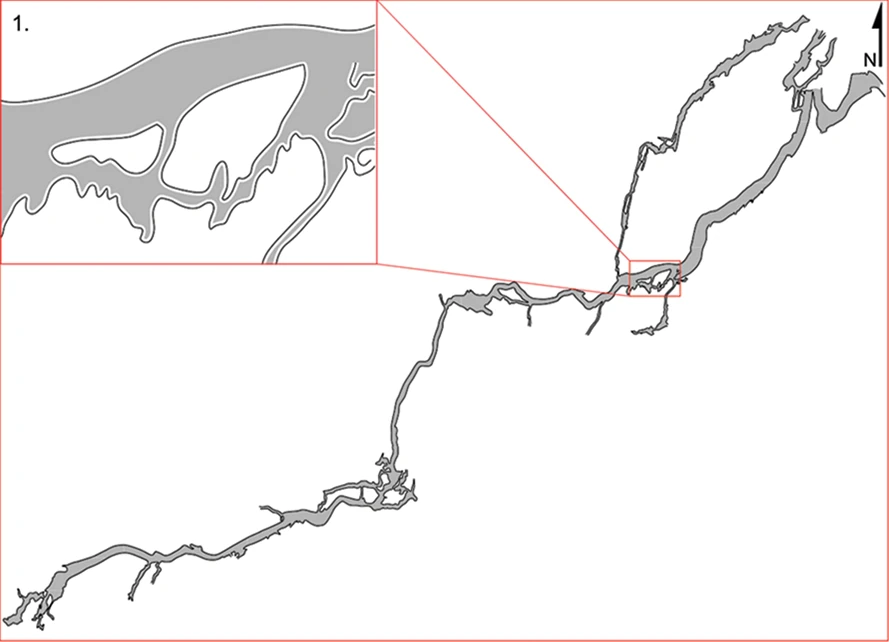
The map identifies the concentration of engravings within the cave. It is an adapted crop of Figure 3, panel 1, from Morales and colleagues’ 2022 Antiquity paper, published under CC BY 4.0. It is a scientific site plan, not a newly produced 2026 survey graphic.
The cave was not an unknown underground chamber discovered in 2026. Its main entrance was reopened in 1957, and part of the system became a visitor attraction in 1993. One reason the engravings escaped recognition was a long-standing assumption that the coarse, irregular rock surfaces were unsuitable for notable Palaeolithic cave art.
How were the engravings discovered among modern graffiti?
On 30 October 2019, archaeologist Josep Maria Vergès Bosch noticed incised lines that seemed different from the names and dates left by recent visitors. The discovery took place in the narrow Gatoneres de Cal Palletes passages, approximately 250 metres from the present-day cave entrance.
The prehistoric lines were not simply buried beneath a thick layer of sediment. They were difficult to distinguish on uneven rock, sometimes overlapped by later graffiti, and could be nearly invisible under straight-on lighting. Light directed at a shallow angle can make the edges of an incision cast small shadows, improving visibility. Researchers then need systematic recording and comparative analysis to assess whether a line is an ancient engraving, a natural fracture or a recent mark.
What was new in November 2026? The comprehensive scientific analysis and publication—not the first entry into the cave and not the initial recognition of the carvings. The discovery itself dates to 2019.
What did archaeologists actually find?
Vergès Bosch and Salas-Altès divided the engraved area into five sectors and examined both identifiable figures and non-figurative marks. Their documented corpus comprises 280 graphic elements, including 55 animal representations. The other elements include straight or parallel strokes, circular signs and more complex arrangements. The final stretch of sector 5 contains a particularly high concentration of animal imagery.
| Finding | What the study records | What it does not prove |
|---|---|---|
| 280 motifs | The currently documented total of graphic elements | Not 280 individual animal paintings |
| 55 animal figures | Horses, deer, caprines, bovines and a bear, with some uncertain identifications | Not all animals can be assigned to a precise species |
| 33 animal figures in sector 5 | An unusually dense concentration in one section | Not evidence they were all carved together |
| About 250 metres | Approximate distance from the present entrance to the engraved passages | Not the length of the entire cave system |
| 2019 / 2026 | Year of recognition / year of the detailed paper | Neither is the prehistoric date of manufacture |
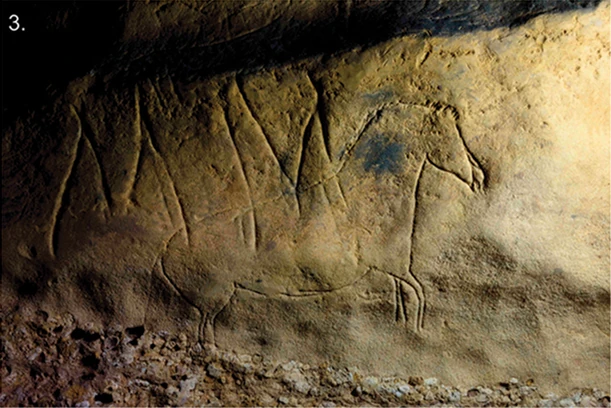
This is a genuine photograph of a horse engraving at the site, published in the 2022 archaeological documentation. It shows how an animal outline can be difficult to separate from the texture of the wall. The photograph is evidence of the engraving itself, but it does not date the carving.
Why is the bear engraving significant?
The animal motifs include horses, cervids, caprines and bovines, as well as an unusual bear image. The 2026 researchers describe the bear with ears represented in a relatively frontal perspective and a slightly open mouth. Those details help archaeologists compare artistic conventions. They do not, by themselves, establish the drawing’s meaning or show that it formed part of a particular ritual.
The 2026 paper includes a figure of the bear. The image reproduced in this article is instead an older, separately licensed photograph of a horse, so readers should not mistake one for the other.
Most of the marks are not recognisable animals
Non-figurative engravings make up most of the collection. They include short groups of parallel lines, larger concentrations of strokes and rounded or ring-shaped signs. Their presence does not mean archaeologists have deciphered an Ice Age written language. Nor is every similar-looking shape necessarily of the same age: the researchers distinguish the well-supported Palaeolithic material from marks whose chronological attribution remains uncertain.
How did researchers document such faint engravings?
The team examined the wall surfaces under different lighting conditions, photographed the incisions and used three-dimensional recording to analyse their shape. Many strokes are shallow, with widths typically around 3–7 millimetres. Careful documentation helps determine where a groove begins and ends, how strokes intersect and whether an apparent form is deliberate.
- Observation: identify possible figures while assessing modern graffiti and natural surface features.
- Recording: photograph the grooves and use high-resolution 3D documentation to study their depth, direction and overlap.
- Comparison: compare animals and signs with other documented Palaeolithic artworks, recognising that stylistic similarities are not direct dates.
- Contextual dating: compare the art with securely studied archaeological layers, without assuming that a nearby dated object fixes the age of a carving.
The researchers also suggest that some artists deliberately incorporated natural fractures or the boundary between rock layers into an animal figure. For example, an existing geological line appears to serve as ground beneath a horse. This is a reasoned interpretation of repeated visual relationships, not proof of the artist’s intention in every instance.
How old are the Font Major cave engravings?
No direct laboratory age has yet been established for every motif—or a definitive direct date for an individual animal engraving—in the November 2026 report. The authors rely on comparisons of artistic style and on archaeological evidence from different parts of the cave. Radiocarbon dates from deeper areas indicate human activity roughly 40,000–26,000 calibrated years before present, alongside much later historical use.
One archaeological layer associated with an age of approximately 26,000 years contained a small flint backed bladelet. This makes the age relevant to human activity at Font Major, but a stone tool or charcoal sample near decorated passages is not a direct date for the wall engraving. Some figures also show stylistic affinities with pre-Magdalenian Palaeolithic art. Those observations support an ancient attribution without establishing a single exact age for the complete group.
At least one animal figure is overlain by calcite. The researchers propose future uranium-series dating of that deposit, which could potentially provide a minimum age for the underlying engraving. Even a successful measurement would not automatically date the other 279 motifs or show that the entire assemblage belongs to one episode.
Are there medieval and modern markings in the cave too?
Yes. The study records evidence of medieval activity, including an inscription dated 1199, together with more recent names and dates scratched into the rock. Heavy visitation after 1957 left graffiti and abrasion on parts of the wall, affecting both the preservation and recognition of older lines.
The cave also preserves traces of use in other prehistoric and historical periods. In the Sala del Llac, for example, archaeologists have identified evidence connected to Iron Age ritual activity. This is a different body of evidence and must not be used to claim that all visible incisions share one creator, purpose or date.
Why does Font Major change the map of Ice Age art?
Palaeolithic cave art is strongly represented in the Franco-Cantabrian region of northern Spain and adjacent France, whereas the documented record in Catalonia had seemed remarkably sparse. Before Font Major was recognised, just two isolated cave-wall representations had been tentatively identified as Palaeolithic in Catalonia.
The 55 animal figures place Font Major third among known Palaeolithic cave-art assemblages along Mediterranean Iberia when ranked by zoomorphic figures, after Ardales and La Pileta. The study notes that approximately three-quarters of regional assemblages have five or fewer animal figures, and more than 90% have no more than 20. Font Major therefore provides evidence of a much richer local tradition than previously assumed.
The discovery also illustrates a limitation of archaeological maps: a gap in recorded sites does not necessarily mean prehistoric people were absent or lacked an artistic tradition. Survey history, difficult geology, damage and the visibility of surviving artwork all influence what archaeologists can identify. The authors argue that Mediterranean Iberian cave art should be considered on its own terms rather than treated only as a minor reflection of the better-known Franco-Cantabrian examples.
Were the engravings used for communication or rituals?
The study does not establish a single function for the animals and geometric forms. Symbolic expression and social uses of the cave are reasonable topics for archaeological investigation, but there is insufficient evidence to declare the engraved passages an Ice Age temple or to assign every image to a particular ceremony. An interpretation of meaning must be distinguished from what can actually be observed and measured on the walls.
The original photographs: what do they show?
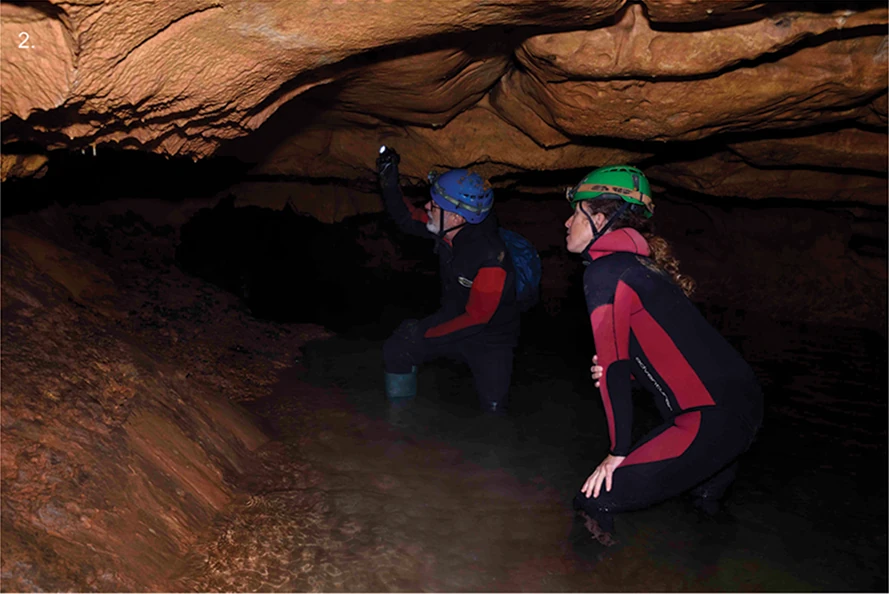
The site map, exploration photograph and horse engraving embedded in this article come from Figure 3 of a 2022 Antiquity publication. They document the real cave and its engravings, but they do not represent a photographic inventory of all 280 motifs analysed in 2026. The older paper is licensed under Creative Commons Attribution 4.0; the relevant figure panels have been cropped and converted to WebP without adding or redrawing engraved details.
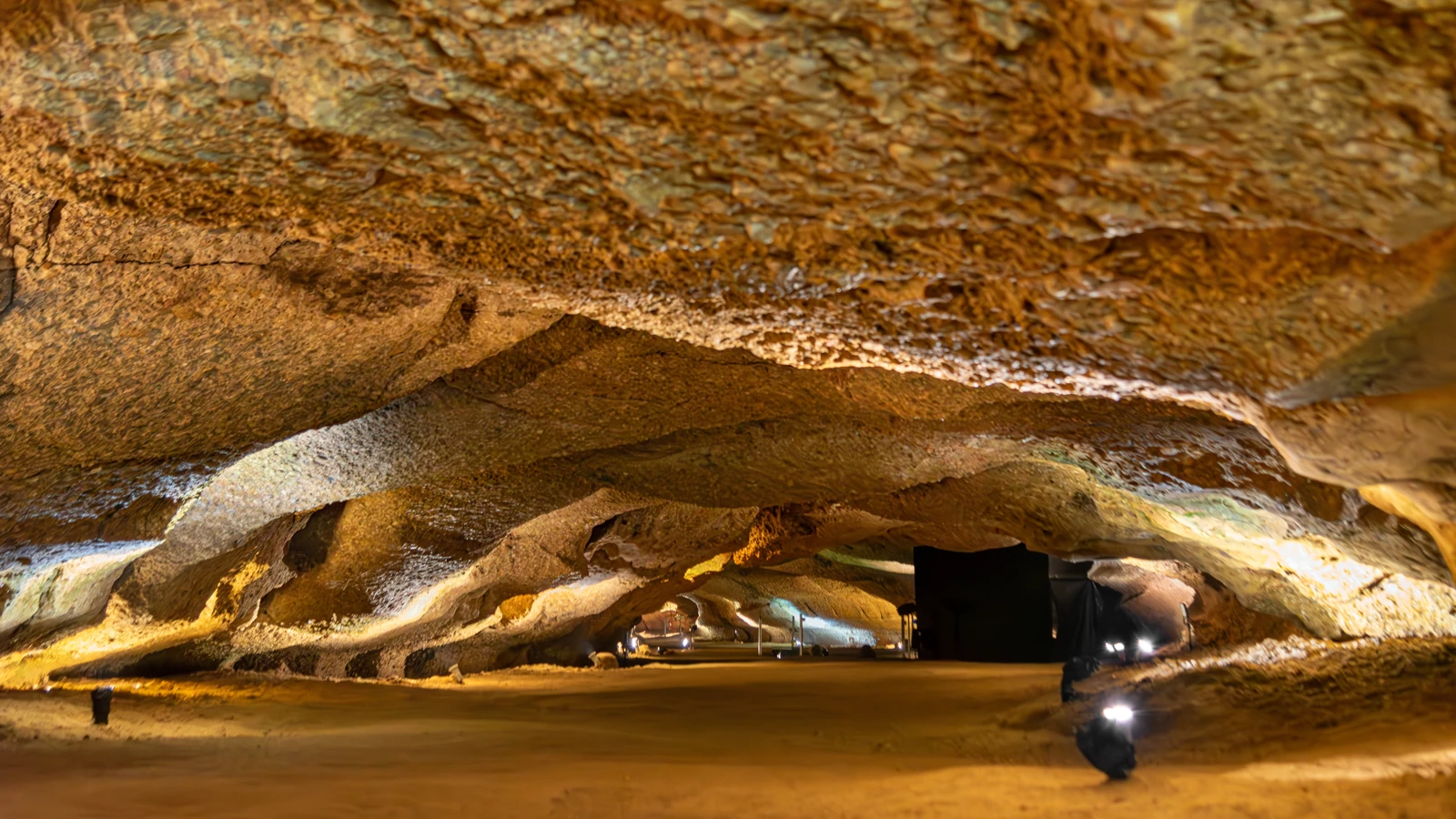
The featured photograph shows a visitor-accessible passage in the L’Espluga cave system, not the specific engraved panel. It was photographed by Jorge Franganillo in 2025 and published on Wikimedia Commons under CC BY 4.0. The image has been cropped to 16:9, resized and converted to WebP. To see newly published images of the bear and other studied motifs, refer to the 2026 paper rather than treating the featured photograph as an image of the newly catalogued engravings.
There is an additional licensing distinction: the 2026 research article is published under a Creative Commons Attribution–NonCommercial–ShareAlike licence, while the three reproduced research-figure crops in this page were sourced from the separate 2022 CC BY 4.0 publication. The images in this ZIP do not reproduce figures from the 2026 paper.
What questions remain unanswered?
- Can researchers obtain safe, reliable direct or minimum dates for selected figures without damaging the cave?
- Do the ring-shaped signs and other uncertain motifs belong to the same prehistoric phase as the animals?
- Were overlapping figures created during a single period or across several generations?
- How much older artwork was obscured or destroyed by contact, surface erosion and later graffiti?
- What further comparisons can reveal the relationships between Mediterranean artistic traditions and those in other European regions?
Frequently asked questions about Font Major Cave
Were the 280 engravings first discovered in November 2026?
No. Archaeologists first recognised the Palaeolithic engravings on 30 October 2019. The more complete scientific report was published online by Antiquity on 5 November 2026.
Are all the engravings 26,000 years old?
That has not been established. Around 26,000 years ago is a date associated with evidence of human presence at the cave, not a direct age determination for every engraving. Stylistic and archaeological comparisons provide broader chronological context.
Does the site contain 280 animal drawings?
No. The researchers documented 280 motifs in total, of which 55 are animal representations. The other motifs include lines, signs and more complex or uncertain arrangements.
Can tourists visit the engraved passages?
Parts of the L’Espluga cave system operate as a visitor attraction. However, access to the sensitive engraved galleries should not be assumed to be included in an ordinary tour. Check the current official visitor information and access rules before planning a visit.
Why did people overlook the carvings for decades?
The grooves are faint on irregular rock and may be hard to see with direct lighting. Modern graffiti and abrasion also complicated recognition. The scientific interpretation required more than simply noticing unusual lines.
Primary research, photographs and further reading
- Vergès Bosch & Salas-Altès, Antiquity (5 November 2026): the original study of 280 motifs, DOI 10.15184/aqy.2026.10447.
- Antiquity (5 November 2026): original research news announcement and regional context.
- Morales and colleagues, Antiquity (2022): archaeological documentation and Figure 3 photographs, DOI 10.15184/aqy.2022.34, CC BY 4.0.
- Wikimedia Commons: Jorge Franganillo’s 2025 photograph of the L’Espluga cave passage, CC BY 4.0.
- Horus Valley: Ice Age DNA reveals connections between ancient European populations.
- Horus Valley: Real archaeological objects emerging from melting ice.
You may also like
 History & Archaeology
Aloe in Egyptian Mummification: What the New Evidence Shows
A new study links Aloe-derived compounds to Egyptian embalming materials. Explore the samples, plant-name uncertainty, and what the…
 History & Archaeology
Weni’s Tomb at Saqqara: Wooden Figures and the Bronze-Tool Mystery
Weni’s newly announced Saqqara tomb contains rare wooden figures and bronze tools. Explore the evidence, their locations, and…
 History & Archaeology
A Cat Walked Across This Manuscript 500 Years Ago—Its Paw Prints Remain
Real cat paw prints survive on a 15th-century manuscript. See the original photo, identify Walters W.305, and separate…