
Weni’s Tomb at Saqqara: Wooden Figures and the Bronze-Tool Mystery
Weni’s newly announced Saqqara tomb contains rare wooden figures and bronze tools. Explore the evidence, their locations, and why medical use is unconfirmed.
Contents
- Where was Weni’s tomb found?
- The finds: keep the objects and locations separate
- Why are the two wooden figures interesting?
- Do the bronze tools prove Weni was a doctor?
- What do the inscriptions and bones tell us?
- How to check pictures of this discovery
- What can we confidently say now?
- Sources and photograph credit
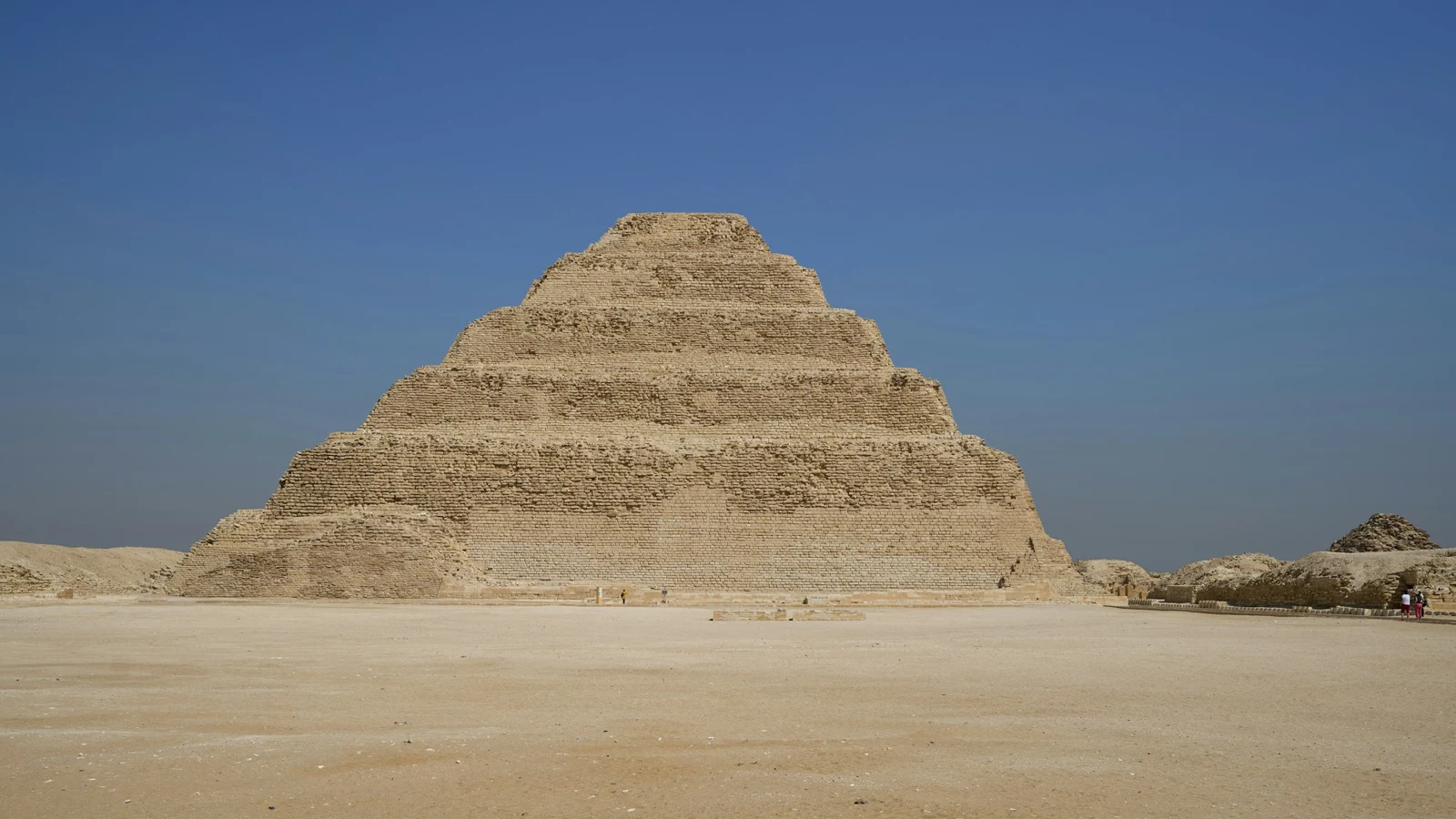
An Egyptian archaeological mission has uncovered the decorated burial chamber of an Old Kingdom official named Weni at Saqqara, alongside two small wooden figures and bronze instruments that may have had medical uses. The discovery was announced during a ministerial visit on 26 October 2026. The instruments are still being studied: the reported inscriptions do not call Weni a physician.
The most useful way to understand the find is to separate three things: what was recovered, where it was found, and what researchers think it meant. The wooden figures and bronze objects came from different parts of the tomb structure, a distinction easily lost in a short discovery headline.
Where was Weni’s tomb found?
The Egyptian mission, working under the Supreme Council of Antiquities, excavated northwest of King Merenre’s pyramid in the Saqqara necropolis. A mudbrick mastaba contained several burial shafts; one led to Weni’s inscribed chamber. A mastaba is a tomb structure, so “the tomb” can refer to a complex of spaces rather than one room.
Egypt’s State Information Service report of 27 October describes a shaft about six metres deep and surviving painted scenes. It attributes their preservation to Saqqara’s dry conditions. The announcement adds evidence about Old Kingdom funerary architecture and the use of its rooms.
For geographical context, the Ministry’s Saqqara guide places the cemetery roughly 40 kilometres southwest of Cairo. It includes monuments from many periods, including Fifth and Sixth Dynasty pyramids and elite tombs. The cover photograph shows Djoser’s Step Pyramid as context for Saqqara; it does not show Weni’s excavation or Merenre’s pyramid.
The finds: keep the objects and locations separate
| Reported evidence | Location or context | What remains uncertain |
|---|---|---|
| Decorated inscriptions naming Weni | Burial chamber | The complete interpretation of his career |
| Two small wooden figures in a devotional pose | Vaulted room directly above the burial chamber | Their precise role and the identity of the figures |
| Bronze instruments | Burial shaft | Their function and relationship to Weni |
| A false door naming Sekhet Nebti | Recovered by the mission | Any personal relationship with Weni |
These locations follow the ministry statement as reported by Xinhua on 26 October. The table is a reading aid, not an excavation plan. It does not establish that every object belonged to a single undisturbed burial deposit.
Why are the two wooden figures interesting?
Officials describe the figures as small and represented in an unusual devotional posture. Their placement in a vaulted room above the burial chamber makes the architecture part of the question: how did that room function within the funerary arrangements?
The Egyptian Gazette’s report identifies the figures as one of the excavation’s notable finds. The released description does not establish their names or explain exactly whom they represent. Calling them Weni and his wife, servants, or medical attendants would add information the announcement has not demonstrated.
A useful comparison comes from another Saqqara monument. The official description of Mereruka’s mastaba explains that rooms could host the deceased owner’s cult and that a false door and statue formed a focus for offerings. That illustrates why room function matters. It does not prove that Weni’s figures had the same role or that the two tombs shared an identical layout.
Do the bronze tools prove Weni was a doctor?
No. Medical use is a proposed interpretation, and the published titles do not identify him as a physician. The ministry statement, reported by Xinhua, explicitly leaves the instruments’ use and their connection to the owner open for further study.
The State Information Service reports the antiquities chief’s comparison with instruments depicted at Kom Ombo. A resemblance can suggest a question to investigate; it does not, by itself, demonstrate how a particular object was used.
For readers assessing later claims, ask what new evidence is offered. A detailed object catalogue, analysis of working surfaces, and a documented account of the burial context would be more informative than simply repeating “medical tools.” These are examples of evidence to look for, not tests whose results have already been announced for this collection.
What do the inscriptions and bones tell us?
The reported titles place Weni in senior administrative and religious roles. Mayor, sem priest and lord of Elkab are among those listed. Translations of some other offices vary across English reports, so it is safer to describe the broad responsibilities than turn every title into a modern job description.
The Gazette also reports preliminary examination of the remains: Weni was estimated to have died after age 50, with advanced dental problems and skeletal changes consistent with repeated physical strain. These findings do not identify a specific occupation, establish the cause of death, or prove that the bronze instruments treated him.
The excavation also produced a false door naming a woman, Sekhet Nebti, with the religious title priestess of Hathor. Her presence adds another named person to the evidence. A family relationship should await an explicit inscription or published contextual argument.
How to check pictures of this discovery
For published photographs of the decorated chamber, see this image-led report, which credits Egypt’s Ministry of Tourism and Antiquities. Its lead picture of two wooden figures is explicitly labelled an author-generated hypothetical reconstruction. It should not be used as a photograph of the recovered artefacts.
- Read the caption, not just the headline: does it identify an excavation photograph or a reconstruction?
- Check the monument: Saqqara contains many tombs, and a general site photograph cannot document a specific find.
- Check what the image actually shows: a painted wall cannot verify the shape or condition of wooden figures outside the frame.
What can we confidently say now?
The announcement concerns a named official, a decorated burial chamber and a set of finds whose locations raise useful questions about funerary practice. The unresolved part is the explanation of the objects, particularly the bronze tools. The discovery becomes more informative when those open questions stay visible.
For a separate excavation programme at the same necropolis, read our guide to the tombs of Sabu and Ptahshepses. That Czech-led project should not be merged with the Egyptian mission’s Weni discovery.
Sources and photograph credit
- Egyptian State Information Service — statement by the antiquities chief, 27 October 2026
- Xinhua — detailed report of the ministry announcement, dateline 26 October 2026 (Arabic)
- Egyptian Gazette — contemporary report, 26 October 2026
- Ministry of Tourism and Antiquities — Saqqara
- Ministry of Tourism and Antiquities — Tomb of Mereruka (comparative context)
- Arkeonews — chamber photographs and explicit reconstruction caption
Sources reviewed on 3 November 2026. The ministry’s Facebook announcement could not be read directly because access was blocked; its contents were cross-checked through the reports above and the State Information Service. Featured photograph: Dmitrii Zhodzishskii / Unsplash, used under the Unsplash License, cropped to 16:9. It shows Djoser’s Step Pyramid at Saqqara as site context.
You may also like
 History & Archaeology
Aloe in Egyptian Mummification: What the New Evidence Shows
A new study links Aloe-derived compounds to Egyptian embalming materials. Explore the samples, plant-name uncertainty, and what the…
 History & Archaeology
A Cat Walked Across This Manuscript 500 Years Ago—Its Paw Prints Remain
Real cat paw prints survive on a 15th-century manuscript. See the original photo, identify Walters W.305, and separate…
 History & Archaeology
Why Were Books Chained in Libraries? The History Behind Chained Books
Why libraries chained their books, how readers used them and why the page edges faced out. Includes documented…