
A Cat Walked Across This Manuscript 500 Years Ago—Its Paw Prints Remain
Real cat paw prints survive on a 15th-century manuscript. See the original photo, identify Walters W.305, and separate the evidence from the viral story.
Contents
- Which manuscript has the cat paw prints?
- Look closely: what can you actually see?
- A manuscript date is not the date of one paw step
- Why would a cat be near valuable books?
- Paw prints and painted cats are different kinds of evidence
- Was this a new discovery in 2026?
- What makes this small accident historically useful?
- Sources and photograph credit
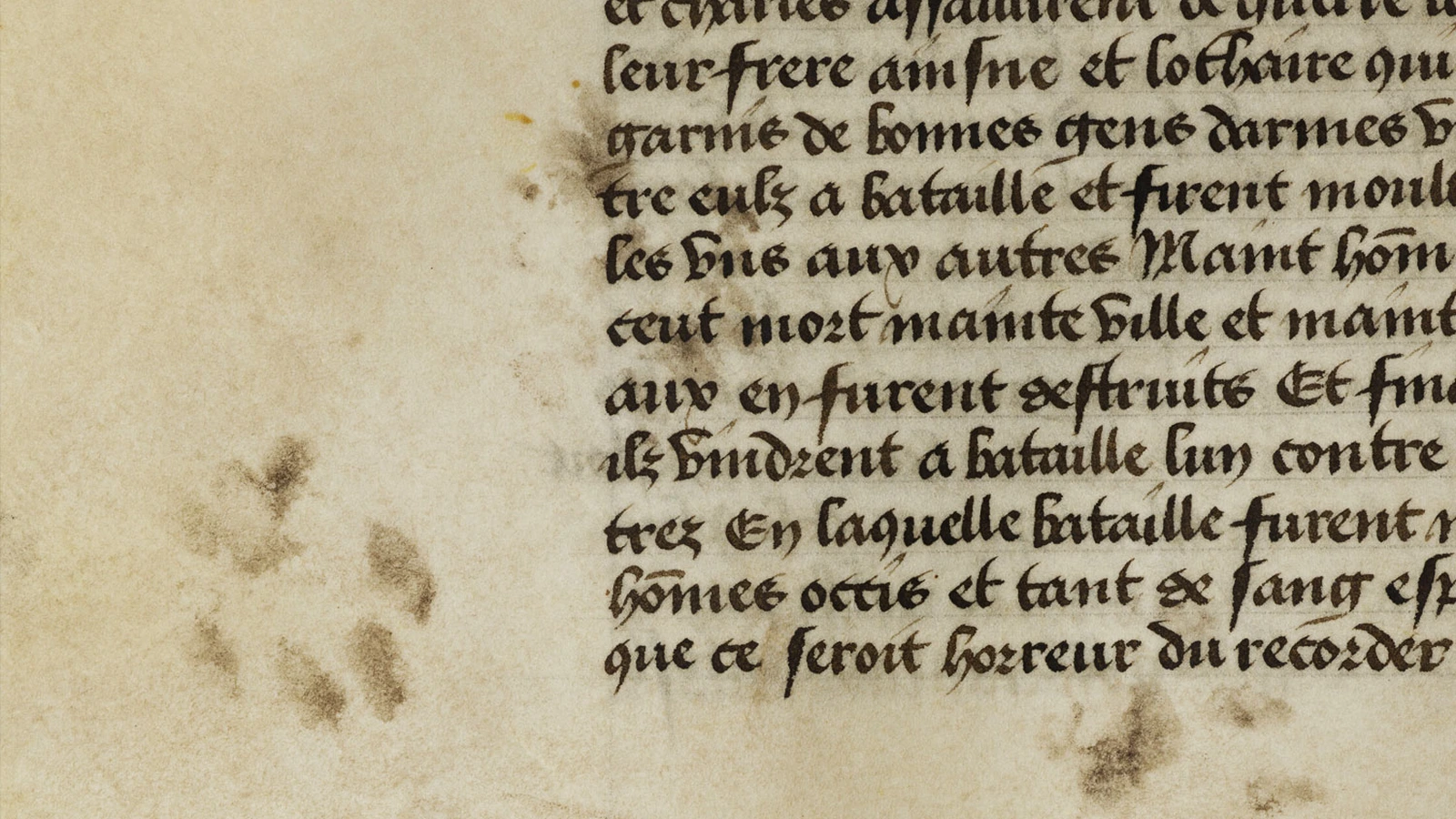
The paw prints are real: the Walters Art Museum identifies marks on a late-medieval manuscript as traces left by a cat crossing the page while the ink was drying. More than five centuries later, the small, irregular impressions remain beside the writing. They are not a modern cat illustration added to make an old book more amusing.
The story is appealing without an invented scene of an angry monk or a named feline culprit. The useful questions are simpler: which book is this, what does its image show, and how much of the familiar online story can the museum record actually support?
Which manuscript has the cat paw prints?
The pictured detail comes from La Fleur des Histoires, accession W.305. The museum catalogue names Jean Mansel as the author and dates the manuscript to approximately 1470–1480. Its material is recorded as ink and pigments on parchment. This identifies a particular book, rather than an interchangeable image of “a medieval manuscript.” Open the collection record.
The credit is The Walters Art Museum, acquired by Henry Walters in 1904. That acquisition year concerns the collection history; it is not the date when the writing or paw marks were made. Likewise, the author of a text is not automatically the person who physically copied this particular volume.
Look closely: what can you actually see?
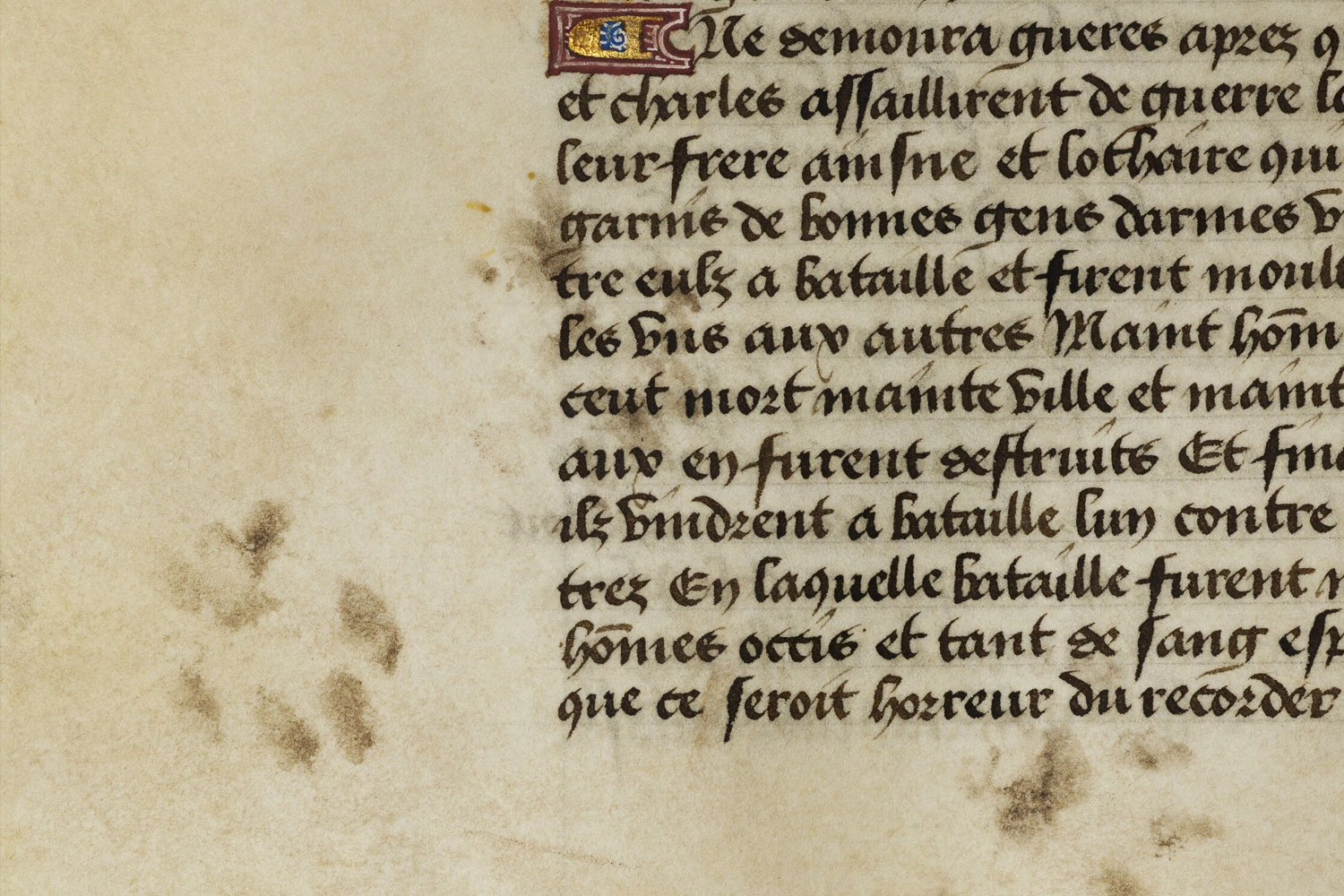
In the un-cropped reproduction above, dark impressions appear in the broad blank area to the left of the text, with additional marks toward the lower right. Some are clearer than others. The photographed writing and marks are the evidence available to the reader; this is a museum-supplied image, not a photograph taken during a Horus Valley visit.
- Start with the blank margin, where a print is easier to separate from the script.
- Compare more than one impression. A repeated pad-like arrangement is more informative than a single isolated blot.
- Look back at the whole image. A close crop can remove the neighbouring writing and make scale harder to judge.
- Keep observation separate from attribution: we can inspect the shapes, while the museum supplies the identification of the traces as feline.
The museum’s explanation is that the cat crossed while the ink was drying. A plausible physical reading is that contact with wet ink transferred marks onto the surface. The photograph alone cannot reconstruct every step, establish the exact direction of travel or identify the animal’s breed. No new forensic test is being reported here.
A manuscript date is not the date of one paw step
The catalogue’s approximate range dates the manuscript. The exhibition places the incident in its fifteenth-century context. Neither gives us a diary entry recording an exact day, an hour or the scribe’s reaction. Saying “over 500 years ago” is appropriate; saying that we know the cat walked across on a particular morning would add precision the cited evidence does not provide.
Nor does the survival of the page prove that the scribe deliberately kept the prints as a joke. The marks remain in the surviving object; the person’s motive for leaving the page in use is a separate question. A charming possibility should not quietly become a documented quotation or an eyewitness account.
Why would a cat be near valuable books?
The museum’s account of Paws on Parchment places cats in a broader world of companionship, pest control and symbolism. Catching rodents could protect stores and possessions, including books. That practical usefulness helps explain why the relationship was more complicated than “people loved cats” or “people feared cats.” The curator’s wider context.
It would still be a leap to claim that the animal in this incident was an officially appointed library cat. An institutional explanation of cats’ general role does not supply a biography for this particular animal. The close connection we feel with a modern pet crossing a keyboard is an analogy, not evidence that medieval working life was identical to ours.
Paw prints and painted cats are different kinds of evidence
A painted cat belongs to a designed image; a paw impression records contact with a surface. They can appear in the same exhibition without being on the same manuscript. This distinction matters when several attractive cat pictures are circulated together.
For example, the museum separately catalogues a late-fifteenth-century Flemish Prayer Book as W.438. That is not the accession number of the pictured paw-print volume. Checking the number is a quick safeguard against merging different objects into one story. Compare the separate prayer-book record.
Was this a new discovery in 2026?
The renewed publicity concerned an exhibition, not a newly excavated book. The official exhibition page lists Paws on Parchment from August 6, 2025, to February 22, 2026. As of this article’s November 1, 2026 review, that run has ended. The W.305 catalogue record currently labels the object “Not on view.” Check the exhibition dates.
An older announcement can preserve an earlier planned closing date. For visit planning, use the dated exhibition page and the museum’s current information rather than a syndicated story written while the show was open. The permanent digital record and a temporary physical display are different forms of access.
What makes this small accident historically useful?
A manuscript is both a text and an object that people handled. An accidental trace shifts attention from what the words say to what happened around the writing. That is the story’s real strength: the image preserves a material interruption, while the collection record keeps us anchored to an identifiable volume.
To check another viral historical image, follow the same sequence: locate the collection record, match the object number, distinguish the age of the object from the date of the photograph or exhibition, and stop where the evidence stops. The cat does not need a fictional name, a confession or an angry owner to leave a memorable mark.
For a related question about dates and evidence, see Horus Valley’s Arabic guide to dating ancient objects.
Sources and photograph credit
- Walters collection: W.305, La Fleur des Histoires
- Walters: Paws on Parchment, official exhibition page
- Walters: Illuminated Ideas, Winter/Spring 2026
- Walters collection: W.438, separate Prayer Book
- Walters image rights and CC0 policy
Photograph: The Walters Art Museum. The W.305 record marks its downloadable images CC0. The supplied detail was retrieved from the museum-credited reproduction accompanying Smithsonian Magazine’s January 13, 2026 coverage. The cover is a crop resized to 1600 × 900; the inline image retains the supplied 1500 × 1000 frame. No prints, letters or other evidence were added or reconstructed. Source photograph.
You may also like
 History & Archaeology
Aloe in Egyptian Mummification: What the New Evidence Shows
A new study links Aloe-derived compounds to Egyptian embalming materials. Explore the samples, plant-name uncertainty, and what the…
 History & Archaeology
Weni’s Tomb at Saqqara: Wooden Figures and the Bronze-Tool Mystery
Weni’s newly announced Saqqara tomb contains rare wooden figures and bronze tools. Explore the evidence, their locations, and…
 History & Archaeology
Why Were Books Chained in Libraries? The History Behind Chained Books
Why libraries chained their books, how readers used them and why the page edges faced out. Includes documented…