
Saqqara Tombs of Sabu and Ptahshepses: What the 2026 Excavations Really Found
A fact-checked guide to the rediscovery of Sabu and Ptahshepses tombs, distinguishing 2023 and 2026 archaeological findings.
Contents
- What exactly was announced in October 2026?
- The timeline: an old excavation, a rediscovery, and new results
- 1858–1860: Auguste Mariette explores the area
- 2022–2023: the team locates and excavates Ptahshepses’ tomb
- October 26–27, 2026: the family complex is presented with further findings
- Who were Sabu, Ptahshepses and Ikhetneferet?
- Sabu: the father with the larger northern tomb
- Ikhetneferet: why the mother’s chapel changes the story
- Ptahshepses: a court official whose career spanned several kings
- How large were the two tombs, and how can the figures be compared?
- What was found inside Ptahshepses’ burial chamber?
- Why do the false doors and reliefs matter more than the gold that disappeared?
- How did archaeologists relocate a tomb hidden under sand?
- How to recognize misleading photos and confusing names
- How reliable is the royal-marriage story?
- Can visitors enter these tombs at Saqqara today?
- What remains unknown, and what research comes next?
- Bottom line: what is new and what is not
- Original sources, real photographs and image notes
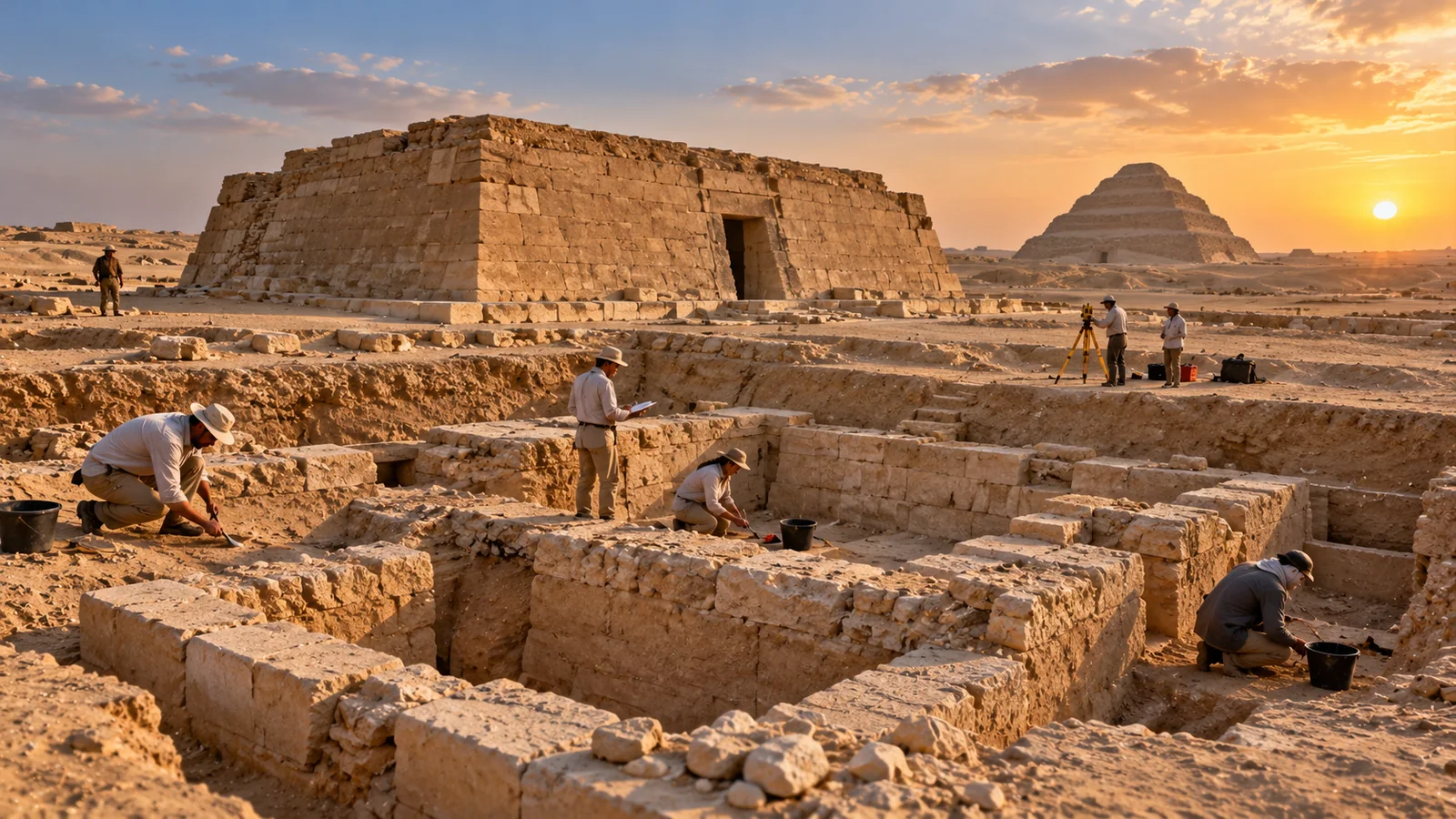
A Czech archaeological mission has revealed newly documented sections of the Old Kingdom tombs of Sabu and his son Ptahshepses at Saqqara, Egypt. Announced on October 26–27, 2026, the work includes an offering chapel dedicated to Sabu’s wife, Ikhetneferet, reliefs identifying family members, and renewed attention to Ptahshepses’ burial chamber. But there is an essential correction to many dramatic headlines: the team had already relocated and excavated Ptahshepses’ lost tomb in 2022–2023. The October 2026 announcement highlights an ongoing research programme, not a wholly new discovery of his tomb. This distinction is documented by the university’s September 2023 report and the Czech Institute’s October 2026 statement.
The real story is more interesting than a simple “tomb found” headline. A monument partially surveyed in the 1850s disappeared under desert sand; modern fieldwork reconstructed its location; and the subsequent investigation has opened a window onto a powerful family living near the royal court roughly 4,500 years ago. This article separates the original nineteenth-century excavation, the 2022–2023 rediscovery, and the evidence announced in 2026.
What exactly was announced in October 2026?
The Czech Institute of Egyptology at Charles University reported that an expedition led by Professor Miroslav Bárta had relocated and investigated Old Kingdom tombs connected with senior officials and the worship of Ptah, the deity whose important cult centre was Memphis. Following an October 26 visit by Egypt’s minister of tourism and antiquities, Sherif Fathy, the institute published a detailed statement on October 27. Its central highlights were previously undocumented architectural sections, preserved decorative reliefs and evidence of family relationships. The excavations and conservation work are continuing; the released statement is not a final excavation monograph.
- A newly identified offering chapel belonging to Ikhetneferet, the wife of Sabu, whose scenes show her husband and their sons.
- Reliefs within Sabu’s tomb showing him and Ptahshepses observing processions of offering bearers.
- A detailed account of Ptahshepses’ large mastaba and its underground chamber, with a limestone sarcophagus and human remains examined by Egyptian specialists.
- Further documentation of the two monuments as part of a wider, multi-season project to rediscover tombs left partly explored in the nineteenth century.
The timeline: an old excavation, a rediscovery, and new results
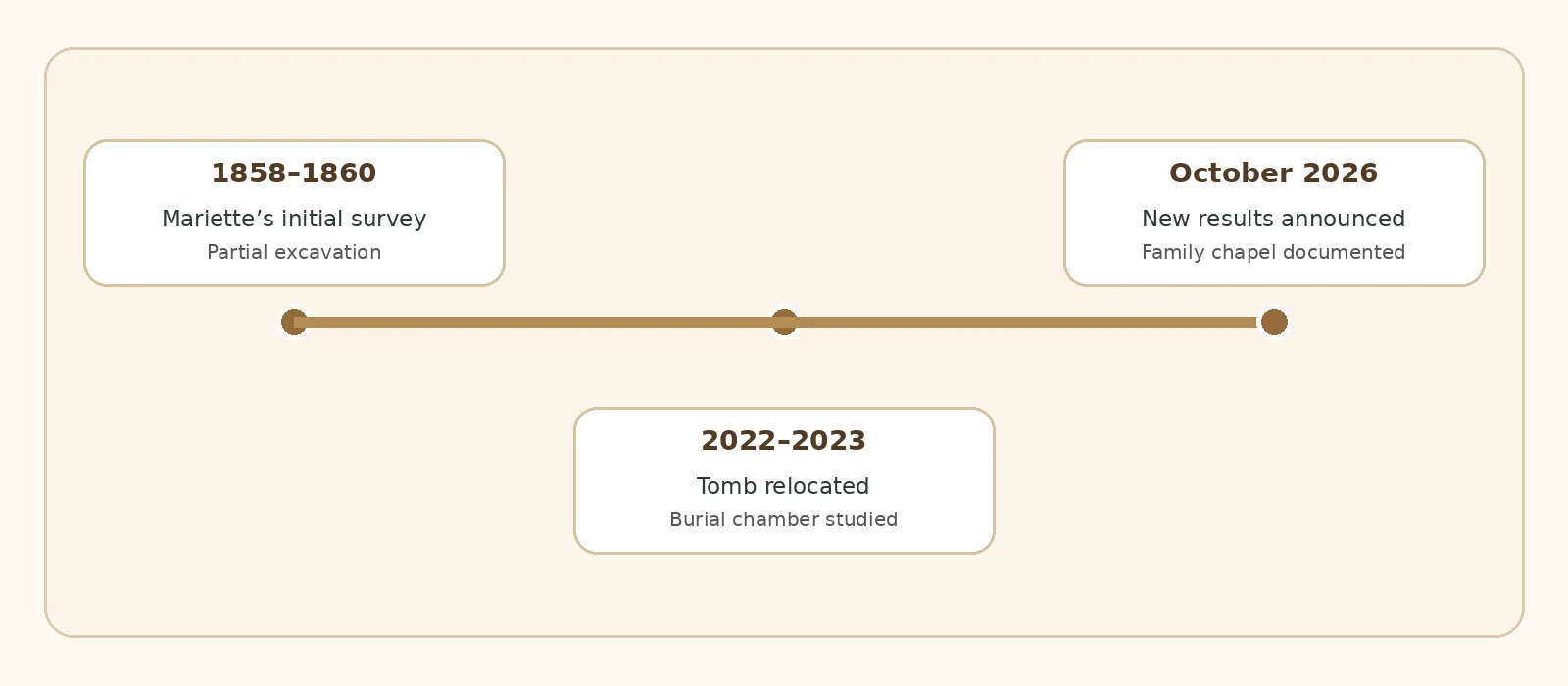
1858–1860: Auguste Mariette explores the area
French Egyptologist Auguste Mariette, who helped establish Egypt’s antiquities administration, worked in this part of the Saqqara cemetery between 1858 and 1860. The 2026 ministry statement says he identified roughly 160 Old Kingdom tombs from different phases. Archaeological recording then was not as comprehensive as today’s standards; excavations often prioritized decorated chapels, entrances and selected chambers. As desert sand accumulated, some monuments were buried again and their exact positions became difficult to relocate.
This matters because “lost tomb” does not imply nobody in modern times had ever seen it. Some structures were recorded, inscriptions and architectural pieces were removed to museums, and certain locations faded from practical use. The modern challenge was to reconnect historical descriptions with the actual buildings under the present-day surface.
2022–2023: the team locates and excavates Ptahshepses’ tomb
The University of Charles’ report dated September 25, 2023 describes field seasons in 2022 and spring 2023. Researchers combined satellite imagery with old maps and on-site surveying to find Ptahshepses’ mastaba. The university recorded a 42 × 22-metre superstructure, an entrance with surviving painted decoration, two statue rooms known as serdabs, a passage, and a robbed subterranean chamber containing the owner’s mummy in a partly opened sarcophagus. The important point is that the burial chamber and human remains were publicly reported in 2023, not first discovered in 2026.
October 26–27, 2026: the family complex is presented with further findings
The minister’s visit was reported in Egypt on October 26, while the institute published its English account on October 27. It drew particular attention to Sabu’s tomb and Ikhetneferet’s offering chapel, including a false door showing named family members. The 2026 statement also summarised what the team learned about Ptahshepses’ chamber. Treating both reports as successive phases yields an accurate chronology rather than a false “new mummy discovered today” claim.
Who were Sabu, Ptahshepses and Ikhetneferet?
The newly studied family belonged to the privileged circles of Old Kingdom Memphis. Sabu was associated with the cult of the god Ptah and had a large tomb with decoration modeled on elite and royal architectural traditions. His son Ptahshepses is especially notable because biographical inscriptions preserve an unusually rich account of his education and career. The evidence points to access to the royal household and multiple reigns, not an ordinary family burial.
Sabu: the father with the larger northern tomb
According to the October 2026 report, Sabu’s monument lies north of the tomb of his son. The exposed structure measures about 54 metres by 28 metres, with an original height estimated at approximately five metres. The outer façade imitates the recessed or niched surface associated with palace-front decoration. Within the offering chapel, reliefs show Sabu and Ptahshepses supervising processions of people bringing gifts for funerary rituals. These scenes are not merely decorative: they tell visitors who the owner wanted to be remembered as and what kinds of offerings could sustain his cult.
Ikhetneferet: why the mother’s chapel changes the story
Researchers identified an offering chapel dedicated to Sabu’s wife, Ikhetneferet, that had escaped Mariette’s earlier excavations. Its decorated false door depicts the woman with her husband and their two sons, Ptahshepses and Ranefer, as named in the institute’s 2026 account. Other reporting transliterates the names differently; they should not be silently conflated with kings bearing similar names. The chapel broadens the evidence beyond two male officeholders and permits a more family-centred reading of the tomb complex.
An Egyptian false door was a symbolic architectural element rather than a hinged entrance. It marked a place where the living could present food and drink while inscriptions and images connected the offering ritual to the deceased. A picture showing several named people therefore acts like a genealogical clue: it can support relationships more securely than reconstructing family ties from proximity alone. The word “clue” is deliberate; every relationship must still be checked against inscriptions, context and translations.
Ptahshepses: a court official whose career spanned several kings
The 2023 university announcement places Ptahshepses in the 25th–24th centuries BCE and explains that his biography refers to time spent at the royal court in the late Fourth Dynasty and an elite career through the Fifth. The 2026 summary highlights his service under Sahure, Neferirkare, Raneferef and Nyuserre. These are selected Fifth Dynasty rulers, while the older account describes a longer biographical sequence also including earlier kings. The differing lists need not contradict each other: one statement summarizes key Fifth Dynasty offices and the other follows the full biography.
The university describes him as the earliest known non-royal official to have married into the royal family, through the princess Khamaat. That is a claim about what surviving evidence currently attests, not proof that no earlier such marriage ever occurred. The father of Khamaat is also presented differently across respectable sources: the university’s report identifies her as a daughter of Userkaf, whereas the British Museum catalogue for EA682 says she was probably a daughter of Shepseskaf. Rather than conceal that difference, readers should treat the specific parentage as an attribution requiring careful interpretation.
How large were the two tombs, and how can the figures be compared?
Both are mastabas: large above-ground tomb structures whose overall form is broadly rectangular with a flat roof and sloping sides. A numerical comparison is helpful, but the reported lengths and widths describe the footprint of each superstructure, not every underground passage or chamber. A floor area calculated by multiplication is an approximation of a bounding rectangle, not a new archaeological measurement.
| Tomb | Reported dimensions | Approximate rectangle area | Evidence |
|---|---|---|---|
| Sabu | 54 × 28 m | 1,512 m² | October 2026 institute statement |
| Ptahshepses | 42 × 22 m | 924 m² | September 2023 university report |
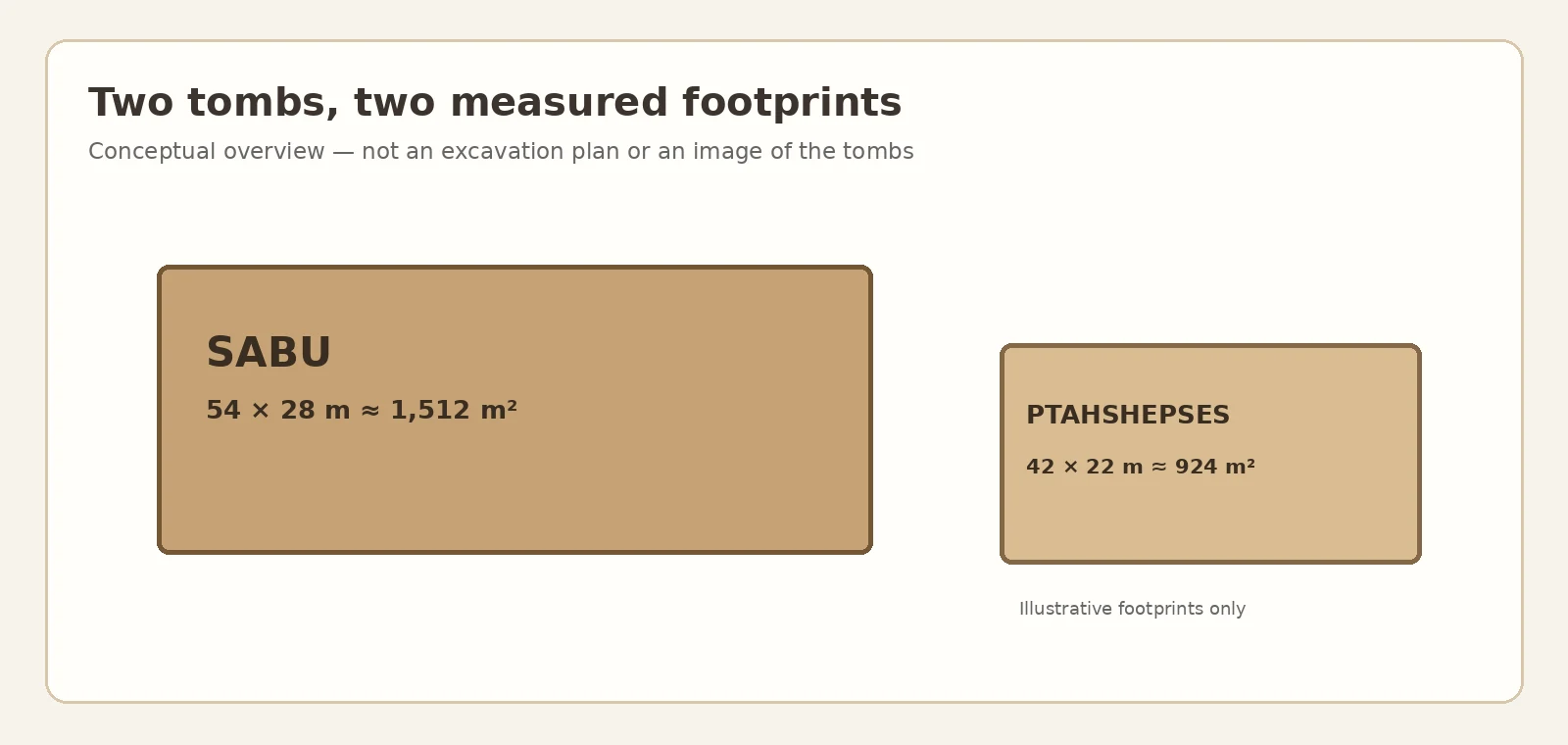
The 2026 ministry account also describes Ptahshepses’ monument as covering more than 900 square metres, a formulation consistent with 42 × 22 metres producing about 924 square metres. Sabu’s footprint is roughly 1.6 times that rectangle. That comparison says something about the monument sizes, not that one man necessarily ranked 1.6 times above the other. Status was expressed through titles, access, decoration, funerary investment and changing practices—not a simple area formula.
What was found inside Ptahshepses’ burial chamber?
The 2023 field report details a descending access route, a blocking stone, and a chamber robbed in antiquity. Researchers noted pottery fragments, votive objects, canopic jars and even mummified fish; they described a mummy surviving inside a partially opened sarcophagus. The 2026 statement again identifies a limestone sarcophagus and surviving human remains. These are not competing accounts of separate people, and readers should not infer a second intact mummy discovery from the later announcement.
Anthropologists studying the remains concluded that Ptahshepses lived past sixty years of age. The 2023 university communication gives a more specific estimate of at least 65 years. Ancient Egyptian life expectancy is frequently misunderstood: average life expectancy at birth can be lowered by high infant and childhood mortality, but it does not mean that adults never reached their sixties. The meaningful claim here is that the individual studied appears to have lived to an advanced age relative to the population and that this assessment fits his unusually lengthy recorded career.
Why do the false doors and reliefs matter more than the gold that disappeared?
The ancient robbery removed valuables, but information survives in architecture and inscriptions. A carved false door can record titles, family members, social relationships, funerary beliefs and ritual practices. Reliefs of offering bearers suggest how a household wished to portray continuity and abundance. Stone features also give archaeologists a physical plan that can be matched to old descriptions and excavation records. A stolen piece of jewellery may be irrecoverable; a surviving line of hieroglyphs can still change a historical interpretation.
For a real surviving object associated with this very official, consult the British Museum’s record for object EA682. It describes Ptahshepses’ limestone false door and architrave, removed during Mariette’s nineteenth-century work and now displayed in London. A Creative Commons photograph on Wikimedia Commons shows the actual artefact; it is not a photograph of the newly uncovered 2026 chapel. This distinction is essential when looking at archaeological images online.
How did archaeologists relocate a tomb hidden under sand?
The modern search combined historical documentation, satellite images and field surveys. An old map may identify a relative position, but landscapes change and mapping conventions are imperfect; a satellite image can reveal a promising pattern but cannot establish the tomb’s owner on its own. Once a target area is identified, a controlled excavation documents walls, stratigraphy, finds and original position. The strongest conclusion comes when the physical structure agrees with the old descriptions, inscriptions and dimensions.
- Historical clue: a nineteenth-century report, inscription or museum object indicates that a tomb existed and suggests its position.
- Remote-sensing clue: imagery helps narrow a search area and flag shapes or disturbances that deserve field investigation.
- Field confirmation: survey and excavation expose architecture and record its context.
- Identity and dating: inscriptions, artefacts, archaeological relationships and specialist analysis test who was buried and when.
This workflow explains why “satellites discovered the tomb” is too simple. Satellites helped guide a search whose decisive evidence depended on archaeology on the ground. Nor does the method imply that the public can now locate and enter the tomb using a satellite view.
How to recognize misleading photos and confusing names
At least three image mix-ups are easy to make. First, photos from the 2022–2023 excavation sometimes circulate under 2026 headlines. Second, the British Museum false door EA682 is a real ancient object from Ptahshepses’ Saqqara tomb, but it was recovered in the nineteenth century, not during the latest excavation. Third, there are other officials named Ptahshepses—including a famous vizier associated with a mastaba at Abusir—whose photographs should not be silently substituted for the Saqqara tomb covered here.
To verify an image, check whether its caption names Saqqara or Abusir, whether it refers to the high priest or another Ptahshepses, its date and photographer, and whether a museum accession number or archaeological site reference is provided. The 2026 expedition photos reproduced by news organizations are credited to the Czech Institute; they are linked in this guide rather than copied without permission.
How reliable is the royal-marriage story?
The strongest support is not a dramatic modern reconstruction but the biographical texts preserved on Ptahshepses’ false door. They connect the official to court upbringing and to the princess Khamaat, and therefore suggest privileged access to royal institutions. Yet translating royal genealogy and sequencing kings can involve uncertainty, which is why even the British Museum’s public object catalogue uses qualified wording for her father. A careful article can explain the significance of the marriage while leaving the precise family attribution open.
It would be an overreach to claim that one marriage “invented nepotism” or to infer specific corruption from the existence of family connections. The expedition leader discusses early favouritism and elite networks as a historical research theme; the archaeological evidence makes these relationships visible but does not automatically establish how every decision in the administration was made.
Can visitors enter these tombs at Saqqara today?
An excavation-site visit by a minister or the publication of images does not mean a tomb is open for independent tourism. The tombs are under ongoing research and conservation, and there was no publicly verified visitor ticket or opening schedule for Sabu’s or Ptahshepses’ newly investigated areas in the sources reviewed on October 30, 2026. Do not arrange access through unofficial social-media claims. Check notices from Egypt’s Ministry of Tourism and Antiquities or the official Saqqara ticketing channels before planning a specific visit.
What remains unknown, and what research comes next?
The institute says the mission continues to study, restore and document both tombs and other monuments at the necropolis. More publication may clarify the layout and chronology of individual chapels, the readings of family names, the conservation condition of the wall paintings, and how different building phases related to one another. These are questions for ongoing research, not findings already established by the October 2026 announcement.
The wider lesson is that archaeology often advances by returning to known places with improved records and methods. What Mariette saw in the nineteenth century, the field team mapped in 2022–2023 and specialists documented in 2026 are connected episodes of research. That cumulative history is precisely why the discoveries matter.
Bottom line: what is new and what is not
Newly highlighted in October 2026: Sabu’s tomb investigations, the previously missed chapel of Ikhetneferet, decorated family scenes and further documentation of a cluster of elite tombs. Already established by 2023: the modern relocation of Ptahshepses’ tomb and the excavation of his burial chamber, sarcophagus and mummy. Known since the nineteenth century: major inscriptions from his false door, now conserved in the British Museum. Keeping these three stages separate makes the finding clearer—and more remarkable—than a single sensational discovery date.
Original sources, real photographs and image notes
- Czech Institute of Egyptology (October 27, 2026): official report and excavation photographs. The institute credits excavation photography to Petr Košárek; permission for republication was not established.
- Charles University (September 25, 2023): original report on the 2022–2023 rediscovery and burial chamber.
- British Museum EA682: the authentic inscribed false door and architrave of Ptahshepses.
- Wikimedia Commons: real photograph of the false door, by Sanjay ach, CC BY-SA 4.0; the page explains attribution and reuse terms.
- Al-Ahram Arabic report on the minister’s October 26 site visit, for the announcement chronology.
- Related Horus Valley guide: The Lost Ahramat Nile Branch, for context on the wider pyramid landscape.
Image transparency: the featured image is a conceptual illustration of Egyptian field archaeology, not a photograph of the Sabu or Ptahshepses excavation. The timeline and footprint diagram are independently designed explanations; the second is not a measured site plan. Links above lead to real photographs and the authentic museum artefact. Research and links reviewed October 30, 2026.
You may also like
 Science & Discoveries
Altermagnetism Explained: What the New Evidence Shows
What is altermagnetism? Understand the new MnTe experiment, how it differs from other magnetic orders, and what the…
 Science & Discoveries
White Christmas 2026: What Can We Actually Predict?
Can we predict a white Christmas in 2026? Learn to read NOAA’s historical snow map, understand the winter…
 History & Archaeology
Aloe in Egyptian Mummification: What the New Evidence Shows
A new study links Aloe-derived compounds to Egyptian embalming materials. Explore the samples, plant-name uncertainty, and what the…