
Altermagnetism Explained: What the New Evidence Shows
What is altermagnetism? Understand the new MnTe experiment, how it differs from other magnetic orders, and what the evidence means for future electronics.
Contents

Altermagnetism is a form of magnetic order in which opposing spins cancel the material’s overall magnetization, while the crystal’s symmetry allows behavior that ordinary compensated antiferromagnets do not share. A study published in Science on 29 October 2026 adds evidence by detecting a chiral magnon—a collective spin excitation with a particular handedness—in manganese telluride, or MnTe. Original paper.
The advance concerns how magnetism behaves inside a crystal. It is not the first evidence that altermagnetism exists, and the study does not demonstrate a finished computer chip. Here is what changed, how the measurement works, and why the distinction matters.
What makes an altermagnet different?
An electron has a quantum property called spin, which contributes to magnetism. Arrows are often used to represent spin directions; they are a teaching aid, not a picture of little balls physically spinning inside atoms.
In a ferromagnet, aligned magnetic moments can produce a net magnetization. In a conventional compensated antiferromagnet, opposing moments balance. Altermagnets also have opposing moments, but the crystal environments associated with the two spin groups are related differently—by rotation in the MnTe example. That symmetry changes the electronic and magnetic behavior.
The useful distinction is therefore not simply “up versus down.” It is how spin order and crystal symmetry fit together. The Czech Academy of Sciences’ explanation describes why the combination can allow spin-split electronic states even when the overall magnetization cancels.
| Magnetic order | What balances or aligns? | Distinguishing feature |
|---|---|---|
| Ferromagnetism | Magnetic moments align to give net magnetization | Familiar permanent-magnet behavior |
| Conventional compensated antiferromagnetism | Opposing magnetic moments cancel | Its symmetry differs from the altermagnetic case |
| Altermagnetism | Opposing moments also cancel overall | Crystal symmetry permits characteristic spin splitting despite that cancellation |
This comparison covers three relevant forms of magnetic order. It is not a complete list of every magnetic response or arrangement found in nature.
What did the October 2026 experiment measure?
The SLAC-led team investigated MnTe at the ID32 beamline of the European Synchrotron Radiation Facility (ESRF) in Grenoble, France. The experiment compared how the material scattered X-rays with opposite circular polarizations. SLAC’s research announcement.
Three terms make the result easier to follow:
- Magnon: a collective excitation of an ordered spin system, often described as a spin wave.
- Chirality: handedness. In this study it concerns the spin excitation, rather than a visible spiral carved into the crystal.
- Circular dichroism: a difference in response to the two opposite handednesses of circularly polarized light.
The researchers used circular-dichroism resonant inelastic X-ray scattering, abbreviated CD-RIXS. Measuring the scattered photons reveals energy transferred to excitations inside the material. Comparing the two polarization channels then exposes information about the excitation’s handedness. The authors’ accessible manuscript explains the method and its limitations.
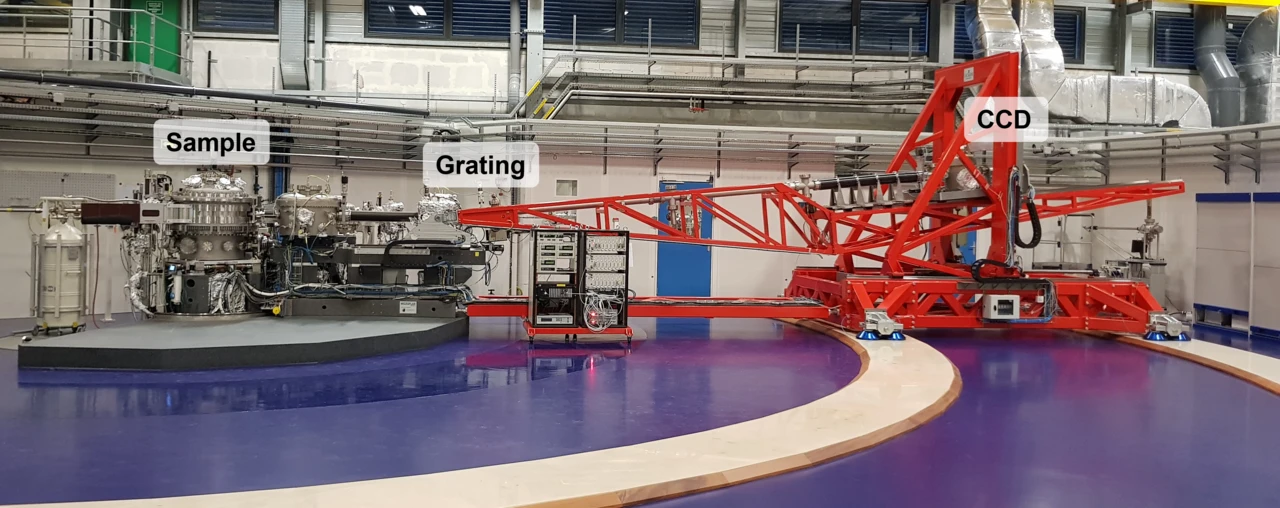
This 2023 reference photograph shows the ID32 RIXS spectrometer, not the October 2026 publication’s experiment in progress. The source labels identify the sample, grating and CCD detector. Photo: Gps1810, Wikimedia Commons, CC BY-SA 4.0. Resized and converted to WebP; the derivative retains that license.
Why the signal is stronger evidence than a single unusual reading
The important result was a structured pattern: the chiral signal changed with momentum in a way consistent with the predicted altermagnetic symmetry of MnTe. Momentum here describes the crystal-scale motion probed by scattering; it is not the speed of the entire sample.
To understand the logic, imagine testing a patterned surface from several directions. One odd response could have many explanations. A response that changes in the specific pattern predicted by a model is more informative. That analogy illustrates the reasoning, not the physics of the apparatus.
The accessible manuscript also distinguishes detecting chirality from fully resolving the energy separation of the magnon modes. It discusses competing interpretations of differences in spectral widths and calls for higher-resolution work. The result strengthens a particular physical explanation without making every remaining measurement question disappear.
Was altermagnetism only discovered in 2026?
No. Different studies have tested different signatures. Treating every new result as the first discovery hides that progression:
- 15 February 2024: the Czech Academy of Sciences reported experimental evidence of spin-split electronic states in MnTe, associated with research published in Nature.
- 29 January 2025: the first version of Jost and colleagues’ chiral-altermagnon manuscript appeared on arXiv.
- 26 August 2026: Cambridge reported bulk measurements in chromium antimonide, CrSb, using a different approach. Cambridge’s account.
- 29 October 2026: the Science paper on chiral altermagnons in MnTe was published.
The Cambridge and SLAC results concern different materials and experimental questions. The October publication is a further test of the emerging picture, rather than evidence that no earlier experiments existed.
Why could this matter for electronics?
Researchers want materials that combine useful spin-dependent behavior with little or no net magnetization. That combination could help engineers develop devices that use spin to carry or process information while reducing unwanted magnetic interference.
The relevant field is spintronics, which uses electron spin as well as charge. SLAC identifies memory, quantum technologies and data centers as possible areas of interest. Those are research directions, not products or performance gains established by this experiment.
For a technology claim to become convincing, look for a device demonstration answering practical questions: Can its state be written and read reliably? Under what operating conditions? What are its speed, energy use and endurance compared with an existing device? The October result alone does not answer that comparison.
How to read the evidence yourself
Start with the paper’s title, “Chiral altermagnon in MnTe,” then compare it with any headline about a “third type of magnetism.” The narrower title identifies both the material and the measured phenomenon.
In the open manuscript’s Figure 4, compare the two polarization-channel spectra and the difference between them. Next read how that difference changes across the measured momentum directions. The graph records a scattering measurement; it is not a microscope photograph of individual electrons rotating.
That is the central finding to retain: the experiment probes the handedness and symmetry of collective spin behavior in MnTe. Its importance lies in testing the underlying physics, which future devices would need to exploit.
For another example of separating a measurement from a dramatic headline, read our guide to the new Van Allen radiation-belt study.
Sources and image credits
- Jost and colleagues, Science: Chiral altermagnon in MnTe, published 29 October 2026; PubMed record.
- Authors’ manuscript and figures, an accessible earlier version; the journal paper is the publication of record.
- SLAC: research announcement, 29 October 2026.
- Czech Academy of Sciences: the 2024 experimental evidence, 15 February 2024.
- Cambridge: bulk altermagnetism in CrSb, 26 August 2026.
Featured photograph: Marco Cammarata, ESRF and the Grenoble valley, taken 27 December 2020. Cropped and converted to WebP under CC BY-SA 4.0; the derivative image retains that license. It shows the facility, not the experiment in progress. Sources checked on 4 November 2026.
You may also like
 Science & Discoveries
UK November Cold Snap: What the Met Office Forecast Says
What the Met Office forecast says about the UK November cold snap, possible northern wintry showers, frost and…
 Science & Discoveries
White Christmas 2026: What Can We Actually Predict?
Can we predict a white Christmas in 2026? Learn to read NOAA’s historical snow map, understand the winter…
 Science & Discoveries
Dinosaur Blood in a 115-Million-Year-Old Fossil? What the Evidence Shows
A Brazilian dinosaur fossil contains heme signatures and cell-like structures. See how researchers tested the evidence, why it…